P14
The fermion sector of Cosmological Relativity
three chiral generations from the maximally-symmetric slicing structure
Abstract
The companion papers establish that the black-hole/de Sitter substrate of Cosmological Relativity (CR) is a maximally symmetric manifold sliced perspectivally, and that the Standard Model gauge group does not arise as a continuous isometry of it: the geometric route to su (3) is excluded, leaving the substrate's discrete orientation structure as the one opening for matter.
This paper puts a Dirac spinor field on the slicing structure and asks what that discrete opening delivers.
Three results follow, each stated at the scope it is established.
First, the signed areal radius forces the radial Dirac superpotential to change sign at the throat, binding exactly one chiral zero-mode there; its chirality is the diagram-automorphism parity R=γ5 (an exact solution, not an assertion). The norm in which it binds is the one CR's ontology selects, and the point is load-bearingP14R9: the fermion is a mode of the existent spatial leaf, of which the spacetime is a projection, so its measure is the induced proper distance dℓ=dr/√|f|, in which the horizon turning points lie at finite distance and the r=0 crossing is an integrable square-root singularity.
In the conserved spacetime Dirac norm—the tortoise measure—the same static mode does not normalize, the horizons standing infinitely far.
The two are not interchangeable, and CR reads the fermion on the leaf, where it is a bound state.
Second, the substrate is symmetric in three 120∘-separated hinges, and the maximally-symmetric—least-arbitrary—matter construction, which is the one CR's own founding principle selects, places a slicing plane on each: three throat walls, hence three chiral zero-modes. A one-hinge truncation is excluded not as disfavoured but as carrying an unfixed arbitrary modulus, which the principle forbids. That count is a well-defined index in the precise sense the ontology makes available: in the leaf's proper measure the closed slicing has finite total lengthP14R10, so the leaf is compact and its Dirac operator carries a well-defined analytical index—exactly where the bulk index on the non-compact substrate, which the boundary paper's non-compactness escape turns on, is obstructed. And the finiteness survives the member this programme's cosmology actually is: at the Nariai double root the two horizons merge, f acquires a double zero, and 1/√|f| becomes a simple pole—the non-integrable exponent, so the hypothesis fails pointwise exactly there. The length nonetheless converges, to 1.8138 α as the gap closes through four decades, because ∫dr/√(r-rb)(rc-r)=π independently of the gap: the interval closing compensates the integrand blowing up, so the pointwise divergence never reaches the limitP14R10L10.
The signed-radius flip moreover passes through the r=0 branch pointP14R49—the wall and the branch point being one locus with two properties rather than two loci that coincide, which is checked on locus, type, definition, equivariance and separability—rather than a single-valued crossing on a loop, so the even-crossing constraint does not apply and the three modes, being of one chirality, have no cancelling partner: dim ker+=3, dim ker-=0, the net chirality a γ5-graded index.
Its stability under deformations preserving the three-wall structure is the expected behaviour of such a count and is stated here at traced weight: the receipt establishes the mechanism—one mode per wall, the even-crossing obstruction on a simple loop, and the necessity of the r=0 branch point—and marks the Atiyah–Singer statement on the branched bead as traced rather than computed.
Third, the three zero-modes are permuted by the full S3 generated by the three hinges, and that S3 is not a second group resembling the substrate's own: each hinge designates one of the three roots of the horizon cubic as its own black-hole horizon, so a transposition of roots is a hop to a neighbouring hinge and the Weyl S3 is the relation among the three hinges. Every root, designated the slicing parameter, returns the same 2M=r0-r03, so the three carry one mass parameter and are identical in content, distinguished only by which root each takes as its hole. Which index that threeness is, this paper settles (Section 6): the hinge S3 is a within-state index and not a family symmetry, the generations' own threeness being the turnaround's deck Z3, with the wall structure fixing the number at either seat.
So the wall structure delivers a count and a chirality rather than a seat: a generation is not a wall, and the wall fixes how many sit at whichever seat carries them.
Those two data—a chirality and a count—are the two factors of one group, D6=S3×Z2, and the paper closes by saying why they descend differently, which is a reading of established structure rather than a fourth result.
The factors act on independent structures, the Weyl S3 on the three roots and the inversion on the two rulings; on the substrate's waist those are the two relations a figure can bear to a circle, the roots being the three special points on it and the rulings the lines tangent to it, and on and tangent are independent relations. The directness of the product is not itself the evidence for that, and should not be cited as though it were: Aut(A2) is a Weyl S3 extended by a diagram Z2, every automorphism of S3 is inner, and a semidirect product by an inner automorphism is isomorphic to the direct one—so no semidirect alternative exists to be ruled out. What the two relations supply is which factor is which, and that they differ in kind.
The kinds then differ for the same reason: a tangent is a line of the substrate, so exchanging the two rulings is a motion of it—an isometry, acting on the cut spinor as γ5, and chirality descends as an isometry; a root labels a different cut, so permuting the three moves through the solution space—the monodromy symmetry, and the walls' S3 is global. The pairing of a chirality carried by an isometry with a global index on the three seats is, in this reading, the difference between being on the one circle and being tangent to it, and this sector is where that difference becomes two physical data.
The net structure—a count of three, a chirality, and the generations' cyclic Z3, with a within-state S3 beside them—is the Standard Model's discrete flavour structure, obtained here as the maximally-symmetric slicing of a maximally-symmetric substrate. Read against the boundary paper's synthesis of the substrate's two real forms [JanzenBoundary], it is the matter's discrete structure on the Lorentzian one, colour's continuous algebra sitting on the compact face.
It is not the mass spectrum (electroweak breaking), and the boundary is drawn explicitly; what it does deliver about the gauge sector is the fourth result below. The count that correspondence has to meet is specified rather than gestured atP14R21: one generation splits 12 coloured against 3 colourless (4 with a right-handed neutrino), and the sector's deliverables are matched factor by factor against that split rather than against the total. Where that matching succeeds and where it fails is stated exactly. The twelve factor as 3×2×2—colour, the horn, and the ruling—giving four classes, against the Standard Model's five multiplets per generation, and the difference is precisely one pair, on the right-handed side, where SU(2)L does not act and uc and dc are separate singlets. The cause is identified rather than left as a discrepancy: the grading operators available here cannot produce it, since the species operator acts identically on both chirality eigenspaces and one-dimensional characters cannot act on one and not the other; and the reason they cannot is that the geometry constructed is the polarised, and therefore achiral, member of its own range. That cause is a theorem rather than a diagnosisR: where the handedness-exchanging involution is a realised symmetry it commutes with the horn swap, so the swap's two chirality restrictions are conjugate and cannot differ in orbit structure—and the missing multiplet is exactly such a difference, a doublet against two inequivalent singlets. The difference is therefore forced and not merely found, and it reaches further than one multiplet: the same argument makes the sector's isospin structure vector-like, on which the anomaly conditions are automatic and fix no hypercharge. The unpolarised member—which carries the second propagating mode, and with it handedness—is built in the companion development, where the exchanging map is shown to lie outside the identity component and to carry a conserved twist whose sign it reverses, with an explicit inhomogeneous propagating member of it carrying that handedness as the definite-signed winding of its turning polarisation plane [JanzenDynamics]; its Dirac sector is built there too, and propagates. So the two absences are not one: the polarisation is supplied and the multiplet is not, and on that chiral member the asymmetric action is permitted and not selectedP14R53, so the multiplet is delivered on neither member. This sector, built on the polarised cut, matches the Standard Model's left-handed shape and draws on the right-handed pair a distinction the Standard Model does not: its horn orbits are 2+2 where the observed content is 2+1+1.} The correspondence with the Standard Model's content is stated explicitly rather than left implicit: one generation there is fifteen Weyl fermions in five multiplets of su (3)c× su (2)L×u(1)Y—sixteen with a right-handed neutrino—and the quark/lepton distinction is which of them carries the colour 3. On this construction that distinction lands as a grading rather than as a countP14R20: the triality class is what separates the two, a coloured constituent carrying a non-zero class and a lepton the zero one, and no counting argument in this sector distinguishes them.
This sector fixes the number of such families, their chirality, the S3 relating the three walls and the cyclic Z3 relating the generations, and fixes nothing about their internal content: not the multiplet count, and not the colour or isospin assignments.
Two items it does bear on: the wall structure requires each generation's content to be anomaly-free on its own—there being no bulk gauge field for inflow to come from—and the observed content meets that condition on every count and only as a complete set; and given the colour and isospin assignments, that same condition fixes the hypercharges uniquely up to normalisation—so hypercharge is not a separate external input, but it is not a separate delivery either, and the distinction is the theorem above: the assignments it is given are the chiral 2+1+1, which is exactly what the no-go excludes on the achiral member this sector builds. On that member the structure is vector-like, the anomaly conditions are automatic, and they fix no hypercharge at all.
Hypercharge therefore rests on the same step as the fifth multiplet—and that step has been taken, in the negative. The chiral member permits the asymmetric action and does not select itP14R53, so the 2+1+1 the anomaly solution is handed is not delivered on either member. What that settles is where the hypercharges come from: the computation is a correct anomaly solution, and its premises—the multiplet structure and the existence of the Yukawa couplings—are the Higgs sector's. This sector contributes the requirement that each generation be anomaly-free on its own, there being no bulk field for inflow to come from; the other contributes what is being made anomaly-free. The hypercharges are therefore neither a separate external input nor a separate delivery: they are the composition of the two, and this construction's half of it is the constraint, not the content.
And the two obstructions to chirality should be read together, because they are independent and this sector escapes only one of them. The boundary paper's obstruction bars a connected gauge isometry on the compact face, and what it leaves there is not a vector-like spectrum but no massless content at all: the face is the five-sphere, odd-dimensional, so the Atiyah–Hirzebruch index route is vacuous on it, and the Lichnerowicz route—positive scalar curvature, no Dirac zero modes—carries the conclusion. Its load-bearing hypotheses are compactness and a connected gauge isometry, and its one opening is the disconnected orientation parity it cannot reach—the opening this sector is built in [JanzenBoundary]. The obstruction above uses neither compactness nor connectedness: it needs only that the exchanging involution be a realised symmetry commuting with the species grading. So building in the disconnected component clears the first and not the second, and the polarised cut is caught by the second alone. The chiral member is what clears it, the conserved twist being the invariant that separates them. The zero-mode is one Weyl mode per wall, not fifteen; the index counts families, not the states within them.
Carried across the branch point at r=0 the structure is inherited rather than remade: the reassignment fixes the expansion rate and does not touch the leaf-carried content, so the generations cross unchanged, seated on the comoving turnaround's three rather than on the horizon roots (§6); the crest, where two of the three roots merge, is a fixed point of the roots' S3 but not of R, so the parity is untouched, the inherited matter stays chiral, and no matter/antimatter asymmetry is a cosmogenesis event—it stays the ordinary route. Fourth, and reached after the three above, the discrete opening delivers more than a flavour skeleton. The bundle the operator acts on is not a bundle of the substrate: every ambient candidate is real, and a real bundle's complexification carries a parallel conjugation, so its holonomy lands in the real form and none can carry su (3). The module is the branching itself.
Because the wall is a wall of a hinge, the construction carries three signed areal radii rather than one, so a wall crossing branches only the vantage that owns it and the monodromy is diagonal in the vantage basis and non-abelian across it; the three wall monodromies and the hinge 3-cycle generate a finite group of order 81 in U(3), each monodromy carrying determinant ω, whose determinant-one part is Δ(27) and lies in SU(3), with the lap as its centre. Second quantisation—the ordinary step, available because the three wall modes are one operator's kernel and therefore identical particles—places a three-fermion state in the exterior cube, one-dimensional and generated by ε, and returns baryon 1, diquark 0, meson 1L18: every channel the Standard Model has, with the configuration group selected rather than chosen.
And the negative half is as sharp and is stated with it: the bundle is flat. Flat holonomy supplies exact selection rules and no curvature, so the construction delivers the discrete content of colour and supplies no force—the geometry quantises and does not couple.
Two further facts about the sector's discrete group are recorded. It is larger than D6=S3×Z2: the residue pairing the horizon roots' surface gravities carry has a holonomy about the Nariai points which, adjoined to the walls' S3, closes the Weyl group of the substrate's own complexified isometry algebra—so the excess is substrate-derived rather than assumed. What forces that closure is the cubic, and what is specific to this substrate is the match: a group of order twenty-four with S3 image and Klein four-group kernel is what any cubic's residue pairing returns, so the closure is forced by the cubic and not by this oneRL3. What is not forced is that the substrate's Weyl group is that same group, and that is a rank-three coincidence: |W(Dn)| runs 4,24,192,1920 and meets 24 only at D3, where so (6,C)≅sl(4,C). The match holds where it holds and fails immediately on either side—at so (8,C) the cubic still gives 24 and the Weyl group gives 192. And that holonomy acts on the walls' chiralities, which are the σy eigenvalues of Proposition 1, changing their signs only in pairs: the observed configuration is therefore the unique member of its orbit with all three walls at one chirality, and dim ker- cannot be reached from dim ker+=3 by any number of loops, three and zero lying in different parity classes. The generation count is thus not merely what the index returns but what no holonomy of this connection can move.
The count is forced within CR by the programme's own criterion of necessity, not by an added axiom, and its footing is stated plainly: a framework declining that criterion reads the natural single-hinge index—one—not three. A further consequence is drawn in Section 7, and it runs the other way to the rest of the paper: because the fold the count reads is D-1 in a D-dimensional cut, and because the horizon relation collapses to a single multiple-angle only at four and five dimensions while the mass-parity that grades chirality exists only in even dimension, four is the only dimension carrying both a generation count and a handedness. Within CR, and on the same footing as the rest, three generations and four-dimensional spacetime are one fact read at two ends.
The question, and what is and is not claimed
One statement in this paper runs the other way to the rest, and its footing is stated here. Section 7 draws a consequence about the dimension of the cut—four dimensions being the only one in which the sector's own two deliverables, the count and the chirality, both exist. It rests on the same criterion as the count, and on two inputs of its own: that the construction gauge's lock gttgrr=-1 holds at general dimension as the single slicing curve enforces it at four, and that the transverse space is the round sphere. The metric function at general dimension is not among them: the operator returns the Tangherlini–de Sitter family as its entire solution space [JanzenSlicing].
The slicing operator of CR generates the spherically symmetric, stationary sector of general relativity as the perspectival reading of a single maximally symmetric substrate [JanzenOperator, JanzenCRframework, JanzenGeometricCore]. The boundary paper [JanzenBoundary] asks whether the matter content can be read off the same substrate, and returns a precise negative for the gauge sector: su (3)⊄ so (5,1), structurally, so the Standard Model gauge group is not a continuous substrate isometry. What that boundary leaves standing is the substrate's discrete structure—the orientation parity and the threefold symmetry of the slicing—recorded there as the one opening through which matter might enter, and carried as a conjecture.
This paper takes up that opening concretely. We put a Dirac field on the slicing curve and compute what its zero-mode content is. The result is a fermion sector with exactly the discrete shape the Standard Model wears: three chiral generations carrying a family symmetry. We are careful throughout to separate what is delivered from what is not:
- Delivered. The generation count (three), the chirality of each generation (γ5), and the S3 relating the three walls—a within-state index rather than a family symmetry, the generations' own threeness being the turnaround's deck Z3 (Section 6), with the wall structure fixing the number at either seat. These are the discrete flavour structure [IshimoriEtAl2010]. And, reached after them, the discrete content of colour: the module the operator's colour structure acts on is the branching rather than any bundle of the substrate; the three wall monodromies with the hinge 3-cycle generate a finite flat holonomy whose determinant-one part, Δ(27), lies in SU(3); and second quantisation on the wall kernel returns baryon 1, diquark 0, meson 1, the configuration group selected rather than chosen. With them, the kind of each—why the chirality descends as an isometry and the walls' S3 global—which Section 5 reads off the two relations the substrate's waist admits.
- Not delivered. The coupling: the bundle above is flat, so the construction supplies colour's exact selection rules and no force—it quantises and does not couple. Weak isospin as a gauging: T is a discrete horn swap and delivers a species label, not SU(2)L's chiral action, the two occupations differing on the right-handed pair (Section 6). Nor does any rotation of the substrate supply that action: a compact su (2) acting on one handedness needs a Euclidean four-space whose chirality is γ5, and the substrate's one Euclidean four-space carries the chirality of its normal X0, which anticommutes with γ5, while the four-space whose chirality is γ5 is Lorentzian, where the chiral split of the rotation algebra is complexP14R87. What the geometry delivers is both ingredients of the weak coupling's chiral projection—the chirality γ5 itself, as the parity R, and a compact su (2), as the spatial rotations—and not their product, which is not a symmetry of the substrate. Hypercharge's normalisation is fixed by the winding rather than by the anomalies, which are homogeneous. And the mass spectrum: the zero-modes are massless, and their splitting is electroweak physics, external to the geometry.
The generation count is forced within CR, in the precise sense made explicit in Section 3: it follows from the maximal-symmetry principle that defines the programme, applied to the matter construction as the same principle is already applied to the substrate and to the discrete breaking [JanzenGeometricCore]. It is not a theorem a framework lacking that principle must accept. That is what the word “forced” means here.
The chiral wall
On the slicing curve the areal radius r is a signed coordinate: the curve runs forward through the seam and backward through r=0 as one closed object—the cosmogenetic bead the framework proves one closed curve [JanzenCRframework], on which this sector's chiral wall is built—r=0 being a branch point the field crosses smoothly, not a barrier [JanzenSlicing, JanzenCircle]. The massless radial Dirac problem separates into a first-order pair with superpotential
This superpotential is the explicit output of the leaf frame: the orthonormal tetrad e0=√f dt, e1=dr/√f, e2=r dθ, e3=r sin θdφ of the M≠0 slicing geometry has radial–angular spin connection ω21=(√f/r) e2, ω31=(√f/r) e3, and the radial first-order pair carries W=λ√f/r in the tortoise variable dx=dr/f (receipt: P14R2); read instead against the frame derivative √f d/dr the same operator carries W=λ/r, the two being one operator written on two derivatives and giving the one logarithmic derivative ψ'/ψ=λ/(r√f)R. The wall's structure does not turn on which is written: √f/r vanishes at the horizons (f=0), and both forms are odd under the reflection that carries (r,M)↦(-r,-M)—so the sign change at the throat, the count and the chirality below rest on either. What does turn on it is the near-throat exponent, which is taken up where the index is read. Because r is signed, W changes sign at r=0: a domain wall [JackiwRebbi1976]. A superpotential of this kind invites the question whether the pair is shape invariant — the condition under which the supersymmetric ladder generates the whole spectrum — and it is not. Writing W=λ√f/r and V±=W2±dW/dx, the requirement V+(λ)=V-(μ)+R with R independent of r admits no constant shift μ(λ) except the degenerate μ=-λ, which returns V+(λ)=V-(-λ) exactly and so R=0: the partners coincide and there is no energy shift to climb. So the exactness available here is the zero mode's and not the spectrum's—the mode below is obtained because W changes sign, which is topological, and not because the problem is solvable, which it is notL14. That is why the count that follows is read from an index rather than from a list of levels. The zero-mode equation Hψ=0 for H=-iσx∂x+m(x)σz, with m(x) the wall profile crossing zero at the throat, integrates to
with χ+ the σy=+1 eigenspinor. For a wall m= tanh (x/a) this is ψ= cosh-a(x/a) χ+, an exact normalizable solution; the conjugate branch χ- grows as cosh+a and is rejected [CallanHarvey1985].
The norm in which the mode is normalizable is the one CR's ontology selects, and the point is load-bearing. The fermion is a field on the evolving spatial leaf—the existent of the layered ontology [JanzenCRframework], of which the spacetime is a projection—so its norm is the induced proper-distance measure on the cut, ∫|ψ|2 dℓ with dℓ=dr/√|f|.
In that measure the turning points (f=0, the horizons) lie at finite proper distance and the r=0 crossing is an integrable √-singularity, so the bound state is genuinely normalizable, as the tanh model captures.
In the conserved spacetime Dirac norm (tortoise measure ∫|ψ|2 dr*, dr*=dr/f), by contrast, the same static mode is not normalizable: the horizons sit at infinite tortoise distance, where the mode tends to a constant.
The two are not interchangeable, and CR reads the fermion as a mode of the existent leaf, not a propagating spacetime field carrying the tortoise norm—on the leaf it is a bound state. The direction of that failure is fixed rather than symmetric, and saying so sharpens the caveat rather than softening it. On the static region between the horizons dℓ/dr*=√f is bounded, so L2(dr*)⊂L2(dℓ): the leaf norm is strictly the weaker condition, and the selection it performs is done on that static region itself—where the leaf-measure amplitude runs as rλ, so that one chirality decays and is bound while its conjugate grows and is rejected P14R3—and not at the horizons, where the two norms disagree about every bounded mode alike.
Nor is it done at r=0: on the operator the frame actually gives, both chiralities approach the throat as a bounded phase rather than parting company there, the crossing being an integrable square-root singularity that selects nothingR.
The count is unaffected—one bound chiral mode per wall, as Proposition 1 states—and what changes is only where the selection is located. And the static mode's failure in the tortoise norm is a statement about that mode rather than about the sector: a modulus tending to a constant at infinite tortoise distance is the plane-wave asymptotic, so it is the normalisation condition of a continuum state and not an obstruction to one.
The ω≠0 problem the same superpotential defines is accordingly an ordinary short-range scattering problem—W and both partner potentials W2±dW/dr* decaying exponentially in r* at the surface gravity, by the same simple-root exponential that carries a thermal spectrum, with unitary transmission across the towerR. That supplies the radial continuum, and the sector's completeness closes in the two measures by two different theorems. In the tortoise measure the continuum is complete by Kato–RellichR. In the leaf's own measure there is no continuum to be complete with: the leaf is a closed curve of finite length, on which the radial coefficient is bounded except at the three walls, where it runs as ℓ-2/3 and is integrable, ∫01 m dℓ=61/3; so the operator has compact resolvent, and its spectrum is a pure-point ladder at the Weyl spacing of the leaf's own length, a complete eigenbasis in which the wall-bound modes sitP14R95. And the join between the static region's continuum and the wall is determined. The wall's locus is the signed radius's own zero, which the slicing construction carries by a C∞ continuation—“a branch point and not a barrier” [JanzenSlicing, JanzenCircle]—and there it is an interior point of one closed curve at which the radial pair's coefficient is integrable, so a solution continues across it uniquely, with no transmission condition left to chooseP14R95. Nothing in either closure is a mechanism this construction adds: compact resolvent on a compact domain, Weyl asymptotics and the continuation of a first-order system with integrable coefficients are the standard spectral theory of a Dirac operator on a fixed background, and the closed domain and finite length they need are read off the slicing. So the quantised field on the slicing is ordinary field theory on that background and is fixed there; at the Nariai member the leaf's compactness rests on the slicing's own itinerary [JanzenSlicing]. Direct solution of the exact zero-mode across a full undercritical slicing confirms both limits (divergence at the horizons in the tortoise measure, convergence in the leaf's proper measure). Hence:
This is the Z2 (chirality) half of the substrate's discrete structure, realised as a bound state, not posited. Reversing the wall reverses the sign of the eigenvalue, flipping the chirality—the parity is the chirality, exactly as the algebroid paper reads it off the constraint algebra. One feature of W deserves comment, since λ=j+ 12 appears in it and might be thought to carry multiplicity. Written on either of the two paired forms above the first-order pair gives one logarithmic derivative, ψ'/ψ=λ/(r√f), so the zero mode is ψ= exp (λ∫dr/(r√f)) rather than the tanh model's exponential. On the static region between the horizons that integral is finite and the amplitude runs as a power of |r|, which is where the branch selection is made; near the throat it is not a power at all, f→-2M/r making the exponent ∝i√|r| and the mode a bounded phaseR.
That the mode is a power of the signed radius, and that the signed radius is a cube root at the wall, together decide a question about the mode that is worth settling here because it is not obvious and its answer sorts the spectrum.P14R25 Near the wall f→-2M/r gives r3= 92 Mℓ2 in the leaf's proper measure, so a crossing of the wall is a half-loop in ℓ and sends r↦ωr exactly, ω=e2πi/3. A mode transported across a wall therefore returns multiplied by ω-λ.
The consequence is a dichotomy rather than a uniform statement: a mode with λ≡0 3 is unaffected and is an ordinary single-valued function of position, while a mode with λ≢0 is not—its value depends on which path reached the point, two paths differing by one crossing disagreeing by ω-λ. So the spectrum divides into modes that are functions of where they are and modes that are functions of how they got there, and the divide is exactly the residue λ 3. That divide has the shape of the quark/lepton distinction — the residue-zero modes locally readable and free, the others neither — and what stands between the shape and the distinction is two identifications this paper holds as assumptions rather than results: that the residue graded here is the physical colour, which the boundary paper walls and this paper does not reopen [JanzenBoundary], and that the triality class is the fractional part of the charge, marked as an assumption where it is used below. A further consequence follows without extra input and is stated on the same footing: since a field on the manifold must be single-valued, a configuration whose total λ is not divisible by three is not a field on it at all, so only combinations of vanishing total residue exist as configurations. We record the shape of that statement and claim nothing from it: it is the shape of a confinement condition, and whether the residue it grades is the physical colour is the question the boundary paper walls and this paper does not reopen [JanzenBoundary]. And the shape is tested against the observed spectrum rather than left as a shape.
Taking the condition at face value—a configuration exists only if its total residue vanishes, and confinement is the failure of a winding to close its lap—and enumerating the low-lying combinations returns agreement on eleven of eleven: meson, baryon, antibaryon, tetraquark, pentaquark and dibaryon close and are observed; a free quark, a diquark, q q–q, qqqq and qqq–q do not close and are not. The thirds themselves follow from three geometric constraints with no Standard-Model input. We still claim nothing about whether the residue is physical colour—that wall stands—but the condition it defines is a test the spectrum passes and not only a shape. Its reach is stated with it: once a quark carries residue one and an antiquark residue two, which is the identification marked above, any condition selecting vanishing total residue returns these eleven verdicts, as the Standard Model's own triality rule does—so the agreement shows the condition selecting exactly as triality does and no more finely, and what this construction adds beyond that rule is the residue and its thirds, derived from the geometry rather than assigned. Near the branch point the leaf measure behaves as dℓ=dr/√|f|∼√|r|/2M dr, an integrable square root, and the mode is a bounded phase there, so the throat admits both branches and selects neither. The selection is made on the static region, where the exponent λ∫dr/(r√f) is real and finite: one branch decays and is bound, its conjugate grows and is rejectedP14R3. At the horizons the measure carries an integrable inverse square root and ψ is finite, so the norm converges there as wellP14R13.
Hence exactly one branch is bound for each j, and the tower over j is infinite. The angular spectrum is worth stating exactlyP14R48: λ fixes a grading and not a content—it indexes partial waves of one field and supplies no multiplet structure, so nothing in the angular sector is internal content—and the spectrum alone does not exclude a graded infinite tower whose lowest level reproduces one generation; that reading is closed by the Kaluza–Klein negative below rather than by the spectrum itself. That is the ordinary angular decomposition of a four-dimensional field, not additional multiplet content: j labels the partial wave of each generation's mode, and the index of Section 3 counts walls, not partial waves. We record this because the appearance of λ in the superpotential invites the opposite reading— that the wall problem might supply the internal structure of a generation—and it does not. And it is not a Kaluza–Klein tower either, which is the other reading the shape invites.P14R47 A Kaluza–Klein tower requires an internal space to reduce on; λ indexes the Dirac operator on the transverse S2, and that S2 is the r2dΩ2 of the four-metric—it is spacetime, and 2+2=4 exhausts the cut, so there is nothing left to reduce on and the levels are not distinct four-dimensional fields.
The one genuine extra direction, the cut-normal, cannot supply a tower either, and for the opposite reason: it is a single non-compact dimension, giving a continuum rather than a discrete tower. The internal content is fixed where Section 3 places it, on the far side of the gauge wall: by the Standard Model's representations and by measurement. The programme's cosmological side meets the same content from the other end, and the two meetings are one. The cosmological companion inherits two composition data across the branch point: a ratio of energy densities taken over the matter as a whole, and a ratio of numbers taken over the baryons alone [JanzenCRcosmology, JanzenCosmogenesis]. Passing between them requires knowing which fermions the handover delivers, in what numbers and at what masses—which is that content, approached from the cosmological side. That the two data enter there as measured inputs is therefore not a second question: it is how the matter content presents itself to a cosmology, which reads them off the sky as the standard account does. We record the identification and claim no derivation from it. It is worth stating plainly where the boundary sits, since the index of Section 3 is easily read as producing more than it does.} That index counts zero modes of a Dirac operator acting on a bundle, and it returns one mode per wall per internal state of that bundle. The count of three is a count of walls; the multiplicity of a generation is the bundle's rank. So the question of what fixes a generation's content is a question about the bundle: what does the operator act on, and what fixes it? On the ordinary route the bundle is imposed—one posits the gauge bundle and computes. On a geometric route the substrate would supply it, and the substrate is not short of bundles: the tangent bundle of the five-dimensional embedding space, the spinor bundles it carries, the normal bundle of the wall itself, and the two ruling bundles the framework's construction already draws [JanzenCRframework].
That list, however, can be settled at a stroke, and settling it moves the question rather than answering it.P14R26 The obstruction is this: su(3) requires a complex rank-three module, and a real bundle's complexification carries a parallel conjugation, so its holonomy commutes with that conjugation and lands in the real form—so(3), of dimension three, with no room for eight. Every member of the list falls to that or to rank. The embedding tangent bundle is real of signature (5,1), and a metric-compatible complex structure J splits a space into η-orthogonal definite planes span{x,Jx} and so forces both signature blocks to be even, which 5 and 1 are not; the spinor bundle has rank four; the rulings are lines. The wall's normal bundle alone has the right rank, and it is reality rather than any decomposition that removes it—the 2+1 splitting one is tempted to use is covariant only under the stabiliser of a chosen cut direction, whereas under the full transverse SO(3) that bundle is the vector representation and is irreducible. What the column shows is that every candidate was built from the substrate's ambient geometry, and ambient geometry is real: the question was never which real bundle but where the complex structure is. It is at the branch point.
And finding it there requires taking this paper's own definition of the wall literally.P14R28 The wall is where the signed areal radius vanishes, and that radius is fixed relative to the hinge about which the slicing plane swings—so there are three of them, one per vantage, and three branch loci rather than one. The companion slicing paper states as much at the outset: the matter construction places a plane on each of the three hinges, giving “three throat walls at distinct points of the throat circle with disjoint support” [JanzenSlicing].P14R44 The two readings agree on the label and differ only on the group: with one radius the cover is cyclic and its monodromy abelian, which is why the search above returned only a Z3; with three, crossing a wall branches only the vantage that owns it. The two are not in conflict but are two constructions—for the vacuum family the three hinges are equivalent vantages and a single swinging door charts everything, so a single radius is the right bookkeeping there; for the matter sector the planes are placed rather than swung. Independently, eliminating -X02+X12 between static de Sitter's α2-r2 and the equatorial section's -X02+X12+X22=α2 gives r2=X22, so on the throat circle rj=α sin (φ-θj), returning this paper's own “the back, X1=-α” rather than being fitted to it, and vanishing at each vantage's own wall and neither other.
Nothing then has to be adjoined. A single wall monodromy has determinant ω, so the unimodular content sits in the ratios, and γAγB-1 is a non-central diagonal of determinant one; it fails to commute with the three-cycle permuting the vantages, the pair's commutant is the scalars, and the pair preserves no symmetric bilinear form—so the smallest connected group containing the ratios together with the hinge three-cycle is SU(3) itself. The monodromies themselves, with the three-cycle, generate a finite group of order 81 in U(3); its determinant-one part, of order 27 and generated by the ratios and the three-cycle, is Δ(27), and the remaining factor is a Z3 of phases carried by the determinant.P14R80 The two generators are this paper's two threes doing different jobs, needed together for the first time rather than kept apart: the diagonal one is the three walls, the permuting one is the three hinges, and neither alone is more than Z3 or S3. A full lap, being the product of all three, comes out as ω-λ times the identity—the centre—which is the sense in which the single-valuedness criterion of §2 is a statement about a lone constituent and not only about a pair of routes. It also settles what cannot work: the three colours cannot come from the three sheets of a single cover, since a mode has one triality and would then have one colour.P14R33 Nor is this rank-three object the one two paragraphs above. That one was rank three because a cube root has three branches and it graded the tower by triality; this one is rank three because there are three hinges. A single mode occupies one line of the first and exists at all three vantages of the second, so all three colours of one constituent carry the same triality—which is the Standard Model's own relation between the centre, carried identically by every state in a representation, and the index running within it.
The reading owes an account of the null legs, since it is on the legs and not the equatorial arcs that this section reads the crossings.P14R29 The leg joining two hinges grazes the wall owned by the third—three legs, three walls, each leg opposite its wall—which is this section's own observation that a hinge's legs never graze its own wall, seen from the other side. The assignment reproduces a multiplicity it was not built from: two punctures per hinge give 2×2=4 legs per hinge pair, all sent to one wall, returning the 12=3×4 of the twelve null legs. So each leg meets exactly one wall, the three legs meet the three walls once each as one lap does, and the closed bound triple acts by the centre. What looks at first like the reading's difficulty is its content: a constituent at one hinge is labelled by the leg it is not on, and a label that cannot be read locally is what route-labelling means.
What the resulting selection rule reaches, and what it does not, has to be said in one breath.P14R30 The centre gives N- N≡0 (mod 3) and nothing finer—it does not distinguish a triple spread one per hinge from one doubled on a single hinge, exactly as the centre of SU(3) does not—so triality zero is necessary for a colour singlet and not sufficient, and the one-per-hinge condition comes not from it but from the causal trichotomy of the six hinge-ends.P3R53 The two conditions arrive from unrelated places and neither does the other's work. Sufficiency needs the invariants of the group just identified, and counting them on the tensor cube returns too many and, under the full holonomy group, the wrong one—which is a feature of gradings rather than a defect of this construction, since a grading records how many constituents occupy each slot and nothing about their order or sign, whereas εabc is a statement about antisymmetry.P14R31 Antisymmetry, however, is not a gauge datum, and this section has been carrying what supplies it since Proposition 1.}
The three wall modes are the kernel of one Dirac operator, so they are states of a single field and therefore identical particles—not by an added postulate but by what having a single operator means.P14R32 A three-fermion state is accordingly not a general tensor; it lives in the exterior cube of the kernel, and since Λ3 of a three-dimensional space is one-dimensional with the totally antisymmetric generator, the surplus invariants are not states a symmetry fails to forbid—they do not exist: the one with all three constituents on a single vantage vanishes by the Pauli principle, and the symmetric combination is not in Λ3. Counted on the exterior powers the channels come out baryon one, diquark none, meson one—each exactly what SU(3) gives, with the diquark a prediction rather than a fit, nothing here having asked that Λ2 carry no invariant. And the count decides a question this construction could not otherwise settle: of the three defensible readings of which loops a bound configuration may traverse, exactly one returns all three channels correctly, and it is the unimodular group—the same group the SU(3) entailment above reached by an unrelated argument. One consequence bears on §2 in its favour}: under that group the baryon line has trivial holonomy and is invariant exactly, while the one-particle space carries no invariant at all and the action on it is irreducible, so a lone constituent does not return to itself up to a phase, which a ray could absorb, but returns a different vector. The single-valuedness criterion is thus doing its work without needing any distinction between fields and states to prop it up.
What remains is then not a defect but a description. All of this is holonomy—a flat bundle and exact selection rules—so the construction supplies the discrete content of colour and supplies no force, which is what the winding label was separately found not to supply.P14R23 And the flatness is a complete obstruction rather than a stage not yet reached, which is worth showing rather than asserting, since a reader is otherwise entitled to hear it as a promise.P14R51
The holonomy group generated by the three wall monodromies together with the hinge three-cycle is finite, of order 81—necessarily so, since the holonomy is branching and a branch structure has finitely many sheets. The flatness is then not a stipulation but a consequence of that finiteness: by Ambrose–Singer the holonomy algebra is spanned by the curvature, so a finite—hence zero-dimensional—holonomy group forces F=0 identically, which is the same theorem the algebroid paper invokes for the reverse reading [JanzenAlgebroid]L3. And a finite group in characteristic zero has vanishing first cohomology with any coefficients, so the representation does not deform as a representation of its own holonomy.
Deformations of the fundamental group's representation that keep each wall's conjugacy class fixed are counted directly and the moduli space is zero-dimensional: a wall branches one vantage and leaves the other two alone, so its monodromy carries a repeated eigenvalue and its class is subregular, of dimension four rather than the regular six; three regular classes on a three-punctured base would have left a two-parameter family, and the disjointness of the vantages' supports is exactly what removes it.
But the dimension is a bonus and not the argument. The moduli space of flat connections consists of flat connections, so a deformation within it changes which flat bundle one has and not whether there is a field strength; obtaining curvature means leaving the flat locus, and no holonomy datum can take one off it, because holonomy is precisely the complete invariant a flat connection has. Leaving it requires a variational principle, and a Yang–Mills term in four dimensions carries a dimensionless coupling that a single length cannot build—the substrate's one invariant being α=√3/Λ, whose energy ℏc/α sits some forty-one decades below the strong scale, and in the infrared rather than the ultraviolet direction from it.
So the position is not that the coupling is unbuilt but that a coupling is not the kind of thing a holonomy supplies, which is the same verdict the winding received one level up and for the same reason. What is not excluded here is a mechanism that is neither holonomy nor isometry; the isometry route is excluded separately, and no third mechanism has been named, so naming one remains open. What can be said about one before it is named is more than nothing, and it is the dimensional sentence just used, which mentions no route.
That sentence constrains the target rather than the mechanism: whatever produces the connection, what it must end in is a four-dimensional Yang–Mills term, and that term requires a dimensionless number the substrate's ledger does not carry—the one physical length being α and not ℓP, whose ratio α/ℓP∼1061 is a number in gauge-units and not a tuning [JanzenGeometricCore]. So what a third mechanism must deliver is therefore a fixed pure number rather than a free parameter, and a candidate is accordingly falsifiable against one quantity rather than searched for in an unbounded spaceR.
And the wall is four-dimensional and nothing else: dimensional consistency of ∫dDx F2/g2 gives [g2]=LD-4, so at the substrate's own D=5 a Yang–Mills coupling is a length and the substrate has exactly one—the obstruction appearing only after the descent, which locates where such a mechanism would have to act without asserting that anything stands there. The same counting is what distinguishes this from a general ban on geometry producing fields: the Einstein–Hilbert coupling has [1/16πG]=L2-D, dimensionful in every dimension, so a single length builds it and gravity is precisely the case the argument does not touch. One objection to a winding label deserves its answer here, since it is the natural one: a route-dependent quantity is not readable at a place, and electric charge is.P14R24 The winding splits as w=n+φ with n an integer lap count and φ a Z3 class, and the two pieces transport differently—one wall crossing multiplies the field by ωtriality while a full lap is three crossings and ω3=1—so the integer part is route-independent and the fractional part is the monodromy.
Hence w is locally readable exactly when it is an integer, exactly when the triality vanishes: a fractionally charged object is precisely one whose charge is route-dependent, hence not readable, hence not free.
The Z3 is therefore the obstruction to charge being observable rather than a rival to it. One qualification: the agreement between “is a field” and “has integer charge” is not an independent check that could have failed.
On the identification used here the triality class is the fractional part of the charge, so the two predicates are the same predicate and agree on any rational whatever. What the argument establishes is the implication, not a test of it: an object with non-zero triality is route-dependent, hence unobservable, and colour confinement is that statement read as a selection rule. A genuine test computes the triality from the colour content independently of the charge, and that test is available here: the wall monodromies generate the centre, and triality is the centre's action, ρ(ωI)=ωtI with t=(p-q) 3 on a tensor of p upper and q lower colour indices. Evaluating it on the channels above returns t=0 for the meson and the baryon and t=2 for the diquark—the triality-zero channels being exactly those the count on the exterior powers admits, obtained a second way and with no charge on either sideR.
What the two routes agree on is the selection; the identification of the triality class with the charge's fractional part remains the assumption it was, and is not what this test establishes. The winding itself, its closure rule and the derivation of the thirds are the companion slicing paper's [JanzenSlicing]: there the graze points cut the throat into three equal arcs, the two routes between punctures at different hinges differ by exactly one lap, and imposing closure on both horn-headed arrangements forces the winding into thirds with no Standard Model input. One question that construction leaves is properly this paper's, because it is about matter content rather than about the lap, and it has a clean answer with a clean negative before it.P14R22
What exchanges uud and udd is not charge conjugation: w↦-w carries the quark class to the antiquark class, and no lap shift repairs it, because conjugation reflects through the origin while the (u,d) pair is not centred there.
Solving for the involution that does it—rather than positing one—returns a unique affine map, w↦ 13-w, whose constant is fixed by the pair itself. And it is the Standard Model's own map: in this paper's own normalisation Q=I3+Y, the isospin Weyl reflection at fixed hypercharge is Q↦2Y-Q, and the constant came out equal to twice the quark doublet's hypercharge, 2× 16= 13, with nothing fitted. The map is the same in the other common normalisation Q=I3+Y/2, where the same reflection reads Q↦Y-Q and the doublet's Y is itself 13—but the two must not be mixed in one sentence, since it is the constant that carries the claim. Its two factors are both already in hand—w↦-w is the slicing paper's independent charge Z2, and w↦w+ 13 is one graze-point crossing, which is one wall. And nothing needs adjoining: the exchange is the horn swap T, a substrate isometry the construction already carries and already reads as weak isospin. The offset is no obstacle to that, the apparent difficulty—that Aut(A2) acts linearly while a map with a non-zero constant does not—arising only if the two are compared in a single space, which they do not share. Two things are worth marking about the standing of the whole: that the vantage rotates the areal direction is a reading of the sentence quoted above rather than a computation of it, though the companion paper's disjoint-support statement carries the same content independently; and the exhibit of the three radii is at the M=0 member, where the cut is the substrate.
Where a generation's internal content could come from is a separate question from where colour's discrete content comes from, and one negative result bears on it, recorded above: the angular decomposition does not supply multiplicity, since λ=j+ 12 labels partial waves and each contributes exactly one bound mode. That result is stronger than a fact about the sphere we wrote down, because no other transverse space is available to the construction.P3R43
Run with the transverse curvature k left free, the operator of the companion slicing-operator paper returns as its entire kernel f=k-2M/r-Λr2/3, so the operator alone does not fix k; but k enters as an additive constant independent of M, and the family passes through 2M=0 six times per swing, at which marks the cut is the substrate, f=1-r2/α2, whose constant term is unity—so k=+1 is an output of the construction rather than a choice of chart. Constant curvature +1 leaves the global form S2/Γ, and there Γ is fixed by the spin structure the Dirac operator requires: every non-identity element of SO(3) is a rotation about an axis meeting the sphere in two fixed points, so no non-trivial subgroup acts freely, and the one free finite action—the antipodal map, which is not in SO(3)—has the non-orientable quotient RP2, which carries no spin structure at all.
The transverse space is therefore the round S2 and nothing else, and the tower over λ is infinite for that reason rather than by stipulation. Nor would any alternative have helped: an orbifold quotient S2/ Zn thins each level's degeneracy from 2λ to roughly 2λ/n and removes no level, a quotient leaving untouched the local geometry that sets λ. So the source of the tower's multiplicity is closed by exhaustion and not by inspection—a definite question about a definite object, rather than an absence. Two questions have been called “the bundle question” and only one of them is this one: what module the operator's colour structure acts on is settled above, and it is the branching rather than any bundle of the substrate; what supplies the multiplicity of a generation—its fifteen or sixteen Weyl states—is the representation content this paper declines (§3). And that second question is not one of rank. The substrate's own spinor bundle is five-dimensional in base, and in odd dimension the Dirac representation is irreducible of dimension 25/2=4, restricting to a codimension-one slice as the four-dimensional Dirac representation—the same rank the operator already usesP14R11—so it supplies no multiplicity beyond what is in hand. Nor is rank the relevant measure. Fifteen is a sum of representations, not a bundle rank: a rank-fifteen bundle carrying no su (3)× su (2)×u(1) action would supply nothing, while a rank-three bundle carrying colour would supply the essential thing. So the question is not which bundle has the right rank but what would furnish the group action, which is why the reality obstruction, and not a count of ranks, is what decides the candidate list above.
A condition the construction imposes on its own content
One constraint follows from the construction as it stands. The wall of Section 2 localizes chiral zero modes on a codimension-one surface of a higher-dimensional bulk, which is the configuration of Callan and Harvey [CallanHarvey1985]—cited above for the rejection of the growing branch, but carrying a second consequence. Chiral fermions confined to such a wall have an anomaly, and consistency requires it be cancelled either by inflow from the bulk or within the wall's own content.
Here there is no inflow to be had. Inflow proceeds through a bulk term built from a gauge field, and this bulk has none: the substrate is maximally symmetric vacuum geometry, and the gauge group is established not to arise as an isometry of it [JanzenBoundary]. So the bulk contributes nothing, and the wall's content must be anomaly-free on its own. And because the walls are three separate loci carrying separate zero modes, the condition applies to each wall—which is to say generation by generation, not to the three together.
That is a requirement this construction imposes, and the observed content meets it non-trivially. A Standard Model generation cancels every condition—[ su (3)]3, [ su (2)]2 u(1), [ su (3)]2 u(1), [u(1)]3, and the mixed u(1)–gravitational—and cancels them only as a complete set: removing ec leaves [u(1)]3=-1, removing uc leaves 8/9, removing L leaves 1/4P14R18. And the Standard Model's anomalies cancel generation by generation, which is the pattern the three-wall structure requires and not the weaker one it might have required.
And the condition's reach has a definite edge, which is worth drawing because the sixteenth Weyl fermion sits exactly on it. The right-handed neutrino νc:(1,1)0 carries no colour, no isospin and no hypercharge, so its contribution to every one of the conditions above is identically zero: fifteen is anomaly-free and sixteen is anomaly-free, and the condition returns the same number in both casesP14R19. So the one constraint this construction places on content cannot distinguish them—and the generation count, being a graded index of wall-localised zero modes, counts generations rather than the content within one and does not reach the question either. Both of this sector's handles on matter content are therefore blind to that state, and a preference between fifteen and sixteen must be sourced from outside the construction, which is the representation-content step this paper declines.
We are careful about what this is. It is not a derivation of the content: anomaly freedom is a condition, and many contents satisfy it. It is a condition the geometry supplies rather than one imposed to make a model work, and it is the first place this sector says anything at all about a generation's content. It also has a definite falsifier: were a bulk gauge field to be found in the substrate, the inflow would be non-zero and the per-wall condition would relax, so the argument stands or falls with the absence established in [JanzenBoundary].
The condition has a further consequence, which narrows what the content needs from outside. Of the three structures a generation's charges are usually listed under—colour, weak isospin, and hypercharge (§3)—the third is not independent of the other two. Given the gauge group and the multiplet structure, the per-wall anomaly conditions together with the existence of the Yukawa couplings that give the fermions mass—a representation-theoretic requirement, on which assignments admit a gauge-invariant ψφψ term at all and not on any coupling's value—determine the hypercharges completely, up to a single overall normalisation. That last qualification is not a formality, and the sector supplies what removes it.P14R46 Solved at general Nc the anomaly conditions are homogeneous—every hypercharge is proportional to one free q, and the cubic [u(1)]3 condition, not used in the solve, is identically satisfied for every Nc and so selects nothing—which means the anomalies fix ratios and can produce no scale at all. The winding closure is not homogeneous: its unit is one full lap, a closed circuit rather than a chosen normalisation, so it returns absolute values. The two agree where they overlap, the winding's u=+ 23 and d=- 13 giving q= 16 and the anomaly solution then reproducing all five Standard Model hypercharges exactly. Solving [ su (3)]2 u(1), [ su (2)]2 u(1), the mixed u(1)–gravitational condition and the three Yukawa requirements yields
So what the content needs from outside is two items and not three: the gauge group and the multiplet structure, which the Standard Model supplies and measurement fixes; hypercharge follows from them by a condition this construction supplies. The per-wall character is what does the work here and is worth marking: cancellation in total across three generations would not fix the assignment within one, and it is the separateness of the three walls that makes the condition apply generation by generation. And the identification with the cosmological data above is useful, because the cosmological end carries measurements and this end does not. The two data are of different kinds and their quotient is therefore a number: from η=nb/nγ one has ρb/ργ=(30ζ(3)/π4) ηmb/T, and from the onset condition one has ρm in units of ργ at the same temperature, so the ratio of the matter's energy to the baryons' is fixed by measured quantities alone—of order a few at the onset, and rising with the onset temperature. That is an empirical statement about what the handover delivers: the density enters the cosmology as boundary data on the same footing as η, measured as the standard account measures it [JanzenCRcosmology], and which fermions make it up is the matter content and not a component this construction introduces. The same holds on the relativistic side: what shares the radiation with the photons is fixed by the same content.
Read this way the constraint proved in [JanzenBoundary] is informative rather than prohibitive.} It closes the connected isometry route and identifies the single component the obstruction cannot reach, and this sector is built in that component. Together with the numbers above, the two say where the content is fixed and what any account of it must reproduce: the representation content by the Standard Model, and the composition by the measured ratios. We claim no construction of that content here; a deeper theory that supplied it would be a theory of the Standard Model's matter content, and nothing in this construction excludes one.
Three walls: the count
The single wall of Section 2 sits at r=0, and r=0 is not the throat's centre but a point on the throat circle—the back, X1=-α, fixed relative to the hinge about which the slicing plane swings [JanzenSlicing]. The substrate carries three such hinges, 120∘ apart at transverse distance 2α, of which the throat circle is the incircle. That distance is not a stipulation the fermion construction inherits but an output of the substrate's own geometry: the hole determines exactly one circle without further choice—the one on its own edge through its own centre—and 2α is where that circle ends, with the throat-as-incircle, the 60∘ the hole subtends there, and the triangle's nine-point circle being the throat all equivalent to it [JanzenSlicing]. So the three walls of this section stand on a triangle the hole placed, and the Z3 that permutes them is the hole's own three-foldness rather than a choice made here. The walls therefore sit on the same circle everything else in the construction is read off—the circle whose radius is the curvature, whose tangents are the null rulings, and around which the slicing's lap runs—so the generation count this section obtains is one of the faces that circle carries, and is collected as such [JanzenGeometricCore]. The Z3-fixed centre carries no wall; the walls lie on the circle, and the three hinges' walls are three distinct points on it (polar 180∘,300∘,60∘), a Z3-orbit (Figure 1).
That the centre carries no wall is not a further observation about the figure but a consequence of what a wall isP14R38. Vantage j's signed areal radius rj=α sin (φ-θj) on the throat circle is the restriction of a linear form on the transverse plane—the coordinate perpendicular to hinge j's static pair—and the three forms have rank two, so their common zero set is the single point at the centre. A wall is a locus across which one vantage's superpotential changes sign, hence codimension one; a point is codimension two and has no side to cross to. The wall is accordingly the line rj=0, which is hinge j's own axis and meets the throat circle twice, at the front and at the back; naming r=0 at the back fixes a point on one wall rather than selecting between two walls, and the two crossings are exchanged by the antipodal map, which is how R acts there: R is the reflection (r0,r)↦(-r0,-r) through the origin of the horizon locus (§4), and on the throat circle of the M=0 member, where the three radii are exhibited and the mass it reflects is zero, it reverses every signed radius at once. Taking the three forms' mutual angles—which is a different question from where they vanish—they are of equal length, 120∘ apart, sum to zero identically, and have mutual cosine - 12: the weight system of the fundamental of su (3), and in rank two nothing else has that shape. The transverse plane is therefore the weight plane and the vantage index the weight label, reached here from the metric geometry with no representation theory in the derivation. The empty centre is then the origin of that plane, and the fundamental has no zero weight: a state seated at the centre would be a zero-weight vector of 3, of which there are none. The emptiness is an absence of a weight, not a vacancy waiting to be filled.
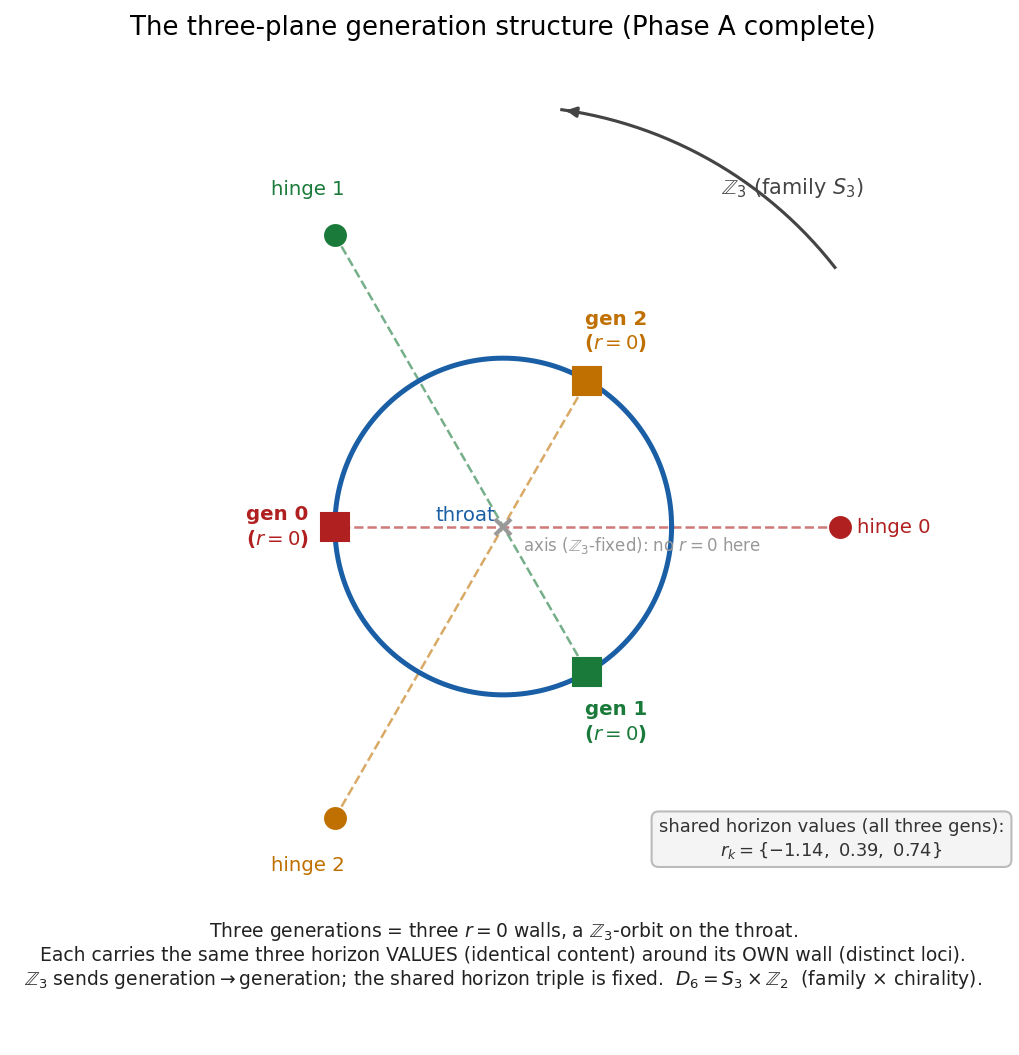
Two constructions are geometrically available: one plane on one chosen hinge, or one plane on each. They are not on equal footing.
The qualification is genuine and we state it plainly: Proposition 2 forces the count within CR, resting on (i) the maximal-symmetry principle, which is the programme's definition rather than an added hypothesis, and (ii) that the fermion generations are set by the matter construction at all—Proposition 1 makes this concrete, but the link is itself the claim the sector establishes. It is not a free-standing theorem. Inside CR it is forced. Two remarks sharpen this. The two legs are in fact one: given the three-hinge leaf, the three throat walls are distinct loci, so the wall-bound zero-modes are linearly independent and span a three-dimensional space—a triplet on three seats, three physical states in any basis, not one state redescribed—so leg (ii) follows from leg (i) rather than standing beside it. And the pillar that remains, leg (i), is the programme's own criterion of necessity—Rule 2 of [JanzenShadowExistence] in the ontological register—for which a symmetry-breaking modulus (which of three Z3-equivalent hinges) is exactly the adjustable parameter it rejects, and maximal symmetry the structure that requires its configuration. “Forced within CR” is thus forced by that vindicated criterion, not an added axiom; its footing is that a framework declining the criterion reads the natural single-hinge index—one—not three. The direction of that dependence is worth stating, since [JanzenShadowExistence] in turn cites this sector: the epistemic paper establishes Rule 2 from the historiographic record, independently of any result here, and cites the three-plane selection only as a worked instance of the rule in the ontological register. The dependence is one-way and the mutual citation is not circular—this paper applies a criterion the other grounds elsewhere.
By Proposition 1 each of the three walls binds one chiral zero-mode; the three are localized at distinct walls, hence linearly independent. The generation count is the number of such modes, a wall-localized index insensitive to the non-compactness of dS5 that obstructs a bulk index [JanzenBoundary]: the modes are normalizable (in the leaf norm of Section 2) and pinned to the throat, and there are three. That count is a well-defined index in the precise sense CR's ontology makes available. In the leaf's proper measure dℓ=dr/√|f| the closed slicing has finite total lengthP14R10—the horizon turning points at finite proper distance, the r=0 crossing an integrable √-singularity—so the leaf is compact and the Dirac operator on it carries a finite analytical index dim ker [AtiyahSinger1968], exactly where the bulk index on the non-compact spacetime (tortoise measure) is obstructed. The leaf is closed as well as compact, and that is a second thing the measure delivers: with no boundary there is no Atiyah–Patodi–Singer correction and no η-invariant term, so the index is the interior one entire and the count is the whole of what the theorem returns.L19 Compactness delivers finiteness and not canonicity, and the distinction is load-bearing here. On the operator the leaf frame gives, the first-order pair has the one logarithmic derivative ψ'/ψ=λ/(r√f) (Section 2), so the zero mode is ψ= exp (λ∫dr/(r√f)). On the static region between the horizons that integral is finite and the amplitude runs as a power of |r|, one chirality decaying and bound while its conjugate grows and is rejectedP14R3; near the branch point f→-2M/r makes the exponent ∝i√|r| and both chiralities a bounded phase, and the leaf measure dℓ=dr/√|f|∼√|r|/2M dr is integrable there, so the crossing selects nothing and costs the norm nothingR. At the horizons the measure carries an integrable inverse square root and ψ is finite, so the norm converges there as wellR. Nothing in the count depends on a boundary condition, the three modes being independent and of definite chirality either way. Each wall's mode is a definite chirality eigenstate σy=+1=R=γ5 (Prop. 1, the conjugate branch rejected), and the signed-radius flip is through the r=0 branch pointP14R49 rather than a single-valued crossing on a loop [JanzenSlicing, JanzenCircle]—so the even-crossing constraint that binds a single-valued sign function on a circle does not apply, and the three modes, being of one chirality, have no cancelling partner. Hence dim ker+=3, dim ker-=0, and the count is the net chirality: a γ5-graded index. Index-theoretic stability under deformations preserving the three-wall structure is the expected behaviour of such a graded count and is traced rather than computed here (P14R1 establishes the mechanism—one mode per wall, the even-crossing obstruction on a simple loop, and the necessity of the r=0 branch point—and marks the Atiyah–Singer statement on the branched bead as traced); we state it as tracedL13. And it is worth saying which half is traced, because the two halves are not equally owed: the analytical index is dim ker+- dim ker- by definition, so the count above is computed and needs no theorem; what the index theorem supplies is its equality with a topological integral, and what that equality buys is exactly the deformation invariance traced here. So the citation is a pointer rather than load-bearing for the count, and the corpus's naming follows the same division—analytical index appears and topological index never doesP14R16. It is a leaf (vantage) index, which is why it is well-defined precisely where the spacetime bulk index is not.
What the count fixes about the dimension. The count above is read off the horizon cubic through the three hinges, and that cubic is an output of the four-dimensional metric function rather than an assumption of this sector. The constraint therefore runs the other way from the way it is usually posed: the flavour content constrains the dimension, rather than being handed one.
In D-dimensional Schwarzschild–de Sitter the mass is the slicing-dependent factor 2M=r0D-3-r0D-1 in the gauge α=1, and two conditions this construction already imposes then bear on D. The first is the collapse. The family is parametrised by the sky angle, and the horizon relation is required to linearise there to a single multiple-angle—in the companion paper's words, the slicing scale 2/√3 is “the one scale removing the residual harmonic” [JanzenSlicing].
The two powers present are D-3 and D-1, so the harmonics standing below the top one number exactly one at D=4 and D=5 and two or more from D=6 upward, while the construction has one scale to spend: from six dimensions up no slicing scale collapses the relation, there is no forced fold, and the family carries no generation count to read at all.
At D=5 the collapse does occur, at scale 1, and returns a four-fold.
The second condition is the parity, and it separates those two. The mass function is odd in the signed offset exactly when D is even, so at D=5 the orientation parity r0↦-r0 fixes each geometry rather than exchanging it with its conjugate: there is no mass-reflection Z2, hence no 3⊕3 Nariai hexad, no outer factor of Aut(A2)=S3×Z2, and no γ5—which is that parity's Clifford generator on the cut (Section 5), and on which this paper's chirality rests through a superpotential odd in the signed radius (Section 2). A five-dimensional spacetime would therefore carry four generations and no handedness—and, on the same computation, no antimatter either, since the parity whose absence removes γ5 is the one whose absence removes the antifundamental.P14R36 The two deliverables are one fact seen twice, and it is visible in the collapse itself: at D=4 the relation collapses to a pure multiple angle 2M=2/3√3 sin 3w of zero mean, whereas at D=5 it collapses to 2M= 18(1- cos 4w)—one harmonic plus a constantP14R50.
Both are single-harmonic in the sense the collapse condition asks for, but the constant is not nothing: it holds 2M≥0 across the whole swing, so the mass never changes sign, and the sign change is the entire content of the mass reflection. And the same obstruction is visible a third time, in the root set itself, where it exhibits its mechanism.P14R42
Writing the horizon condition with the slicing's own root substituted, PD(r)=rD-1-rD-3+r0D-3-r0D-1, the factor (r-r0) divides at every D—that is the designation split—and -r0 is a root exactly at odd D, since substituting it returns 2·2M at even D and 0 at odd.
So at D=5 the cofactor degenerates to (r+r0)(r2+r02-1), a line and a circle, and the 1+3 is really 1+1+2 with the extra one being -r0 itself, where at D=4 the cofactor is a genuine conic and at D=6 and D=8 it does not factor at all. The root-set condition and the mass-parity condition are exact complements dimension by dimension, and the reason is structural: at even D the reflection r0↦-r0 carries the geometry to a different member of the family, which is what lets it serve as a matter/antimatter parity, while at odd D the reflected root already lies in the same geometry's own root set, so the parity has nothing to relate. The geometry is its own image, and that is why five is vector-like. And two further structures fail at odd D for the same evenness, the three being one fact.P14R43
The polynomial rD-1-rD-3+2M has its two powers of one parity, so it is even in r exactly at odd D; its root set is then stable under a fixed-point-free involution, and the monodromy over the mass plane commutes with that involution.
At D=5 this confines the monodromy to the centraliser of (0 1)(2 3) in S4, of order eight against twenty-four, so the monodromy group cannot be the full symmetric group on the roots and the four-dimensional statement that it is has no odd-dimensional analogue. That is an upper bound, and the contrast it draws needs the bound attained: “contained in a group of order eight” is also consistent with a trivial monodromy, which would leave the five-dimensional deck structure empty rather than merely smaller. Continued around loops in the mass plane the permutations generate a group of order exactly eight at D=5—the full centraliser, the imprimitive symmetry of two ± pairs—against the full S3 at D=4, so the confinement is a real structure and the contrast is between two non-trivial groups rather than between a group and nothingP14R54L13.
The root set is likewise not of A2 type: the roots sum to zero at every D, but at four that is three roots summing to zero, and at five it is four summing to zero in ± pairs—so at five there is no A2 whose automorphism group could factorise or fail to. The constant and the evenness are the same obstruction read in two variables—and with no sign change there is no antifundamental, hence no hexad, hence none of the twelve designations the four-dimensional dial carries. Among the dimensions in which the count exists at all, four is the only one that also carries a chirality, so the two halves of this sector's own delivery—the number and the handedness—are jointly available at exactly one dimensionP14R50. Both conditions are read through the sky angle and so through the gnomonic chart, and that chart is not a four-dimensional import: the companion paper forces it by the straight-line criterion alone—a faithful planar chart must carry the straight line of sight to a straight line, and the gnomonic projection is the unique projection sending every great circle to one—“independently of the observer or the slicing scale” [JanzenSlicing], a property of Sn in every n, and the observer's celestial sphere in D dimensions is SD-2. (That paper's secondary exclusion of the orthographic, which turns on sin θ≤1 lt;2/√3, is specific to the four-dimensional scale and is not used here.) The standing is the same as the rest of this section, and the inputs are the two named in Section 1: the construction gauge's lock at general dimension, and a round transverse space. Within CR, and on that footing, the observed flavour skeleton is not merely consistent with four dimensions but selects them.
The correspondence, stated in Standard Model terms
Because the papers above speak of “generations” without saying what a generation contains, we set the correspondence out explicitly. A reader who knows the Standard Model should be able to see at once which of its structures this sector fixes and which it does not.
What a Standard Model generation contains. In left-handed Weyl form, one generation is five irreducible multiplets of su (3)c× su (2)L×u(1)Y:
What this sector fixes. Three features of that skeleton, and only three.
- The number of generations is three, as a γ5-graded index of wall-localized zero-modes (dim ker+=3, dim ker-=0; Section 3).
- Each is chiral, carrying a definite γ5 eigenvalue (Proposition 1). This is not decoration: the Standard Model's content is chiral, and a construction returning a vector-like spectrum would be excluded by that fact alone.
- The three are permuted by a global S3—the turnaround's, acting on its three sheets (Section 6)—and it is a family symmetry, not a gauge one. The part acting on generations and on nothing else is cyclic: the deck Z3, the transpositions being supplied by the horn swap T, which belongs to the isospin sector. The S3 among the hinges (Section 4) is a different three—the within-state index—and the two are related by no covering construction.
What it does not fix, and the list is longer. The internal content of a generation is untouched: how many Weyl fermions it holds (15 or 16), their su (3)c representations—hence which of them are quarks and which are leptonsP14R20—and their su (2)L doublet/singlet structure. The hypercharges are not a third external input: given those two, they follow from the per-wall anomaly conditions of §2 together with the existence of the Yukawa couplings, uniquely up to normalisation. Anomaly cancellation, which the Standard Model's fifteen satisfy non-trivially and which is among the sharpest constraints on any proposed content, enters here only as a condition: §2 requires each generation to be anomaly-free on its own, there being no bulk field for inflow to come from, and records that the observed content meets it. What is not done is the converse—deriving the content from that requirement. Neither is the mass spectrum, the mixing, nor the existence of νc. The zero-mode of Proposition 1 is one Weyl mode per wall, not fifteen}: the index counts generations, not the states within them.
Two consequences of stating it this way are worth drawing. First, the correspondence is 3↔3 at the level of families, with every representation-theoretic fact about the Standard Model on the far side of the wall of [JanzenBoundary]; the sector is compatible with the Standard Model's content in the weak sense of not contradicting it, and does not predict it. Second, the global S3 is a point of contact rather than a free addition: the Standard Model has no exact family symmetry—the Yukawa couplings break it badly—so an exact S3 delivered here must be broken by whatever supplies the masses, and the manner of that breaking is a constraint this sector inherits rather than a freedom. We record that as an obligation, not a result. And the seating sharpens the obligation rather than loosening it, which is worth drawing because the reverse would be the easier reading. The group acting on the three families is S3, so the contact below is with the right group; but only its Z3 is flavour-only, the transpositions being T (Section 6). So the breaking is not the Yukawas' business alone: the cyclic part is theirs to break, while the transpositions' action is fixed in another sector—and already recorded there as matching the Standard Model on the left-handed side and differing from it on the right-handed pair. A flavour-S3 model may break all of its symmetry with the masses; this sector may not. That obligation can be checked against a literature rather than left standing, and it is worth doing because the check could have gone badly. S3 is among the most studied discrete flavour symmetries: the S3L×S3R proposal predicting quark-sector flavour democracy has been followed by an extensive body of work on how to break that democracy and recover realistic spectra and mixing [HarariHautWeyers1978, XingYangZhou2010]. The structure of the symmetric limit is definite and matches what a three-object permutation representation gives: the mass matrices take a universal two-term form, one piece proportional to the identity and one to the democracy matrix. On that decomposition the observed pattern is not accidental—the charged-fermion matrices are strongly hierarchical, the quark mixing matrix is close to the identity, and the lepton mixing matrix carries two large angles, all as consequences of which term dominates where [XingYangZhou2010].
Two things follow for this sector, and they pull in opposite directions. The obligation is met in the sense that matters: an exact S3 broken by the mass mechanism is a viable and worked framework, not an excluded one, so the sector is not committed to a symmetry the data refute. But it is not met for free. Realistic fits generally augment the group—S3×Z3×Z6 in one construction, where the neutrino sector's breaking supplies a naturally small solar-to-atmospheric ratio and next-to-leading corrections bring θ13 into the measured range while the quark sector accommodates the Cabibbo angle and the differing up- and down-type hierarchies [Meloni2012]—and the breaking pattern does substantial work. What this sector supplies is the symmetry, not the breaking: the S3 arrives here from the substrate's geometry rather than being posited, which is a point of contact worth having, while the breaking that generates the observed masses and mixings remains external to it, in the same place as the gauge representations. The mass spectrum and the gauge representations are external to it and are so marked. This is the innermost of the three registers of maximal symmetry the geometric-core paper draws together [JanzenGeometricCore]: the substrate maximally symmetric, the evolving space maximally symmetric, and the discrete matter structure maximally symmetric and counted.
The symmetry of the three walls
The three walls are permuted by the symmetry of the hinge triangle. The Z3 rotation cycles them (180 →300 →60); each of the three reflections—across the axis through one wall—swaps the other two and fixes it. The three transpositions and the three-cycle generate the full S3. With the chirality Z2 of Proposition 1, the discrete group carried by the sector is
the automorphism group Aut(A2) already identified as the substrate's discrete structure [JanzenSlicing, JanzenGroupoid, JanzenAlgebroid].
Writing it as a product invites a question the product hides: D6 has three subgroups of order six, and which one the sector carries is a physical statement rather than a labelling. Exactly one is cyclic, ⟨the Weyl 3 -cycle⟩×⟨γ5⟩—and it is worth saying that this is not the family symmetry paired with chirality, since the Z3 inside Aut(A2) rotates the three horizon roots and is therefore the within-state index of §6, while the generations' own Z3 is the turnaround's deck, which fixes the horizon cover's base and never permutes its fibre and so is no subgroup of this group at all—and the other two are both isomorphic to S3 while being different subgroups: S3×1, in which the roots are permuted and the chirality untouched, and the graph {(σ,sgnσ)}, in which every root transposition carries a chirality flip. The boundary paper's own reading of the hexad settles which: there σ exchanges a pair within a sign-half while the backward-radial reflection—the outer Z2—is what carries between the halves [JanzenBoundary], so a transposition carries trivial Z2 component and the hinge S3 sits as S3×1 and not as the twisted graph. Root transpositions do not flip chirality, which is why the three walls can be same-chirality at all (§3).
Two further facts about this group are established elsewhere and bear directly on the sector.
First, the group is larger than D6, and the excess is substrate-derived. The residue pairing that the horizon roots' surface gravities put on the root triple has a holonomy about the Nariai points—the Klein four-group of even sign changes, arising as the per-root resolution of √Δ, the same square root whose non-squareness fixes the Galois group as S3 [JanzenGroupoid]. Adjoined to the walls' S3 it closes W(A3) in its Weyl embedding, and with the chirality parity a group of order forty-eight; and A3 is the root system of so (6,C), the complexification of the substrate's own isometry algebra, with A2 inside it by deleting one node [JanzenAlgebroid]. So the sector's discrete group is the substrate's own, where this section has been reading a sub-root-system of it.
Second, and physically, that holonomy acts on the walls' chiralities and protects the count's parity. By Proposition 1 each wall's chirality is a definite σy eigenvalue whose sign is the sign of the signed-radius flip, so a sign change is a reversal of that wall's chirality; the holonomy's elements change signs in pairs, unimodularity excluding every odd change. The observed configuration is accordingly the unique member of its orbit with all three walls at one chirality, and dim ker- cannot be reached from dim ker+=3 by any number of loops, three and zero lying in different parity classesP14R14. The count is thus not merely what the index returns but what no holonomy of this connection can move. Two guarantees are in play here and are worth keeping apart: compactness of the leaf makes the count defined, and what makes it stable is the wall's spectral gap—its bound modes are separated from the continuum by the full asymptotic mass, so no small deformation of the wall carries a state across the threshold and changes the number.L19
That the symmetry the three walls carry is global rather than carried by an isometry is not a choice made here but the kind the discrete structure fixes: the Weyl S3 is the monodromy symmetry of the solution space and no substrate isometry, whereas the orientation parity Z2 is an isometry, acting on the cut spinor as γ5—so chirality descends as an isometry, a spacetime symmetry acting on the spinor with no gauge field, and the walls' S3 global, which is the flatness of the sector's holonomy read as a kind: exact selection rules and no force [JanzenGroupoid, JanzenAlgebroid].
That chirality rides the discrete factor is moreover forced, not merely sorted: a fermion sector realised by a connected-group isometry is left not vector-like but without massless content, the compact face's positive curvature removing every zero mode, so an observed chirality can live only on the discrete orientation parity the boundary paper's obstruction cannot reach [JanzenBoundary].
Each plane carries the same three horizon values, so the three wall-modes are identical in content, distinguished only by their wall; this is what makes the count a count of identical copies. That property the generations also have, and having it is not what makes these them: the seating is settled in §6, and it is not the walls. And the wall is not a bare locus. Each hinge designates one of those three roots as its own black-hole horizon, so a transposition of roots is a hop to a neighbouring hinge, and the Weyl S3 is the relation among the three hinges rather than an abstract relabelling [JanzenSlicing]. The S3 the three walls carry and the Weyl S3 of the root system are therefore one group, not two that happen to agree in order: which root a vantage takes as its hole is the same distinction as which wall it binds at—the hinge fixes both. This is what makes “one object read three ways” a statement about the sector rather than about the cubic alone: the three readings are the three hinges, and the fermion sector is where they become three bound modes. What they are not is the three generations—that seating is settled in §6, where the hinge S3 is the within-state index and the generations are carried by the turnaround's deck; what the wall structure fixes is the number. At the massless level the three are degenerate and S3 is exact, and this degeneracy is forced: the three shared horizons are roots of one cubic r3-r+2M=0, and every root, designated the slicing parameter, returns the same 2M=r0-r03 (as r3=r-2M for each), so the three carry one mass parameter—one object read three ways on the fully D6-symmetric horizon locus, a diagonal line and a 45∘ tilted ellipse in the (r0,r)-plane [JanzenSlicing], on which the 2+1 of a designated root against the ellipse pair is the diagonal designation σ and the sign 2+1 (two horizons of one sign against one) the reflection through the origin (2M↦-2M, the chirality parity), each a description structure paired with its symmetric twin—so no asymmetric handle sits in the mass parameter. The locus does carry a breaking structure for that S3 (the slicing singles one root against the ellipse pair), supplied with the triplet in the boundary paper [JanzenBoundary]; but the mass values are the ordinary electroweak route, and whether that geometric structure bears on the physical hierarchy is not claimed—outside the present scope.
The two factors: why they differ in kind
The sector's two data are a chirality and a count, and Section 4 has just written them as the two factors of one group, D6=S3×Z2 (the hinge S3× chirality; the generations are seated on the deck Z3 instead, and §6 settles why). Two things about that group have been established elsewhere and are used above: that its factors act on independent structures—the Weyl S3 on the three horizon roots and the inversion on the two null rulings, the inversion central [JanzenAlgebroid]—and that they descend differently, one as an isometry and one global. The product's being direct is worth separating from both, because it is forced and therefore carries no information about this substrate: Aut(A2) is a Weyl S3 extended by a diagram Z2, every automorphism of S3 is inner, and a semidirect product by an inner automorphism is isomorphic to the direct one—so there was never a semidirect alternative for the geometry to have excluded.
What the geometry supplies is which relation each factor bears to the substrate's waist, and that the two differ in kind; the group structure follows and does not evidence it.
Both have been read off the constraint algebra and off the light cone [JanzenAlgebroid]. And the chirality factor has a second realisation, in a sector with no fermions in it, which is worth stating because it shows the parity is the substrate's and not this sector's. In the radiating sector the same Z2 appears as the graviton's two helicities: chirality there is the turning of the polarization plane, the sign of the rate at which the polarization angle turns, absent wherever a residual connected isometry pins the polarization to a fixed axis—the swept SO(3) of the symmetric sector completing a reflection into a rotation and identifying the two handednesses, a mirror and not a chirality—and genuine once that swept rotation is lost [JanzenDynamics]. That is the same mechanism operating here, by a different instrument.
What makes the wall's bound mode chiral rather than mirror-paired is that no connected group identifies its two handednesses, which is what the obstruction of [JanzenBoundary] says of a connected gauge action, there being no massless content for one to act on, and what confines the parity to the disconnected component. In the radiating sector the identification is lifted by losing a residual isometry and the matter is a direct computation; here it is barred by a theorem about connected groups—one parity, two sectors, two instruments. The corroboration runs the way that matters: a sector with no fermion content returns the same Z2, so the factor read off the light cone is a feature of the substrate rather than an artefact of the wall construction. A third route reaches the same factorisation from the numerals alone, and reaches it without being told to look: an audit of the recurring numbers of the construction, asking of each pair only whether one object derives both, returns every weld through one of these two factors—the triple-angle map for the three, the twelve, the thirty, the √3 and the √[3]2; the ruling-exchange for the two—and every proved split across them, so that the numbers weld within a factor and split across it.
The audit, its receipts, and the splits that cut its law are collected in the programme's combinatorics ledger (COMBINATORICS_LEDGER.md; P14R5, P14R6, P14R7), alongside the figure programme's. Read on the substrate's waist they are one fact, and this is the paper to state it in, because this is where the two factors become matter: the Z2 as a bound state's chirality eigenvalue (Proposition 1), the S3 as a count of three (Section 3). Because that Z2 is a substrate isometry it grades a chirality in the radiative sector as well as this one—the graviton's two helicities [JanzenDynamics] and the fermion's γ5 here are the one isometry factor's two physical faces, the same Z2 read in the two sectors, settled there by direct computation on the free wave and here by the domain-wall zero-mode. Its radiative face becomes a genuine chirality only past the wall of the symmetry-reducible sector, where the last swept SO(3) is lost and no isometry survives to turn the exchanging reflection into a rotation—the geometric onset of the parity the fermion sector here carries as γ5 [JanzenRange].
The two structures the factors act on are the two relations a figure can bear to a circle. The three roots are the three special points on the throat circle: an offset line meets it at two points A and B, with r=0 fixed at the back, and those three points are the geometric counterparts of the three roots of the horizon cubic [JanzenSlicing]—which is why the walls of Section 3 lie on that circle and not elsewhere. That offset is the mass—matter as the bend of the cut, G entering only as the offset-length—so the same offset furnishes both factors geometrically: its odd offset–mass relation (2M↦-2M) is the chirality parity, and its three roots the count [JanzenOperator]. The two rulings are the lines tangent to it: the substrate's null rulings are the tangents to its waist, “doubly ruled by straight null lines” and “every tangent to the throat is null” being one statement, the power of a point with respect to that circle being the square of its height [JanzenGeometricCore]. So the automorphism group factorises because on and tangent are independent relations to one circle; the direct product is that independence. That there is a second factor at all is itself contingent: the inversion is an outer automorphism—not already inside the Weyl S3—only because the cubic realises A2, the one rank-two system with -1 W; were negation inner (as for A1, B2, G2) Aut(A2) would collapse to the Weyl group and leave no chirality factor to sort, which the groupoid paper marks the condition of there being two factors at all [JanzenGroupoid]. The on/tangent independence is then why the two that do exist form a direct product.
And the factors differ in kind for the same reason, which is why the difference is not an extra fact requiring its own argument. A tangent is a line of the substrate, so exchanging the two rulings is a motion of the substrate—an isometry, acting on the cut spinor as γ5, and the chirality descends as an isometry. A root labels a different cut, so permuting the three moves through the solution space and is no motion of the substrate—the monodromy symmetry, and the walls' S3 is global. The same distinction is what the algebroid paper reads off the light cone, in the same objects: the sky-angle periodicity is two steps along a null ruling, hence a closed path of light and an isometry, whereas the Weyl reflection is a loop in the complex 2M-plane, and 2M labels the family rather than pointing along the manifold [JanzenAlgebroid]. The two readings are one reading, because the ruling and the tangent are one line.
The pairing of a chirality carried by an isometry with a global index on the three seats is therefore, in this reading, the difference between being on the one circle and being tangent to it—and the present sector is where that difference becomes two physical data: a bound state's chirality eigenvalue, and a count of three. The generations' own three is not one of the two relations: it is the turnaround's deck (§6), a shift of complexified cosmic time rather than a permutation of roots or an exchange of rulings. Two qualifications bound the statement. It explains the kind of each factor and not the gauge content, which is excluded from the isometry [JanzenBoundary]; and it is a reading of structure already established rather than a new derivation—what it adds is that the two structures, and hence the two kinds, are one circle's two relations, so that the arrangement follows from the geometry having a waist rather than from a further principle.
The cosmogenesis of the generations
The chiral seats are wall-modes of the existent leaf (Section 3) and the generations are seated on the comoving turnaround's own three (§6); both are leaf-carried, and CR's cosmogenesis carries that leaf across the branch point at r=0, where collapse continues as cosmology [JanzenBoundary, JanzenCRframework]. Three features of the crossing fix what becomes of the generations, each read off established structure. Inheritance: the causal reassignment fixes the expansion rate and does not touch the leaf-carried content, so the generation structure—being leaf-carried—is inherited across the branch point unchanged—the fermion-sector reading of the corpus's structural transition law, which the separation of the lapse from the leaf establishes [JanzenOperator].
This is the matter-sector face of the layered reading the cosmology computes on: the reassignment acts on the lapse—the stacking rate, which it resets to the geometry-set law—and not on the leaf, whose bend is the content [JanzenOperator, JanzenCRframework]; so the generations, being leaf-carried, cross as inherited content exactly as the radiation and matter densities do, the fermion instance of the general fact that at the crossing only the rate is reset and everything the leaf carries passes through. A second argument reaches the same conclusion, and it is worth having because it does not depend on what the reassignment touches. The walls are not carried through the crossing: they are at it.
The signed areal radius passes through zero at a point on the throat circle, which is why the walls lie on that circle and not elsewhere (§2), so the wall locus and the branch point are one locus. And the segment terminating there occupies no cosmic time at all—the real part of the complex cosmic time does not advance along it, so the crossing is a boundary of zero duration rather than an interval [JanzenCanonicalTime, JanzenCRframework]. A structure localized at a boundary of zero duration has no interval in which to be altered, whatever a reassignment acts on. The inheritance therefore does not rest on the reassignment being rate-only: even one that touched the leaf would have no elapsed time in which to touch it. The rate-only reassignment gives that nothing acts on the leaf at all; the zero-duration argument adds that nothing could. The crest: the Nariai crest [Nariai1951] is the fixed point of the root-permutation, where two of the three horizon roots merge (the discriminant 4-3r02 vanishing); that permutation is the within-state index, and the generations are seated on the comoving turnaround's own three, not on the roots (§6). Chirality: the crest is a fixed point of S3 but not of R [JanzenBoundary], so the parity R=γ5 is untouched—the inherited matter stays chiral, and no matter/antimatter asymmetry is a cosmogenesis event; it stays the ordinary route.
This is rooted in the substrate's discrete geometry.
The chirality/mass parity R=γ5 is the mass-reflection r0↦-r0 (equivalently 2M↦-2M), the orientation/diagram-automorphism parity, realised on the cut spinor as γ5; as the A2 diagram automorphism it carries the fundamental 3 to the antifundamental 3 [JanzenSlicing, JanzenAlgebroid], and on the wall mode it is an exact operator (Proposition 1). So the R-image of a generation is its antifundamental, and within CR that is its antimatter: the dual 3 branch is antimatter at exactly the weight the fundamental branch is matter—forced within CR by the same discrete residue.
The discrete matter/antimatter skeleton—representation (3 vs 3), chirality (γ5), and mass-sign (R-odd 2M)—is what the geometry supplies on both sides of the pair; the charge structure that closes C is field-level on both sides equally, not a substrate datum—the charge entering the geometry only as the R-even Q2, so charge conjugation is present there as a symmetry rather than an absence and is no substrate isometry, the outer Z2 of Aut(A2)=D6 being R and not C [JanzenBoundary]—so that geometry supplies matter's discrete skeleton and not its charge is no more an obstacle to naming the 3 branch antimatter than to naming the 3 branch matter.
What R is not is the time reflection T: they are distinct reflections—R spacelike and horn-preserving, T timelike and horn-flipping, so R≠T on the substrate's A2 hexad, established in the slicing paper [JanzenSlicing].
That distinctness is exactly why the matter/antimatter parity is not a cosmogenesis (time) event: antimatter is the substrate's ordinary R-partner of matter, not something made at the seam, which the crest, a fixed point of S3 but not of R, leaves untouched. Read on the cosmogenesis, this same R-partner branch is not abstract: it is the conjugate (r lt;0) branch of the bead, the completed collapse whose future is our expansion, so the progenitor of our own universe sits on it—an antimatter black hole, in the signed-radius continuation [JanzenCRframework].
The relation is therefore standing and relational (our matter and the progenitor's, the two ends of one R-conjugation across the bead), consistent with its being no seam-generated asymmetry. R is likewise distinct from the areal-radius spatial parity r↦-r—the corpus's P—whose Clifford generator γ1γ2γ3 anticommutes with γ5.Corpus convention: R is the orientation/mass-reflection parity, the A2 diagram automorphism ∈O(5,1)∖SO0(5,1), realised on spinors as γ5, carrying 3↔3; P is the areal spatial parity r↦-r (γ1γ2γ3, anticommuting with γ5); T is the time reflection. The two parities are distinct, anticommuting operations, uniformly named this way across the corpus. And one further convention: “the wall” and “the branch point” denote the wall of the hinge under discussion. There are three, one per hinge, at distinct points of the throat circle, and each vantage's signed areal radius vanishes at its own and at neither of the others [JanzenSlicing]. The bare singular is used throughout because the natural sentence is about one of them at a time; the test a reader should apply is that a sentence which would be false if there were three is a sentence about a single vantage and must name it. Reading the wall as unique makes the branched cover cyclic and its monodromy abelian, and the whole of the colour structure is the difference between that reading and the correct one.P14R34} The wall-mode's dynamics transitions with the reassignment: under the signature flip the hole-side spatial mass W=λ√f/r passes into a cosmological-side temporal term (its turning imaginary past the horizons being precisely this), so the bound wall-mode continues as a fermion propagating in cosmic time, and the three progenitor wall-modes become three propagating modes of the expanding universe—the chiral seats carried across, the generations being seated on the turnaround's deck (§6)—carried through faithfully by the characteristic crossing of the null boundary.
The explicit continuation of the exact zero-mode onto the cosmological leaf is carried out on a concrete undercritical model (receipt: P14R3): the superpotential W=λ√f/r is real between the horizons, where the mode is the exponentially bound wall-state, and turns imaginary past a horizon (f lt;0), where the same mode becomes a pure phase—a fermion propagating in the now-timelike radius; on the E=1 expanding leaf r(τ)∝ sinh2/3 this is the standard massless-Dirac form of conformal weight a-3/2, which is field-theory bookkeeping on a chosen chart and not a substrate structure—the weight is the one a massless spinor carries on any Friedmann leaf, claimed here for the continuation and for nothing moreL8, so each of the three progenitor wall-modes continues term for term into a propagating mode and the γ5 chirality, untouched by the real-to-imaginary continuation, is preserved.
Inheritance, the crest, chirality, and the bound-to-propagating character stand on the crossing's established null-characteristic machinery.
The universe those three modes cross into is the one whose primordial light-element abundances the cosmogenesis paper computes [JanzenCosmogenesis]—the same branch-point crossing, read on the inherited radiation content rather than the fermion leaf, fixing the thermal history the abundances record.
This realises, on the built sector, the positive closure the boundary paper draws [JanzenBoundary]. There charge conjugation is shown to factorise on the cosmogenetic bead, C=(Q↦-Q)field∘(R∘K)geometric, its kinematic (Feynman–Stückelberg) face carried geometrically by the composite of the mass-reflection R and the cosmic-time reality involution K: τ↦ τ, only the electric-charge sign closing from the field. On the present sector that geometric face acts on the actual zero-modes: R carries each matter wall-mode to the bound opposite-chirality mode on the reversed (r lt;0, 2M lt;0) wall—its antimatter partner 3, exact by Proposition 1—and K, the reality involution of cosmic time, acts on the propagating cosmic-time fermion that the real-to-imaginary continuation above carries the bound wall-mode into, exchanging its positive and negative frequencies, so R∘K acts on the built modes as charge conjugation's kinematic face, the particle↔antiparticle relation of that conjugation being the two ends of this sector's R-conjugation across the bead (receipt P14R8). It is that face and no more, exactly as the boundary requires: the zero-modes carry the discrete flavour skeleton and not the gauge charge, so R∘K carries the discrete matter/antimatter conjugation while the electric-charge sign stays field-level—the identification of a mode with a specific charged particle, and the full antilinear C, remaining the ordinary route. The operator half is explicit and grounded—the reality-involution lift S=γ0γ1γ3 gives γ5S=- iγ2=-(Cγ0), implementing ψ↦ψc on the cut spinor (storyboard_receipts/A3_spinor_lift.py)—but it is an operator identity carrying no charge, so the matter/antimatter pairing of the two ends rests on the actual linearly independent wall-modes of Proposition 1, not on the operator alone; absent that built construction the frequency-wing/species identification would remain unclaimed. The factorisation the boundary paper states is thereby realised on the sector it bounds, at exactly that scope and no further.
Which three the generations are seated on, and why it is not the hinges
The count above is read off the three walls and the S3 of Section 4 off the three hinges. Those are one three, and it is not the generations' three—which the substrate's null structure settles, from outside this sector and by a fact the hinge reading cannot reach.
The substrate's null structure admits a bound triple—a puncture of a hinge together with the two punctures its null generators reach—and the causal classification of the six hinge-ends forces such a triple to take one puncture per hinge: two ends of one hinge are timelike separated, two on one horn spacelike, and only the cross pairs null.P3R53 A bound triple is therefore one-per-hinge without choice. If the three hinges were the generations, a bound triple would be one constituent from each generation, which is not what a bound triple of like constituents is. So the hinge three is the index that distinguishes constituents within a bound state, not the index that distinguishes copies of the whole state, and the generations must be seated elsewhere.
They have somewhere to go, and it is the construction's own second three. The framework paper establishes that no affine change of variable identifies the horizon roots with the roots of the comoving turnaround; the marginally-bound congruence integrates to rD-1=2Mα2 sinh2 ((D-1) τ/2α) in D dimensions, and the shift τ↦ τ+2πiα/(D-1) leaves rD-1 invariant while sending r↦e2πi/(D-1)r, so that second three carries a cyclic deck action of order D-1.P3R37 Three consequences follow, and the seating rests on the third.
First, the count is unchanged and the dimension argument with it. Both threes are D-1, and for one reason: clearing denominators, f=0 is a polynomial of degree D-1, and the two are the two things one does with that single polynomial—the horizon three is its zero set, the turnaround three the deck action of the integral of 1-f. The fold is therefore a property of f and not of which structure reads it, so Section 7's conclusion—that four is the only dimension carrying both a count and a handedness—holds on either seat, its D=5 member included.
Second, the family symmetry the generations bear is a different group from the hinges', and the difference is substantive rather than a matter of naming. The Weyl S3 of Section 4 is the relation among the three hinges, and on this reading that is a statement about the within-state index: its transpositions are the hops between hinges that a bound triple needs in order to be a singlet. The turnaround three carries the cyclic deck action alone. So the family symmetry the generations bear is Z3, and Z3 lt;S3 properly.
Third, and the seating rests on it, the chirality survives. The grading is the mass reflection R, and R acts on the turnaround branch: under M↦-M the right-hand side of the law above becomes non-positive for real τ, so a real image exists exactly when D-1 is odd, and its image is r↦-r, the signed radius. That condition is D even—the same condition Section 7 already reads off 2M=r0D-3-r0D-1 being odd in the signed offset.P3R36 The parity argument therefore transfers to the new seat without modification. Composed with the deck action it gives Z6= Z3×Z2.
That is not the whole of what the turnaround carries, and the rest does not disturb the argument above.P14R45 It is natural to read the Z6 as an index-two subgroup of the D6 the hinges carry, with the missing part exactly the transpositions the within-state index needs.
The transpositions are not missing. The horn swap T descends to the turnaround, acting on the cube-root sheet index as the inversion k↦-k, and it does not commute with the deck action: it conjugates it to its inverse, TDT-1=D-1, which is the dihedral relation. Hence ⟨D,T⟩≅S3 and, with the parity adjoined, the turnaround carries D6 of order twelve. (A second inversion satisfies the same relation on a different three, and the two must not be run together. The reflection of cosmic time, T: τ↦- τ at fixed r and mass, is a symmetry of the outward law in its own right, sinh2 being even, and it too inverts a three—but the Im τ sectors, not the cube-root sheets. Those are independent: a sheet rotation leaves τ fixed and a sector shift leaves r fixed. The corpus reserves T for the time reflection X0↦-X0 of the static time; T reverses the cosmic time τ=τ+χ, and the tilde does the work it does on τ itself.) What keeps this from collapsing the distinction drawn above is that the two S3's permute different triples—the hinge one the three horizon roots, this one the three cube-root sheets—and the companion framework paper establishes that no affine change of variable identifies the two root sets. The statement is available in the stronger form the seating here actually wants: the turnaround's deck carries a root of the horizon cubic to a root of the same cubic only at r=0, since (ωr)3-ωr+2M=r(1-ω) on the root variety, so it fixes the horizon cover's base and does not permute its fibre—and the two threes are therefore not related by any covering-space construction, rather than merely by no affine oneP14R4. Seating the generations on the turnaround rather than the hinges needed the two threes to be genuinely different objects, and had the turnaround deck been a storey of the horizon cover's tower this subsection would have had no room to move.
So the hinge transpositions remain the within-state index's; the turnaround simply has transpositions of its own—though whose transpositions they are is worth saying, because it decides what kind of family symmetry this sector delivers.P14R35
They are supplied by T, the horn swap, which this paper reads as weak isospin; so the turnaround's S3 is the family Z3 extended by an operation belonging to another sector, and reading it as a family S3 would be counting isospin as flavour. The family symmetry proper—the part acting on generations and on nothing else—is cyclic. A second consequence follows from the same computation, and it shows that one natural question admits no answer in the form it is usually put: since T descends as the inversion k↦-k of the sheet index rather than as a translation, the change it induces is 0, 1 or 2 according to k, so “the winding change under T” is not a quantity at all. What is true instead is sharper: T fixes the triality-neutral class and exchanges the two charged ones, which is the action the orientation reflection already has,P14R27 and is consistent with this paper placing conjugation at the branch point rather than on the horns. One consequence is worth recording without being claimed: the representations of D6 that are trivial on the deck Z3—which is what carrying no colour would mean—are its four one-dimensional ones, so a colourless sector on this structure has total dimension four.
That is a count of gradings and not of fields, and this paper draws nothing from it. One thing should nevertheless be said about its shape, because the natural objection to it is misdirected.P14R37 Every Z2 grading splits those four 2+2, which looks like a failure to reproduce a colourless sector that is chirality-asymmetric. It is not a failure, because colour does not see the chirality of a colour singlet in the Standard Model either: SU(3) acts trivially on νL, eL, eR and νR alike, and what distinguishes the doublet from the singlet is SU(2)L. A colour structure delivering a chirality-asymmetric colourless triple would not match the Standard Model but exceed it. The asymmetry is an isospin property, and the question properly addressed to this construction is whether T acts on one γ5-eigenspace of the wall mode and trivially on the other—which is well-posed here, since T and R act on independent data and commute, so that T acts within each chirality eigenspace separately. That they commute is the requirement rather than an obstruction: a chiral action needs simultaneous diagonalisability, not its failure. One half of that question decides whether the other can be asked of this geometry at all, and it is settledR.
Let P be the involution exchanging the two γ5-eigenspaces—the reflection the companion paper's criterion calls the identifier of the helicities. (Not σ, and not R. The corpus reserves σ for the Weyl root-exchange involution on the cut—used in that sense in this paper both before and after this passage—and R=γ5 is the chirality grading, acting as ±1 on the eigenspaces where P exchanges them: diagonal against off-diagonal. The sans-serif marks a parity of a different kind from the areal P:r↦-r; the companion paper's own word for it is parity, the fixed reflection about a polarisation axis that identifies the two helicities.)
It moves the ruling datum and not the horn datum, so it commutes with T for the same independence that makes [T,R]=0; and then T|-= P T|+ P-1, so the two restrictions are conjugate and have the same orbit structure. Acting on one eigenspace and trivially on the other is precisely a difference of orbit structure, so it is excluded whenever P is a realised symmetry—which, by that same criterion, is exactly the polarised case.
Enumerating the four actions T may take, the two with orbits 2+1+1 are the two that admit no commuting P, and the survivors are 2+2 and 1+1+1+1: the shape reported above is the only shape available.
The statement is sharper as one about invariants: on the achiral member every invariant is blind to the chirality, since P exchanges the eigenspaces; on the unpolarised member the conserved twist c is odd under P and so separates them, and c=0 is the polarised cut—the two cases being one charge at two values.
And the positive half is settled, in the negative: the geometry permits the chirality-asymmetric action but does not select itP14R53.
On a member carrying c≠0 the horn swap acts on the wall mode by pullback—an invertible map—and on the round transverse S2 of §6 the turning is a similarity that leaves the radial binding untouched, whatever its form—the leaf measure dℓ=dr/√|f| is radial and the twist transverse, so T's action on the c≠0 mode is its c=0 action conjugated by that frame change.
Triviality on a chirality eigenspace is a conjugation invariant, so the 2+2 above is preserved: no turning, boost or shear moves it to 2+1+1.
The twist can rotate T but not project it, and the invariant that lifts the obstruction—c, transverse and orbit-preserving—is orthogonal to the operation that would realise the split, a chiral projection trivialising T on one eigenspace, which neither the horn swap nor the twist is.
So the chiral member removes the exclusion of §6 and leaves the mismatch standing: the fifth multiplet is not a consequence the geometry delivers but a projection it does not carry, and that is what a successor must supply. Two conditions on such a successor can be stated, and they are not the same condition.P14R56 A colourless triple is chirality-asymmetric, so it must sit where the R-conjugate pairing fails and where R does not act on the three seats as the identity. That second condition is sharper than non-transitivity of the seat symmetryP14R71: transitivity together with R's centrality does not by itself exclude a 2+1, since a central R acting as -1 on the standard representation splits a transitive triple 1+2. What excludes it at the wall is the stronger fact that R there is antipodal within each wall, so it fixes every seat and is +1 times the identity on the mode space. The wall sector meets the first and not the second: normalizability rejects the growing branch at every rung, so the bound content is a single R-eigenspace rather than a conjugate pair; but the hinge S3 carries the three walls into one another, and since the sector's group is the direct product D6=S3×Z2 with R generating the second factor, R is central and three equivalent seats carry one eigenvalue. That is the content of dim ker+=3, dim ker-=0—the split is forced by the transitivity and not settled by which branch normalizes. And the turnaround, which does meet both conditions, seats the wrong three.P14R65 T descends there as the inversion k↦-k, an involution with a fixed point whose permutation representation splits 2+1 under R; but its three are the generations, where a colourless triple is three fermions within one. So the colourless triple is a third three, and the two this construction carries are both spoken for and related by no covering construction (§6). And the candidates can be listed rather than left open.P14R64 The graze points, the horizon roots, the triangle sides, the signed radii, the wall monodromies, the three timelike puncture-pairs and the Nariai root triple all reduce to the hinge three by maps this construction already carries; the triality classes and the winding classes reduce to the turnaround's. One candidate is neither—the three causal classes—and it cannot seat the triple either, since causal character is a metric invariant, so R preserves each class and acts as the identity where a transposition is what a 2+1 requires. That enumeration covers the structures named in this paper and in the slicing paper's geometry, and it does not close the question. Three further places carry threes—the groupoid's discrete operations, the algebroid's symmetric-pair dimensions, and the charged sector—and neither of the two genuinely new ones can seat the triple either. The groupoid's three operations are three distinct maps at three distinct loci, but σ and R generate D6 while ξ is a partial involution outside it, so conjugation by R does not preserve the set and there is no action to have eigenvalues at all. The algebroid's symmetric-pair isotropy dimensions {6,7,10} are a three of which only two are realised—Type O at ten and Nariai at six—so a seat would need R to fix an object that does not existP14R67. The enumeration spans five papers and is not a theorem, and what it asks of a successor is unchanged: to introduce structure rather than to re-read what is present. A candidate meeting the two conditions above is computed, and reported with the dependence that qualifies itP14R71. On the lift—the region of the cosmogenetic bead where the time coordinate is purely imaginary—the relation r3=2Mα2 sinh2(3 τ/2α) makes the time map three-to-one, and integrating the leaf measure along it gives ℓ=(2α/3) sin (3θ/2) in the fibre's own angle. That relation returns the structures the geometry already carries rather than new ones: ℓ vanishes at θ=0,120,240∘ and is extremal at 60,180,300∘, which are the hinge and wall angles; its fold is the monodromy about the binding radius; and a hinge crossing is a half-loop in ℓ, so it sends r↦ωr and multiplies the mode by ωλ, which is the wall monodromy of §2 recovered from the lift. The mode content there is then a normalizability computation run on the lift's own measure: the growing branch is rejected at each of the three hinges by the condition λlt; 34 that no λ=j+ 12 attains, the binding radius obstructs neither branch, and each of the three sectors binds one mode of σy=+1. That threshold is the lift's own and not carried to it: ℓ is regular at a hinge, dℓ/dθ→α there, so the measure cannot supply it—it comes from the exponent, and the exponent is a cube root because the time map is three-to-one, the same three that makes a hinge crossing a half-loop. On the lift τ is purely imaginary, so |r|3∝ sin2(3θ/2) and |r|∼θ2/3 at a hinge, and the growing branch integrates θ-4λ/3: convergent exactly for λlt; 34. So the two loci reach one threshold by different arithmetic—2s+ 12 gt;-1 at the branch point against -4λ/3 gt;-1 here—and the margin is the same, the smallest admissible λ being 1P14R94. What differs is not the content but which map moves the seats: on the lift the involution that acts carries sector one to sector three and fixes sector two, so on the three-dimensional mode space it is a transposition rather than the identity, and its eigenvalues are +1,+1,-1:
written for the eigenspaces of that involution so as not to be confused with the γ5-graded ker± of §3. That is the asymmetric split the colourless triple requires, at a locus where the wall gave 3+0. And the map that performs it is a named oneP14R72. It is T: τ↦- τ with r and the mass held fixed—a symmetry of the bead relation in its own right, since sinh2 is even—and it is not the conjugation of §6. The distinction is a Clifford identity and not a matter of reading: built from the Clifford data, γ5 ∘K anticommutes with γ5, so it flips chirality, and since all three lift modes carry σy=+1 while R sends 2M↦-2M, it carries every one of them off the mode space and onto the conjugate geometry. It is therefore not an endomorphism there and has no eigenvalues there—and being antilinear with square -1 it has none anywhere, so there is no 2+1 for it to carry even in principle. This is what conjugation does and not a defect of the lift: it is what Proposition 1's mode already does at the wall, where R carries the bound mode to a bound mode of opposite chirality on the reversed wall. The two looked alike for one reason: on the lift Re τ=0, so τ=- τ there and nowhere else—on the Lorentzian wing τ is real and the two differ by a sign. So the split above is graded by the bead's time reversal and not by its conjugation, and the asymmetry of the colourless seat and the sector's matter/antimatter map are two structures on one locus rather than one structure seen twice. And the three sector modes are counted independent, which is §3's own ground for counting the three wall modes independent; under the alternative reading, one analytically continued section, the space is one-dimensional and admits the grading only at λ≡0 3. And the gradings that would make it the colourless triple can be asked of it one at a time, which is sharper than asking whether it is the tripleP14R75. Colour is trivial there, and by indexing rather than by placement: the three are one per Im τ sector, the sector period 2πα/3 carries no dependence on the cut, and σ is not a function of the bead phase at allP14R74. Weak isospin is the clause that separates the two loci, and it separates them against the lift. T commutes with R, so on the one-dimensional R-eigenspace each lift mode spans it acts by a scalar; it fixes the bead phase where the deck shifts it, so it is diagonal in the sector basis; and a diagonal operator commuting with a transitive Z3 has all three entries equal. So T is one common scalar on the whole three-dimensional mode space, and the three modes occupy a single (T,R) character where the sector of §6 occupies all four.} The consequence is the one that matters: the pair matching the left-handed doublet is the two T-values carried within one R-eigenspace, and the lift's single R-eigenspace carries one value three times, so it matches for neither sign of that scalar. And the right-handed mismatch recorded above does not arise there, by absence rather than by repair: the lift has no R-odd content for the comparison to be about, where the wall sector reaches that structure and differs from the Standard Model by exactly one pair. Which sign the scalar takes is not fixed by the construction, and none of those three readings depends on it. What the lift's own 2+1 grades is therefore not the isospin of a doublet: in the γ5 grading the lift is 3+0, as the wall is, that split being T's. And the question that failure poses—where in this geometry two values could sit within one R-eigenspace—has an answer that is a single fact rather than a surveyP14R76. The causal stratification of the cosmogenetic contour offers three two-valued data: the horn label signX0, the leg label signr, and the sign of the marginal rate, whose square is 1-f. They are three names for one involution, the exchange of the contour's two ends, and that involution is R itself. The rate makes the point exactly: f is even under the mass-reflecting R, so the rate's square is even while the rate is odd, and an R-odd grading anticommutes with R—it carries one eigenspace to the other rather than splitting either. So the two values are distributed across the R-eigenspaces and never within one, which is the specific thing a doublet requires. The horn spans show the shape of that failure most clearly: T exchanges them rather than acting within either, so they escape the lift's collapse and occupy two characters—but the two are (+1,+1) and (-1,-1), a correlated pair on two one-dimensional eigenspaces. And the count states the condition in general: two T-values within one R-eigenspace requires that eigenspace to be at least two-dimensional, hence at least four states, while every two-valued datum the stratification carries is a two-state exchange. The colourless four of §6 is the one object here with a two-dimensional R-eigenspace, and that is why it is the one object carrying the pair. One structure in the construction supplies a two-dimensional R-eigenspace without being that four, and it fails the pair for a third reasonP14R77. Read from one hinge, the six Nariai marks sort into three pairs: a hinge's two neighbours lie at sky angles ±30∘ from it, and since 2M=(2/3√3)sin 3w those two carry opposite masses, so each hinge holds one member of the 3 and one of the 3. Three hinges, three R-conjugate pairs, and each R-eigenspace three-dimensional. What closes it is neither dimension nor the deck: the deck shifts the bead phase while the hexad is indexed by the sky angle, so it does not act here at all, and the transitive Z3 that does act is the hinge three. It is closed instead by two commutations—the hinge Z3 forcing one entry within each triple, and T's commuting with R forcing those two entries equal—so T is a single scalar across all six and the characters occupied are (t,+1) and (t,-1): both R-values, one T-value in each. And the hinge-relative sign is not an independent label: +30∘ from any hinge has 2M gt;0 and -30∘ has 2M lt;0, at all three hinges, so the sign that would carry the pair is the mass sign itself. And the six are marks in the cut parameter space—which member, at which sky angle—rather than solutions on a leaf, so nothing binds them and nothing is rejected. They carry both R-eigenvalues for the reason a propagating sector does, and their three is a three of marks. So this is a structure of the right shape in the right place, computed rather than read off a locus, and it is not an identification: that the fibre's three elements are the colourless fermions, that the split is the doublet and the singlet rather than some other one, and anything at all about masses are all untouched by it. And the phrase that placement rests on—that it carries both R-eigenvalues for the reason a propagating sector does—asks whether a propagating sector can carry a three at all, which has an answer, and not the one a survey would give.P14R82 This construction carries a second propagating sector beside the unpolarised member, and that one does carry a three: under the signature flip the three bound wall-modes continue into three modes propagating in cosmic time (§6)—the chiral seats carried across, and a three of modes rather than of marks. It fails the conjunction because the continuation is a bijection commuting with γ5, so the map carrying the three across carries the single R-eigenvalue with it, and propagation acquired after binding transports what the binding settled. And the settling is one event rather than two. The wall operator is first order and its two branches are the two R-eigenspaces; written as A=d/dℓ+W, the partner map A carries every free eigenfunction to an eigenfunction of the wall problem at the same energy, so both R-eigenvalues are occupied at every energy but zero, and those states are reflectionless—a wall that binds one mode transmits everything else perfectly. The pairing fails only at E=0, which is the bound level, so localisation—which a three requires—and the collapse to one eigenvalue are the same unpaired level. The deck supplies no third case: as a phase it is a translation by an imaginary amount, of infinite order on any real frequency and of order three only on the Matsubara tower, and as a permutation it needs the three sectors decoupled, which is the lift's λlt; 34 rejection read as a condition on the hinges—one inequality deciding both conjuncts, in opposite senses. And what forbids the conjunction is an anticommutation: the first-order operator's boundary form, the only object that could couple the sectors, is carried by the off-diagonal Clifford element and anticommutes with R, so its matrix elements between states of one R-eigenvalue vanish identically. A mode space inside one eigenspace has nothing with which to couple its sectors, and a coupled one is not inside one eigenspace. And the native propagating sector, asked for the doublet rather than for a three, gets further than anything else here before it fails.P14R81 On the unpolarised member T is not carried at all: it acts on the twelve's horn factor, and a Gowdy–de Sitter member has no vantage and no horn pair, while the spinorial time reflection reflects one direction and so anticommutes with γ5—it exchanges the chirality blocks rather than grading one, and the expansion ψt=√Λ/3 eψ refuses it a second time over. So there is no (T,chirality) character table there, the two labels not commuting, where the lift's failure was a collapse to one of four. What the member does have is the split. The operator is massless, so γ5 decouples it at every momentum, and Σ=γ0γ1 commutes with a block exactly when the transverse momenta vanish; there the block is -E+(k b)σx, the commutant inside it is spanned by 1 and Σ, and both Σ-values are occupied—the two branches of the dispersion. What it has not got is the pairing. The two sit at different momenta at one energy, so a pairing must move z; of the sixteen reflections exactly four preserve chirality and flip Σ, only the two reflecting z also preserve the energy, and both of those send c↦-c. The only operations that could pair two states of one chirality at one energy are exactly the ones that flip the twist, and the twist is what makes the member chiral—c=0 being the polarised, achiral cut [JanzenDynamics]. So the member can be chiral or doublet-paired and not both, its chirality and its pairing being carried by one field. And the face where a continuous algebra could sit answers too, with a branching that is forced and nothing to carry it.P14R80 The compact face is the round S5's isometry algebra so (6) [JanzenBoundary], which is su (4); and su (3) has no irreducible of dimension two or four, so its only faithful four-dimensional representation is 3+ 1—a colourless index sits beside the colour triplet by force and not by choice. Both branches close. The spinor of so (6) is that 4, and the round face has scalar curvature n(n-1)=20 gt;0, so Lichnerowicz's identity leaves no Dirac zero modes to carry the singlet; the vector is 6= 3+ 3, self-conjugate hence real hence vector-like, and carries no colourless weight at all. So the singlet appears in exactly the representation that face has nothing in. And the two objects this construction calls colour are not one: the holonomy group of the three wall monodromies with the hinge three-cycle is finite, of order 81, hence zero-dimensional and flat by Ambrose–Singer, where a compact-face su (3) would be an isometry carrying a curvature. One consequence places a figure rather than adding one: in the sky angle the A2 roots fall on the zeros of 2M—the hinge and wall angles—and the weights of 3+ 3 on the six Nariai marks, set for set, the triples split by the sign of 2M. That placement is forced by the root structure already carried, the zeros and extrema of sin 3w interleaving at thirty degrees for any three-fold structure whatever; and what would make the six a module rather than a weight diagram—the six-dimensional coset of so (6) mixing the two triples continuously—is absent, the construction offering a discrete exchange and a sign where a phase would be needed. And the finite group that holonomy carries is told from the algebra beside it by what it acts on.P14R79 Its determinant-one part is Δ(27), generated by diag(1,ω,ω2) with the hinge three-cycle; it acts on the vantage basis—the three signed areal radii, one per hinge, which are the chiral seats—and on the generation index not weakly but not at all. The seat datum 2M=(2/3√3) sin 3w carries no bead phase; the deck's sector period 2πα/3 carries no sky angle and no mass; and the deck leaves sinh2 invariant, hence r, hence every hinge. The two indices are functions of independent variables, so the group moving one fixes the other identically. And σ meets it on the same seats without entering it: σ is an involution where Δ(27) has exponent three, so it lies outside; read on the sky angle it carries each hinge to a wall, and since each wall is antipodal to its own hinge that is the transposition fixing one seat—so σ normalises the group and the two together give order 54, an extension at index two. What does not follow is an identification with the compact face's algebra. A holonomy is a representation of the fundamental group of the space it is a holonomy on, and the round S5 is simply connected, so every flat bundle there has holonomy of order one; a monodromy group needs a branch locus besides, and a homogeneous face has none where this one has the three zeros of 2M. So the two structures this construction calls colour are not one object twice described, and the reason is not that two embeddings differ: one is a π1 representation, and the face carrying the other has no loops to have holonomy around. And the four-dimensional locus where the two faces meet answers too, with a twist it supplies itself. The two faces meet at X0=0 on a single S4—the substrate's throat and the compact face's equator—and, being even-dimensional, it carries a chirality of its own: the grading by the Clifford element of its normal X0. That is not the physical chirality R=γ5, which is the element of the cut's normal r0; the two anticommuteP14R78. Its spin connection is block diagonal in the sphere's own chirality, so its two blocks are the su (2) connections on the chiral spinor bundles outright, and their second Chern numbers are 1: the self-dual half of the sphere's own connection is the unit instanton, and the radius drops out. So Lichnerowicz is evaded by the geometry rather than by an added field, and the index of the Dirac operator twisted by that bundle is one—computed from the Chern number and again from the Betti numbers, with kernel dimensions 1 and 0. The zero mode is a singlet. It is the constant function, and not because a doublet sits empty: the chirality carrying it decomposes as 1+ 3 and contains no doublet at all, while the chirality that is a doublet is Λ1, which carries no zero mode because b1(S4)=0. The shape is in the bundles and the state is in the singlet, and the factor supplying the twist is the factor of which the zero mode is a singlet. Three boundaries belong with it, and the first settles whether either factor could be the weak one: the factors are chiral with respect to the sphere's chirality, which anticommutes with the physical one, so a state of definite sphere chirality is an equal mixture of physical left and right and neither factor acts on a single physical handedness; they rotate the sphere's tangent space rather than an internal space; and a zero mode on a sphere with no time in it is an index statement about that sphere rather than a state in a spectrum. The causal reassignment carries a three of its ownP14R62—the ruling bundle promoted to the fundamental timelike congruence, its conjugate read as synchronous flat space, and the at-rest worldlines reinterpreted as the photon congruence [JanzenCRframework]. These are congruences of the background, they are neither of the two threes above, and the standing R-conjugation exchanges the first two while the photons stand outside that pair, which splits them 2+1 with chirality's own grading. And they are not a structure apart from this sector: the two rulings cross at a hingeP14R63, and that hinge owns the wall at which Proposition 1 binds—so the two are the in-leg and out-leg of one bead, and the exchange of them is the exchange of species at the turn between. That sharing is what gives the candidate any fermion content and what costs it the colour-freedom in the same move: read as global bundles the three carry no graze-point index, and carry no built modes either; read as three directions at a hinge they have the bound mode to hand, and the graze-point index is the hinge's own. Neither reading is both. The same three-plane structure records where that tension sits: the Z3-fixed axis is the one locus carrying no hinge index, and it is the one the figure says carries no wall. It carries none because it holds no real point of the substrateP14R61: there the section reads -X02=α2, the hinge triangle's centre being the centre of its incircle and the incircle the throat, so the axis runs through the hole. That is a statement about real points and not about absence.P14R59 The power of a point assigns every planar position a height, X0=√ pow with pow=|X|2-α2, which puts a hinge at √3 α and the axis at iα—imaginary, at the one invariant, and reached by the same continuation that reaches the equatorial seam. So the seat is at no real point of this manifold, and the axis vantage is hinge-free by construction, its behaviour under the turnaround's deck being a separate question from its fixity under the rotation—the two threes are related by no covering construction, so neither settles the other. What the axis does settle is a count.P14R58 The height rule is a square root, so the vantage there has the two branches ±iα, exactly as a hinge has ±√3 α and those two are its two horns. It is a pair, not a triple—and the triple wanted is itself a doublet and a singlet rather than three symmetric objects. The singlet is then obstructed, and by a coincidence rather than an absence.P14R57 A single branch requires pow=0, since the root is two-valued elsewhere, and pow vanishes exactly on the throat circle; but the three walls lie on that circle, antipodal to their hinges, so the one unbranched locus is the one carrying the colour index. In this construction, being unbranched and being coloured are the same condition—and R's sole fixed point, the r=0 crossing, is a wall as well. That welding is forced, and by this paper's own dimension result.P14R60 A wall is antipodal to its hinge and a graze point lies between two, so the two coincide exactly when a hinge's antipode is a midpoint—which for n equally spaced hinges holds precisely when n is odd. With the count at D-1 that is even D, and D=4 sits squarely inside it; the nearest separations are at D=3 and D=5, the odd dimensions this section's count and parity jointly exclude. So the missing singlet is the dimension result seen from the matter side: the same fact that makes the cut four-dimensional welds unbranchedness to colour, and a successor that separates them is working in a dimension this one has closed. And one boundary on how the count may be read follows from the same arithmetic, since the temptation runs the other way.P14R39 Chirality and species each split the four leptons 2+2, but SU(2)L does not: it decomposes them as a doublet and two inequivalent singlets, 2+1+1, since it does not distinguish νR from eR at all. A grading by a one-dimensional character is a function to {±1} and its blocks are its fibres, so it has at most two, and no two-valued character count can produce three. The restriction is the premise and not a general fact: a Z3 character takes three values, and this paper uses one—the centre of SU(3), whose triality grading the quark/lepton distinction rests on below.
What a Z2 can carry is the orbit structure—an action swapping the species on one chirality eigenspace and trivial on the other has orbits 2+1+1—which is again the question of the previous sentence.
So the two bits reproduce the lepton content's names and not its gauging, and nothing here should be read as obtaining SU(2)L; T is a discrete horn swap, and no continuous group is derived anywhere in this construction.
And the orbit question, which is the one a Z2 could have answered, is answered too, in the negative.P14R40 At a single wall it cannot even be asked: Proposition 1 binds the σy=+1 eigenspinor with the conjugate branch rejected, so the bound content is one R-eigenspace of dimension one, and every operator commuting with σy—as T does—acts on it by a scalar.
Asked of the sector's occupation it has an answer: the colourless characters are all four of (T,R), so each R-eigenspace carries one T-even and one T-odd state and T acts non-trivially on both.
On a character of a direct product the two factors' values are independent by construction, and the product's directness is itself computed. Set beside the Standard Model the two occupations differ on exactly one pair: its left-handed doublet gives T-values {+1,-1}, which this sector matches, while its right-handed singlets give {+1,+1} where this sector gives {+1,-1}.
So the construction reproduces the left-handed side's shape and fails on the right-handed side, by drawing a distinction there that the Standard Model does not draw.
We record that as a mismatch rather than smoothing it: nothing this sector delivers rests on the clause, and the falsifiable direction is the useful one—a right-handed weak structure distinguishing νR from eR by an isospin-like Z2 would make the geometry right and this comparison wrong.
What rests on the seating and what does not. The wall count, the one-mode-per-wall proposition, the index and its holonomy stability, and the dimension consequence are statements about threeness and parity, and stand on either seat. What the seating fixes is which three: the S3 this paper exhibits is the relation among the hinges and belongs to the within-state index, and the generations' own symmetry is the Z3 of the turnaround. So the generations are not the walls: what the wall structure fixes is the number, which is D-1 at either seat.
Scope, and consistency with the boundary
The result sits inside the boundary paper's wall, not against it. [JanzenBoundary] shows the gauge group is not a continuous substrate isometry and names the discrete orientation structure as the one residue; the present sector is that residue built out—the D6=S3×Z2 realised as three chiral seats. Read against the boundary paper's synthesis of the substrate's two real forms, this sector is the matter's discrete structure on the Lorentzian one [JanzenBoundary]: the flavour skeleton and the flat branching holonomy are built on the Lorentzian real form, the continuous colour algebra su (3)⊂ so (6) sits on the compact face, and that is why the two objects this construction calls colour are not one (§6). The full analytic object on which this sector's three seats and its R∘K conjugation are stated is the boundary paper's plate of Cr×Cτ. Nothing here claims a geometric origin for weak isospin as a gauging or for the mass spectrum; colour's discrete content is delivered above and its coupling is not, the bundle being flat. And there is a single statement covering all of those boundaries at once, which is worth making in the sector's own voice rather than leaving to be inferred item by item.P14R41
What the discrete opening supplies is characters, and a character is one-dimensional: it labels and it does not multiplet. A finite group is abelian exactly when every irreducible representation is one-dimensional, so the deck Z3 offers no multiplet into which three generations could be placed, and the colourless characters being one-dimensional is why T acts on each by a scalar.
So the ceiling is uniform: exact selection rules, exact counts and exact gradings, and no representation content in which a mixing angle, a coupling strength or a mass could live—which is the same fact that makes what is delivered exact. And the ceiling is not a feature of the deck alone; it is where three independent routes off the grading terminate, which is worth recording because each looks at the outset like a way past itR. A complex whose degree is the grading is the first: a Z2-graded complex needs an odd nilpotent differential, and the odd operators a Clifford module supplies square to the metric rather than to zero, so either no complex exists or one of its two maps is set to zero—and the two-term complex that remains has ker ⊕coker for its cohomology, which is the graded index again. On a two-term grading, cohomology is not an alternative to the kernel; it is the kernel.
A representation-theoretic branching is the second, and it is closed by a property of R the boundary paper establishes for another purpose: R does not exchange the chirality eigenspaces but grades them [JanzenBoundary], and a Z2 that fixes rather than pairs contributes a character and no dimension. The residue's own largest irreducible representation is two-dimensional—D6=S3×Z2 has irreducible dimensions 1,1,2 twice over—so a branching carries a label and, at most, a doublet.
A spectral projection is the third and is the only one not closed structurally: it needs a canonical band, the angular spectrum λ=±1,±2,… is uniformly spaced so that no gap is distinguished, and the one canonical rung the construction supplies is the lowest—λ=0 being excluded by W=0—whose multiplicity is 2|λ|=2. So that route too returns a doublet. The three fail in three different ways and arrive at one number, which says the obstruction is the size of the discrete residue and not the choice of bridge. The ceiling is established above; the three routes are enumerated and checked at the receipt, the Z2-complex identity and the residue's irreducible dimensions computed there, and the grading-not-exchanging property taken from [JanzenBoundary]. We make no claim about a fourth route, and none that the bridge does not exist. One consequence should be stated plainly, because a reader from the discrete-flavour literature will otherwise mis-place this sector. That literature's own criterion is that more than one generation can only be explained by a non-abelian symmetry carrying two- and three-dimensional irreducible representations [IshimoriEtAl2010], and in its models an accompanying Z3 is family-independent, separating symmetry-breaking sectors while a Froggatt–Nielsen U(1) shapes the hierarchy. This sector's threeness is not a horizontal symmetry of that kind at all: it is the deck group of a covering, saying the three generations are one object read three ways rather than three components of a multiplet, and nothing in this construction breaks it, so the construction predicts no mixing; the breaking the observed masses require is the mass mechanism's, external to it (§3). The exchange is a fair one and runs both ways: this construction cannot claim the explanatory work those models do, and their standing difficulties are correspondingly not its own—it is tested by the count and the chirality, which are what it predicts. Nor is the non-compactness escape of [JanzenBoundary] in tension: the count is a wall-localized zero-mode index, not a bulk dS5 index, and localized modes are indifferent to the bulk's non-compactness. The localization is itself a statement in the leaf norm (Section 2): the fermion is a mode of the existent spatial leaf [JanzenCRframework], and in that induced proper measure the horizons sit at finite distance and the modes are bound, whereas in the conserved spacetime Dirac norm the horizons are infinitely distant and the static mode does not normalizeP14R9. That the wall-localized index is well-defined thus rests on—and is consistent with—the layered ontology: the count is an object on the leaf, where CR locates the existent.
What CR's matter sector delivers, then, is precisely the Standard Model's discrete flavour skeleton: the number of generations, their chirality, and the family symmetry relating them—three, γ5, and the turnaround's cyclic Z3, carried inside an S3 whose transpositions belong to the isospin sector (§6)—read as the maximally-symmetric slicing of a maximally-symmetric substrate.
What the matter sector dissolves. Gathered, and on the same footing as the rest of the paper—forced within CR, with the content (gauge representations, masses) external throughout—the discrete flavour skeleton dissolves a small family of the Standard Model's standing structural questions, each in the programme's mode of dissolution: not a mechanism supplied but a replication recognised. The generation-replication puzzle—why the fermions come in three families, a number the Standard Model takes as an input—is, within CR, no free count but the fold of the one polynomial f: the three walls count it and the comoving turnaround's deck carries it (§6), both being D-1 for the same reason, so three is the maximally-symmetric matter construction's own index, not a datum to be fit [JanzenGeometricCore]. The origin of the family symmetry—which flavour model-building posits as an added discrete group—dissolves by identity: the cyclic Z3 permuting the three generations is the turnaround's deck action on the integral of 1-f, the horizon three being the zero set of f itself, one group and not two resembling one (§6). The chirality the Standard Model carries as a structural fact, a property of spacetime symmetry, is read here as the difference between being on the substrate's waist circle and tangent to it: the chirality parity is a substrate isometry and descends as an isometry, while the walls' S3, a monodromy symmetry of the solution space, stays global (Section 5). And the matter/antimatter pairing is that same orientation parity R=γ5 carrying each wall-mode to its bound opposite-chirality partner, the discrete residue of the cosmogenesis bead's own r=0 crossing [JanzenBoundary]. Weighed by the programme's criterion of necessity [JanzenShadowExistence], these are consolidations—one substrate's discrete structure where the Standard Model carries several independent inputs—but the footing is the narrowest in the corpus and is marked as such: each holds only within CR, on the maximal-symmetry principle a framework may decline (declining it, the natural single-hinge index reads one, not three), and none touches the gauge or mass content that stays the ordinary route. The dissolution is a recognition of shape.