P7
Collapsed matter must become a universe
the necessary and sufficient augmentation of general relativity into a description of structural existence, proven for gravitational collapse of any symmetry
Abstract
General relativity supplies a four-geometry and field equations but does not single out which of the foliations its formalism admits is the physical one. A companion paper shows that observation does: the isotropy of the cosmological redshift forces a global cosmic time and a uniform expansion [JanzenModernParallax]. Fixing that foliation and reading it ontologically—the lapse the objective rate at which an existing spatial layer advances, the shift the relativity of synchrony—is both necessary and sufficient for a coherent description of an existing, evolving world, and it changes none of general relativity's equations. This paper takes that augmented theory, Cosmological Relativity, and develops it: its axioms, the worked constructions that flesh them out, its central theorem, and what follows for the rest of the programme.
The construction. On the forced foliation, the limiting null direction that the event horizon selects [JanzenBHcausality] is reassigned as the fundamental timelike congruence. The Einstein equations then return the Schwarzschild–de Sitter metric, and the tangency trichotomy—transverse, tangent, or no horizon—forces the degenerate member, at which ΛG2M2/c4=1/9 holds as an equality rather than as a saturated bound. The resulting comoving law r=(2Mα2)1/3 sinh2/3(3 τ/2α) is the exact flat-ΛCDM expansion history with its rate fixed by Λ alone.
The correspondence. We prove a Null–Boundary Correspondence: a collapse horizon and a de Sitter cosmological horizon represent one ontological layer under distinct causal assignments, the map between them being causal and structural rather than metric, and carrying no metric multipoles. Because of that, the argument does not depend on the symmetry of the collapse.
The central theorem. Collapsed matter must become a universe. The two coherent ways to decline the augmentation are closed—taking the four-manifold itself to be the existent is a category error, and reading the local undetectability of an objective present as its absence is a modal fallacy, the latter falsified outright by the measured isotropy—and with the augmentation in place, collapse and expansion are two readings of one continuous closed slicing curve on which the signed areal radius is real throughout.
The beginning. Along the segment of that curve on which the real part of cosmic time does not advance, the areal radius is carried continuously from the comoving turnaround to the branch point, and the process therefore occupies no cosmic time at all. The universe arrives at r=0 carrying exactly the initial data the Friedmann equations require of it. This answers, rather than restates, the objection Eddington pressed against the Einstein–de Sitter model in 1933: the initial expansion rate is explained rather than postulated. The beginning is not a point but a bounded interval, and the interval is a physical process that can be drawn.
The synthesis. Turned on the theory's standing problems, the same augmentation dissolves a family of them together—the non-localizability of gravitational-wave energy, closed timelike curves, cosmic censorship, the information paradox, the laws of black-hole mechanics, and the hole argument—not one at a time by separate devices but as consequences of a single distinction. We mark the scope plainly: the augmentation's necessity is a structural result with its necessary half measured, and the causal result the dissolutions rest on—that no closed trapped surface is realised and no collapse completes at finite exterior time—is general relativity's own result and not a prediction of this framework. What is held to the world is therefore a single test, the confrontation of the cosmology with the microwave background. There the companion cosmology's computed temperature spectrum differs from the sky in one assignment, the rate on which the projection's comoving distance is built: on the stacking rate, which the construction derives for it on any cut, the spectrum leaves a residual the standard model does not, and on the leaf rate the residual is gone; the difference is carried by radiation's absence from the stacking rate, which is where the cosmology is tested.
Introduction
General relativity supplies a four-geometry and field equations, but it does not single out which of the foliations it admits is physical. Cosmological Relativity (CR) is the augmentation that does: it fixes that foliation and reads it ontologically—the primary existent is an evolving three-dimensional spatial layer, a spacetime is a representation of that layer under a causal assignment, and distinct Lorentzian metrics on one manifold are projections of one evolving ontology—while leaving Einstein's field equations, the Lorentzian metric, and the causal structure unchanged. This augmentation is not one interpretation among many: it is, we prove, the necessary and sufficient completion under which general relativity describes a world that exists and evolves at all, and its necessary half is not posited but measured—the physical foliation read directly off the isotropy of the cosmological redshift. General relativity becomes a description of structural existence only as CR, and it is forced to.
Two imported results fix the framework's footing. The event horizon is a metric singularity [JanzenBHcausality]: no finite-time slice of the exterior universe can intersect a horizon generator, so the horizon fixes a unique limiting causal direction, generically non-orthogonal to any spacelike slice. And the cosmic foliation is empirically forced [JanzenModernParallax]: the isotropy of the cosmological redshift measures an objective cosmic rest frame, supplying from the bottom up the foliation the ontology requires. These two are complementary, not dependent: each cites the other precisely to record that its own result stands without the other's evidence. Reassigning the horizon-selected direction as cosmic time on that forced foliation, we find that gravitational collapse cannot terminate: its completion is not an interior curvature singularity—which no finite cosmic layer reaches—but an expanding universe, the collapse horizon and the cosmological seam one ontological layer under two causal assignments. Which member of the Schwarzschild–de Sitter family the collapse selects is not fitted but forced, by a trichotomy the horizon's own structure decides: classifying the family by how the reassigned null congruence meets its horizon gives transverse crossing (two distinct horizons), tangency at a merged double root, or no real horizon; a collapse forms a horizon, excluding the last, and the limiting orientation the horizon selects is tangent rather than transverse, excluding the first—so the unique member whose null direction grazes its own horizon is the Nariai configuration, fixed by the cosmological constant alone. Collapsed matter must become a universe; and because the correspondence that shows it is causal rather than metric, this holds for gravitational collapse of any symmetry.
The paper moves in three parts. The framework (§2–§3) sets out the layered ontology, the distinction of occurrence from representation, and the consistency of the layering with its projections. The applications (§4) re-read the standard structures—Minkowski and curved spacetimes, gravitational waves, the Gödel-type time-travel geometries, cosmic censorship, Hawking radiation, the information paradox, the laws of black-hole mechanics, the hole argument, FLRW cosmology, and the local–cosmic boundary—as projections of one evolving layer; and they do more than clarify, for a family of general relativity's standing problems, each met in the standard framework only by a conjecture or a non-canonical device, is shown to dissolve together by a single distinction. The section closes on that as the paper's first synthesis (§4): the problems and their dissolutions gathered and weighed as theory-choice—dissolution by identity, not management by conjecture. (FLRW carries, among these, one thing the others do not: its standard synchronous reading is a category error, reifying the maximally symmetric projection's own foliation as the physical evolving space, which the framework names and corrects.) On this the construction builds: the non-synchronous Schwarzschild–de Sitter cosmology (§5) whose Nariai member carries the exact sinh2/3 expansion of flat ΛCDM, fixed at the event horizon by the Null–Boundary Correspondence (§6), meeting in the central theorem (§8)—the required augmentation, the cosmogenesis it forces, and its generality as one formal result. The programme's wider structure is then drawn together in the whole-corpus synthesis (§9).
What is settled is structural, with its necessary half measured: that a description of structural existence requires the augmentation, and that on the augmentation collapse continues as a cosmology. That no closed trapped surface is realised and no collapse completes at finite exterior time is settled in the same register rather than pending: it is a theorem of general relativity, established there three ways—by the metric identification of the horizon, by the behaviour of every exterior-adapted Cauchy temporal function of a globally hyperbolic exterior, and along the source's own outgoing generators—with no premise about which foliation is physical among its hypotheses [JanzenBHcausality]. The programme therefore puts one test of its own to the world: the empirical test of the cosmology against the microwave background, where the full-spectrum likelihood counts against the computed spectrum [JanzenCRcosmology]—the continuation of collapse as a cosmology tested through the universe it produces. What the framework does not yet build is set out at the close, beside the boundaries at which it hands over (§10). The Standard-Model matter sector is the first of those boundaries: its discrete flavour skeleton—three chiral generations, the family symmetry, and the chirality—is built and forced within CR and shown to fix the dimension of the cut at four rather than to take it as given [JanzenMatter], its gauge group not arising as a continuous isometry of the substrate [JanzenBoundary]; the Dirac sector on the chiral member, which is the unpolarised one, is built and propagating [JanzenDynamics], and the chirality-asymmetric action on it is permitted by the geometry and not selected, so that it is fixed on the ordinary route; and the internal content of a generation is fixed, as it is for every theory, by the Standard Model and by measurement [JanzenMatter].
The Layered Geometric Framework of Cosmological Relativity
Cosmological Relativity (CR) is a layered geometric framework augmenting general relativity. It does not modify Einstein's field equations, the Lorentzian metric, or the causal structure of spacetime; it adds the ontological structure that distinguishes the representation of events from the spatial existence they represent, under which distinct Lorentzian geometries on one manifold are read as projections of a single evolving three-dimensional layer. The reach established in this paper and its companions is gravitational and cosmological—the symmetry-reducible vacuum sector of general relativity read as causal reassignments of one de Sitter substrate, and the observed cosmological expansion recovered from it—while the framework's boundaries—among them the point at which it hands the Standard-Model matter content to the Standard Model and to measurement—and its open problems are set out at the close. This section states the framework's axiomatic structure.
Underlying Spacetime Structure
An event is defined as a point p∈M. The manifold M represents the totality of events that occur.
Occurrence and Representation
Occurrence as defined here is a representational property; it does not by itself assign ontological status to events.
Layered Geometric Framework
Representability Condition
Ontological Simultaneity
Ontological simultaneity is not identified with Einstein synchrony, has no operational definition, and introduces no new causal relations.
Compatibility with General Relativity
Consistency of Layered Ontology and Spacetime Projections
We now establish that the axioms of Cosmological Relativity are internally consistent and compatible with standard solutions of general relativity.
Event Horizons
No modification of this definition is made in CR.
Imported Result from General Relativity
The following result is established in the accompanying work on the metric-singularity structure of the event horizon [JanzenBHcausality].
Smoothness of Ontological Layers
Consistency Statement
Applications of the Layered Geometric Framework
Cosmological Relativity permits multiple spacetime representations of a single underlying evolving spatial geometry. In this section we formalize how standard relativistic spacetimes arise as distinct projections of the same layered geometric framework.
Projection Principle
No uniqueness of the projection is assumed.
Representational Non-Uniqueness of Spacetime Geometry
Flat Spacetime Projections
Curved Spacetime Projections
A fuller discussion of how distinct Lorentzian metrics on the same smooth manifold may encode different causal assignments while preserving the underlying ontological foliation is provided in §6.
Gravitational Waves
Time Travel
In standard interpretations of general relativity, the possibility of time travel arises from treating the spacetime manifold (M,g) as a fixed four-dimensional structure in which all events are equally real. In such a framework, coordinate-dependent simultaneity relations and global spacetime constructions may admit closed timelike curves [Godel1949] or apparent causal loops.
The status of these structures is, in general relativity itself, an unresolved one. The field equations admit solutions containing closed timelike curves—Gödel's rotating cosmology [Godel1949], and the van Stockum, Tipler, and Kerr-interior geometries among others—and the classical theory carries no principle that forbids them: on the block reading, in which the four-manifold is the existent and all its events equally real, a worldline that closes on itself is a coherent physical history. The exclusion of such histories has therefore had to be sought outside classical general relativity, in the semiclassical conjecture that quantum effects diverge at an incipient chronology horizon and prevent its formation—Hawking's chronology protection conjecture [Hawking1992], a proposal about physics the classical theory does not contain, and unproven. Cosmological Relativity dissolves the problem at the level general relativity leaves it open, and does so structurally rather than dynamically: it excludes closed timelike histories not by a mechanism that forbids the chronology horizon, but by the ontology that withholds existence from the loop.
Cosmic Censorship
Cosmic censorship—Penrose's conjecture that the singularities of realistic gravitational collapse are clothed by event horizons, never visible to a distant observer—is, like chronology protection, a proposition general relativity requires but cannot establish from within: the field equations produce singular solutions [Penrose1965], and whether those singularities are generically hidden is pursued as a conjecture, through partial theorems and counterexample-hunting rather than proof [Penrose1969]. Cosmological Relativity neither proves nor refutes the conjecture; it removes its precondition. The companion causality paper establishes that the event horizon is a metric singularity approached only in the limit of infinite exterior time, so that for any black hole causally accessible to the external universe no horizon is completed and no closed trapped surface interior to it is realised; the curvature singularity the maximally extended geometry would contain is reached on no finite cosmic layer [JanzenBHcausality]. Where no singularity is physically realised, whether it would be clothed or naked does not arise—there is nothing to censor. The conjecture is thus dissolved rather than settled: its subject, a realised singularity whose visibility is in question, is never actualised on the evolving layer, and what the collapse produces instead is the cosmogenesis branch point of §5—crossable because the substrate's curvature is finite there and its tortoise measure convergent, the divergence being the geometry's—onto which it continues as an expanding cosmology. The singular interior belongs to a global extension the realised worldtube never instantiates [JanzenBHcausality, JanzenCircle]. This is a structural dissolution of the same kind as the framework's others (§4): a standing problem of general relativity that does not survive the distinction between the evolving existent and the maximally extended representation of it.
Hawking Radiation
The semiclassical derivation of black-hole evaporation [Hawking1975] evolves a quantum field on a fixed background containing a globally completed horizon and reads a thermal flux from the inequivalence of the in- and out-vacua at past and future null infinity—a Bogoliubov transformation requiring a globally defined horizon, a completed causal structure joining I- to I+ across it, and the permanent loss of causal contact that renders the two vacua inequivalent. On the layered ontology none of the three is realised: no horizon is completed, so there is no globally defined horizon to compute on; the field lives on a single connected exterior whose causal structure is never joined across one; and no region is permanently inaccessible, so no mode is traced across a boundary and the two vacua are not rendered inequivalent [JanzenBHcausality]. The Bogoliubov transformation that would yield the thermal spectrum has therefore no realised background to be computed on. The scope of this is narrower than “black holes do not radiate”: what is absent is horizon-induced Hawking radiation, the thermal spectrum whose entire mechanism is the completed horizon and the vacuum inequivalence it induces, while local, horizon-independent particle production—strong-field vacuum polarisation and the like—is untouched, and a perpetually collapsing ultra-compact body need not be quiescent [JanzenBHcausality]. The absence needs no ultraviolet completion of gravity and no modification of quantum theory; it follows, like the rest of this section, from the causal structure alone—the horizon that would source the flux occurring only as the metric singularity of the infinite-time boundary, never as a surface realised on a finite layer.
The Information Paradox
The black-hole information paradox—that the formation and complete Hawking evaporation [Hawking1975] of a black hole would carry a pure initial state to a thermal, mixed final one, in conflict with unitary evolution [Hawking1976]—is general relativity's sharpest tension with quantum theory, and its candidate resolutions are without exception conjectural, each positing new physics to restore unitarity. Cosmological Relativity restores unitarity structurally, and thereby preserves the information, with no new physics—and it does so by removing the paradox's premise rather than by recovering what was lost, for on the realised spacetime nothing is lost. The paradox requires a completed horizon that severs a permanently inaccessible interior and, on complete evaporation, leaves only thermal radiation; the companion causality paper establishes that no such horizon is ever realised, so the collapse spacetime stays globally connected and globally hyperbolic, with a global Cauchy surface throughout [JanzenBHcausality]. There is then no hidden interior sector over which the exterior state must be traced—the very operation that would carry a pure state to a mixed one—so evolution is unitary and a pure state stays pure: the information is preserved, not because a mechanism recovers it but because none is ever lost. The same unitarity holds at the canonical, quantum-gravitational level: on the cosmic foliation the scalar constraint deparametrizes to a true Hamiltonian generating a unitary evolution in cosmic time [JanzenCanonicalTime]. And with no completed horizon there is no background on which the Bogoliubov mode-mixing yielding an exactly thermal Hawking flux can be computed, so the thermal endpoint the paradox must reconcile is itself absent as a horizon effect, ordinary local particle production untouched [JanzenBHcausality].
Where the information goes is then answered rather than deferred: it rides that unitary evolution, which does not terminate but continues across the branch point—where the substrate's curvature stays finite while the geometry's diverges, and the tortoise measure r* converges so the crossing carries no scale—into an expanding cosmology (§8)—the daughter universe's macroscopic boundary data the progenitor's (M,J,Q), the cosmological no-hair of §6, and the fine-grained state carried forward by that same unitary evolution across that finite-curvature, well-posed crossing [JanzenBHcausality].
Two things a reader arrives with should be named here, because the resolution above resembles a known one and the difference is worth stating.P7R23 The first is the scenario. “It becomes a universe” is, in the standard literature, the baby universe resolution, and the name appears nowhere in these papers. Its known objection is precise and it is not about unitarity: information carried into a causally disconnected daughter is still lost to the exterior, so global unitarity is restored while the question the paradox actually asks—whether an outside observer's state stays pure—is not answered. That objection presupposes two spacetimes joined at a neck, and this construction has one. The collapse spacetime here stays globally connected and globally hyperbolic with a global Cauchy surface throughout, so there is no disconnected region and no sector to trace over; the daughter is the same spacetime read across the branch point, not a second one attached to it. Global hyperbolicity is what answers the objection, and it is claimed here independently of it.
The second is the diagnostic. The modern statement of the paradox is the Page curve [Page1993]: the entanglement entropy of the emitted radiation should rise, turn over at the Page time, and return to zero if evaporation is unitary. There is no Page curve on this reading, and the reason is not that one has been computed and disagrees—it is that the curve is a property of a Hawking flux, and the flux is absent as a horizon effect for want of a completed horizon, so there is no radiation whose entanglement entropy could turn over and no Page time at which it would. That is a consequence of what is already claimed rather than a further claim, and it is the same footing on which the Bekenstein–Hawking entropy is set aside in §4. And it cuts, which is why it is worth stating rather than leaving as a silence. A measured Page curve would not be a difficulty for this reading to absorb: the flux whose entropy it tracks is denied here, so observing that entropy rise and turn over would falsify the denial and with it the resolution built on it. We state the falsifier and not a prediction: what would distinguish the readings is whether the flux exists at all, and not the shape of a curve neither reading disputes the meaning of.
And the lift raises, then settles, the obvious objection. Across it the acoustic modes of the radiation are suppressed by e-kcs|Δη|—at the first acoustic peak, k=0.02 Mpc-1 with cs=1/√3, the exponent is 204.6P16R25—which reads at first sight like loss. It is not. On the lift Re τ does not advance: no proper time elapses there, so nothing dissipates over an interval. The factor is the mode function's value at the far end of an analytic continuation—the imaginary-time segment of one closed contour, the same object read at another point of itself, not a state degraded by evolution. What the continuation selects is which content is carried to the expansion leg: the frozen, non-oscillatory part passes untouched; the oscillatory part is not represented there. No information is destroyed on the realised spacetime; a basis is selected on it. The crossing itself is settled on both halves, and the two are one geometry read on two clocks (§10): the segment carries no species selection rule, because a filter acting on oscillatory content has nothing to select from when nothing arrives oscillating, and it is accordingly lossless for content and fatal for bodies; and carried through the branch point on a concrete interior, the one thing the crossing does that depends on the species is to reverse the sign of the radiation amplitude, which no observable reads [JanzenCosmogenesis]. The black hole thus does not end as a thermal remnant whose purity must be explained; it becomes a universe, by an evolution that never leaves the unitary, globally hyperbolic setting the layered ontology's realised spacetime always occupies.
The Laws of Black-Hole Mechanics
The laws of black-hole mechanics—the constancy of the surface gravity over the horizon, the first law dM=κ/8πdA+ΩdJ+ΦdQ, and the area theorem that the horizon area never decreases [Bardeen1973, Hawking1971]—are, like the singularity theorems [Penrose1965], correct results whose object is a realised event horizon carrying a definite area and surface gravity. That object is never instantiated on a finite cosmic layer: the horizon occurs only as the metric singularity of the infinite-time boundary, and no finite layer carries the area whose monotonicity the area theorem asserts [JanzenBHcausality]. The laws therefore characterise the maximally extended geometry, not the realised worldtube—the classical, area-side companions of the horizon-induced Hawking temperature already set aside above; and the Bekenstein–Hawking entropy [Bekenstein1973], read as the entropy of that horizon, shares their status. What content survives for a perpetually collapsing ultra-compact body—as with the local particle production of the preceding subsections—is not settled by the horizon-thermodynamic reading of this subsection; what the collapse does produce is the subject of the central theorem below (§5, §8)—it continues as an expanding cosmology—whose observational consequences the cosmology papers work out [JanzenCRcosmology]; the point is only that the horizon-thermodynamic apparatus, area law and entropy alike, has on a finite layer no realised horizon to be defined on, exactly as its temperature has none. The layered ontology thus reads black-hole thermodynamics as the thermodynamics of an idealisation—the completed geometry the collapse asymptotically approaches but never, on any existent layer, becomes.
The Hole Argument and Event Identity
The hole argument highlights an apparent tension between diffeomorphism invariance and the individuation of events in general relativity. Since Einstein's equations are invariant under smooth diffeomorphisms, distinct mathematical models may assign different field values to the same manifold points without observational distinction [EarmanNorton1987].
The argument's force is a threat of indeterminism. A diffeomorphism that is the identity outside a bounded “hole” region but non-trivial within it carries a solution to a distinct solution agreeing with it everywhere outside the hole; if the points of the manifold are individuated independently of the fields they carry—the substantivalist reading, on which the bare manifold is a self-standing existent—then the field data outside the hole fail to fix the field values at the manifold points inside it, and general relativity is deprived of determinism [EarmanNorton1987]. The standard resolutions purchase determinism by deflating the manifold: the relationalist and sophisticated-substantivalist readings deny spacetime points any identity independent of the fields defined on them, so that two models differing only in which points carry which field values describe one physical situation. Cosmological Relativity resolves the tension without that deflation, by distinguishing event representation from event individuation.
The distinction between manifold structure, metric structure, and ontological layering will play a further role below in discussing how distinct Lorentzian metrics on the same manifold may represent different causal assignments while preserving the same underlying ontological content.
CR/FLRW as a Symmetric Projection — and the Category Error of Synchronous Cosmology
The Friedmann–Lemaître–Robertson–Walker (FLRW) cosmological model is conventionally derived in general relativity by imposing a set of strong symmetry assumptions: the existence of a global cosmic time, hypersurface orthogonality of the cosmic time flow, spatial isotropy, spatial homogeneity [Robertson1935, Walker1937], and dynamical evolution governed by the Einstein field equations. Together, these assumptions permit the construction of a highly symmetric Lorentzian metric whose scale factor satisfies the Friedmann equations.
In standard GR, this construction is often interpreted ontologically: the FLRW metric is taken to describe the real large-scale evolution of space itself. Cosmological Relativity rejects this identification. In CR, the FLRW metric is reinterpreted as a projection of an underlying evolving spatial geometry onto a highly symmetric foliation. The foliation records the causal appearance of expansion rather than defining the ontological structure of space.
As established in the layered geometric framework introduced above, CR distinguishes between ontological spatial layers (St,hij(t)) and their spacetime representations. Real space may be locally curved, dynamically distorted, and inhomogeneous, while remaining diffeomorphic to the spatial slices of an FLRW foliation. The freedom to select among distinct Lorentzian metrics on the same underlying manifold, while holding the cosmic foliation fixed, is examined in §6. This clarifies that synchronous and non-synchronous projections of the same cosmic foliation differ in their representational structure while preserving the underlying ontological layering; the SdS construction below identifies the non-synchronous projection as the one selected by the horizon causal structure.
The success of FLRW cosmology therefore does not require that space itself be homogeneous, isotropic, or synchronously expanding; it requires only that the causal projection of the evolving universe admits a maximally symmetric representation.
From this perspective, the assumption of hypersurface orthogonality of the cosmic time flow—central to standard FLRW cosmology—is revealed as a representational assumption rather than a physical necessity, and one the framework's epistemology will identify (in the capstone remark below) as an unforced and category-mistaken commitment rather than a benign simplification. CR allows for asynchronous evolution of real space while preserving observational isotropy for congruences propagating through the layered geometry. The familiar FLRW model is recovered as a limiting case corresponding to projections with maximal symmetry.
The empirical success of standard cosmology is thus preserved without elevating its symmetry assumptions to ontological principles. CR/FLRW retains all observational predictions of the standard model while clarifying that its symmetry content reflects properties of a particular projection, not of the underlying evolving universe.
The Local–Cosmic Boundary
A standing question of relativistic cosmology is where, and whether, a bound structure ceases to partake in the cosmic expansion—the boundary between local gravitational binding and the Hubble flow, carried by the expanding-space tradition as the Hubble–Eddington radius a bound structure can reach [PavlidouTomaras2014]. Read through the layered ontology it is not a coincidence of opposing forces but an appearance to be read for the existent that casts it, and read so it resolves into one geometric fact. The intrinsic Gaussian curvature of the existent slicing surface, KG=1/α2-M/r3, changes sign exactly once, at the static radius rHE=(Mα2)1/3, where the local bend of the cut cancels the substrate's cosmological curvature [JanzenSlicing]; there the slice is intrinsically flat, and it is the same radius at which the sub-marginal bound orbits hand over to the marginally-bound (E=1) congruence that is the cosmology [JanzenOperator]. The one scale Λ that sets the global expansion therefore sets, for every mass, the local radius at which a structure's hold gives way to the flow: the local–cosmic boundary is a per-structure geometric locus—the flat locus of the existent slice, its curvature sign the boundedness/expansion dichotomy itself—one substrate read at two ranges [JanzenCRcosmology, JanzenGeometricCore]. The several companion descriptions of this boundary—the curvature-flat locus, the orbital handover, the local range of the single scale—are, read each for the world it shadows, not distinct results but one existent fact; that convergence is itself the companion epistemic discipline's worked synthesis of the boundary, the discipline returning a novel consequence and not only weighing one [JanzenShadowExistence].
Synthesis: dissolution by identity, not management by conjecture
The applications of this section are not a miscellany of re-readings but a single move seen several times, and gathered they carry a weight none does alone. The gravitational-wave energy that general relativity cannot localize, the closed timelike curves it admits and cannot forbid, the singularities whose nakedness it cannot rule out, the thermal evaporation of its black holes and the information they appear to destroy, the horizon thermodynamics they are assigned, the hole argument's threat to determinism, the frozen problem of time, the local–cosmic boundary the expanding-space tradition could set but not ground—and, in the cosmological sector the companion papers carry, the horizon and flatness problems of the hot big bang—are among general relativity's deepest standing difficulties. Each has, within the standard framework, either no resolution or one of a single kind: a conjecture, or a non-canonical or supplementary device, brought in to manage a discrepancy the framework itself produces—chronology protection [Hawking1992], cosmic censorship [Penrose1969], the pseudotensor and quasi-local surrogates for gravitational energy, the firewall, island, and complementarity programmes for information, the horizon-thermodynamic apparatus read as a fundamental account, inflation for the cosmological horizon and flatness. In Cosmological Relativity none is managed and each dissolves; and—this is the point of gathering them—each dissolves the same way, from the same distinction, drawing on results the companion papers establish and here brought under one reading.
Two linked facts carry the whole set. The four-manifold is the representation, not the existent: what exists is the evolving spatial layer, and the manifold of events is its record (§2). And the physical foliation is fixed—not posited but measured, forced from the isotropy of the cosmological redshift [JanzenModernParallax]—so that every finite cosmic layer is smooth, containing no completed horizon and no curvature singularity (§3). These are one distinction read twice, for to fix the physical foliation is to read the layer, and not the manifold, as what exists. From the representational status of the manifold the problem of time (§2), the hole argument (§4), and the admission of closed timelike curves (§4) dissolve together—three faces of the one category error of granting the manifold the existence that belongs to the layer—and the perspectival status of spacetime curvature itself, the Schwarzschild mass an artefact of the reading rather than a property of the existent as the curved-projection subsection above sets out, is the same point carried to the field.
The standard machinery testifies to the same thing from its own side. A conserved mass charge in an asymptotically-de Sitter spacetime is widely held not to be well defined—there is no spatial infinity and no global timelike Killing vector—and the candidate constructions disagree on Schwarzschild–de Sitter itself, the Abbott–Deser charge returning the mass parameter while conformal and Kastor–Traschen constructions return it multiplied by the cosmological scale factor [JanzenSlicing]. Read as a defect in the definitions that is an open technical problem; read here it is not a problem at all, because the constructions differ over how to subtract a de Sitter background, and on this reading there is no background to subtract—the de Sitter structure is the substrate, so the question presupposes exactly the separation the layered reading denies. And the positive half is the same distinction again: the invariant of the construction is a length, the throat radius α, and the mass is what a slicing reads off it, so there is no invariant mass to be recovered by a better charge. The companions read the same absence each from its own object, which is what makes it one move rather than one paper's remark: on the slicing operator's reading the offset is the mass, so there is nothing at infinity to measure—the quantity sought is a placement of the cut, not a content of the geometry [JanzenOperator]; on the algebroid's anchor energy is the Hamiltonian constraint, a local functional of the leaf's bend, so a boundary charge is the wrong kind of object rather than a hard one [JanzenAlgebroid]; and in the canonical reading the ADM mass waits on an asymptotic time translation the substrate does not supply, while the time this construction runs on is selected and measured instead [JanzenCanonicalTime]. In the Schwarzschild reading all of it is unproblematic—spatial infinity and a global timelike Killing vector are both available and the ADM mass returns the parameter [JanzenCircle]—which locates the difficulty exactly where the substrate replaces the background.
From the smoothness of every finite layer—no realized horizon, no realized singularity—the entire black-hole family follows: cosmic censorship (§4), Hawking radiation (§4), the information paradox (§4), and the laws of black-hole mechanics (§4) each lose the completed horizon they presuppose, never instantiated on any existent layer. The non-localizability of gravitational-wave energy (§4) is that same fixed foliation read on the radiative sector—the energy local on the layer whose foliation the framework fixes, non-localizable only in the projection. And the local–cosmic boundary (§4), with the cosmological horizon and flatness, is the one substrate scale Λ read at two ranges rather than a pathology unrealized—the same ontology, its single scale requiring what the standard framework tunes [JanzenGeometricCore, JanzenCRcosmology]. What general relativity leaves as a list of separate pathologies is, read through the layered ontology, the consequences of one distinction—whose necessary half is already measured. Not every dissolution in the corpus costs that ontology, and the difference is worth marking because it is a difference in what an objector must dispute. A second tier stands on the bare analytic structure and is untouched by any verdict about what exists: the companion circle paper undoes the standing judgement that the Schwarzschild curvature singularity is an inextendible boundary not by a claim about which manifold is fundamental but by exhibiting the continuation that carries the curve through it [JanzenCircle]; the slicing paper shows the two critical points of the slicing curve to be of identical analytic type, and the circle paper classifies the Kretschmann divergence at r=0 as a pole of finite order—twelfth in the cycloid parameter, the order raised from six by the chain rule at a non-degenerate critical point of r(z)—so that the divergence is real and the curve nonetheless continues through it, a pole being continuable where an essential singularity would not be [JanzenCircle]; and the overcritical regime, where the standard reading has no horizon and nothing further to say, is reached by the same analytic continuation that joins the seam [JanzenSlicing]. These are reclassifications in their most economical form—each dissolves its puzzle by identifying what the offending object is, and each stands whatever one concludes about the layer and the manifold. So the cluster is graded rather than uniform: the problem of time, the hole argument and the closed timelike curves are consequences of the layered reading and carry its weight; the horizon–singularity family is read through that ontology without resting on it, the completed horizon its four members presuppose being withheld by general relativity's own causal structure [JanzenBHcausality], so an objector who declines the layered reading still owes that family an answer; the fine-tuning pair and the local–cosmic boundary follow from the single scale alone; and this third tier costs nothing beyond the analytic structure both readings share.
This is precisely the pattern the companion epistemic discipline names as the signature of a sound framework, and weighing the cluster by that discipline is what fixes its significance [JanzenShadowExistence]. Its criterion of necessity—the load-bearing rule—prefers the structure that requires a phenomenon as a consequence of its form to the one that merely permits a resolution through an adjustable device: a framework on which the outcome could not have been otherwise explains it; one on which it is a managed possibility among many only describes it. Each standard patch is a device of the second kind—chronology protection, cosmic censorship, the information programmes, the horizon-thermodynamic apparatus, and inflation the modern equants, ungrounded in the classical theory and present only to absorb a discrepancy the framework itself produces, exactly the growth of discrepancy-absorbing apparatus by which the discipline reads a framework failing. The layered ontology carries no such device: the outcomes are forced—the loop excluded because existence is ordered, the singularity and its horizon-thermodynamics absent because no finite layer reaches them, the wave energy local because the existent's foliation is fixed, the local–cosmic boundary set by the one scale that also sets the expansion—so that, in the discipline's own terms, the puzzles dissolve by identity rather than being managed by conjecture. That the cluster is one move and not a coincidence of many is carried by its members' shared root.
The standing of these results is not uniform across the set. The ontology on which the dissolutions rest is not free-standing coherence: the augmentation to the layered reading is the necessary and sufficient completion of general relativity for a description of structural existence, and its necessary half is measured—the physical foliation forced, not chosen, by the redshift isotropy [JanzenModernParallax], the central theorem's foundational datum (§8). What is not settled is whether the world realizes the full construction that ontology grounds, and that is left, as everywhere in the programme, to one test: the confrontation of the cosmology with the microwave background, in which the full-spectrum likelihood counts against the computed spectrum [JanzenCRcosmology]. The causal result on which the family's dissolutions turn is not a second one held to the world: it is settled where §1 places it, inside general relativity and for every exterior slicing the theory admits [JanzenBHcausality]. Held so, the gathering is a result of the discipline's own kind. As, turned on the programme, the discipline resolved the several descriptions of the local–cosmic boundary into one existent fact (§4) [JanzenShadowExistence], it here resolves a family of general relativity's standing problems into the shadows of a single distinction—the epistemic engine returning, on the applications, a consolidation and not only a certification. And the reading runs both ways through the programme: backward to the causal-structure result that renders the horizon a metric singularity [JanzenBHcausality], to the empirical forcing of the foliation [JanzenModernParallax], and to the theory-choice discipline that weighs it [JanzenShadowExistence]; forward to the cosmology, the cosmogenesis, and the matter sector the same layered reading determines [JanzenCRcosmology, JanzenCosmogenesis, JanzenMatter]. Where the standard framework meets each problem with a device of its own, the layered ontology meets them all with one reading, and asks of the world only what the redshift isotropy already shows: that the existent is the evolving layer, and the manifold its record.
Three optical additions to the same gathering. The dissolutions above are argued causally and canonically; the same distinction has an observational face, and three items belong with the list because they are the form the world would show it in. First, the member a collapse selects is the one whose photon sphere lies on its own horizon: the circular null orbit sits at r=3M, independently of α, and at the Nariai value that is the merged root α/√3 itself, so the trichotomy of §5 is the photon-sphere condition read causally rather than a second criterionP7R16. Second, at that member both the surface gravity and the photon orbit's Lyapunov exponent vanish, and with Ωc=λ identically on this family the eikonal ringdown—whose quasinormal frequencies are ω≃Ωcℓ-i(n+ 12)|λ|, with Ωc=√f(rph)/rph the orbital angular velocity of the circular null geodesic [Cardoso2009]—has universal shape and no scale at allP7R19—so the signal by which a black hole would announce a completed horizon is absent at exactly the configuration the framework says a collapse reaches. That Ωc=λ is a four-dimensional coincidence, and it is worth saying which part of it is.P7R22 In D-dimensional Schwarzschild–de Sitter the identity behind it reads 2f-r2f”=2+2M[(D-3)(D-2)-2]r-(D-3), whose bracket factors as (D-1)(D-4); and evaluating the Lyapunov exponent and orbital frequency at the photon sphere gives λ2/Ωc2=D-3 identically, with no residual dependence on M or α in any dimension. So the quality factor is ℓ/[√D-3 (n+ 12)] throughout, and it is the value λ=Ωc rather than the mass-independence that singles out four dimensions. Third, the perspectival reading settles a question the lensing literature has argued: the null orbit equation carries α only as an additive constant, so the trajectory is the Schwarzschild one and Λ-free, while the measured bending carries the local factor √f and is not—the Λ-dependence is in the observation and not in the light's pathP7R17. Each is a consistency of the reading rather than an independent prediction, and each is of the family this section gathers: a standing difficulty that dissolves once what is invariant is separated from what is vantage.
The optical locus is the foliation's own, and the two rates merge rather than merely vanish. The circular null orbit's locus is not a fact about this family alone. On any static spherically symmetric metric the condition rf'=2f is at once the stationarity of the null potential f/r2 and the vanishing of the trace-free part of the constant-r surfaces' extrinsic curvature, whose mixed eigenvalues are (f'/2√f,√f/r,√f/r): the photon sphere is the umbilic locus of that foliation. Here the Λ terms cancel identically in rf'-2f=6M/r-2, so that locus stands at r=3M for every member and strictly between the two horizons throughoutP7R26—what the forced member does is bring the horizon onto a locus that is there regardless. The two quantities that do answer to the member then do more than vanish together: each goes as √2(1-M/MN) /α about MN=α/3√3, so their ratio runs to unity, and the departure from it is carried at first order by the horizon separation Δ=rc-rb, as λ/κb=1-Δ/√3α and κb/κc=1+2Δ/√3α. So three vanishings at that member are two independent conditions, one of them a locus identity that holds across the whole family and knows nothing of which member is forced.
Non-Synchronous SdS Cosmology via Causal Reassignment
The CR/FLRW framework decouples ontological evolution from spacetime representation while preserving the empirical successes of standard cosmology. However, CR/FLRW retains an inherited synchrony condition: spatial hypersurfaces of constant cosmic time expand uniformly across the entire universe. This synchronous evolution is not required by the Einstein field equations, nor is it implied by observation. In CR, synchrony is therefore a representational assumption rather than an ontological one.
We now construct a cosmological model in which cosmic expansion is not globally synchronous, yet the observational expansion history coincides exactly with that of a flat ΛCDM universe. The construction is based on a causal reinterpretation of de Sitter (dS) space consistent with the layered geometric framework introduced above. The geometric legitimacy of this reinterpretation, which involves selecting a distinct Lorentzian metric on the same underlying manifold while preserving the cosmic foliation, is discussed in §6.
Causal Reassignment in de Sitter Space
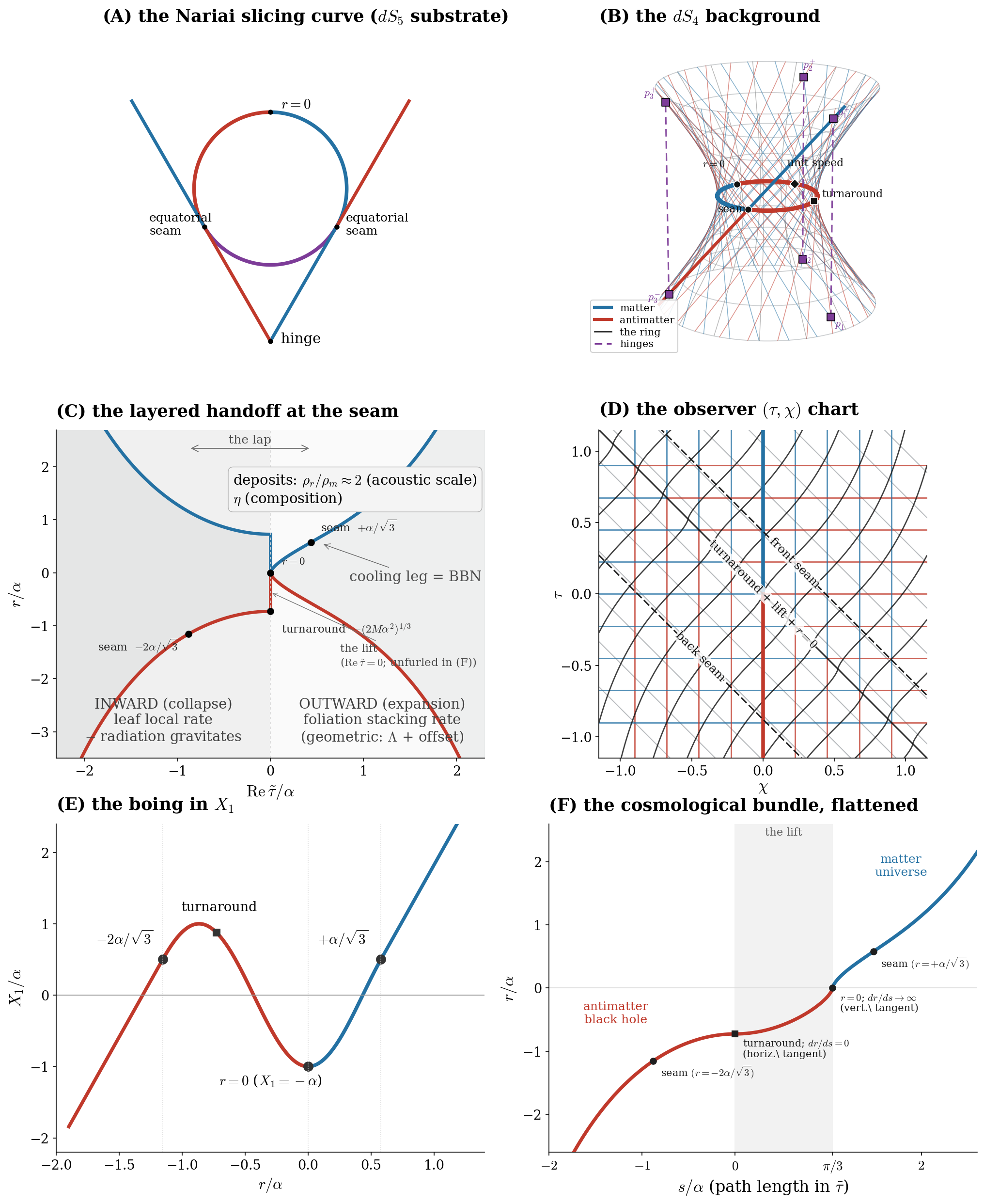
Four-dimensional de Sitter space [deSitter1917] may be represented as a one-sheeted hyperboloid embedded in five-dimensional Minkowski space, and its null geodesics are straight null lines of the embedding that lie on the hyperboloid (each spanned, with the origin, by a null 2-plane). In the CR framework a single future-directed congruence of these null lines plays the structural role: the family whose causal sense matches the event-horizon generators arising during gravitational collapse. This bundle of future-directed null curves on the de Sitter hyperboloid is the one reassigned to timelike to define the fundamental congruence in the Schwarzschild–de Sitter (SdS) projection.
The complementary congruence used in the reassignment is not another family of null lines. Instead, it is the congruence of at-rest comoving worldlines—those that remain fixed on the expanding 3-spheres, each at a fixed point of the 3-sphere with 3-sphere radius X=α cosh (T/α) growing as the slices expand. These are the closed-slicing comoving geodesics, timelike in de Sitter space, but in the SdS projection they are reinterpreted as null geodesics and serve as the photon congruence. This exchange of causal roles—the two congruences trading their timelike and null characters, the null rulings becoming timelike and the timelike at-rest worldlines becoming null—is an instance of the representational freedom of §6, where distinct Lorentzian metrics on the same manifold encode different causal assignments while preserving the underlying foliation. Thus the causal reassignment proceeds as follows:
- The future-directed null generators associated with the collapse-induced horizon structure are reinterpreted as the timelike worldlines of fundamental observers.
- The at-rest comoving worldlines, which trace points that remain at fixed locations on each 3-sphere (the closed-slicing comoving geodesics, timelike in de Sitter), are reinterpreted as the null trajectories of photons.
This reassignment preserves the foliation by evolving 3-spheres while altering the causal roles of the two congruences. The resulting projection remains fully diffeomorphism invariant and yields the Schwarzschild–de Sitter spacetime as the unique vacuum representation compatible with the reassigned causal structure. The geometric structure underlying this reassignment is illustrated in Fig. 1.
Construction of the Schwarzschild–de Sitter Representation
To represent this causal reinterpretation, we take the radius of the expanding 3-sphere as a timelike coordinate r. Since each spatial slice is a 3-sphere orthogonal to r, the remaining spatial dimensions are spherically symmetric. A general line element consistent with these conditions takes the form
Imposing the vacuum Einstein equations with a positive cosmological constant selects the Schwarzschild–de Sitter (SdS) metric [Kottler1918]:
The coordinate r is timelike when
with the boundary value
defining the Nariai configuration, at which the two positive roots of the metric function coincide, at rN=1/√Λ, and the mass is fixed to
The cosmological reassignment selects this boundary case, and the selection is geometric rather than a tuningP7R8. The de Sitter hyperboloid is ruled by null generators; the reassignment promotes one such bundle to the fundamental timelike congruence (Fig. 1). A comoving worldline of this congruence runs along a null generator of the embedding, and it is the only worldline of the SdS family that encounters no horizon along its length: every configuration with ΛG2M2/c4 lt;1/9 has its fundamental curve cross the embedding's symmetry structure transversally, and that transverse crossing is precisely what produces the finite-mass black-hole and cosmological horizons of a localized source. Only the Nariai tilt—the self-dual null direction at which the two positive horizons merge—gives a comoving curve that produces no such horizon, and so only the Nariai configuration admits a reading as a cosmology rather than as the field of a localized mass. The cosmology is therefore not one member of an overcritical family selected by fitting a mass; it is the unique non-pivoting member, fixed by Λ alone. The geometric construction underlying this selection—in which the SdS horizons are the turning points of a single radial slicing curve and Nariai is the fixed point of that curve's root-exchange involution, the configuration of maximal mass any slicing of a given de Sitter geometry can carry—is developed in the companion paper [JanzenSlicing], and the same uniqueness is obtained algebraically in the description groupoid: the generic vantages fall into two-cycles of that involution and Nariai is its one fixed point, so the reassignment—forbidden by the two-cycle structure at every generic vantage—selects it and no other, a structural fact about the groupoid rather than a fitting [JanzenGroupoid]. Here we take the Nariai configuration as the cosmological case the reassignment picks out and read off its consequences.
This selection is not merely internal to the reassignment; it is forced by the limiting causal structure of gravitational collapse. The companion causality paper establishes that the future event horizon H+=∂J-(I+) is approached by every exterior-adapted slicing only in the limit of infinite exterior time, the slices becoming asymptotically tangent to a single horizon generator and meeting H+ at no finite time [JanzenBHcausality]. The limiting orientation the collapse selects is therefore a null direction grazing the horizon—tangent to it, never transverse. Promoting that direction to the fundamental timelike congruence, as the reassignment does, and classifying the family by how a null-generator congruence meets the horizon, yields a trichotomy: transverse crossing (ΛG2M2/c4 lt;1/9, two distinct positive horizons), tangency at a merged double root (ΛG2M2/c4=1/9, (5)), or no real horizon (ΛG2M2/c4 gt;1/9). A collapse forms a horizon, excluding the horizonless overcritical case; the limiting orientation is tangent rather than transverseL1, excluding the undercritical case; and the unique member whose null-generator direction is tangent to its horizon is the Nariai configuration, the self-dual direction at the merged root. The asymptotic alignment of collapse therefore forces the Nariai member. This supplies the identification deferred in [JanzenBHcausality], where the null direction the horizon selects is promoted to the fundamental congruence and the external universe is named the unique non-pivoting (Nariai) member: that promotion is here shown to be not merely admissible but selected by the limiting structure of the horizon the cosmology continues.
The forcing fixes the Nariai member—the self-dual null direction, the double root—and what is metrically true at the seam follows from the double root itself. At Nariai the two positive roots of the horizon cubic merge: the black-hole horizon and the cosmological horizon coincide, both at the areal radius rN=α/√3, with equal areas 4πα2/3. (This is the M gt;0 member of a parity-conjugate pair. The three horizon roots sum to zero, so they cannot share a sign: for 2M gt;0 two are positive and one negative, and for 2M lt;0 one positive and two negative—two critical Nariai configurations, at r02=1/3 and r02=4/3, exchanged by the backward-radial reflection r↦-r that reverses the mass. The cosmology selects the M gt;0 member; the full root structure and its fundamental ellipse r2+rr0+r02=1 are developed in the companion papers [JanzenSlicing, JanzenGroupoid].) At the occurrence the two horizons are therefore one, and the null-boundary correspondence between them is metric there—the identity on a single coincident horizon—not merely causal. The areas 16πG2M2/c4 and 4πα2 that differ are the family's two readings—the Schwarzschild collapse vantage (horizon 2GM/c2) and the empty de Sitter cosmological vantage (horizon α)—and equivalently the generic pre-seam correspondence, in which the collapsing horizon is still small and the cosmological horizon large and the two are mapped causally; neither is the seam, where the configuration is Nariai and the horizons are one. What the forcing does not give is the identity rN=α, nor α as an output of the collapse: the merged seam horizon sits at α/√3, a fixed fraction of the de Sitter scale, and α=√3/Λ is fixed by Λ alone. The de Sitter scale α is the size of the throat 3-sphere, a distinct quantity from the areal radius α/√3 of the merged horizon carried on it—conflating the two is the crossing this paragraph is at pains to prevent. The forcing determines which member of the family occurs, and that at the occurrence the two horizons coincide; it does not set the value of the invariant.
The locus r=0 in Eq. (3) is a genuine curvature singularity for the massiveP7R9 (M≠0) Nariai configuration: the Kretschmann scalar diverges as 48G2M2/c4r6 there. Consistent with the companion papers [JanzenBHcausality, JanzenCircle], it is a real metric singularity, not a coordinate artefact; what the causal reassignment alters is the causal role of the congruences threading the geometry, not the reality of the singularity. This construction exemplifies how a change of metric on a fixed manifold, subject to compatibility with the underlying foliation, produces a distinct but admissible Lorentzian representation of the same ontological evolution.
Fundamental Observers and the Induced Metric
Fundamental observers correspond to worldlines comoving with the spatial 3-spheres of constant r (fixed χ,θ,φ); on account of the non-synchrony these are orthogonal to the constant-τ rest-frame slices rather than to the constant-r slices themselves. In their proper frame, the line element becomes [Janzen2015]
where
defined on τ+χgt;0.
The quantity τ=τ+χ defines the parameter along which the 3-sphere radius evolves. Since this parameter is tilted relative to the fundamental rest frame, the universe is non-synchronous: spatial slices of constant τ are Euclidean but do not coincide with cosmological spatial slices.
What this cosmology opens onto
The framework laid out in this paper—the layered ontology, the projection principle, and the causal reassignment that selects the Nariai member—finds its final application in a complete physical cosmology, of which the construction to this point fixes the geometric core: the proper-frame line element (7) carries the exact sinh2/3 law (8) of flat ΛCDM, and the Null–Boundary Correspondence proved below (§6) fixes that cosmological future at the collapse horizon. The physical theory this determines is developed in full across the companion arc; we describe it here, as the synthesis the framework culminates in, with the forward references that make that synthesis coherent. The descriptions that follow deliberately overlap the companion papers—each develops formally what is synthesised here—because the theory is one, and is read off a single Λ-set de Sitter geometry.
The expansion history and the contents. The areal radius (8) is not merely like the flat-ΛCDM scale factor; at the Nariai member it is that scale factor, with both the rate 12√3Λ c and the amplitude—a length set by Λ alone, distinct from the de Sitter 3-sphere size α=√3/Λ and from the merged-horizon areal radius α/√3—fixed by the cosmological constant, with no parameter left to tune. The Friedmann densities are then bookkeeping for one Λ-set geometry rather than its drivers: the matter fraction is not an independent amplitude but the reading of a clock, so that the present value Ωm,0 records the cosmic epoch τ0 at which we observe, and the so-called coincidence problem dissolves into the observation that we exist at a time of order the single timescale the geometry possesses, ∼1/(√Λc). The expansion law, the density bookkeeping, and the dissolution of the apparent Hubble and acoustic tensions are developed in full in the companion cosmology paper [JanzenCRcosmology], which carries the cosmology through to the microwave background; the early-universe divergence from standard ΛCDM is treated below (§6).
The Hubble rate, fixed. Radiation carries no term in the stacking rate at any epoch, while the sound horizon is the plasma's own accumulation on the leaf's rate, which carries it. The acoustic scale is computed from the rate (§5), the plasma being handed over at the branch point where every acoustic mode is outside the horizon, so the angle carries no early-universe parameter and H0 is fixed by it together with the baryon-acoustic distances, at H0≃68.6 [JanzenCRcosmology]; matter–radiation equality then follows from the same epoch, 1+zeq=ωm/ωr with ωr measured. The discrepancy with the local distance ladder is left where the standard model leaves it, a disagreement between the ladder and the early-universe inference; what the two frameworks do not share is the ruler's provenance, pinned there by a radiation-era physical density and here accumulated on a rate whose geometric part carries no radiation. This is developed in full in the companion cosmology paper [JanzenCRcosmology] and carried into its microwave-background sector; we synthesise it here as one consequence of the geometric rate. The same handover fixes the light-element composition, produced on the cooling leg by a genuine nuclear network: helium-4, helium-3 and deuterium at their observed values (deuterium and helium-4 within 1σ of the measured primordial values), the near-zero metallicity of the oldest systems from the handover, and lithium-7 carrying the standard threefold over-prediction—the lithium problem shared with flat ΛCDM rather than dissolved, the cooling leg being a standard nucleosynthesis—all developed in the cosmogenesis paper [JanzenCosmogenesis].
The recovered cosmic time. The same non-orthogonal foliation the reassignment installs resolves the canonical problem of time. With the cosmic clock supplied by the existent—the comoving congruence whose rest frame the redshift isotropy measures [JanzenModernParallax]—rather than by the bare geometry, the scalar constraint deparametrizes to a true Hamiltonian generating the layers' advance, and the frozen Wheeler–DeWitt dynamics stand revealed as the symptom of granting the four-manifold an existence the layered ontology withholds. The objective cosmic “now” and the relativity of synchrony are thereby reconciled rather than opposed (§2); the canonical structure is developed in the companion canonical-time paper [JanzenCanonicalTime].
The matter dynamics. What sets a given epoch's contents is the bend of the spatial cut: the matter density is the cut's deviation from the empty-de Sitter slicing, forced by the same empirical foliation that forces the rate, not by a separate dynamical input [JanzenModernParallax]. The dynamics of that bend—the slicing operator whose generative boundary is the wall at which free gravitational radiation switches on, and the chiral matter carried onto the cosmological side—are the subject of the dynamics paper [JanzenDynamics] and its operator and range companions [JanzenOperator, JanzenRange]. In the linear regime the leaf's transverse-traceless shear is the gravitational wave (§4), returning the standard graviton as the projection-dependent representation of a spatial-metric perturbation.
The perturbation spectrum. Finally, the de Sitter substrate fixes the structure of the primordial spectrum while the progenitor handover supplies its content. The sharp acoustic coherence is fixed by the geometry—every mode arrives at the branch point outside the horizon and frozen with no velocity, so one datum per mode is one phase per mode, the common phase computed to yield the regular comb that randomized phases wash out—and the source spectrum is that of a closed S3, discrete by degree, but projected to the sky through the flat distance slicing rather than a closed one—the flat/closed decoupling carried by the non-synchrony. The flat projection of the discrete source leaves a parameter-free low-multipole deficit: the lowest physical mode, fixed by Λ through the present curvature radius, lands near ℓ≈8 with no power below it. On a genuine Boltzmann transfer the deficit is mild and shaped—a dip bottoming at ℓ=4 (≈0.487, 0.435, 0.359, 0.666 of the expectation at ℓ=2,3,4,5), its shape and depth cross-validated between two independent transfers—and non-discriminating, consistent with the standard model within the lowest multipoles' cosmic variance; the confrontation is developed in the cosmology paper. The degenerate Nariai seam carries no scale, and the branch point, where the modes cross, accumulates no phase, so the inherited content is transmitted faithfully rather than imprinted with a scale of the geometry's own. The decomposition of the observed spectrum into substrate-fixed structure and handover-fixed content, and its consequences for the microwave background, is the work of the cosmology paper [JanzenCRcosmology], which opens with the cosmological theory synthesised here and closes it by developing that sector.
The economy of assumption. Read as one theory, this cosmology reaches the observations the standard model reaches, and the substance of the comparison is what each must assume to do so. The standard model assembles the observed universe—a dark-energy component for the acceleration [Riess1998, Perlmutter1999], an inflationary sector for the causal contact, flatness, coherence, and near-scale-invariance its background dynamics do not supply, added early-universe physics where the sound horizon and the rate come into tension—a dedicated part per phenomenon. This construction adds none: those same phenomena are read off structure the single Λ-set geometry already carries—the isotropizing throat, the coherence-fixing null boundary, the exactly Euclidean slice, the scale-free crossing that transmits rather than imprints—each fixed by Λ alone, with no parameter free to produce it. That is the distinction between a structure that requires a phenomenon and one that merely permits it through adjustable apparatus—the criterion by which competing frameworks are rightly weighed ahead of the measurement that will decide between them [JanzenShadowExistence], the same the programme applies in reading the cosmic foliation as forced rather than chosen [JanzenModernParallax]. Drawn in full in the cosmology paper [JanzenCRcosmology], that reckoning falls to this construction on the theory-choice axis, and on the data axis it is split. The geometric rate fits the acoustic scale and the baryon-acoustic distance ladder together at one H0, leaving the discrepancy with the local ladder where the standard model leaves it [JanzenCRcosmology]; and the forced cooling leg produces the light-element abundances, deuterium and helium-4 within 1σ of the measured primordial values [JanzenCosmogenesis]. So two of the discriminators return in this construction's favour—a data result, not a tie, the baryon-acoustic ladder holding against the DESI DR2 dataset at χ2/ dof≃1—with the low-multipole comparison a mild deficit consistent with the standard model within cosmic variance. The acoustic peak structure counts the other way. The end-to-end transfer to recombination is run: the joint fit leaves the damping-scale signature as the Gaussian residual it predicts, a computed, non-reabsorbable CR-specific effect, and the full-spectrum likelihood leaves, on the construction's assignment of the projection's distance to the stacking rate, a residual in the acoustic contrast that the standard model does not carry, the sharpest datum against the construction as it stands; built with that distance on the leaf rate the residual falls below the standard model's own, and the stacking rate light's path distance takes is derived on any cut, so the residual is the derived configuration confronted with the sky, carried by radiation's absence from that rate [JanzenCRcosmology]. And the reading makes falsifiable commitments—no inflationary scale-invariant attractor, no consistency relation, no substrate-sourced primordial B-modes—exactly where the standard picture keeps its freedom.
These developments are not appendices to the construction but its point. The layered ontology was introduced to render the observed universe intelligible, and the cosmology, the dissolved tensions, the recovered cosmic time, the matter dynamics, and the perturbation spectrum are the one physical theory it determines—each a face of a single Λ-set de Sitter geometry read through the reassigned causal structure. The geometric result this paper proves is that theory's foundation; the companion arc is its development; the observed universe is its Nariai reading.
The inherited datum
Inherited boundary data. The acoustic scale is computed from the rate rather than calibrated against it: the plasma is handed over at the branch point, where every acoustic mode is outside the horizon, so the sound horizon carries no early-universe parameter and the angle is an output [JanzenCRcosmology]. What the handover supplies is the composition—the baryon-to-photon ratio η—and with it the primordial amplitude and tilt As,ns, with the consistency target the measured primordial abundances (deuterium, the helium-4 fraction, the near-zero metallicity of the oldest systems). That target is carried in the cosmogenesis paper [JanzenCosmogenesis]: the progenitor handover heats the infalling matter above the deuterium bottleneck and re-expands through it at the standard rate, so the run is a standard nucleosynthesis that produces helium-4 and deuterium at their observed values and shares the standard lithium problem. η is inherited as flat ΛCDM inherits it, and nothing here needs it derived.
One quantity the handover does not supply is a second datum beside η. A configuration that starts the plasma at a placed redshift carries a radiation amplitude there, and that amplitude follows from η and the measured matter-to-baryon ratio by standard thermodynamics alone—ρr/ρm=[1+ν](π4/30ζ3)T /[η(ωm/ωb)mN]—so it is the start restated rather than an inheritance, and with the handover at the branch point there is no such start [JanzenCRcosmology]. The composition half of the consistency target is met with η inherited, exactly as flat ΛCDM inherits it; what would go beyond that is a derivation of η, and the cosmogenesis paper shows the lap cannot supply one: baryon number crosses conserved and the branch point relabels its sign, so the construction has no baryogenesis and needs none [JanzenCosmogenesis]. And a derivation of η is constrained in kind, not merely in difficulty. The cosmogenesis account has the infall thermalize four orders above the deuterium bottleneck, so the progenitor's composition is erased and the abundances are synthesized in the window rather than inherited; what survives that passage is baryon number, which no dissociation destroys, and η is a ratio of baryon number to photon number [JanzenCosmogenesis]. So η is inherited because it is protected by a conservation law, and the abundances are predicted because they are not. A derivation of η must therefore reach a conserved charge of the progenitor, and can draw on nothing the peak erases—which excludes the entire nuclear history and leaves the progenitor's own baryon number as what it would have to reach: a datum at the head of a genealogy, the asymmetry's sign being which region the reading is taken in [JanzenCosmogenesis]. And the two quantities are not free of one another, though the relation between them is not a further datum. They are quantities of different kinds: ρr/ρm is a ratio of energy densities taken over the matter as a whole, while η is a ratio of numbers taken over the baryons alone. Passing between them requires knowing what the matter is—which fermions the handover delivers, in what numbers, and at what masses. That the two are not the same quantity is not a modelling choice but a fact about the world: matter is not baryons, a neutral hydrogen plasma carrying one electron for every proton, so a count by baryon number omits half its particles.
So the two composition data meet the matter content from the cosmological side, and where that content is fixed settles what they are. The matter sector supplies the number of generations, their chirality, the cyclic Z3 relating them and the S3 of the three walls; the representation content—which species, in which multiplets, with which masses—is fixed where it is fixed for every theory, by the Standard Model's representations and by measurement [JanzenMatter, JanzenBoundary]. So the two data are boundary data and not the trace of a missing sector. The matter density enters the cosmology on the same footing as η, measured as the standard account measures it [JanzenCRcosmology], and passing between the two is passing through that content, which the Standard Model supplies: the two are one item read at two ends, the cosmological end here and the matter end in the matter paper [JanzenMatter]. Two constraints on any derivation of them are established, and both fix the shape such a derivation must take. The first fixes the class of what can be inherited: the segment preceding the branch point acts on perturbations as a filter that damps oscillatory content and leaves frozen content untouched, and every mode has exited the shrinking comoving horizon before the crossing, so what crosses is non-oscillatory—an amplitude and a tilt, never a phase (§7). The scope of that constraint should be stated exactly. It is an argument about perturbation modes, so it binds the primordial amplitude and tilt: As and ns are of the frozen class, and a candidate derivation producing a phase-carrying primordial datum is excluded on that ground alone. It does not bind the composition: ρr/ρm is a background ratio, not a mode, and the filter argument says nothing about it. So the two data are constrained differently—the spectrum's by the crossing's selection rule, the composition's not at all by it—and a derivation of the composition, were one wanted, would rest on other grounds.
The second excludes the mechanism one would try first. The crossing itself cannot supply an asymmetry: the imaginary segment's action has integrand r[f(r)-1]=-2M-r3/α2, odd under the standing conjugation acting on offset and mass together, so the two branches carry equal and opposite action summing to zero identically [JanzenCosmogenesis]. The balance is exact and is traced to the same oddness that fixes the chirality parity and the progenitor's antimatter identity, so it cannot be lifted by refining the crossing—what would have to fail is the relation that makes the progenitor antimatter at all. Whatever supplies the datum must therefore be carried by the matter field or be genuinely inherited as content, and not produced by the geometry of the handover. Together the two constraints remove the most natural place to look and fix the shape an admissible answer can take.
The discrete side of that content stands across three papers. The skeleton the programme reads off the horizon cubic is Aut(A2), of order twelve. The residue pairing which the horizon roots' surface gravities place on the root triple has a holonomy about the Nariai points—a Klein four-group, arising as the per-root resolution of the same √Δ whose non-squareness fixes the Galois group—and adjoining it closes the Weyl group of so (6,C), the complexification of the substrate's own isometry algebra [JanzenGroupoid, JanzenAlgebroid]. So the sector's discrete group is the substrate's own, and the cubic read alone gives only its sub-root-system.
Two consequences bear on this section's accounting. The generation count is protected: the holonomy changes the walls' chiralities only in pairs, so dim ker- cannot be reached from dim ker+=3 by any number of loops, and the observed uniform-chirality configuration is the unique member of its orbit [JanzenMatter]. And the continuous question is closed on both real forms rather than one: the substrate's canonical connection is genuinely non-abelian, with holonomy in so (4,1), and neither su (3) nor su(2,1) embeds—on the tangent bundle because both require six real dimensions where five are available, and on the spinor bundle because a compact algebra of dimension eight cannot sit in a group whose maximal compact is six-dimensional—that six being the fixed-point set of so (4,1)'s Cartan involution θ(X)=ηXη, which is what a maximal compact subalgebra isR—while the non-compact form founders on the quaternionic structure sp(1,1) preserves. The wall reported in the boundary paper is therefore not particular to the compact form, and the continuous half stands where that paper places it.
Null–Boundary Correspondence and SdS Entry Geometry
In Cosmological Relativity (CR), the ontological structure of the universe is encoded in a layered family of spatial manifolds
The purpose of this section is to establish a structural correspondence between two geometric objects:
- a null hypersurface arising as the limit of infalling timelike worldlines in a Lorentzian projection of CR, and
- the initial representational slice of an SdS cosmology obtained by causal reassignment.
This correspondence is structural: it identifies a morphism between two projections of the same ontological layer. The theorem proved below establishes that the horizon event-of-events at the limit of collapse and the initial slice of an SdS cosmology represent the same ontological layer of CR under distinct causal assignments. What this identification implies for the post-horizon evolution—the dynamics on the cosmological side of the correspondence—is fixed by the SdS construction itself, whose expansion law is sinh2/3 as derived above; the transition of matter and observers across the branch point is not addressed in this section but is settled in §10, where the worldline side is computed: a comoving worldline reaches the branch point at finite proper time with divergent curvature and divergent tidal stretch and terminates there, what continues being the analytic continuation. What is settled about crossing concerns perturbation content rather than bodies: the cosmology paper gives a transmission mechanism at the branch point, on which the amplitude and tilt of a frozen mode cross unaltered while its oscillatory content does not [JanzenCRcosmology].
Horizon Null Structure and One-Way Causal Ordering
Let (M,g) be a Lorentzian manifold representing a gravitational collapse scenario. From the metric-singularity structure established in Ref. [JanzenBHcausality], the event horizon H+ is a null hypersurface foliated by null generators γλ, where:
- each generator consists of topologically distinct, causally ordered, but metrically coincident events,
- successive infalling timelike worldlines accumulate asymptotically onto these generators, and
- the causal relation is one-way: earlier infalling worldlines lie in the past null boundary of later ones, but not conversely.
Topologically, the horizon has the structure
SdS Cosmology and Causal Reassignment
In the SdS construction above, we showed that by preserving the cosmic foliation while reassigning the causal roles of null and timelike congruences in de Sitter space, one obtains a Schwarzschild–de Sitter representation of the same layered ontology. The geometric legitimacy and structural meaning of this reassignment are clarified in the following subsection. In this construction:
where r is a timelike coordinate aligned with the cosmic foliation, and the spatial slices are 3-spheres of radius r.
In this representation:
- the fundamental cosmological rest frame is defined by one bundle of null generators of the de Sitter hyperboloid;
- the complementary congruence becomes the null (photon) congruence in the SdS projection;
- the foliation by 3-spheres is preserved;
- the evolution of r follows the sinh2/3 law matching flat ΛCDM.
Metric Reassignment and Representational Freedom on a Fixed Manifold
The causal reassignment employed in the SdS construction rests on a structural distinction that is standard in differential geometry yet rarely articulated in the relativistic literature. A smooth manifold M is, by definition, a topological space equipped with a differentiable atlas; it carries no intrinsic geometric or causal structure. Lorentzian geometry arises only after the choice of a metric, that is, after specifying a smooth assignment to each tangent space TpM of a symmetric bilinear form of signature (-,+,+,+). The null cones, causal relations, and classification of tangent directions as timelike, null, or spacelike are therefore features of the metric g, not of the manifold itself.
For a fixed Lorentzian metric g, the null directions at each point are invariant under coordinate transformations: changing charts cannot alter the light cone defined by g. However, there is no requirement that a given manifold admit only one such metric. Replacing g with a distinct Lorentzian metric g' on the same manifold M alters the causal structure while leaving the underlying topology and differentiable structure unchanged. The pairs (M,g) and (M,g') thus represent the same manifold endowed with inequivalent Lorentzian geometries. This is entirely orthodox: the freedom to equip a single manifold with distinct Riemannian or Lorentzian metrics is foundational in differential geometry, and no part of the manifold structure is affected by such a replacement.
The causal reassignment carried out in this work is a highly constrained instance of this general freedom. Rather than introducing an arbitrary new metric, we consider two Lorentzian structures g and g' that share the same foliation by spacelike hypersurfaces corresponding to the layered ontology { St}. The foliation is held fixed, while the causal classification of certain congruences threading this foliation is altered. Specifically, a congruence that is null with respect to g may become timelike with respect to g', and a congruence that is timelike in one representation may serve as the null (photon) congruence in another, provided the resulting (M,g') retains smoothness and Lorentzian signature. In this sense, the SdS construction implements a reassignment of causal roles among congruences while preserving the manifold and the ontological layering.
This has a straightforward geometric reading. Altering the causal roles of congruences corresponds to selecting a different Lorentzian structure on the same underlying manifold, one that remains compatible with the same foliation. The transition from the de Sitter metric to the SdS metric is such a selection: the manifold, its differentiable structure, and the ontological layering are held fixed, and only the metric assignment of null and timelike directions to the threading congruences is changed.
This perspective also clarifies the conceptual economy of the construction. The reassignment does not invoke higher dimensions, additional fields, or modifications of Einstein's equations. The manifold M remains fixed; only the metric chosen to represent the causal structure is changed. From this viewpoint, the question addressed in the SdS construction is simply: given a manifold equipped with a fixed layered ontology, how many physically distinct Lorentzian metrics g are compatible with that ontology and its cosmic foliation? More than one are admissible in general; the SdS metric arises as the choice selected by requiring compatibility with the horizon-induced temporal orientation identified in gravitational collapse, and the cosmological case among the SdS family is the Nariai configuration singled out above.
In this sense, a Lorentzian metric is equivalently understood as a choice of equivalence class of coordinate charts related by local Lorentz transformations, and replacing g with g' is a change of that equivalence class. The manifold itself is indifferent to which metric it carries; what changes is the causal projection of the underlying ontology that the metric encodes. The SdS cosmology therefore exemplifies how distinct Lorentzian representations of the same underlying manifold may encode different but admissible causal assignments, while preserving the ontological content encoded in the cosmic foliation.
Null-Boundary Correspondence
We now formalize the relationship between the null horizon structure and the SdS cosmic entry slice.
- N maps each collapse-horizon generator γλ to a unique generator of Hc+(p);
- the celestial S2 cross-section of H+ maps onto the bifurcation S2 of Hc+(p), matching the observer-pole of each;
- the null affine ordering along the generators of H+ corresponds to that along the generators of Hc+(p), with future orientation preserved;
- by Diffeomorphic Representability and the Non-Identity of Ontology and Representation, the layer represented along H+ and the layer represented along Hc+(p) are one ontological layer: H+ and Hc+(p) are distinct spacetime representations of the same existing 3-space.
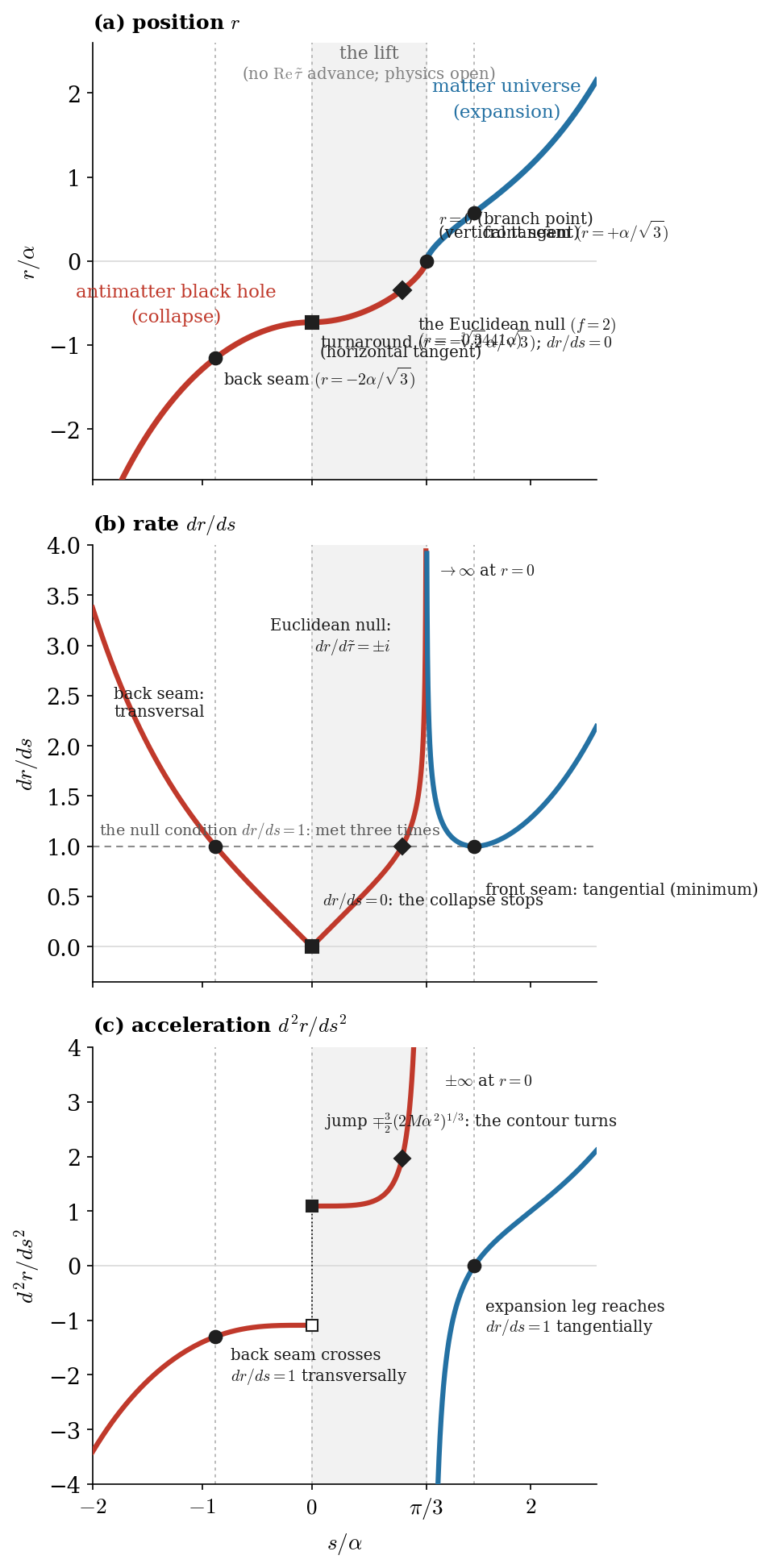
F_triptych.py.)}
- the Hubble–Eddington radius rHE=(Mα2)1/3, since M=α/33/2—the boundary between a structure's local gravitational hold and the cosmic expansion [JanzenSlicing];
- the flat locus of the slicing surface's intrinsic curvature, where the local bend of the cut cancels the substrate's cosmological term [JanzenSlicing]—which is also, in dynamical words, the exact locus at which the areal acceleration changes sign, since d2r/d τ2=-f'/2=r KG identically on the marginal congruence, so the areal radius decelerates where the slice is negatively curved and accelerates where it is positively curved—generally in the mass, not only here. The two are one reading in two languages and are counted once;
- the handover from the sub-marginal bound orbits to the marginally-bound congruence that is the cosmology [JanzenOperator];
- the unique fixed point of the vantage involution σ, at which the horizon cubic's two non-fixed roots collide and the reassignment is uniquely available [JanzenGroupoid].
And the bead's amplitude—the comoving turnaround at which the collapse's areal radius stops decreasing—stands at 21/3rHE, the two differing by exactly the cube root of two, and the factor has a cause rather than being a coincidence.
The turnaround is the locus 1-f=0, that is r3=-2Mα2; the Hubble–Eddington radius is the locus f'=0, that is r3=Mα2. The two conditions differ by the single factor of two that distinguishes 2M/r from the balance of 2M/r2 against 2r/α2, and one factor of two inside one cube root is the whole of the √[3]2. That the amplitude is thereby tied to a horizon root is particular to the forced member: only at the Nariai double root do f and f' vanish together, so only there is the f'=0 locus also a root of f. On a generic member the ratio is unchanged—it is exact for every M and α—but the quantity it ties the amplitude to is the static radius and not a horizon.P7R10L6
Two of the readings are the companion epistemic paper's and are not repeated in the list above—the radius as the local range of the substrate's single scale, and as a consequence of this framework's own closure [JanzenShadowExistence]—so six readings of that one radius stand across the corpus, of which this list carries four.
And the stratification of Fig. 3 sharpens what the coincidence is not.} That figure marks the front seam as the one locus crossed at unit speed without dividing two causal regions: on both sides r is timelike and the marginal rate real, because the seam is the horizon cubic's double root and f touches zero there without changing sign. So at rHE the areal acceleration changes sign and the causal character does not. The two sign-questions are independent and answered oppositely at the same radius—which is why the turn is invisible to the causal stratification and why an observer crossing it records a change in their expansion history and none in the character of their own radial coordinate.
What that list is and is not should be said plainly. It is not four derivations of one another: the Hubble–Eddington statement is a balance on a local exterior, the curvature statement a fact about a surface (its dynamical face the same fact read as a second derivative on a curve), the handover a fact about orbits, the fixed-point statement a fact about a groupoid, and none entails the others. It is four readings of one radius, and the epistemic companion counts exactly this as its evidence—appearances read for the world that casts them, converging where nothing arranged them to [JanzenShadowExistence]. The second, in its dynamical face, is the one that exhibits the projection rather than redescribing it: nothing accelerates anything at that radius, the sign of d2r/d τ2 being a property of a fixed curve read where f' crosses zero, so what an observer records as the onset of cosmic acceleration is the second derivative of a fixed function changing sign along the path they are carried on. The universe accelerates when it reaches its own Hubble–Eddington radius—and that sentence is a statement about a curve, not about a force.
First, the two cosmic-time legs are complex conjugates. Continuing r from Eq. (8) onto the signed lap, the two readings of a given real r are related by τ↦ τ: they coincide on the real expansion leg and separate into a +πα/3 wing and its -πα/3 mirror. The full imaginary period is 2πα/3—the shift τ↦ τ+2πiα/3 multiplies r by e2πi/3, a cube-root order-three distinct from the horizon-cubic order-three the companion groupoid analysis carries (Lemma 1) [JanzenGroupoid]—and the turnaround bound | Im τ|=πα/3 is exactly half of it.P7R2
Second, the null congruence crosses the branch point. Because the areal radius is signed and gθθ=r2 is insensitive to signr, the radial null geodesics continue through r=0 onto the conjugate (r lt;0) branch rather than terminating there; integrated in τ the passage is a bounded, vertical-tangent crossing, not a barrier—the cosmological face of the branch-point reading of the preceding remark. Read as light propagation, the photon congruence does not end at the branch point but is continuous across it. (Receipt: photon_cross_test.py.)}
Third, the three readings collapse in the (r,τ) frame. Since r is a function of τ=τ+χ alone, every real curve—each of the two null rulings and the photon congruence alike—projects onto the single graph r(τ); the three congruences are distinguished on the substrate (where the hyperboloid is doubly ruled, A and B two genuinely distinct null-line families, the photon congruence the at-rest worldlines, a third object that is no ruling) and in the (τ,χ) chart, and coincide in the (r,τ) frame, separating only off the real axis. One assignment is derived: the photon—the at-rest congruence reassigned to null—rides the real (Im τ=0) crossing, integrated as the branch-point crossing null geodesic of the second structural factP7R1. The two ±πα/3 wings are the τ↦ τ conjugate pair of the one cosmic-time continuation of the first structural fact; which physical congruence each wing carries—the map from the two distinct substrate rulings A, B to the two conjugate sheets—is closed in the synthesis (§9): the rulings are borne on the mass-reflection R's real (r) axis and the wings on the reality involution K's (τ) axis, so they are not two candidates for a single assignment but the linear and antilinear faces of the one analytic plate. The conjugate (r lt;0) branch is the areal reflection r↦-r of the expansion leg, and under the mass-reflection R=γ5 (the A2 diagram automorphism, 2M↦-2M) it is the antifundamental 3=R(3) of the matter branch: within CR it is antimatter, at the same weight the fundamental branch is matter, the discrete skeleton (representation, chirality, mass-sign) geometric on both and the charge field-level on both [JanzenMatter, JanzenBoundary]. This naming of the branch is independent of that sheet-to-ruling face-structure.
The lift, and the explanation of the initial rate
The lap—from the back seam through turnaround, lift and branch point to the front seam—is the portion of the history the dS4 background represents on a single minimal S3 at the throat. It is therefore precisely the region in which the background's null rulings, and with them the synchronous reading built on the second ruling [JanzenOperator], are not available as they are on the horns.
Theorem 2 establishes the contour; this section reads the physics of its most exotic segment, and the reading answers a question the standard beginning has never answered. The contour is not free-standing: it runs on the ring the companion circle paper exhibits, whose two poles are the horizon and the conjugate critical point at r=0, and whose smoothness there is what permits the passage this section reads [JanzenCircle]. The seams are that ring's outer roots met a lap apart—one substrate point, since in the phase φ=2πr/√3α they sit at +120∘ and -240∘—and the branch point is its second pole.
The excursion's three critical loci are moreover three equally spaced values of the structure function, a triple independent of its roots. Since (dr/d τ)2=1-f for the marginal congruence, the seam sits at f=0 with dr/d τ=±1 real, the turnaround at f=1 with it vanishing, and the Euclidean null at f=2 with it ±i; that is, 1-f∈{+1,0,-1}, the three causal characters. The excursion is stratified by that character, and the stratification is worth setting out because its arithmetic is not the obvious one. Two characters are in play and must be kept apart: the sign of f, which decides whether r is timelike or spacelike, and the sign of 1-f, which decides whether the marginal congruence's radial rate is real or imaginary. Reading both along the contour gives five spans—the collapse horn, the seam-to-turnaround stretch, the lift, the branch-point-to-front-seam stretch, and the cosmological horn—but only four distinct characters, because the fourth and fifth spans share one: on both sides of the front seam r is timelike and the rate is real. The front seam does not divide two causal regions. Three joints therefore carry all the character changes: the back seam (timelike to spacelike), the turnaround (real rate to imaginary), and the branch point (spacelike to timelike and imaginary to real together, through infinity rather than through zero).
The joint that opens the lap is also the lap's one horizon, and two levels must be held apart in saying whose—the same two the transition's own remark separates (Remark 1). The back seam is the horizon cubic's third root, the simple one, met on the conjugate sheet at r=-2α/√3. At substrate level it is the merged horizon re-entered. It is the backward-radial root the lap closes on [JanzenSlicing], and in the phase φ=2πr/√3α it stands a full turn from the front seam, so the two are one point of the underlying geometry [JanzenCircle]; the collapse horizon and the cosmological seam are one ontological layer under two causal assignments (§1); and the matter whose collapse the lap carries fell in the universe the horn beyond it opens onto, an arbitrarily dilute asymptotically de Sitter region that for an ordinary bead is a previous universe's late expansion [JanzenCosmogenesis]. Read locally, on the sheet the collapse runs on, the same locus presents as the cosmological horizon of the mass rather than as a black hole's. The signature decides it: outside the back seam the areal radius is timelike and the region runs out asymptotically de Sitter, while inside it the geometry is static, down to the branch point. That is the pattern a cosmological root carries and the exact reverse of a black-hole root's; and the sheet holds no black-hole root to set beside it, since f restricted to r lt;0 is strictly monotone and therefore has exactly one zero. Neither reading displaces the other: the first says what the substrate point is, the second what that point presents as on one sheet of the chart, and a reader who takes either for the whole will find the other contradicting it.
And the absence of a black-hole root on that sheet raises a question about the central move, which is answered rather than left. If the collapse sheet carries only the one root, what does the causal reassignment act on? Nothing on that sheet. The trichotomy of §5 classifies the family by how the reassigned null congruence meets the horizon and selects tangency at a merged double root; and the merged double root is the radius at which the two positive horizons merge, r=+α/√3. So the locus the reassignment acts on is the front seam, on the r gt;0 sheet—which is the locus Remark 1 already names in placing it at α/√3. The collapse sheet's carrying no black-hole root is therefore not a gap in the account but a consequence of where the account acts: the selection is a statement about the orientation a horizon forces on a congruence, and it is evaluated where the two positive roots coincide. The back seam is that same substrate point met a lap earlier, which is why the lap closes on it; and reading it locally returns the mass's cosmological horizon not because a black-hole horizon has gone missing from the collapse sheet, but because the sheet such a root would sit on is the other oneP7R28.
The lap carries no other horizon, at either level. At the front seam f only touches zero, the double root, and the surface gravity vanishes with it. At the back seam it does not, κ=3√3/4α, or 1.299/α—the same number the bead's own acceleration takes there, and by an identity rather than by coincidence. At any root of f one has 1-f=1, so the marginal congruence's d2r/d τ2= 12(1-f)'=- 12 f' while κ= 12|f'|: the transverse crossing's acceleration and the surface gravity are one quantity of opposite sign, which is why panel (c) of Fig. 2 prints -1.299 at that seam without naming it a surface gravity. And the crossing is read on two clocks, which is what the horizon's own structure requires of it. No finite-time slice of the exterior universe intersects a horizon generator [JanzenBHcausality], so no finite layer of the exterior's reckoning reaches this seam at all; the layer that carries the collapse crosses it at a finite reading and continues, 0.878α of cosmic time—14.9 Gyr on the corpus's own 1/√Λ=9.8 Gly— short of the comoving turnaroundP7R27.
With the levels separated, the stratification reads as one thing: the lap is a collapse into a black hole, told on the cosmic clock, and each of its joints is the counterpart of a feature the static reading puts somewhere else. The pieces are established above and in the companions; what follows is the reading they composeP7R28. Coming in, the contour arrives out of the parent universe at large and crosses the back seam—locally the cosmological horizon of the mass, with surface gravity 3√3/4α—into the mass's own static neighbourhood. That neighbourhood has no balance radius in it: the locus f'=0 sits at +(Mα2)1/3, which is positive for every mass and so lies on the other sheet, at the front seam, where it is the Hubble–Eddington radius of the four coincident readings above. And the absence is the same fact as the seam's surface gravity, since f' is what fails to vanish on r lt;0: monotonicity gives one horizon, gives it simple, and leaves no balance point, in one stroke. Then the turnaround, which is not a zero of f at all but stands to the cosmological congruence as a horizon stands to the static one—by Remark 4, the horizons are where the maximally bound member E=0 of one energy-indexed congruence turns and the comoving turnaround is where the marginally bound member E=1 turns, the same kind of point read by two energies of one family. That is a statement about kind and not about location: on the cosmic clock no horizon is crossed between the seam and the beginning, and the turnaround stands in the place one would look for it. Then the lift, the stretch inside the turnaround, which is classically forbidden to the marginally bound member—1-f lt;0 throughout—so that it is cosmic time rather than the radius that turns there, rotating to imaginary. The shape follows the same division: | sin (3s/2α)|2/3 on the lift against sinh2/3 and cosh2/3 on the real legs, which is the companion circle paper's own pairing for the black hole itself—trigonometric on the interior arc, hyperbolic on the continued arms of one analytic curve [JanzenCircle]. And then the branch point, where f changes sign through infinity rather than through zero and the areal radius turns from spacelike to timelike: the radius takes up the clock, and keeps it for the whole of our expansion.
Which locates the one feature the reading might have been expected to put in a single place. Inside a Schwarzschild horizon two things happen together: the static time ceases to be a time, and the radius becomes the clock. On the lap they fall at different joints. Time ceasing to be real happens on the lift, where f stays positive and it is the rate that goes imaginary; the radius becoming the clock happens at the branch point, where f passes through infinity. One interior's two signatures, carried at two loci of one curve—and the stratification's arithmetic is what separates them, the front seam carrying neither and the turnaround carrying only the change of rate.
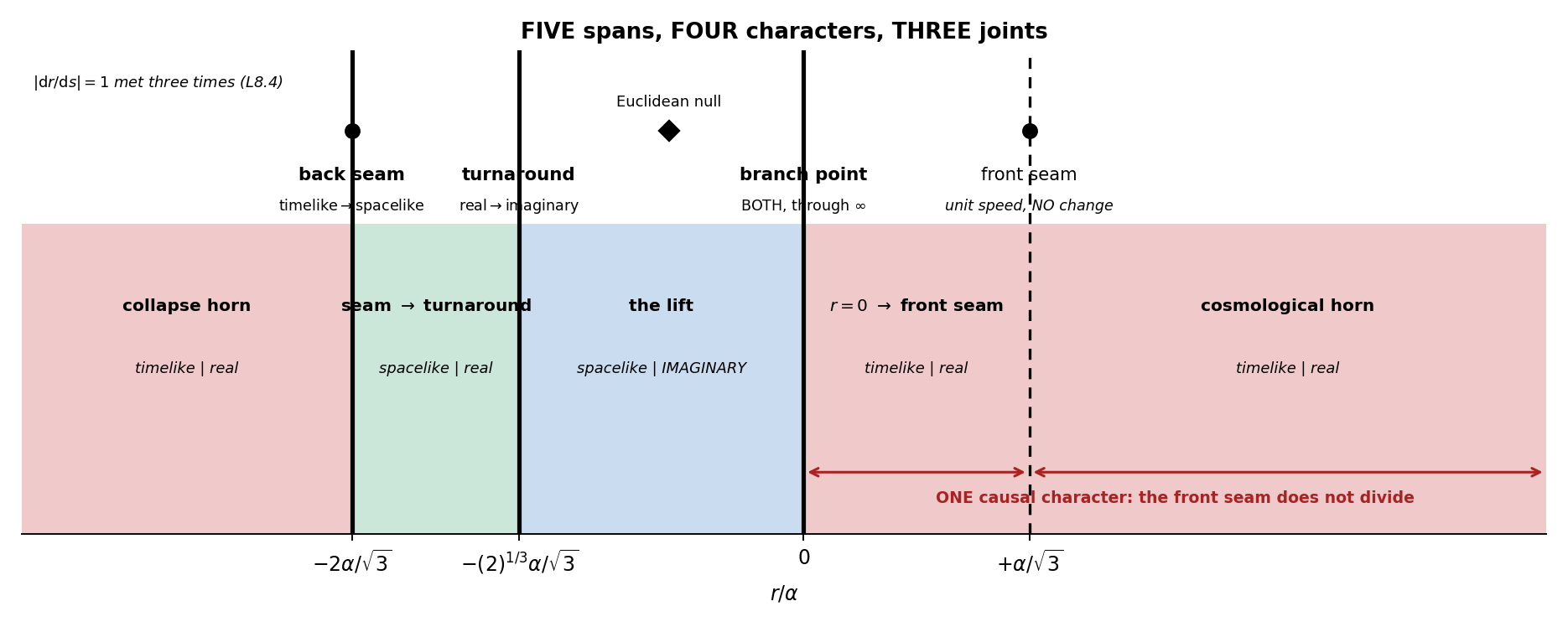
And the front seam's failure to divide is not an accident of the arithmetic; it is a fixed-point statement, and the companion groupoid paper proves it. The front seam is the Nariai locus, and Nariai is the unique fixed point of the root-exchange involution σ on the sky-angle circle—the unique vantage at which the two non-fixed roots of the horizon cubic collide, so that the involution acts trivially there [JanzenGroupoid]. A fixed point induces the identity rather than a passage between distinct objects. That the seam is met at unit speed while changing nothing is the geometric face of that algebraic fact, and it is the same degeneracy—the double root—that makes the member Nariai, that makes the surface gravity and the photon orbit's Lyapunov exponent vanish there, and that leaves the degenerate horizon without a bifurcation sphere. One degeneracy, read four ways.
How fast those quantities vanish is fixed by the way the roots collide, and the answer is not special to this cubic. At the merger the horizon polynomial has a double root with non-vanishing second derivative while the mass enters it additively and at first order—a fold, in the standard classification of one-parameter collisions—so the two horizons separate as the square root of the distance from the critical mass, and κ, being proportional to the polynomial's slope at a root, vanishes at that same square-root rateP7R11L4. The exponent is fixed by the collision type and not by this family, and that reading is checked in the only way that could have refuted it: written at a general dimension the degenerate member persists, with the horizon polynomial's second derivative there equal to -2(D-1) and so never vanishing, which is the condition for a fold. The square root is therefore dimension-independent, as an argument from the collision type ought to be [JanzenSlicing]; what is particular to four dimensions is only the value -6 that the second derivative takes there. So how near the degenerate member a configuration must sit for its surface gravity to carry no appreciable scale has a definite answer, and the answer is a square root.
One caution about the word. Fold is used here in its bifurcation-theoretic sense, and is not to be read against the bifurcation sphere of a Killing horizon—which the degenerate member does not possess, as the previous paragraph records.
And these are not three unrelated markings: they are the three solutions of one condition, and together they are what makes the causal character of the excursion well defined. In the contour's own path-length parameter the null condition is |dr/ds|=1, a single equation with no free input, and on the lap it is met exactly three times—at the seam on the way in, at the interior Euclidean null, and at the seam again on the way out (Fig. 2, panel b). The turnaround is not among them: there dr/ds=0, and it separates the three. The count is a count of passes rather than of places, since the two seam passes are one substrate point met a lap apart, so the null condition is met three times at two loci, the Euclidean null being the one met once.
That structure carries the causal reading of the whole excursion, and it is worth saying why the arrangement is not merely tidy. The lap is the stretch the background represents on a single minimal S3 at the throat: the entire worldline bundle—matter on r gt;0, antimatter on r lt;0, and the photon congruence—is gathered at the equatorial joint where the two null rulings cross, so one might expect the causal character along it to be ill defined or to require a choice. It is neither. The character is fixed pointwise by 1-f, and the three passes of the null condition are exactly the loci at which it changes: real speed on the lap's real segments, zero at the turnaround, imaginary on the lift. And the third pass exists only because the excursion leaves the real axis. A contour confined to real cosmic time meets the null condition twice, at the seam's two passes, and has no way to carry a well-defined causal character across the interval between the turnaround and the branch point; it is the imaginary excursion—available because the substrate's two real forms are real forms of one complex group [JanzenGeometricCore, JanzenBoundary]—that supplies the third pass and closes the reading. The Euclidean null is therefore not an incidental feature of the lift but the condition on which the lift's causal well-definedness restsP7R12.
The root triple grades position on the ring—and, read on a fermion sector, the three chiral seats [JanzenMatter]—while these values grade causal character along it. The two are not one structure, and the reason is a difference of kind: the root triple is the set of zeros of one cubic, f=0, while the causal triple is three values of f, each with its own locus, so a single condition would have to return a set of roots and a set of levels from one statement. What one condition does return is the three loci: they are the turning radii of the energy family of Remark 4, read at E2-1=-1,0,+1P7R13.
ShadowFormal.LapKilling), with no unproved step.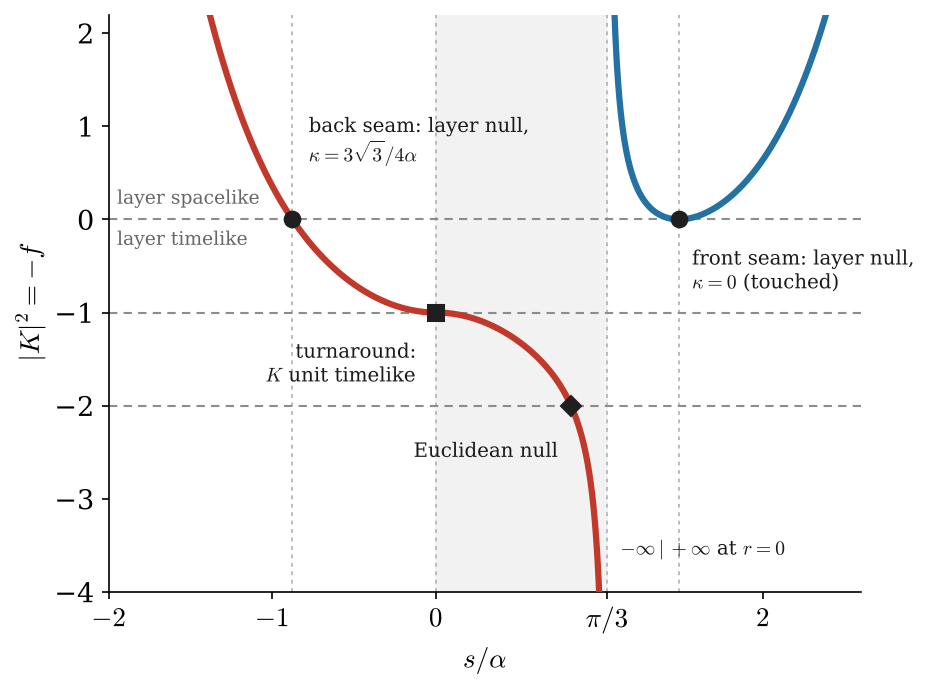
F_killing.py.)}The lift is the stretch of the contour, of path length πα/3, along which Re τ does not advance while the areal radius climbs from the comoving turnaround |r|=(2Mα2)1/3 to the branch point r=0. Since τ=is there, sinh (3is/2α)=i sin (3s/2α), and on the branch joining the collapse leg the bead's own law reads
What the segment does is visible in the derivatives. Along it (Fig. 2, panels b and c) the rate dr/ds is carried continuously from zero at the turnaround, through unity at the Euclidean null, to divergent at the branch point, with the acceleration growing without bound over the same interval. And because cosmic time is Re τ, which is frozen there, the entire process occupies no cosmic time at all. The lift is not a gap in the cosmic-time evolution but a single instant of it—a forced phase shift of finite path length and zero duration—which is why the deparametrized Hamiltonian evolution [JanzenCanonicalTime] passes from the collapse leg to the expansion leg with no interval in which to act. A sharp separation follows and is worth recording for the matter sector: any quantity whose value depends on elapsed cosmic time is necessarily continuous across the lift, having no time in which to change, while quantities depending on path length or on Im τ may differ across it.
The universe therefore arrives at r=0 carrying exactly the initial data the Friedmann equations require of it: vanishing areal radius, divergent expansion rate, and divergent deceleration, the last working against a rate already large enough to absorb it. This is not a restatement of the standard initial condition but an account of where it comes from. Eddington pressed the objection against the Einstein–de Sitter model in 1933, and pressed it precisely: rival accounts that dispense with a driving force “necessarily… postulate that the large velocities have existed from the beginning. This might be true; but can scarcely be called an explanation of the large velocities”; and of the model itself, that it “leaves me cold. One cannot deny the possibility, but it is difficult to see what mental satisfaction such a theory is supposed to afford” [Eddington1933]. The objection was never answered; it was retired with its advocates [JanzenEinsteinConsiderations]. The lift answers it. And in the same passage Eddington set down, in a footnote, the structure that would supply the requirement—“the system once extended much further than now, that it collapsed, and is now on the rebound… the inward velocities being turned into outward velocities by passage through the centre. So far as I know, this is not advocated by anyone”—his stated reservation being the distribution of velocities, a quantity no one could then compute. What the footnote could not anticipate is that the passage through the centre is not a point but an interval.
The explanation is moreover of this framework's characteristic kind, and that is the substance of it rather than a gloss. The divergent rate and the divergent deceleration are not dynamical causes acting at a first instant; they are effective—perspectival consequences of continuous parametric motion in r along the bead, read in a coordinate that is itself a projection. Nothing is driven; the geometry is traversed, and the dynamics are what that traversal looks like from within. The equations are read leftward from the geometry, and the beginning ceases to be a mystery requiring new physics at a first moment. That matters independently of this construction, because the alternative route is closed on general grounds: the decelerative force grows without bound towards r=0, so a quantum-gravitational modification of that point is not a plausible source of an enormously repulsive first instant [JanzenEinsteinConsiderations]. If the initial rate is to be explained rather than postulated, the explanation must be structural—and this one is.
The quantum reading of the segment
The account above is classical, and the same fact that gives it its classical form gives it a quantum one. Because cosmic time does not advance along the lift, the kernel carrying a state across is not the unitary e-i HΔτ but the Euclidean K=e- H|Δη|—consistent with the evolution operator being the identity, since no cosmic time elapses and the kernel is not an evolution in cosmic time [JanzenCanonicalTime]. That kernel damps a mode of frequency ω by e-ω|Δη|, which is the classical selection rule of this section term for term, and it supplies what the classical reading cannot—it acts on oscillatory content only, a frozen, zero-frequency mode being a fixed point of the kernel. And at the crossing no mode is oscillating—on the contracting leg aH grows without bound as r→0, so the comoving horizon shrinks to zero and every mode exits it and freezes first [JanzenCRcosmology]—so what the segment removes is the sub-horizon oscillation, that is the acoustic phase, and not the frozen amplitude that crosses. The state it selects is the one the canonical companion had already fixed on independent grounds—the regular Euclidean state at the de Sitter horizon's surface gravity κ=1/α, used there to close a one-parameter family of self-adjoint extensions—so the condition closing that quantization and the condition governing the beginning are one requirement met twice.
The segment is a solution of a variational principle, an instanton in the inverted potential, and in the gravitational normalisation its Euclidean action is finite and negative, SE=-0.0481 α2/G: the Hartle–Hawking sign, an enhanced rather than suppressed weight, obtained from a contour this construction already possessed rather than from a boundary condition imposed to secure it. The register is worth marking: the segment's parametrisation runs imaginary, but the continuation is a real analytic one on a spacetime Lorentzian throughout, not a Wick rotation—distinct in kind from the de Sitter horizon's Gibbons–Hawking continuation, in which ℏ is fixed by the period β=2πα [JanzenGeometricCore]. The comparison with the no-boundary sign is therefore a comparison of signs and magnitudes, not an identification of frameworks, and the action is a real integral along a real curve rather than an exponent awaiting a quantum of action. The adiabatic correction to the projection is likewise finite—the tower's frequencies diverge at the branch point but only as s-2/3—and larger than the constant-frequency estimate by a factor 2.32, so the suppression is stronger than the naive reading gives. Its adiabaticity is controlled by the harmonic index alone, the parameter being C/μn with C≤1.72, which is of order unity only at n=2 and n=3.
The central theorem: the augmentation general relativity requires, and the cosmogenesis it forces
The construction to this point has proceeded piece by piece—the horizon's causal structure imported from general relativity, the empirically forced foliation, the layered ontology, the causal reassignment, and the null–boundary correspondence built upon them. We now state, in summation, what those pieces compose: three results, landed together. First, that the CR augmentation is the necessary and sufficient completion under which general relativity describes a world that exists and evolves at all—a required augmentation, not an optional interpretation, with its necessary half measured. Second, that on that augmentation gravitational collapse cannot terminate but must continue as a cosmology—collapsed matter becomes a universe, the collapse horizon and the cosmological seam one ontological layer. Third, that this holds for gravitational collapse of any symmetry, non-spherical collapse dissolved rather than deferred. The section closes by isolating the one datum these leave open.
We fix the foundational data as established results of the programme's papers (their dependency structure—two streams from the wedge, converging on this framework—is shown in Fig. 6, and counted in Table 1).
- [(F1)] The horizon's causal structure [JanzenBHcausality]. The event horizon is a metric singularity: no level set of any Cauchy temporal function of the exterior adapted to an exterior observer meets it at finite value, every infalling timelike worldline accumulates asymptotically onto its null generators, and it fixes a unique limiting null direction, generically non-orthogonal to any spacelike slice. The horizon is a null hypersurface of topology S2×R foliated by generators that carry a one-way affine ordering. These follow from the Lorentzian causal structure alone—from global hyperbolicity and the horizon's definition as the null future boundary of the exterior—and make no use of spherical symmetry and no premise about which foliation is physical; the statement is a theorem of general relativity as it stands, and the quantifier over all admissible exterior slicings is what makes it one.
- [(F2)] The singularity taxonomy [JanzenCircle, JanzenBHcausality]. The event horizon and the r=0 curvature singularity are two species of one genus; the horizon is the finite-curvature species, a substrate-regular null boundary, while the infinite-curvature locus is reached at no finite exterior time, and so on no finite cosmic layer.
- [(F3)] The slicing curve [JanzenSlicing]. De Sitter and Schwarzschild are two readings of one slicing curve on a single de Sitter substrate, horizons are its turning points, and the Nariai configuration ΛG2M2/c4=1/9 is the fixed point of the curve's root-exchange involution—the unique tilt whose fundamental worldline meets no horizon.
- [(F4)] The reassignment groupoid [JanzenGroupoid]. The causal reassignments relating these readings are morphisms of a description groupoid, the discrete symmetry of the solution space, each altering the causal reading of one fixed geometry rather than the geometry.
- [(F5)] The forced foliation [JanzenModernParallax]. The isotropy of the cosmological redshift measures an objective cosmic rest frame, forcing a cosmic foliation and a uniform expansion from the bottom up; a differential expansion set by the inhomogeneous matter is excluded at the observed level.
- [(F6)] The existent [JanzenShadowExistence, JanzenCanonicalTime]. Existence is what endures: the evolving spatial layer is the primary existent, and the four-manifold is the representational record of the events that occur as it exists, not an existent of the same kind. The competing readings are closed—“no objective present” as a modal fallacy, falsified outright by (F5), and “the block is the existent” as a category error whose canonical symptom is the frozen problem of time—so that theory-choice, weighing a required structure against a merely permitted one, selects the layered reading.
By the CR augmentation we mean the single addition these motivate: the primary existent is the evolving spatial layer { St}, a spacetime (M,g) is its representation under a causal assignment, distinct Lorentzian metrics on one manifold are projections of one layer, and the admissible causal reassignment preserves the cosmic foliation—Einstein's field equations, the Lorentzian metric, and the causal structure left unchanged.
- [(i)] Necessary. A description lacking the ontological lapse collapses existence into occurrence: it grants the four-manifold the existence that belongs to the evolving layer, which on analysis smuggles a fifth, meta-temporal dimension general relativity does not contain and is incoherent as a basic description—the block reading, whose canonical symptom is the frozen problem of time (F6).
- [(ii)] Sufficient. Fixing the one physical foliation and reading it ontologically—the lapse the existent's rate of advance, the shift the relativity of synchrony—closes the only coherent escapes: the “events exist” horn as that category error, and the “no objective present” horn as a modal fallacy, the latter falsified outright by the measured redshift isotropy (F5). No alternative survives.
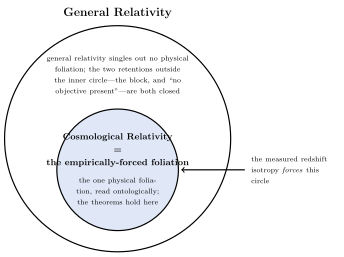
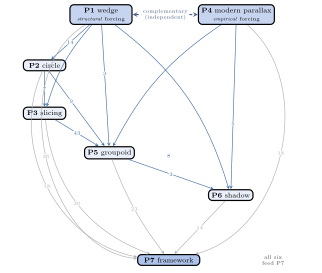
| ⋯ draws on (cited paper) → | ||||||||||||||||||
|---|---|---|---|---|---|---|---|---|---|---|---|---|---|---|---|---|---|---|
| paper | P1 | P2 | P3 | P4 | P5 | P6 | P7 | P8 | P9 | P10 | P11 | P12 | P13 | P14 | P15 | P16 | P17 | P18 |
| P1 wedge | – | 2 | 2 | ◊2 | . | 1 | 8 | . | . | 2 | . | . | . | . | 3 | 1 | 2 | . |
| P2 circle | 14 | – | 24 | 1 | 1 | 3 | 8 | 2 | 3 | . | . | 1 | 3 | 2 | 1 | 2 | 2 | . |
| P3 slicing | 3 | 7 | – | . | 15 | 2 | 18 | 3 | 4 | . | . | 3 | 11 | 21 | 2 | 5 | 14 | . |
| P4 mod. parallax | ◊3 | . | . | – | . | 4 | 7 | 2 | 2 | 1 | . | . | . | . | . | . | . | . |
| P5 groupoid | 3 | 9 | 43 | 7 | – | 2 | 19 | . | 5 | . | 3 | 6 | 8 | 7 | . | 5 | 5 | . |
| P6 shadow | 5 | 4 | 6 | 6 | 3 | – | 11 | 1 | 1 | 4 | . | 2 | 3 | 5 | 4 | 3 | 5 | . |
| P7 framework | 37 | 19 | 32 | 18 | 23 | 14 | – | 15 | 11 | 30 | 14 | 13 | 23 | 34 | 44 | 20 | 14 | . |
| P8 operator | 4 | 7 | 8 | 2 | 3 | 6 | 20 | – | 6 | 3 | 3 | 2 | 1 | 5 | 4 | 4 | 6 | . |
| P9 range | . | 2 | 3 | . | 2 | 1 | 11 | 9 | – | . | 5 | 3 | 3 | 1 | 2 | 3 | 3 | . |
| P10 canon. time | 8 | 1 | 3 | 4 | 1 | 3 | 19 | 4 | 2 | – | 2 | 2 | 1 | . | 3 | 2 | 10 | . |
| P11 dynamics | 2 | 1 | 5 | 1 | 2 | 1 | 10 | 4 | 12 | 6 | – | 4 | 3 | 2 | 2 | 1 | 3 | . |
| P12 algebroid | 2 | . | 9 | 3 | 6 | 2 | 4 | 5 | 11 | 4 | 2 | – | 2 | 5 | . | 2 | 7 | . |
| P13 boundary | 1 | 1 | 8 | 1 | 5 | 3 | 13 | 5 | 6 | 5 | 4 | 14 | – | 35 | 3 | 3 | 8 | . |
| P14 matter | . | 3 | 18 | . | 4 | 3 | 11 | 4 | 1 | 1 | 4 | 9 | 26 | – | 2 | 2 | 8 | . |
| P15 cosmology | 4 | 3 | 10 | 8 | 3 | 4 | 20 | 11 | 4 | 4 | 4 | 1 | . | 4 | – | 24 | 5 | . |
| P16 cosmogenesis | 2 | 4 | 3 | 1 | 1 | 3 | 13 | 7 | 4 | 3 | 1 | 2 | 4 | 3 | 19 | – | 3 | . |
| P17 core | 2 | 3 | 26 | 7 | 10 | 4 | 18 | 7 | 7 | 10 | 5 | 13 | 20 | 22 | 12 | 3 | – | . |
| P18 synthesis | 17 | 15 | 26 | 14 | 15 | 19 | 35 | 18 | 12 | 25 | 10 | 13 | 20 | 18 | 47 | 15 | 21 | – |
| ⋯ is drawn on by (paper) → | ||||||||||||||||||
|---|---|---|---|---|---|---|---|---|---|---|---|---|---|---|---|---|---|---|
| ledger | P1 | P2 | P3 | P4 | P5 | P6 | P7 | P8 | P9 | P10 | P11 | P12 | P13 | P14 | P15 | P16 | P17 | P18 |
| algebraic geometry | . | . | 1 | . | . | . | . | . | . | . | . | . | . | . | . | . | . | 1 |
| cartan holonomy | . | . | . | . | . | . | . | . | . | . | 1 | . | . | 2 | . | . | . | . |
| catastrophe singularity | . | 1 | 1 | . | . | . | 1 | 1 | . | . | . | . | . | . | . | . | . | . |
| category theory | . | . | . | . | 1 | . | . | . | . | . | . | . | . | . | . | . | 1 | . |
| combinatorics | . | . | 1 | . | 1 | . | 2 | . | . | . | . | . | . | 1 | . | . | 2 | . |
| complex analysis | . | 1 | . | . | 2 | . | . | . | . | . | . | . | . | . | . | 1 | . | . |
| conformal geometry | . | . | 2 | . | . | . | . | . | . | . | . | . | . | 1 | . | . | 1 | . |
| convexity optimisation | . | . | . | . | . | . | . | . | . | . | . | . | . | . | 1 | . | . | . |
| functional analysis | 2 | . | . | . | . | . | . | . | . | 1 | 1 | . | . | 1 | . | . | 1 | 1 |
| harmonic analysis | . | . | 1 | 1 | . | . | . | . | . | . | . | . | . | . | . | . | 1 | 3 |
| involution real forms | . | . | . | . | . | . | . | . | . | . | . | . | 2 | . | . | . | . | . |
| optics lensing | . | . | . | . | . | . | 1 | . | . | . | . | . | . | . | 1 | . | . | . |
| quadric geometry | . | . | 1 | . | 1 | . | . | . | . | 1 | . | . | . | . | . | . | 3 | 1 |
| representation theory | . | . | 2 | . | . | . | . | . | . | . | . | . | . | 1 | . | . | . | 1 |
| spectral theory | . | . | 1 | . | 1 | . | . | . | . | . | . | . | . | 2 | 1 | . | 1 | 3 |
| statistics inference | . | . | . | 1 | . | . | 1 | . | . | . | . | . | . | . | . | 1 | . | . |
| variational | . | . | . | . | 1 | . | . | . | 1 | 1 | . | . | . | . | . | . | . | . |
| graph theory | . | . | 1 | . | . | . | . | . | . | . | . | . | . | . | . | . | . | . |
| figure theorem | . | 1 | 4 | . | 1 | . | 1 | . | . | . | . | . | . | . | . | . | 8 | . |
| information theory | . | . | . | . | . | . | . | . | . | . | . | . | . | . | 1 | 1 | 1 | 1 |
| number theory | . | . | . | . | 1 | . | . | . | . | . | . | . | . | . | . | . | 1 | 1 |
| numerical analysis | . | . | . | . | 1 | . | . | . | . | . | . | . | . | . | 1 | . | . | . |
| probability | . | . | . | 2 | . | . | . | . | . | . | . | . | . | . | . | . | . | 1 |
| index theory | 1 | . | . | . | . | 1 | . | 1 | . | . | . | 1 | . | 2 | . | . | 1 | . |
| integrable systems | 1 | 1 | 1 | 1 | 1 | 1 | . | 1 | 1 | 1 | . | 1 | 1 | 1 | 1 | 1 | 1 | . |
Synthesis and Structural Closure of the Programme
Two crossable boundaries, of opposite type
One structural observation belongs at the head of the synthesis, because it is what several of the results below have in common and it is not visible from any of them alone. The construction crosses two boundaries at which the standard reading would stop, and it crosses them for opposite reasons.
At the event horizon the curvature is finite while the tortoise measure diverges: f→0, so r*=∫dr/f grows without bound as the boundary is approached, and the crossing is licensed by the geometry being regular there—the horizon is a metric singularity, at which the spatial measure collapses while the curvature does not [JanzenBHcausality]. At the branch point of the cosmogenetic contour the reverse holds. There f→-2M/r diverges, so r* converges—the crossing carries no scale—while the areal curvature diverges without limit, and r=0 remains a genuine infinite-curvature locus [JanzenCircle]. Each boundary is crossable; neither is crossable for the other's reason.
What this says about the standard verdict is the substance of it. “Singularity” is habitually read as a single condition, with curvature blow-up and geodesic incompleteness treated as two faces of one fact. They are independent, and this construction realises each without the other: a boundary with finite curvature and divergent measure, and a boundary with divergent curvature and finite measure. The singularity theorems' criterion is the second of these—incompleteness in an affine measure—and it is the one the horizon fails to meet while the branch point meets it in a form that continues rather than terminates. A boundary is passable if either failure is absent, and the two failures do not coincide anywhere in this construction.
That is also what makes the imaginary-time segment of the contour a well-posed object rather than a formal manoeuvre. The segment terminates at the branch point, where the curvature diverges; but it is crossed over a finite imaginary interval with r* finite, so the divergence obstructs nothing [JanzenCanonicalTime]. The same complementarity that lets the collapse be read as a cosmology lets the beginning be read as a continuation.
A second such observation concerns a single radius, whose readings are drawn from several sections and two papers. On the forced member r=α/√3 is, at once: the Hubble–Eddington radius; the flat locus of the slicing surface's intrinsic curvature, which is identically the locus at which the areal radius stops decelerating and begins to accelerate; the handover to the marginally-bound congruence; the unique fixed point of the vantage involution; a consequence of this framework's own closure; and the local range of the substrate's single scale. Six readings of one radius—and the second, read dynamically, exhibits the projection the others redescribe, since nothing accelerates anything there and the change of sign is a property of a fixed curve.
The central theorem (§8) established the collapse–cosmology closure formally: the augmentation general relativity requires for a description of structural existence is the one under which the horizon-selected null direction becomes the cosmic congruence, so that collapse continues as the Nariai Schwarzschild–de Sitter cosmology and the expansion history of the real universe is set by the single scale Λ. Three consequences of that closure are worth recording before the reach is widened. First, because no finite ontological layer contains a point-mass configuration, density remains finite on every finite cosmic slice. Second, because the SdS expansion is observationally indistinguishable from flat ΛCDM at late times but differs at early times, the framework offers empirical avenues for distinguishing representational cosmologies while retaining full agreement with the tested predictions of general relativity—the discriminators the companion cosmology paper carries to the microwave background [JanzenCRcosmology]. Third, the single scale reaches down as well as out: the same Λ that sets the expansion sets, for every mass, the local boundary at which a structure's gravitational hold gives way to the cosmic flow—the Hubble–Eddington radius [Eddington1933] rHE=(Mα2)1/3, which the slicing geometry reads as the flat locus of the existent slice, the local bend of the cut cancelling the substrate's cosmological curvature [JanzenSlicing, JanzenOperator]. The long-standing local–cosmic boundary—whether and where structure partakes in the expansion—is thereby a per-structure geometric locus, one substrate Λ read at two ranges.
The general reach: the symmetry-reducible sector as one substrate's cuts
The closure above is drawn for the collapse–cosmology pair, but the same construction, developed in the companion papers, reaches the whole symmetry-reducible vacuum sector of general relativity, and it is worth setting out both what that reach amounts to and—as sharply—what it does not. The slicing operator promotes the de Sitter slicing curve from a classifier of the SdS family to a generator of the static, spherically symmetric sector, with the vacuum solutions the kernel of the matter functional and matter the bend of the cut off that kernel [JanzenOperator]; the range of that operator is exactly the symmetry-reducible sector—a geometry is a cut of the substrate precisely when its isometry group contains a sweep-subgroup of the substrate's—filled across every Petrov type, the vacuum members the substrate's own families (from Schwarzschild–de Sitter through the rotating Kerr–NUT–(A)dS family to the functional Weyl class) and matter the bend throughout, bounded by a wall at which a symmetry able to anchor a sweep, and with it the generative reach, is lost [JanzenRange]. What general relativity holds as a catalogue of separate exact solutions is, in this reading, the family of cuts of one de Sitter substrate whose only scale is the throat radius α=√3/Λ: general relativity's own covariance—one geometry under change of chart—lifted one level, to one substrate under change of geometry, with the slicing curve the gauge object.
This reach answers, for the reducible sector, the classification question this programme places on the table (§10): how much of the standard catalogue of exact solutions is geometric multiplicity and how much is vantage. The apparent multiplicity of the reachable catalogue decomposes on three orthogonal axes. Vantage multiplicity is a finite groupoid of causal readings of one fixed cut—the backward-radial reflection r↦-r exchanging de Sitter and Schwarzschild [JanzenSlicing, JanzenGroupoid], the orientation parity ±M exchanging the black-hole and naked readings [JanzenAlgebroid], the slicing reassignment relating the Kantowski–Sachs and flat-FLRW readings of one Schwarzschild–de Sitter geometry (differing by the rest-energy term alone) [JanzenRange], and the null↔timelike reassignment relating the collapse interior to the expanding cosmology [JanzenCRcosmology]—each changing the reading, not the geometry, and organised as the discrete symmetry of the solution space [JanzenGroupoid]. Geometric multiplicity is the moduli of genuinely distinct vacuum cuts within the reachable classes: the vacuum kernels of the range—the one-parameter Schwarzschild–de Sitter family, the separable Type-D family Kerr–NUT–(A)dS, the functional Weyl class, the homogeneous Bianchi families—with mass, rotation, and NUT charge the moduli transverse to the substrate's orbits [JanzenRange, JanzenAlgebroid]. And matter enters on a third axis orthogonal to both: charge and acceleration are not vacuum cuts but bends off the kernel [JanzenRange]. The reducible catalogue is therefore one substrate read through a finite vantage groupoid, over a moduli family of vacuum cuts, with matter the bend; algebraic type is no constraint on the reach (types O, D, I all filled), and Type D is the separable corner where the substrate's symmetry surfaces as the Carter constant rather than the edge. The Friedmann initial singularity, on this classification, is the cosmogenesis branch point of the degenerate Nariai member of the homogeneous kernel [JanzenRange]—a boundary of the cut, not a breakdown of the geometry, its curvature divergent but its tortoise measure finite, which is why the crossing carries no scale. The branch point and the Nariai member are not the same locus: the branch point is at r=0 and the Nariai member is seeded at α/√3, and this paper elsewhere lists those as quantities never to be conflated. What the reducible classification leaves open is the irreducible interior remainder: the Kerr-inner and Reissner–Nordström-interior reassignments, which tie to the matter side and lie in the interior geometry the reducible classification does not reach.
These vantage readings are of one ontological layer, not autonomous geometries on distinct realities. By the ontological event individuation of §4 and the metric reassignment of §6, de Sitter, Schwarzschild, and the Nariai cosmology are distinct Lorentzian geometries representing a single layer—the de Sitter manifold and its invariant α themselves invariants of the representation, the individuating entity the layer, realised as readings of one slicing curve [JanzenSlicing]. Of the discrete relations among those readings, the within-geometry vantage-change is a Weyl reflection of the horizon triple fixed at the Nariai cosmology, while the de Sitter↔Schwarzschild correspondence is the A2 diagram automorphism, the backward-radial reflection under which the de Sitter geometry is fixed and the Schwarzschild mass reversed; the two together generate the full discrete symmetry Aut(A2)=D6 [JanzenGroupoid, JanzenAlgebroid]. That symmetry is itself orthogonal in the sense this section's decomposition uses: D6=S3×Z2 is a direct product, its factors acting on independent structures—the Weyl S3 on the three horizon roots, the reflection on the substrate's two null rulings—so the vantage axis carries two sub-axes rather than one graded list, and the independence is geometric: the roots are the three points on the throat circle and the rulings the lines tangent to it, and on and tangent are independent relations to one circle [JanzenGeometricCore, JanzenMatter].
The two-sided closure: matter and antimatter, and charge conjugation as the cosmogenesis's face
The reflection factor just isolated—R on the substrate's two null rulings, the Z2 of Aut(A2)=D6—is the hinge of a closure the programme carries in full, and it is set down here as a result. R is the mass-reflection r↦-r (2M↦-2M), a linear isometry whose sole fixed point is the bead's own r=0 crossing and which exchanges the two species-regions r gt;0 and r lt;0 bijectively; under R=γ5 the collapse leg (r lt;0) is the antifundamental 3=R(3) of the matter branch, so within CR it is antimatter at the weight the fundamental branch is matter, and the completed collapse whose future is our expansion is, in the signed-radius continuation, an antimatter black hole (Theorem 3). That is the real, linear face. The substrate carries a second, antilinear face of the same object: the reality involution K: τ↦ τ on complexified cosmic time—complex-analytic and geometric—which fixes the neutral real axis, the self-conjugate photon congruence, and swaps the two conjugate wings of the lap. R and K are the two axis-symmetries of one analytic object, the plate Cr×Cτ: the r-axis carrying R with the A2 hexad and the two rulings, the τ-axis carrying K with the cosmogenetic lap and its two wings. The substrate's two rulings and the lap's two wings are therefore not two candidates awaiting a single assignment but the linear and antilinear faces of that one plate—the rulings borne on R's r-axis, the wings on K's τ-axis—meeting at the r=0 crossing that is R's fixed point and the branch point the cosmogenesis completes [JanzenBoundary].
Their composite closes charge conjugation. R∘K is an antilinear involution reproducing C's action on species, on |2M|, on the mass-sign, and on the Feynman–Stückelberg particle↔antiparticle wing structure, while being blind to the electric-charge sign—the metric carrying charge only through Q2—so charge conjugation factorises, C=(Q↦-Q)field∘(R∘K)geometric, the substrate supplying every kinematic (CPT/Feynman–Stückelberg) datum of C and only the electric-charge sign closing from the matter field [JanzenBoundary]. The geometric factor's fixed point is the bead's r=0 crossing, so the vertex on which charge conjugation's kinematic face turns is the very branch point that completes collapse into our expansion—the crossing itself, and not either seam of the lap: charge conjugation and the cosmology are one structure, read off the one plate, the discrete residue of matter and the conjugation of charge two faces of a single object. The built fermion sector realises that face on its actual zero-modes, R carrying each wall-mode to its bound opposite-chirality antimatter partner [JanzenMatter]. What the two-sided structure leaves genuinely open is narrow, and is the matter sector's rather than the framework's: the identification of a wing with a specific charged particle and the full antilinear C whose charge sign closes from the field—both carried and weighed in the companion boundary and matter papers [JanzenBoundary, JanzenMatter]. The two-sided structure itself—rulings and wings, matter and antimatter, charge conjugation and cosmogenesis as the R and K faces of one plate—stands closed.
Standing features of general relativity, recovered
Three standing features of general relativity are recovered as consequences of that single structure rather than as separate inputs. The hidden symmetry of the Type-D family—the Killing tensor and Carter constant that render Kerr geodesics integrable, which general relativity carries without explanation—is the substrate's own maximal symmetry surfacing in the separable corner [JanzenRange]. The canonical problem of time—the frozen Hamiltonian constraint of the Dirac algebra—is not a defect awaiting a technical repair but the canonical face of reading the four-dimensional manifold as the existent; on the substrate's empirically forced cosmic foliation the same constraint deparametrizes to a true Hamiltonian generating the layer's advance, the two being one content under two readings, so the problem is dissolved rather than solved [JanzenCanonicalTime]. And the Dirac constraint algebra itself—famously not a Lie algebra, its normal–normal bracket closing on the tangential generators with the inverse spatial metric as a structure function—is, on the symmetry-reducible sector, the symmetric-space grading of the substrate term for term: under the identification of the cut-deforming coset directions with the Hamiltonian constraint and the cut-fixing isotropy with the momentum constraint, the relation [m,m]⊂h of the symmetric space SO(5,1)/SO(4,1) is the hypersurface-deformation bracket, the structure function is the substrate's own coset metric, and its base-variation across the cuts is the canonical root of the problem of time [JanzenAlgebroid]. The dynamics of the cut is, correspondingly, a true-Hamiltonian flow through the strata of this sector and ordinary Einstein evolution beyond its boundary—the wall the regular, radiative generative boundary at which generation-by-symmetry hands off to that evolution, distinct from the cosmogenesis branch point, whose curvature diverges, and no singularity of either species itself [JanzenDynamics]. These recoveries, together with the intrinsic-Lorentzian signature of the substrate (§6, the positive-curvature remark) and the constant ledger of the equilateral pseudo-sphere (c,G,ℏ,kB unit gauges over the single scale Λ, the gravitational–cosmological–quantum sector carrying no free dimensionless constant in its geometric ledger), are gathered as one reading in the companion geometric-core paper—the substrate's single maximal symmetry seen at several rungs, the same property that forbids the cosmology a free parameter and walls a continuous internal matter symmetry [JanzenGeometricCore]—stated there as a conjecture, together with the test that would decide it.
The scope of the unification
It is worth stating plainly what the construction amounts to, for the scope is easily lost in the care of the parts. Three structures standard physics assigns to separate theories are read here as one substrate's. General relativity's vacuum solution space—its catalogue of exact geometries, carried as independent solutions—is the symmetry-reducible cut-family of the de Sitter substrate (§9). The discrete CPT and charge-conjugation structure—which quantum field theory carries with no tie to gravitation—is the substrate's own R∘K, turning on the cosmogenesis bead's r=0 crossing (§9). And the internal gauge algebra su(3) with the quantum of action—the Standard Model's colour and its ℏ, carried as data external to spacetime—are borne on the substrate's conjugate (Euclidean) real form, the compact face of the one complex SO(6,C) whose Lorentzian face carries the gravitational physics [JanzenBoundary, JanzenAlgebroid]. That is where a continuous colour algebra can live, and it is not the only place the corpus finds colour. The matter sector reaches colour's discrete content on the real Lorentzian side and without any isometry at all: no bundle of the substrate can carry it, every candidate being real; the module is the branching itself; the three wall monodromies together with the hinge 3-cycle generate a finite flat holonomy whose determinant-one part, Δ(27), lies in SU(3); and second quantisation on the wall kernel returns the hadron channels and selects the configuration group uniquely [JanzenMatter]. The two routes deliver different things: the compact face is where a continuous algebra with a curvature could sit, while the Lorentzian route gives a flat bundle—exact selection rules, the discrete content of colour, and no force. So the unification's third leg is a delivery of colour's structure and not of its coupling, and the geometry quantises without coupling. The gravitational solution space, the CPT and matter/antimatter skeleton, and the gauge-and-quantum framework are then not three unifications owed but one maximally symmetric object read three ways—on its cuts, on its discrete residue, and on its two real forms. That reading is of the structure; whether the two real forms are physics' actual gauge and quantum sectors, at the level of the world, is item 5.
And the recovery of general relativity's sector is not the inheritance of its troubles. The black-hole singularity and the whole family resting on a completed horizon—cosmic censorship, the information paradox, the laws of black-hole mechanics, the horizon-induced Hawking flux—together with closed timelike curves, the problem of time, and the hole argument, are on the layered reading not inherited but dissolved: each is the shadow of one category error, the granting to the four-manifold of the existence that belongs to the evolving layer (§4) [JanzenBHcausality]. Read as that existent cosmic-time layer—the foliation measured, not posited—the substrate is causally clean: every finite layer is smooth, carrying no completed horizon and no realised singularity, and its order on the layers is chronological by construction, so a chronology-violating solution represents no layered world. The consolidation is thus twofold: areas held apart are brought onto one substrate, and the pathologies those areas carry fall away with the manifold-reading that bred them—the unification reached not by adding structure to repair the troubles but by the reading under which they do not arise.
And the substrate is pinned as tightly as it is unified. The maximal symmetry that leaves it the single scale Λ leaves the gravitational–cosmological–quantum sector's geometric ledger no free dimensionless constant: the fundamental constants enter as unit gauges over that one scale, each fixed to a feature of the determined geometry rather than dialed. c is the null-ruling slope—the equilateral condition making the substrate's asymptotic cone the null light-cone (§6), a slope meeting Λ's inverse-area in the rate H=c√Λ/3 and in no dimensionless relation. G enters only as the gravitational radius GM/c2, a mass↔length gauge on a mass that is itself the perspectival offset of the cut. And ℏ is the sharpest instance: the lone place a free quantum parameter could sit—the self-adjoint-extension freedom of the scale-factor Hamiltonian—is closed without a free parameter by the de Sitter horizon's own Gibbons–Hawking thermal state, ℏ entering scaled by Λ alone and at every order of the coupling, with kB the temperature gauge of that same state [JanzenCanonicalTime]. The claim is about the geometry's own constants and does not reach the regularisation of a mode sum: the graviton tower's log-scale coefficient is computed on the tower's own spectrum and does not vanish, so the mode sums spend one dimensionless constant [JanzenCanonicalTime]. So the substrate is not only maximally unifying but maximally unforced—one real scale, every place a free constant could have hidden either a unit gauge or locked by the geometry's own symmetry, the full ledger consolidated in the companion core [JanzenGeometricCore]. This economy—unification and pinning alike—is a structural fact about the framework, and it is weighed in what follows.
Weighed by the same economy of assumption that governs this paper's cosmological claim [JanzenShadowExistence], the reach is a consolidation on the theory-choice axis. Where the standard treatment carries the vacuum catalogue as independent solutions, the Carter constant as an unexplained gift, the problem of time as an open obstruction, and the constraint algebra's structure function as a technical fact, the construction grows each from one substrate—required where the catalogue permits, one structure where the standard treatment carries many, a dissolution where it carries a puzzle. The data axis is not in play here, and no credit is claimed on it: these applications alter no equation of general relativity and make no prediction it does not already make, so the sector's empirical content is general relativity's, preserved exactly. The framework's own empirical claim is its cosmology, made in one place only [JanzenCRcosmology].
Two things fix what this reach claims. First, the constructions carry their own scope: the slicing operator, the range, the deparametrization, and the algebroid closure are established on the symmetry-reducible sector—finite-dimensional, so(5,1), not the full infinite-dimensional Dirac algebra—and the companion papers mark plainly what that leaves open; the covariance-of-geometries reading is what these theorems ground, not a corollary they entail, and it is adopted as such. The discrete root structure the construction exhibits—the A2 system organizing the horizon cubic, completing to Aut(A2)=D6 on the substrate—is likewise the established skeleton and no more: a continuous su(3) isometry does not embed in the Lorentzian substrate, which the framework asserts neither, nor any rise in its dimension. The continuous su(3) that shares that A2 root system lives instead on the substrate's conjugate real form—the compact SO(6)/ SO(5) which, with the Lorentzian SO(5,1), are two of the real forms of the single complex SO(6,C) (su(3)⊂so(6) but su(3)⊄ so(5,1))—so the discrete skeleton and colour's algebra share their roots analytically, across the two real forms, and not by accident of abstract type; the sharing is a relation between the real and Wick faces, off the real Lorentzian substrate, and no substrate symmetry [JanzenAlgebroid, JanzenBoundary, JanzenGeometricCore]. Second, the structural reach is held to the world in one place, the empirical test of the cosmology [JanzenCRcosmology]; the metric-singularity result is not a second place, (F1) being imported from general relativity rather than a further prediction this reach puts at risk [JanzenBHcausality]. That one test returns both ways: the geometric rate is confirmed across the baryon-acoustic distance ladder, and the forced hot dense era produces the light-element abundances within 1σ of the measured values, while the full-spectrum likelihood rejects the computed temperature spectrum on its shape [JanzenCRcosmology, JanzenCosmogenesis]—so the one test the reach faces is returning in both directions at once, which is the form a single confrontation takes when it is carried across several observables. The same standard runs one level up, to the discipline that draws these distinctions: whether its rules of theory-choice track truth is itself an empirical hypothesis—the vindication lemma, held to the historical record of theory-choice as the discipline's own first programme [JanzenShadowExistence].
Frontiers, boundaries, and what would re-open them
The structural closure above is what the framework establishes; what it does not yet build is, by the same token, the map of where the programme goes next. Each item below is a frontier the construction has carried to a definite edge, listed plainly so it can be worked rather than deferred. The entries are of two kinds, and a reader is owed the difference. Work is something unworked that a definite computation would close, and it shrinks as it is done. A boundary is a result rather than a gap—a statement of where this construction hands over and to which sector—and it does not shrink, because there is nothing in it left to do. An entry may carry both, and one below does: where a frontier hands over in one part and awaits a computation in another, saying so is more use to a reader than forcing it into a single kind. A list that ends with only boundaries and standing conditions has not failed to empty; it has finished, and saying which entries are which is what lets that be told from a list quietly going stale.
Of the five below, one is work, three are boundaries, and one carries both kinds at once. The scalar perturbation sector (item 1) is a boundary, its every rate derived and what it leaves waiting on data. Its end-to-end transfer to recombination is run on this cosmology's own background, with the perturbations on the leaf congruence the framework assigns them to, and it returns the peak spacing to one part in six hundred, the first three peaks within a grid step of the measured ones and the fourth about one per cent high, with the heights within a few per cent — and the full-spectrum likelihood leaving, at the parameters' full reach, a residual the control does not carry [JanzenCRcosmology]. The rate light's path distance takes is derived, and the residual is carried by it. The residual is an acoustic contrast rather than a phase, located in the projection from wavenumber to multipole; built with the projection's comoving distance on the leaf rate it is gone, while the construction builds that distance on the stacking rate, the identification it cites—that it is the distance measured across the observer's own flat slice—fixing which length the distance is, and the reassignment the rate, since on any cut the photon family crosses the leaves at the matter congruence's own unit cosmic-time rate; radiation put into the cut lengthens the distance and does not supply the leaf rate [JanzenCRcosmology]. Its fourth-peak part — what displaces the fourth peak — is reported apart, since there the sky cannot tell the two models apart and the question waits on data; and the item is narrower for what is already ruled out. The driving is measured on both arms by subtraction and this one's is the control's to four per cent, so it does not supply one; and the damping envelope is tested by imposing the control's and recomputing, which moves the peak a seventh of a multipole against an offset of two, so it does not either [JanzenCRcosmology]. And what the datum left open the handover fixes: at the branch point every acoustic mode is outside the horizon and the potential has returned to its regular value, so the phase is an extremum with no velocity and the amplitude is the frozen value the collapse leg carries — the two read at one locus, with no free choice in the specification. The potential's own evolution is derived on each leg—closed form on the collapse leg, constant growing mode on the expanding one—and the two are joined at the branch point, where Φ→Φi for every k and the expanding leg inherits 9/10Φi scale-invariantly [JanzenCRcosmology]. The quantum sector (item 3) carries both kinds at once, which is why it is named rather than sorted: a handover this construction cannot close, and work a definite computation would. The handover is the ordering, shown external rather than undecided. The work is the completion of the interacting tower's definition—a definition of the mode sums is delivered, and its completion is a value a measurement fixes: the coefficient is completed across levels, and the order it completes is not covariant from inside, so the invariant it would belong to is a stated limit of the reduction [JanzenCanonicalTime]. The divergence itself is characterised, and its asymmetry is the informative part: the tower's frequencies grow as μn∼n and the three-sphere degeneracy as n2, so the shells grow as n3 and the sum diverges as N4—the generic zero-point divergence of a field in four dimensions, at the generic power—while compactness makes the sum discrete over a tower starting at n=2, with no zero mode and no soft region. So this construction has no infrared problem to solve and an ultraviolet one at the generic power, and the ultraviolet one is met by a definition whose completion the item states. The matter sector (item 2) is a boundary: the chiral geometry is built, and on it the asymmetric action is permitted and not selected; what the item states is which sector fixes each remaining piece. It also carries the one standing condition in this paper—a compatibility that holds and would be re-opened by a particular kind of future result, recorded there so that it cannot be re-opened silently. The Hubble–Eddington radius read against measured masses (item 4) is the second boundary: the radius is general relativity's with Λ, so nothing in it is left for this construction to compute, and what stands open is two measurements the sky has not yet been read for. And whether the substrate's two real forms are physics' actual gauge and quantum sectors (item 5) is the work}: the structural identification stands, and the identification at the level of the world waits on an argument. Each item states what is settled inside it and what is not, since a frontier list whose entries quietly empty is worse than none: a reader uses it to choose what to work.
- The scalar perturbation sector, to a verdict. The cosmology's end-to-end transfer from the branch point to recombination is run [JanzenCRcosmology]: a two-arm line-of-sight Boltzmann integral on this cosmology's own background, the perturbations on the leaf congruence the rate rule assigns them to. The control is calibrated in the configuration the comparison is made in — reproducing a standard code's first-to-second height ratio to 0.23% at peaks 220, 536 and 814 — and on the background the baryon-acoustic distances fix this construction's arm returns peaks at 222, 538, 818 and 1134 against the sky's 220.4, 537.7, 817.3 and 1123.9, a comb of 298.0 against the sky's 298.4, and height ratios 2.264 and 2.298 against 2.217 and 2.277, with nothing in the spectrum fitted to the microwave data. Neither instrument fault a reader would suspect is the cause: the wavenumber integral is carried past the reported multipole, and the projection carries the polarisation source rather than a damping envelope. What the datum leaves open the handover fixes: at the branch point every acoustic mode is outside the horizon, so the phase is an extremum with no velocity and the amplitude is the frozen value the collapse leg carries, and the seventeen readings admitted before that specification — whose first peaks span 148 to 228 with position and alternation moving against each other — measure what choosing a reading had cost. And the driving is measured by subtraction on both arms: removing every coupling to the potential shifts the control by 0.1792 in ℓ1/ℓA and this arm by 0.1717, so the potential's grip on the oscillator is within four per cent of the control's and slightly weaker rather than stronger—a result the two instrument paths return identically [JanzenCRcosmology]. The likelihood is run, both arms scored on the same bins by the same code, and it goes against this arm: over the full-range lensed configuration the control returns 1.16 in χ2 per bin and this arm 2.98, the arm at 2.57 times the control's distance from the data; refitting both arms' own parameters on the full range leaves it at 1.57 times, and moves this arm's expansion rate and matter density by under a thirtieth of a per cent from where the baryon-acoustic distances put them [JanzenCRcosmology]. At the exact least-squares minimum of the linearised fit the control leaves 186.0 in χ2 and this arm 278.8, about a hundred lying outside every direction the model has, along the acoustic contrast. What the sky prefers differs from the construction in exactly one assignment, the rate the projection's comoving distance is built on: built on the leaf rate, radiation restored, the arm's unreachable χ2 falls to 184.989, below the control's 186.007, while the construction puts that distance on the stacking rate, its identification with the distance measured across the observer's own flat slice fixing the length and the reassignment the rate—the photon family crossing the leaves at the matter congruence's own unit cosmic-time rate—and the proper frame's own light cone, a third distance, the acoustic comb excludes [JanzenCRcosmology]. And the derivation holds on any cut, bent or straight, while radiation put into the cut as its bend lengthens the distance to 14397\,Mpc rather than supplying the leaf rate, so the residual stands on a configuration whose every rate is derived, and what it measures is radiation's absence from the stacking rate, the cosmology's load-bearing commitment [JanzenCRcosmology]. On the construction's derived configuration what the residual amounts to is about one multipole at each peak, the comb itself being right to a part in six hundred and the phase intercept inside the sky's own locating spread. The joint fit leaves the damping-scale signature as a Gaussian residual in ℓ that no tilt removes. That multipole at each peak is not the instrument faults, which are removed, and not the third-peak band, which tracks matter–radiation equality on both routes to it and is therefore fixed by the same epoch the distance data fix [JanzenCRcosmology]. The exact large-angle shape is computed on a genuine Boltzmann transfer—a mild, non-discriminating low-multipole deficit consistent with the standard model within cosmic variance. And the one shape inside it that the floor does not produce is the sky's own: a single floor starves ℓ=2 and ℓ=3 together, and the sky suppresses ℓ=2 alone, but 5.4 per cent of this construction's own skies reach that selective suppression against 6.7 per cent of the standard model's, so it is a low quadrupole of about two standard deviations that both carry at the same size [JanzenCRcosmology]. And the damping-scale signature carries one question of its own, and it is a question for the data: whether the displacement it induces in the inferred tilt is a tension—with the tilt measured off the damping tail and again on the tail alone, the signature's prediction and its absence sit 1.6 standard deviations apart on Planck's tail, short of deciding, and tail data 1.25 times as precise would decide it. Its magnitude is fixed: inside the instrument's own source the ratio damps the photon amplitude, its effective exponent on the power is 1.70 rather than the one an imposed ratio applies, and on that faithful route the signature at the adjudicated ratio costs under a hundredth in χ2 per bin [JanzenCRcosmology].
- The Standard-Model fermion and gauge sector. As developed here the framework is a theory of the gravitational and geometric sector: the de Sitter substrate, the vacuum solution space as the slicing operator's symmetry-reducible range, and matter as the classical bend of the cut up to the wall of inhomogeneity [JanzenOperator, JanzenRange]. Whether the same substrate yields the Standard Model is mapped, at a precise and bounded scope, in the companion boundary paper [JanzenBoundary]: the gauge group does not arise as a continuous isometry of the substrate—su(3)⊄ so(5,1) structurally; the gauge structure lives only on the compact (Wick) face, off the real Lorentzian substrate; the genuine A2 root structure is discrete, not the continuous algebra; and a compact-face isometry-realised fermion sector has no massless content at all, the round face carrying no Dirac zero modes—the index route lapsing there on dimension and the positive-curvature route supplying the conclusion. What the substrate settles in this sector, and where each remaining piece is fixed, can be stated as a list rather than left to be assembled from three papers. Settled here: the generation number is three, as a γ5-graded index of wall-localised zero modes (dim ker+=3, dim ker-=0); each generation is chiral; the three are related by the turnaround's deck Z3, the hinges' S3 being a global within-state index and not the family's, the two threes proved affinely inequivalent and unrelated by any covering construction [JanzenMatter]; and each generation is required to be anomaly-free on its own, there being no bulk field for inflow to come from [JanzenMatter]. And the chirality's non-geometric origin is itself settled, not assumed: the index obstruction needs a compact connected group, whose circle action is what makes the equivariant Dirac index vanish, while this construction's handedness is carried by the discrete orientation parity O(5,1)∖SO0(5,1), which contains no such circle—so the fermion chirality is forced to sit off the continuous isometry rather than merely found there [JanzenBoundary]. Fixed elsewhere, and the corpus says where: colour on the compact Wick face and not the real substrate; the gauge group beyond a rank cap, the compact isometry reaching SU(3)×U(1) where the Standard Model needs compact rank at least four; the internal content of a generation—how many Weyl fermions, which carry colour, the doublet and singlet structure—by the Standard Model's representations and by measurement, as for every theory [JanzenMatter]; the multiplet count in the matter sector and not in the substrate's grading, on either member of the range; the hypercharges in the composition of the two, the per-wall anomaly conditions being this construction's half and the multiplet structure and Yukawa couplings the other's; and every dimensionless magnitude in the sector that supplies magnitudes, a dimensionless ratio requiring two invariants where the substrate has one. And the one place the geometry might have reached further can be closed rather than left standing. The boundary paper's rank count leaves a route open in principle: the compact isometry reaches SU(3)×U(1) at a raise to dS6, the Standard Model needs compact rank at least four, and a larger ambient raise—the chiral grand-unified landmark being SO(10)—would supply it, “each rung of which is unforced by the real geometry” [JanzenBoundary]. Unforced is the weaker statement, and the stronger one is available from the algebroid paper—though not by the route it first suggests, and the difference matters. A raise of the real substrate does not raise the cut with it: every rung above the last is a plane section, a plane section of dSD of radius α returns dSD-1 of radius √α2-c2 with the normal gauge, and so a step above the last changes the scale and nothing else—the entire tower entering the four-geometry through the single combination that is its α [JanzenAlgebroid]. So a rung added to buy compact rank delivers that rank to the ambient isometry and nothing to the cut's own geometry, which is why the substrate's dimension is bounded below and not above. One route past that exists, and the boundary paper both states it and closes it: a totally geodesic four-geometry in dSD has stabiliser SO(4,1)×SO(D-4), so from D≥10 the normal factor contains su(3) and acts trivially on the cut while rotating the normal index of the second fundamental form—the bend this construction reads as matter, hence an internal action by construction. What that route lacks is not reach but necessity: the normal bundle's structure group is so(6), and the reduction to su(3) needs an orthogonal complex structure and a preferred complex volume form that nothing here supplies, so colour would be permitted and not required [JanzenBoundary]. The compact face is the other half and is capped separately: it is reached by a change of signature rather than by any real-substrate operation, and there the rank count stops at SU(3)×U(1) [JanzenBoundary]. What is settled about dimension is the CUT's, and it is a different statement: four is the only cut dimension carrying both a generation count and a chirality, the horizon relation collapsing to a single multiple-angle only at four and five and the mass-parity grading chirality existing only in even dimension [JanzenGeometricCore, JanzenMatter]. That settles the geometry the operator delivers and not the substrate it is delivered from—a distinction this paper's companion states expressly, and one worth keeping, since the two are easy to run together and the argument differs on each side. The list is a join and not a ledger of absences: each entry names a sector, and the two meet at the selection rules above, which the Standard Model's content satisfies and which do not choose among the contents that satisfy them. This sharpens the framework's claim to a gravitational-cosmological unification rather than a geometric unification of matter; it is explicitly not the universal statement that colour cannot arise from this geometry by any route, and colour placed by the ordinary route—an SU(3) matter bundle on the spacetime—is untouched. That distinction carries a standing condition, and it is worth stating in the paper rather than in a companion note. The construction declines to supply the gauge sector's ingredients; it does not forbid them, and the difference is what keeps it compatible with the Higgs mechanism, which needs a scalar in a definite gauge representation. The condition is this: were a later result to promote the gauge group from the ordinary route to a forced one, the scalar's representation would be forced with it and could then disagree—so any such promotion re-opens the compatibility question rather than strengthening the claim. Nothing here promotes it, and the condition is recorded so that a future result cannot promote it silently. What the boundary leaves is correspondingly sharp. The framework's own matter is the bend of the cut rather than a spinor field, and on top of that a sector of bound modes on the existent leaf is built [JanzenMatter]; the descent onto a propagating spinor sector is built as well—a Dirac field on the unpolarized member below propagates, its characteristic cone the light cone independently of the twist [JanzenDynamics]. The gravitational side of the handedness is meanwhile closed inside the range: the framework's first genuinely chiral member—the unpolarized, turning-polarization Gowdy–de Sitter wave, whose handedness is the definite-signed winding of its polarization plane and which reduces to the achiral polarized cut when the second mode is switched off—is constructed explicitly as a propagating, inhomogeneous solution, not merely its homogeneous reduction [JanzenDynamics]. So handedness is exhibited on a cut the operator generates rather than deferred past the wall, and the propagating spinor sector on that chiral member is built as well [JanzenDynamics]: what the boundary leaves is the chiral content—the asymmetric action being permitted on that member and not selected [JanzenMatter]—and not the geometry of chirality. The approach this leaves has a known shape, set out here without being claimed. There is the ordinary, non-geometric route—an SU(3) matter bundle placed on the spacetime by hand, untouched by the wall but not read off the geometry. And there is one geometric opening: the boundary paper's mechanism shows that geometric chirality can be carried only by the discrete orientation parity O(5,1)∖SO0(5,1)—the one component the Atiyah–Hirzebruch obstruction, a theorem about connected groups, cannot reach, and where the gravitational sector's own chirality already lives [JanzenBoundary, JanzenDynamics]—so a fermion sector built on that discrete component is the single candidate the wall does not foreclose. That opening is built [JanzenMatter]. A Dirac field on the slicing structure binds exactly one chiral zero-mode at each of the substrate's three throat walls, and the discrete residue's D6=S3×Z2, read on that sector, is a threeness times two chiralities. Which three that is, the matter sector settles: the walls' S3 is a within-state index and the generations' own threeness is the turnaround's deck Z3, the wall structure fixing the number [JanzenMatter]. The multiplicity is forced within CR: the offset-mass relation is the pure triple-angle at the unique gnomonic-fixed slicing scale, and each of the three hinges designates one root of that cubic as its own black-hole horizon, so a transposition of roots is a hop to a neighbouring hinge and the Weyl S3 is the relation among the three hinges [JanzenSlicing]—the three walls one object read three ways, identical in content (every root returns the same 2M) and distinguished by which root each takes as its hole. The chirality is gauged (the parity R acting as γ5) while the walls' S3 is global (the monodromy symmetry of the solution space, no isometry)—the flatness of the sector's holonomy read as a kind, following from which factor is an isometry. What the sector delivers is the discrete structure of the families—the count, the chirality, the walls' S3 and the generations' Z3—and the discrete content of colour as well: the module the operator's colour structure acts on is the branching rather than any bundle of the substrate, every ambient candidate being real and a real bundle's complexified holonomy landing in the real form; the three wall monodromies together with the hinge 3-cycle generate a finite group of order 81 in U(3), whose determinant-one part Δ(27) has SU(3) as its smallest connected home; and second quantisation on the wall kernel returns baryon 1, diquark 0, meson 1, the configuration group selected rather than chosen [JanzenMatter]. What it does not deliver is the force. The bundle is flat: flat holonomy gives exact selection rules and no curvature, so the sector supplies the discrete content of colour and supplies no force—the geometry quantises and does not couple, and the coupling strength stays the ordinary route, as does the mass spectrum. The descent onto a propagating spinor sector is taken: a Dirac field on the unpolarised member propagates, its characteristic cone being the light cone independently of the twist and of the transverse momenta, so nothing binds—against the bound modes of the existent leaf, which bind on a superpotential's sign change [JanzenMatter]. And the twist that carries the graviton's handedness is a component of the very spin connection the fermion is transported by, entering its operator on γ5 alone, so that the orientation parity is a symmetry only as the joint operation c↦-c with γ5↦-γ5: the graviton's handedness and the fermion's are one datum on that background [JanzenDynamics]. The count's footing is the one the matter paper states: it is forced by the programme's own criterion of necessity, and a framework declining that criterion reads the natural single-hinge index—one—not three. And the same construction, read in a general dimension, is found to say something about the dimension of the cut rather than to presuppose it. The fold the count reads is D-1; the horizon relation collapses to a single multiple-angle in the sky angle only at four and five spacetime dimensions, the harmonics standing below the top one numbering two or more from six upward against a single available slicing scale; and the mass-parity that grades chirality—2M odd in the signed offset—exists only in even dimension. So four dimensions is the only one in which this sector's two deliverables, the count and the handedness, both exist [JanzenSlicing, JanzenMatter]. It rests on the same criterion as the rest of the sector and on two inputs of its own—the construction gauge's lock gttgrr=-1 held at general dimension, and a round transverse sphere—the metric function itself being obtained from the operator at every dimension rather than assumed [JanzenSlicing]; and it settles the dimension of the cut, not of the substrate, on which every constraint the framework states remains a lower bound. Read at its widest, the sector is the innermost of three nested registers of maximal symmetry the geometric-core paper draws together [JanzenGeometricCore]—the maximally symmetric substrate, the maximally symmetric evolving three-space it presents, and the maximally symmetric discrete breaking the slicing takes from it—so the one principle grounding this framework's gravitational and cosmological sector reaches, at its furthest, for the Standard Model's family structure—and, for that discrete skeleton, built and forced within CR [JanzenMatter]—as a maximally-symmetric breaking of a maximally-symmetric substrate. That built sector leans on the layered ontology at the matter rung: its generation zero-modes are normalizable as modes of the existent spatial layer, bound in the layer's proper norm—where the slicing's horizons lie at finite distance and the r=0 crossing is integrable—and not as propagating spacetime fields carrying the conserved Dirac norm, in which the same static modes, with the horizons infinitely distant, do not bind [JanzenMatter]. Two things about the sector's mapping onto the Standard Model are settled, and they cut opposite ways. The confinement condition the residue defines agrees with the observed hadron spectrum on eleven of eleven—meson, baryon, antibaryon, tetraquark, pentaquark and dibaryon close and exist; free quark, diquark, q q–q, qqqq and qqq–q do not close and do not—with the thirds following from three geometric constraints and no Standard-Model input [JanzenMatter]. Against that, the content count is not the geometry's: the twelve coloured states factor into four classes where the Standard Model has five multiplets, the difference being precisely one pair on the right-handed side. The distinction those multiplets turn on is nonetheless delivered, and delivered as a grading rather than as a count: the quark/lepton separation is the triality class, a coloured constituent carrying a non-zero class and a lepton the zero one, computed on the wall solution before it was asked to mean anything—and no counting argument in this sector distinguishes them, so the difference is a count and not a missing distinction [JanzenMatter]. And the count is forced rather than found. Let P exchange the two chirality eigenspaces; it moves the ruling datum and not the horn datum, so it commutes with the species operator by the same independence that makes the two gradings independent, and the operator's two chirality restrictions are therefore conjugate. A doublet against two inequivalent singlets is precisely a difference of orbit structure, and conjugate restrictions cannot differ in one—so wherever that involution is a realised symmetry the missing multiplet is excluded, and on the polarised cut it is realised [JanzenMatter]. The exclusion costs more than a multiplet: the argument never uses colourlessness, so it makes the whole generation vector-like, on which the anomaly conditions are automatic and fix no hypercharge—the hypercharge result rests on the same step. No grading available on the polarised cut can act on one chirality eigenspace and not the other, that member being achiral—its single polarisation pinned to a fixed axis, which lets parity identify the two helicities. The unpolarised member is built: the inhomogeneous, two-mode, turning-polarisation Gowdy–de Sitter wave is an explicit propagating vacuum solution, its handedness the definite-signed winding χ= d (h++i h×) of the turning polarisation plane, vanishing identically on the polarised cut and reversed by the transverse parity [JanzenDynamics]. So the two absences are not one: the polarisation is supplied and the multiplet is not, and what that leaves should be stated exactly rather than as a closure. The no-go's hypothesis fails on the chiral member and only there—the exchanging map reverses the sign of the conserved twist c=Re2PQt, and a map that changes a conserved charge is no symmetry of a solution carrying c≠0, with c=0 the polarised cut. And the computation returns the second of its two outcomes: the exchanging map acts on the wall mode by pullback, an invertible map, so on a member carrying c≠0 it conjugates the action it has at c=0 rather than projecting it—and "trivial on one chirality block" is a conjugation invariant, so the doublet-plus-two-singlets structure is preserved and no turning, boost or shear reaches the missing multiplet [JanzenMatter]. So the geometry permits the chirality-asymmetric action and does not select it, on either member—which locates the multiplet structure rather than leaving it open: it is fixed in the matter sector and not by the substrate's grading, and the three obstructions say so with proofs rather than by survey. That is a join and not a gap: the same composition the epistemic companion records between a selection-rule theory and a magnitude theory [JanzenShadowExistence], read here at the level of a specific count. The grading delivers the generation number, the chirality and the walls' S3; where the four classes meet the Standard Model's five is where this construction hands over.
- The quantum sector: the deparametrized content in hand, the interacting tower's definition delivered, and its completion open. On the substrate's cosmic foliation the closed-S3 layer's transverse-traceless graviton modes form a discrete tower that deparametrizes to a unitary evolution in cosmic time and projects, in a fundamental observer's frame, to the flat-ΛCDM graviton [JanzenCanonicalTime]. The quantization ambiguity is closed without a free parameter by the de Sitter horizon's own thermal state—and closed not only for the free scale-factor sector but for the coupled tower at every order of the coupling, Hartle–Hawking regularity supplying the self-adjoint boundary condition on the sub-threshold subspace throughout [JanzenCanonicalTime]. That closure is of the boundary condition, and it holds for either operator ordering; the ordering itself—which physical content the tower carries, whether its zero-point energy gravitates at the horizon—is not fixed by it. An exhaustion of the construction's candidate selectors—the thermal state and the seam (which act downstream of the ordering), the substrate isometry, positivity, the single-scale ledger and covariance (which respect both orderings), and the deparametrization (which makes normal ordering available but not mandatory, and removes the anomaly-freedom lever by solving the constraint)—finds that none selects it, so the ordering is genuinely external: a localized instance of the cosmological-constant problem, reached from inside the boundary coefficient, an epistemic gap of a single physical datum rather than a residual freedom of the quantization [JanzenCanonicalTime]. The classical nonlinear Λgt;0 regime is likewise settled: the de Sitter background is an attractor and the propagating sector is ghost-free to all orders, so the continuous dynamics is first-class general relativity, admitting rather than forcing a quantum structure [JanzenDynamics, JanzenAlgebroid]. What the definition of the interacting tower turns on is three things—the spectrum of the boundary operator Γ, whether it is bounded below, and the ultraviolet definition of the mode sums: whether the coupled quantum graviton sector is a consistent, well-defined theory. Two of those three are settled. The operator is bounded below: the full inverse-square coefficient is positive wherever the metric is non-degenerate, so it retains its floor beyond leading order. And its spectrum is computable branch by branch—minimum 14 under normal ordering, 34 under symmetric ordering with one mode occupied, the two differing by exactly that mode's zero-point quantum, which is why the self-adjointness threshold sits at 34= 14+ 12 rather than at a chosen value [JanzenCanonicalTime]. That threshold has two derivations sharing no step, and the second is not a quantum one at all: the limit-circle condition for -∂x2+Γ/x2 is √Γ+ 14 lt;1, placing the boundary at 34=1- 14 where the indicial exponent reaches 2s-=-1 and the lower branch turns marginally non-integrable P10R13. So the threshold is fixed by the operator's own singularity structure and the ordering arithmetic meets it there—the ordering gap is a physical datum landing on a boundary the operator already had, not a freedom of the quantization placing one. The decomposition is untouched by which branch holds, since it uses only that both sides of the threshold are occupied and both orderings occupy both sides; the physical content is not. The choice between the branches is settled as external by the exhaustion above—asking which ordering is asking whether the graviton tower's zero-point energy gravitates at the horizon, the cosmological-constant problem arriving from inside this construction rather than imported into it, and a datum of the one world rather than a freedom of the quantization. So two of the three items named above are settled, and the third is not: a definition of the mode sums is delivered, and its completion stands open.} And the wall the ultraviolet part was expected to meet is not the one its name suggests. The deparametrized content is a unitary evolution in cosmic time of a tower of time-dependent oscillators, one per tensor harmonic — a system with a countable degree-of-freedom count on a compact section, not a field theory on a background. The obstruction usually invoked for a graviton sector is the non-renormalizability of perturbative quantum gravity, which is a statement about counterterms for a field theory; the constraint here is already solved, so there is no field theory left for it to be a statement about. And one question inside the item is narrower than the item and is answered: whether a divergent sum over a known discrete spectrum admits a definition at all. It does, and the definition is the construction's own—the tower's spectral function, calibrated on the free case's known value before being used, continues the interacting sum to an exact rational, and the back-reaction it defines has one sign across the whole tower [JanzenCanonicalTime]. What the definition costs is counted rather than bounded: the second-order energy answers to one counterterm, at operator dimension six, whose logarithmic coefficient on the cubic's same-level part is computed and does not vanish, while the quartic's contribution to the same dimension vanishes by the opposite reading of one selection rule, every quartic's two-label part being a product of one-loop sums with no logarithm of its own [JanzenCanonicalTime]. And that counterterm is where the completion stands, in three parts that are not alike [JanzenCanonicalTime]. The coefficient is what is computed, and the renormalised value at that dimension is not claimed—a renormalised value is read from the world rather than computed, so that part is a handover and not work. The complete coefficient was work, and it is done: the cubic also joins three different levels, and on a scale factor that varies the same-level part alone is the reduction of no covariant invariant even up to the scale factor's equation of motion, where the free tower's logarithm is, so the cubic summed over all three levels and the quartic on a varying scale factor complete the order [JanzenCanonicalTime]. The three-level sum is derived in closed form, and it is not singly logarithmic: where one level stays low and two grow, the high pair has a logarithm of its own, local in the low level, so the bare sum carries the logarithm squared and its single logarithm becomes a coefficient only once that nested divergence is subtracted by the one-loop counterterm inserted at the low level [JanzenCanonicalTime]. And the complete order is not covariant: up to the equation of motion covariance at that dimension is one linear condition, and the complete order's double logarithm—the cubic over all three levels with the curvature and kinetic quartics—fails it, while the single logarithm's share is moved by the subtraction's own freedom; so the invariant is a stated limit of the reduction, the difference located in the transverse-traceless sector rather than in the truncation [JanzenCanonicalTime]. The tower's closed forms, on which the coefficient rests, are derived from the recoupling algebra, as identities in the level that hold at every level [JanzenCanonicalTime]. So what remains is the completion of a definition rather than a verdict this construction could fail, and each even order otherwise answers to one operator dimension, which orders spend a constant being settled by the vertex coefficients at that order exactly as in any effective theory. The results established here—the classical dynamics, the deparametrized unitary evolution, and the parameter-free closure of the quantization ambiguity—never depended on it, and the ledger's own statement is about the geometric constants rather than the tower's regularization.
- The Hubble–Eddington radius read against measured masses: two tests, each waiting on a sample. The radius is derived here as the flat locus of the existent slice—the local bend cancelling the substrate's cosmological curvature—where the literature proposes it from a test shell's equation of motion, and its value is general relativity's with Λ, so it discriminates no cosmology and what the construction adds is the account [JanzenSlicing, PavlidouTomaras2014]. Two things about it are unmeasured, and neither is a computation. Which mass it tracks: the radius is profile-independent given its mass and does not settle which mass, a radius set by the baryonic mass alone being smaller by a factor of 1.85, worth 6.4 in an inferred Λ—a measurement that discriminates the dark fraction rather than the framework, both readings taking the same m(r) [JanzenSlicing]. And the bound itself: the masses the published ensembles carry are taken at the virial radius rather than inside the radius being tested, so the test the radius was proposed as waits on an ensemble whose masses are measured inside it, the radius located independently of the internal dynamics. It is a boundary and not work, by this section's own distinction: nothing in it is left for this construction to do, and it is carried here until the sky is read for it.
- The two real forms: whether they are physics' actual gauge and quantum sectors, or a structural rhyme with them. The structural identification is established—the gravitational physics on the substrate's Lorentzian real form, colour's algebra and the quantum of action on its compact one (§9)—and the identification at the level of the world is not discharged [JanzenBoundary]. The two halves are open in different ways. The gauge half has a named test: a rhyme predicts nothing further, an actual gauge sector carries a field strength and a coupling—and the branch-point bundle is flat, its holonomy group finite, so the compact face delivers colour's discrete content and no force, and the test cannot be met from isometry [JanzenBoundary, JanzenMatter]. Nor by the three routes outside isometry the construction offers directly: a dynamics-induced connection is metric and so real, three components where su (3) needs eight; the horizon's thermal state is one number, and a one-parameter datum carries no curvature; and the walls' flat bundle is rigid, with no deformation for a wall current to exciteP13R20. Nor by a spectral triple built from the matter sector's pieces, which live over the one-dimensional leaf and so carry no two-form for a curvature to beP13R21. Over the face itself the almost-commutative triple does reach one: its inner fluctuations are su (3)-valued one-forms with curvature that does not vanish, a field strength from the algebra rather than an isometry; but the construction fixes no coupling for it. The coupling is a moment of the cutoff function in the spectral action Tr f(D/Λ), which needs that function and a scale, and the construction supplies only the scale: the face's only dimensionless datum is the ratio β/α=2π of two lengths, which is not a moment of a cutoff functionP13R22, and its own thermal trace, though it sets Λ=β-1, is not a spectral action of this triple, the thermal weight taking the two values eπ on the face's lowest Dirac eigenspace, where any function of the Dirac operator is constantP13R24. What stays open in the gauge half is whether anything in the construction fixes the cutoff function and with it that coupling, with a composite or emergent connection the one route not yet examined. The quantum half has a test of its own, and it is unmet: the framework's structure is the Lorentzian form's own and only the scale ℏ sits on the Euclidean face [JanzenBoundary], so a test for a structure cannot score it, and its test is a selection — the face is the actual quantum sector rather than a rhyme if its data remove a freedom of the quantum theory, with physically distinct members, that no other principle removes. No freedom on the standard list is one the face alone removes: the thermal relation fixes no value, adding one equation with its own unknown [JanzenCanonicalTime]; the self-adjoint extension it selects is the one finite quadratic-form energy selects on its own, the family's members being physically distinct and the form energy finite at that member alone; and the operator ordering, the one freedom the construction cannot close internally, lies upstream of the thermal state [JanzenCanonicalTime]P13R19; and the vacuum state, the strongest candidate, its family of de Sitter-invariant vacua carrying a dimensionless parameter and physically distinct members, is selected by the face's regularity as the Bunch–Davies member [JanzenDynamics] and selected equally by three principles with no Euclidean content: regularity of the two-point function at the antipode, the Hadamard short-distance condition, and a vacuum without particles in the flat limitP13R23; and the rest of the standard catalogue of freedoms for a field on a fixed background offers the face nothing to remove, the face carrying exactly one spin structure, no bundle sectors for a vacuum angle to choose among, no charge, so that its representation follows the state, and renormalisation ambiguities that measurement fixes and that on this background reduce to the scale itself. What keeps that from settling the half is that the catalogue's entries are not independent freedoms: the state alone carries at least two, the vacuum's parameter and the period of imaginary time, which the face fixes by its smoothness and the requirement that the two-point function be singular only at coincidence fixes as well, so the list cannot be shown complete by checking its entriesP13R25. It is work and not a boundary, by this section's own distinction. What would close it is, for the gauge half, a coupling for the face's gauge field that the construction fixes, or an argument that it fixes none, which would settle that half as a rhyme at the level of the world while the structural identification stands; and for the quantum half, a dimensionless selection the compact face makes and no other principle makes, or an argument, over a list of independent freedoms, that every one the face could close is closed elsewhere, which would settle that half as a rhyme at the level of the world while the placement of the scale stands.
The quantised fermion field on the slicing: fixed by the standard spectral theory of the background, and so not among the items. The matter paper builds the sector's discrete structure as the wall-bound chiral zero-modes, one at each of the three walls, and reads the wall's tortoise divergence as the normalisation of a radial continuum carrying a thermal spectrum with unitary transmission [JanzenMatter]. The field's mode completeness closes in the two measures by two different theorems: in the tortoise measure by Kato–Rellich, and in the leaf's own measure by compact resolvent, the leaf being a closed curve of finite length on which the radial coefficient is integrable at each wall, so that the spectrum there is a pure-point ladder at the leaf's Weyl spacing with no continuum to be complete with. And the join of the static continuum to the wall-bound modes is determined: the wall's locus, which the slicing carries by a C∞ continuation [JanzenSlicing, JanzenCircle], is an interior point of one closed curve at which the coefficient is integrable, so a solution continues across it uniquely and there is no transmission condition to choose [JanzenMatter]. Neither closure is a mechanism this construction adds: both are the standard spectral theory of a Dirac operator on a fixed background, with the closed domain and finite length read off the slicing, so the quantised fermion field on the slicing is ordinary field theory on that background and is fixed there.
The matter branch-point crossing: settled, and so not among the items. On the field side the segment's selection rule e-kcs|Δη| has two factors, and reading it at fixed k rather than fixed cs makes it a criterion on species: a pressureless component has cs=0 identically, so its exponent vanishes at every wavenumber and its crossing is exact rather than adiabatic, while at the acoustic peak the exponent is of order 102cs/c. Read as a selection rule on species that is too strong, and for a structural reason. The kernel acts on oscillatory content, and on the progenitor's own interior no content arrives oscillating: |aH| diverges as 1/x at the branch point while cs saturates at 1/√3, so csk/|aH|→cskx→0 for every k, and every mode in the observed range freezes strictly before the crunch—the highest, ℓ≃2475, with 0.065% of the collapsing leg still to run P16R25. So the exponent has nothing to act on, and the crossing is lossless for every species rather than for cold ones alone—which is the premise §7's fixed-point statement requires, and it leaves no species selection rule at the crossing: a filter acting on oscillatory content has nothing to select from when nothing arrives oscillating. On the worldline side there is nothing to compute: a comoving worldline reaches the branch point at finite proper time with divergent curvature and divergent tidal stretch and terminates there, and what continues is the analytic continuation [JanzenCircle]. The two are one geometry read on two clocks—the segment has zero cosmic duration and finite conformal length 3.32αP15R245—and the asymmetry is why the crossing is lossless for content and fatal for bodies. The curvature at the locus diverges; what is universal is the approach, whose Kretschmann in the faller's own proper time is M-free. A concrete matter model's own approach is moreover computed rather than assumed—the infalling matter's temperature and density along the collapse worldline with an ordinary nuclear network run upon them, which finds the crossing lossless for every species on a real composition [JanzenCosmogenesis]. And the crossing's matter dynamics is computed, not only its approach: the cosmogenesis paper carries its own interior, dust plus radiation, through the branch point exactly. For dust alone the crossing is an involution—nothing is lost and nothing added, and the turn from collapse to expansion comes out of the parity rather than being put in; with radiation it is an involution on the family rather than on the member, handing out the radiation amplitude reversed in sign, and no observable reads that sign, every function of the scale factor carrying its square and never the amplitude itself. The depth is fixed too: the regulated peak is a density, ρPlanck/6π one Planck time before the branch point and free of the progenitor's mass [JanzenCosmogenesis]. So no sector is left free by the crossing: the composition is fixed on the approach and erased by total dissociation before the branch point, and the one thing the crossing changes is determined by it and read by nothing.
The chart's vantage-dependence: settled. The circle paper asks whether the asymmetric charting of two analytically identical metric singularities—one passed through smoothly, one ringed with a divergent curvature invariant—is an artefact of the vantage or carries content about how such geometries are observed [JanzenCircle]. It carries content, and a measurement reads it. On the swept chart a falling observer's two tidal components are the substrate's constant plus a term in M/r3 alone, the same constant at both critical points, so the whole of what separates them is the mass term; and the substrate itself displays no such discriminant, every local curvature invariant being a constant and every tidal component a radially boosted observer measures being 1/α2, isotropic and independent of position and rapidityP3R73. So the vantage-dependence predicts something about observation that the symmetric substrate alone does not, which is the question's own criterion; the attribution of that mass term to the forced pivot rather than to the mass remains the perspectival reading the slicing paper marks [JanzenSlicing].
The classification of causal reassignments. Its reducible sector is settled in the synthesis above, and its irreducible remainder—the Kerr-inner and Reissner–Nordström interiors—lies on the matter side, in interior geometry the exterior correspondence does not read; the branch-point crossing is not part of it, being settled above. What is left of it is ordinary interior analysis rather than a frontier of this construction.
The structure of the lap, and the physics of the lift. A boundary, and the positive account is §7. What is settled there is the lap's causal structure entire: the three causal characters graded along the ring; the back seam as the one horizon the lap carries at either level, simple rather than degenerate, with a surface gravity equal to the value the marginal congruence's own acceleration takes there, and presenting on the collapse sheet as the cosmological horizon of the mass rather than as a black hole's; the front seam as the merged double root, which therefore divides no two causal regions and carries no surface gravity; and no balance point anywhere on that sheet—one monotonicity giving the one horizon, giving it simple, and leaving no balance point, in one stroke. And the one question inside it is answered: the root triple's grading of position on the ring and these values' grading of causal character are not one structure, the first being the zeros of one cubic and the second three values of f, while the three loci are the turning radii of one energy familyP7R13. Nothing in the lap's account rests on the two gradings being one, which is why the entry is a boundary.