P3
The de Sitter substrate and its slicing curve
horizons as turning points, and de Sitter and Schwarzschild as two readings of one slicing
Abstract
In a companion paper the maximally extended Schwarzschild geometry was shown to be the analytic completion of a single cycloid arc, r(z)=M(1+ cos z), whose two endpoints—the horizon at r=2M and the curvature singularity at r=0—are non-degenerate critical points of identical analytic character on a smooth underlying manifold. This paper carries the construction to the Schwarzschild–de Sitter family, and the vacuum construction it arrives at has a single moving part: one slicing plane swings about one fixed line, and the whole family of cuts is the single arc of that swing.
We exhibit a single radial curve r(l), defined by dr/dl=√|f(r)| with f(r)=1-2M/r-r2/α2, whose turning points are exactly the roots of the horizon cubic and whose three regimes are read off the single discriminant 4-3r02. The throat radius α=√3/Λ is fixed throughout and is the one invariant of the construction: the de Sitter and Schwarzschild geometries are not two limits of the curve but two readings of one slicing of the fixed-α manifold. The cubic factors cleanly when the slicing parameter is taken as one of its own roots, and the map carrying one root to another is an involution with fixed point at the Nariai configuration; this root-exchange is a genuine symmetry of the line element, the mass parameter being invariant under it.
The slicing parameter is fixed by the geometry of observation. The hole's image lies on the observer's celestial sphere, and obtaining a planar chart forces the gnomonic projection; the offset is then r0=2/√3 sin w with w a genuine geometric angle, and the horizon relation is the pure triple-angle 2M=2/3√3 sin 3w, the slicing scale 2/√3 forced as the unique value removing the residual harmonic. That collapse to a pure multiple angle is available in four spacetime dimensions and—up to a parity—in five, and in no other.
Three consequences follow for the geometry. The slicing surface has intrinsic Gaussian curvature KG=1/α2-M/r3: finite throughout the static region, invisible to the horizons, and changing sign once, at rHE=(Mα2)1/3, between a Schwarzschild-like and a de Sitter-like regime. The mass parameter is the throat radius modulated by the slicing, 2M=α((r0/α)-(r0/α)3)—a turning point, not a coefficient—so that α is the invariant and M its slicing-dependent factor. And the equatorial seam joins a Riemannian spherical piece to a Lorentzian de Sitter piece by the continuation θ↦π/2+iψ, the signature flip automatic and confined to the two-dimensional slicing surface, the spacetime Lorentzian throughout.
Because the areal radius is signed, the slicing closes: run inward to the seam, around the throat through r=0—a branch point and not a barrier, the geometry smooth across the locus the chart labels r=0—and out onto the conjugate branch, the curve closing on the backward-radial root. The horizon, the curvature singularity and the cosmological horizon are thereby points of one curve: the horizons its turning points, r=0 the branch point it passes through.
The slicing curve is intrinsic: moving the observer who charts it changes the description and not the geometry. But the de Sitter and Schwarzschild descriptions are not two labellings of one swept geometry. The de Sitter description sweeps the complete arc about the manifold's own axis of symmetry; the Schwarzschild description, viewing the hole from outside in the timelike orientation, cannot use that axis and is forced to pivot its sweep on a selected off-axis point, the critical point r=0. This forced pivot is the geometric origin of the horizon-versus-singularity asymmetry that the companion paper identified algebraically: the asymmetric standard classification tracks the asymmetric sweep, not the analytic structure of the curve, which is symmetric. Read in the other direction the same fact says how this construction produces a curvature singularity at all—by the sweep about the areal origin, and at no other locus.
Introduction and ontological setting
The companion paper established the maximally extended Schwarzschild geometry as the analytic completion of a single smooth curve. In cycloid coordinates the areal radius is r(z)=M(1+ cos z); the horizon (r=2M, at z=0) and the curvature singularity (r=0, at z=π) are non-degenerate critical points of r(z) of identical analytic type, and the Kretschmann scalar's divergence at r=0 is a chain-rule artefact of the chart's labelling of that critical point as r=0 rather than as a finite value. The smooth underlying manifold, parametrised by z, has no curvature invariant that diverges anywhere along the construction.
That paper set out two readings of its construction and did not choose between them. This paper works throughout in the second: the smooth manifold is taken as fundamental and the chart built upon it as a perspectival construction. Here that manifold is a maximally symmetric one—de Sitter space—smooth, with one point per place and no privileged points, and its throat radius α is what this paper establishes as the invariant of the construction. A perspectival construction on it consists of a fixed projection axis and the chart it induces. Features standardly attributed to a black-hole spacetime—the horizon, the singularity—are properties of the perspectival construction, of where the chart degenerates, and not of the fundamental manifold. This is not offered here as one interpretation among others. It is the reading in which the constructions below are carried out, and the paper is written in it throughout.
The construction has a single moving part. One slicing plane—a door—swings about one fixed line in the substrate, the hinge, and the whole family of cuts is the single arc of that swing. Every angle the paper computes is a shadow that one swing throws when it is charted: the sky angle w is the swing read on the observer's celestial sphere, the throat angle u the same swing read on the throat (sin u=2/√3 sin w), and the horizon angle 3w its triple-angle image in the horizon cubic. The paper is written object-first—the swinging door on its hinge is the thing, and w, u, and 3w are three projections of it, not three independent parameters that happen to be related. It is holding that one object fixed and reading its shadows that keeps the de Sitter and Schwarzschild forms from presenting as two spacetimes: they are two vantages on the one swing. The substrate in fact carries three such hinges, 120∘ apart at transverse distance 2α, of which the throat circle is the incircle (Section 6—where that distance is shown to be an output of the construction rather than a stipulation: the hole determines one circle without further choice, and 2α is where it ends); for the vacuum construction of this paper they are equivalent vantages—the root-exchange σ is the hop from one to the next, and one swing charts the whole family—so a single door suffices, and the singularity of the moving part is a statement about charting the vacuum, not a structural claim about everything the substrate carries. A construction that must place its slicing planes at loci, rather than chart a family with one of them, would read the three hinges differently—the distinction is between one door swung through a family and three doors standing at once—and that is a construction for elsewhere [JanzenMatter].
The present paper extends the construction from Schwarzschild to the Schwarzschild–de Sitter family. A consequence of that extension, drawn in Remark 2, is that the triple angle on which the whole family turns is not generic in the spacetime dimension: the same demand returns a pure multiple-angle in four dimensions and in five, and in no other, which is the first place in this sequence where the construction speaks about the dimension rather than presupposing it. The result is a single radial curve, the slicing curve, whose turning points are the SdS horizons, and whose Schwarzschild and de Sitter forms are not two limits reached by deforming α or M to a boundary value, but two readings—two causal vantages on one slicing of a single fixed-α manifold, exchanged by the backward-radial vantage-swap this paper makes explicit. The de Sitter ↔ Schwarzschild relation, which the companion paper could only gesture at, is here exhibited as that vantage-swap—the reflection r↦-r—its exactness secured concretely by the structurally invertible continuation through the equatorial seam. Read across the full swing, the family reveals a discrete symmetry: its six Nariai members form the A2 hexad—a fundamental 3 and its antifundamental 3, with automorphism group Aut(A2)=D6—drawn in the substrate itself as a skew hexagon of null rulings across the two horns. What that discrete skeleton bears on, once a matter sector is built on it, is taken up in the companions [JanzenMatter, JanzenBoundary]; here it is a structural fact about the vacuum family.
We work in geometrised units. Where convenient we set the de Sitter radius α=√3/Λ to unity; this is a choice of gauge, and we are explicit about it. The throat radius α is held fixed throughout: it is never sent to a limit, and reaching Schwarzschild by α→∞ would dismantle the very throat the construction lives on. That prohibition is a consequence of Section 8 rather than a stipulation, and the reason is worth stating where the rule is given: because 2M=α ((r0/α)-(r0/α)3) is linear in α with a dimensionless slicing profile as its coefficient, M cannot be held fixed while α varies without turning the slicing—so α→∞ at fixed M drives the profile to zero, which is a choice of reticle offset and not a limit of the geometry. Schwarzschild is this substrate read at a small sky angle, not a limit of it. The mass parameter M is, throughout, a coefficient in a cubic; Section 8 establishes how it sits in the construction—the throat radius modulated by the slicing—and identifies the throat radius, not M, as the invariant.
The substrate and the cut
The Schwarzschild–de Sitter line element [Kottler1918] is
The single function f carries both structural features that the companion paper treated separately. The term 2M/r diverges at r=0; it is the source of the Schwarzschild curvature singularity. The zeros of f are the horizons; at each, gtt=-f and grr=1/f change sign, so the (t,r) signature flips. A curvature singularity and a family of signature-flipping seams thus sit in one function.
The substrate beneath that line element is de Sitter space, taken in its maximally extended form: the one-sheeted hyperboloid in a higher-dimensional Minkowski space, a single smooth manifold finite at the equatorial throat and opening without bound toward the poles (Figure 1a). Viewed along the axis of symmetry, the exterior is an infinite geometry with a hole at its centre—the throat—a connecting passage between the two halves of the hyperboloid, not a puncture. The throat radius is α=√3/Λ, the one fixed invariant of everything that follows.
The choice of de Sitter as the substrate is forced, and forced as a real manifold. Among the maximally symmetric solutions of Rμν=Λgμν, de Sitter (Λgt;0) is the unique real Riemannian manifold whose Lorentzian signature is intrinsic to its positive curvature: the surface carries a real coordinate basis on which the signature is read off the real metric, the ambient timelike coordinate being no coordinate of the manifold at all [JanzenThesis]. That maximal-symmetry result is stated for the four-dimensional case—the background dS4 of the geometric core's ladder—and the property it establishes is the substrate's: the substrate proper is dS5=SO(5,1)/SO(4,1), of which the four-geometries of the symmetric sector are cuts, the fifth dimension forced because slicing a four-dimensional de Sitter space only re-coordinatizes it [JanzenGeometricCore, JanzenAlgebroid]. This paper works the equatorial section throughout, where the distinction does not bear on the construction; it bears on what the object is, which the geometric-core paper owns. The throat's minimum radius and the Lorentzian signature are therefore intrinsic properties of the positive curvature, not features imposed by an embedding or a chart. This is the substrate-level fact that Proposition 11 guards locally at the seam: the manifold is intrinsically real and Lorentzian throughout, and the imaginary variables the construction reaches through—the embedding coordinate here, the seam's analytic continuation in Section 7—are instruments over an everywhere-real geometry, developed in full in the companion paper [JanzenGeometricCore].
The real surface is doubly ruled by straight null lines. The null condition on de Sitter makes the light-cone generators straight lines in the flat embedding: a null generator traverses a sky angle π/2 across the exterior αlt;r lt;∞, and two generators separated by π at the throat run parallel and never meet [JanzenThesis]. These null rulings are the lines the slicing curve's real legs run along (Section 7). Maximal symmetry fixes their geometry: it forces the equilateral profile of the one-sheeted hyperboloid, on which the null cone is the locked asymptote and the throat curvature the single free scale, so that the speed of light is the null-ruling gauge and α=√3/Λ the scale, meeting only in the expansion rate H=c√Λ/3 [JanzenCRframework]. The invariance of α throughout this paper is the invariance of the scale of that ruled equilateral substrate.
A perspectival construction on this manifold is a straight radial line that meets the throat. Unless it strikes dead-centre it cannot pass through; the manifold is not there. The line meets the throat circle, and the only continuation available is to run around that circle—to bifurcate around the hole and emerge on the other side (Figure 1b). When the line is set at offset r0 it meets the throat circle at two points, A and B, with the point r=0 fixed at the back of the circle; these three special points are the geometric counterparts of the three roots of the horizon cubic, and r0 is the slicing parameter. The audit that fixes this correspondence, its receipts, and the splits that cut its law are collected in the programme's combinatorics ledgerL6. Here r0 is a value of the areal radius r—one of the three roots of the horizon cubic, the radius at which the cut sits—not an angle and not the family's dial. The dial is the swing angle w of Section 5, about which the plane swings; r0=2/√3 sin w is its gnomonic image, so where the slicing turns hyperbolic past the equatorial seam (Section 7) the areal radius r0 runs on down its hyperbolic arc while w remains the angle. And because r0 is a value of r under the many-to-one cubic, one geometry is designated by several r0-values; those are designations of the areal radius, never distinct positions on the dial. The line the slicing plane swings about—the hinge, the swing-pivot of the family of cuts—is set by the construction and does not translate; it is the charting-side centre the sky angle of Section 5 will pivot about, and it is distinct from the manifold observer whose off-axis position fixes a single r0.
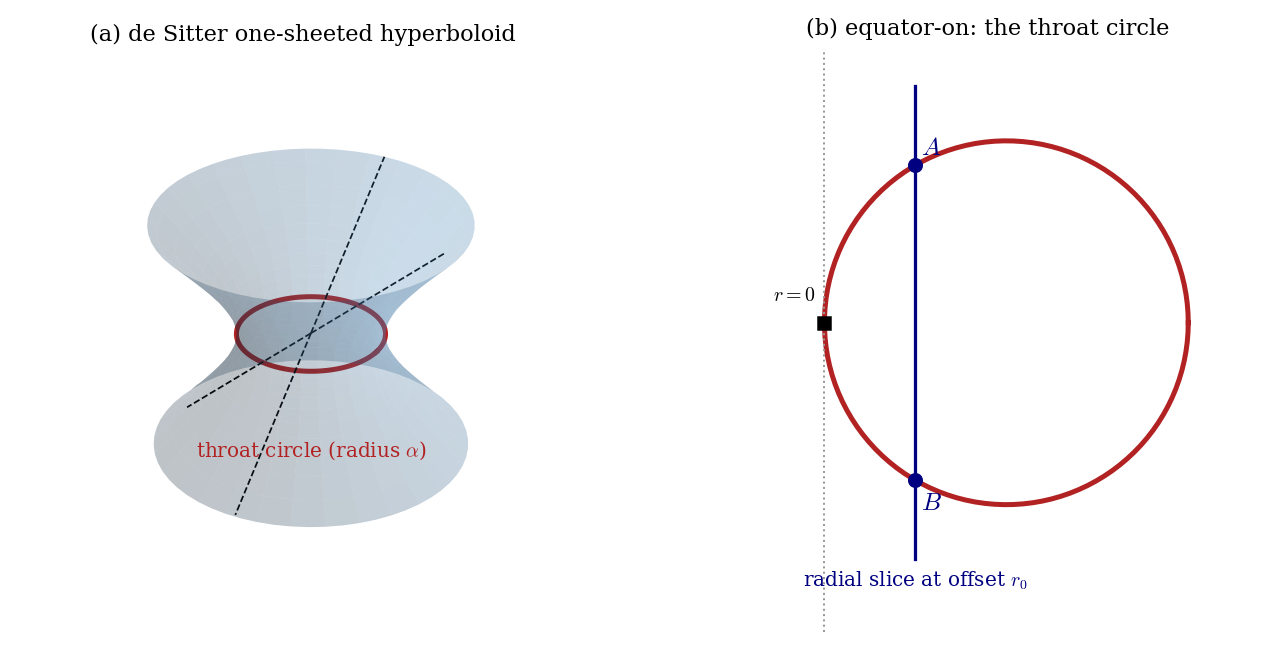
The cut itself is a single radial curve.
The curve is the graph of the radial coordinate against proper radial distance. Its defining feature is immediate from (2): dr/dl vanishes exactly where f(r)=0, that is, exactly at the horizons. The horizons are the turning points of the slicing curve. Proper distance l enters here only as the integration variable that traces the curve; it is a derived quantity, demoted from the spine of the construction to the closing remark of Section 10, for reasons that become visible at the Nariai configuration. The primary radial variable is r, signed (Section 7); the primary parametrisation of the family is the swing angle of Section 5.
Three parameters, and what each one flattens
Three distinct quantities run through the construction, and letting them blur is what breeds confusion about it. We declare them once, with the structure each one is blind to, and use all three deliberately.
The first is the throat angle u: position around the throat circle in the manifold, measured from r=0. It is a genuine geometric angle on a real circle of the geometry; a point of the unit throat circle at angle u has chart coordinates ( sin u,- cos u). The second is the sky angle w: the angular coordinate, on the charting observer's celestial sphere, of the line of sight relative to the centre of the hole's image (Section 5). It too is a genuine angle, but on a different surface—the sphere of directions at the observer's eye—and the gnomonic projection relates the two nonlinearly, sin u=2/√3 sin w. The third is the signed areal radius r0: the areal value the slicing plane reads off at the designated seam, r0=2/√3 sin w along the real swing.
Each parameter flattens a different structure, and that is exactly why all three are needed. The throat angle u is tied to one circle, so it is blind to which member of the family is in play and carries both harmonics of the horizon relation. The sky angle w collapses the family's three-fold structure into the single sin 3w of the triple-angle relation, but in doing so folds the root-exchange involution σ (the reflection w↔π/3-w) from view as a mere reflection. The signed radius r0 is one number per seam, so it is blind to where on the conjugate lap one stands. Read together—the angle on the circle, the angle on the sky, the signed radius on the cut—they recover what each alone hides.
The horizon structure, read in r0
A horizon is a zero of the metric function f. Clearing the denominator, in the gauge α=1, gives the horizon cubic, and the turning-point structure of the slicing curve is read directly from it.
And the degeneracy stops there for every mass, which makes the classification complete rather than localL4. A triple root of r3-r+2M would force the fixed linear coefficient to vanish—three equal roots a give -3a2=-1 against a coefficient that is -1 by construction—so no mass reaches it. The turning points of this family are therefore simple or double and never worse, and the companion's finding that the collapse critical point is a fold rather than a sharper degeneracy is a statement about the whole family and not about one member [JanzenCircle].
The proposition's own formula says what kind of system this is, and the potential it names was written down in the original derivation [JanzenThesis, Eqs. (4.24), Fig. 4.3]: there f is the scale-invariant effective potential Veff for a test particle, with (dr/dτ)2=γ2-Veff at vanishing angular momentum. Writing V(r)=-|f(r)|/2, the slicing law (dr/dl)2=|f| is 12(dr/dl)2+V(r)=0 and the second derivative above is -dV/dr exactly. So the slicing curve is the zero-energy orbit of a one-dimensional conservative system, the horizon cubic is its turning-point condition V=E, and Nariai is the case where a turning point coincides with an equilibrium: there f has a double root, so V and V' vanish together and V has a maximum at the orbit's own energy. That is why the degeneracy costs infinite affine parameter—near an unstable equilibrium |f|≃3(r-rN)2, so ∫dr/√|f| diverges logarithmically and the merged horizon is approached and never reachedL14. And the vanishing surface gravity is the same statement: κ=f'(rh)/2 is -V'(rh), so κ=0 at Nariai is the equilibrium condition, not a separate coincidence.
This is the precise sense in which the horizons are turning points: the companion paper found the Schwarzschild horizon and singularity to be two non-degenerate critical points of the cycloid; Proposition 1 generalises that statement to the SdS family, with the cubic (3) their defining equation.
Factorisation with a root as parameter
The construction becomes transparent the moment the slicing parameter is taken to be one of those roots. Write 2M=r0-r03, which says exactly that r0 is a root of (3).
The discriminant of the quadratic factor, 4-3r02, is the whole regime structure, read off r0 and nothing else. It is positive for |r0| lt;2/√3 (three distinct real roots, the undercritical regime), zero at |r0|=2/√3 (a double root, Nariai), and negative for |r0| gt;2/√3 (one real root and a complex-conjugate pair, the overcritical regime, Section 7); the special value r0=1/√3 makes r0 itself coincide with rB, the Nariai case where two horizons merge. That quantity is the quadratic factor's discriminant in r0, and it is worth distinguishing from the cubic's own, which is the root system's: substituting 2M=r0-r03 gives disc(r3-r+2M)=(4-3r02)(3r02-1)2, so the two differ by an exact square and their zero sets are not the same. The squared factor is where the distinction earns its keep: 4-3r02 vanishes at r0=±2/√3, where the quadratic factor's own two roots collide, while the cubic's discriminant vanishes there and at r0=±1/√3, where the designated root r0 collides with rB instead. All four are Nariai—each carries |2M|=2/(3√3) exactly and each leaves the cubic with a repeated root—so they are the four r0-designations of the two Nariai configurations, and 4-3r02 sees only two of them. Which discriminant is meant therefore has to be said, not because one set of zeros is not Nariai but because the slicing parameter's own discriminant misses half the designations at which it is reached. Restoring α, the cubic's elementary symmetric functions are e1=0, e2=-α2 and e3=-2Mα2: e1=0 is the tracelessness that puts the roots in the Cartan at all, and the other two are the A2 Weyl group's two basic invariants, of degrees two and three—the degrees of su(3)'s two CasimirsL18. So the slicing's two parameters are not two numbers the construction happens to carry but the complete invariant content of the A2 it already realises; and since that discriminant, -4e23-27e32, is the Weyl invariant vanishing where two roots collide, Nariai is the wall of the Weyl chamber and the undercritical dial its interior. This is the point of reading in r0: the three regimes are fixed by a single algebraic quantity, with no appeal to a proper distance diverging and no “two limits of one object.” Nariai is not a pathology reached by something blowing up; it is the value of r0 at which the discriminant vanishes. The three roots sum to zero, so they cannot share a sign: in the undercritical regime they are two of one sign and one of the other. For 2M gt;0 the cubic has two positive roots and one negative; for 2M lt;0, one positive and two negative; the negative-root horizon of the first case is the backward-radial root carried by the major axis of the locus ellipse (Section 4).
The reading-swap as a symmetry of the line element
The reading-swap is not confined to r0=0. It is, for every slicing parameter, a symmetry of the line element itself.
The reading-swap is therefore a genuine symmetry of the SdS line element, not a coincidence at one point: the involution exchanges which root is designated the mass-horizon while leaving the geometry strictly unchanged. The two readings are two designations within one line element—and they separate into the two named geometries, de Sitter and Schwarzschild, only as the two causal vantages at the throat (Section 5), the throat radius α left fixed throughout. A second partition of the same triple runs alongside the designation, and the two are neither independent nor identical.P3R1 From the factorisation above the designated root is r0 and the pair is (-r0±√4-3r02)/2, whose product is r02-1; so the pair members share a sign—and the designation split therefore coincides with the split by sign of the roots—exactly when |r0| gt;1, and differ otherwise. The discriminating quantity is the offset and not the mass, and the boundary |r0|=1 is the M=0 member, the de Sitter one. At Nariai the two do not merely differ: the designated root there merges with a pair member, so the designation split loses its content while the sign split stays sharp. Two structures that fail in different places are not two readings of one structure, which is the reason for stating the relation rather than leaving the two partitions side by side. Reading this symmetry in r0 is what exhibits it as a literal symmetry of the line element; reading it in the sky angle (Section 5) folds it from view as a mere reflection.
The involution
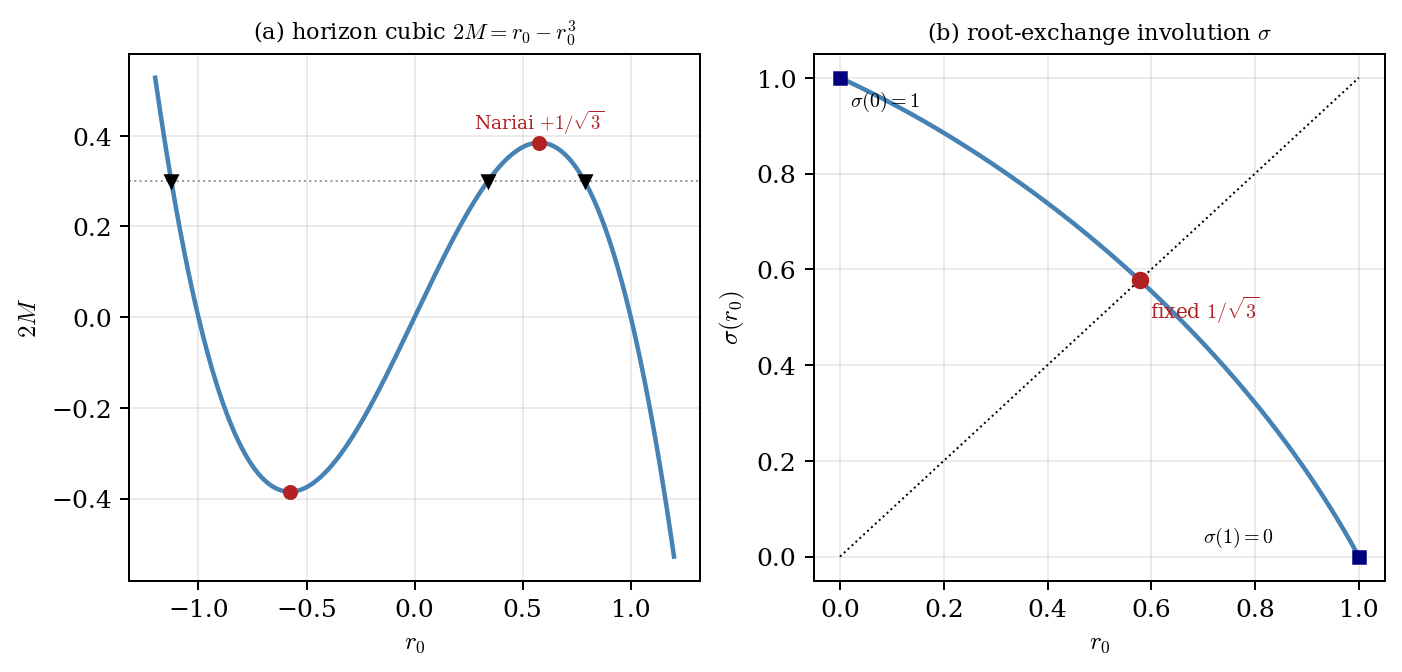
The horizon locus: a line and a tilted ellipse
Taken over all values of the slicing parameter at once, the horizon triplet traces a definite locus in the (r0,r)-plane.
The line r=r0 is the trivial root—the slicing parameter is always itself a horizon—and the ellipse carries the other two (Figure 3). The anti-diagonal is the geometrically meaningful axis: the ellipse is symmetric under (r0,r)↦(-r0,-r), the reflection through the origin which is the exchange r→-r, the backward radial direction—the radial coordinate run in the negative sense, the long way from r=0. The negative root of the horizon cubic, which appears whenever the other two roots are positive, is not a bookkeeping artefact and not unphysical: it is the horizon reached in the backward radial direction. The companion paper already carried this, the continuation z↦π+iρ' at the conjugate critical point of the cycloid producing the back-seam continuation onto r lt;0; the major axis of the tilted ellipse is the locus of that backward direction. The reflection (r0,r)↦(r,r0) across the diagonal, by contrast, is the relabelling of which root is called the parameter—the root-exchange involution of Proposition 5 seen in the plane.
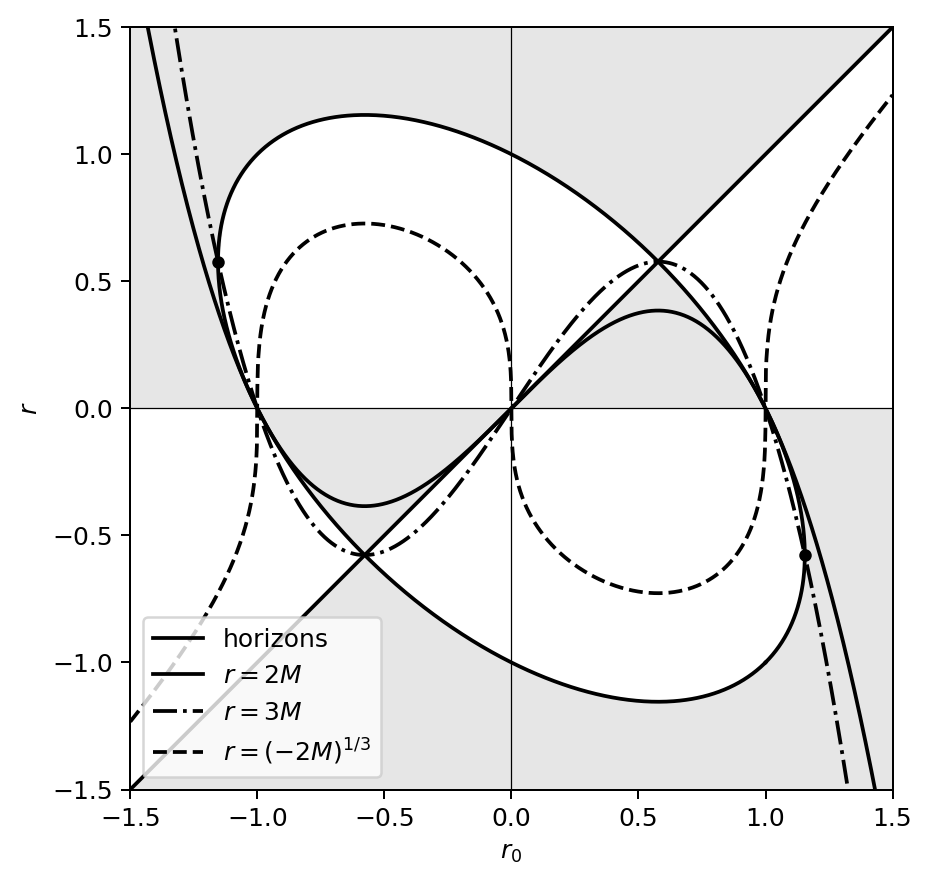
The Nariai configurations are the vertical-tangent points of the ellipse, at r0=±2/√3 with r= 1/√3: there two horizons of the triplet merge. For |r0| lt;2/√3 the vertical line at r0 meets the ellipse in two real points and the locus in three real horizons; for |r0| gt;2/√3 it misses the ellipse and only the diagonal root is real. The single threshold |r0|=2/√3, equivalently |2M|=2/(3√3), is the undercritical/overcritical boundary, treated in Section 7.
The ellipse carries, beyond its three roots, two distinguished points of its own: its fociP3R19L19. With semi-axes √2 and √2/3 the focal distance is c=√a2-b2=√2-2/3=2/√3, so the foci lie on the backward-radial major axis at the value 2/√3—the Nariai offset, the extreme r0 of the ellipse, which is the lone backward-radial root the closed slicing runs out onto and closes on (Section 7). This is not a coincidence of the number. The axis ratio is a/b=√3—the equilateral signature carried by the unit cross-term—and for that ratio alone the focal distance √a2-b2 equals the r0-half-width √(a2+b2)/2, which is the Nariai offset; so the metric foci of the horizon locus and the root the curve closes on stand at one scale, the forced 2/√3=2α/√3=2/√Λ, twice the merged-pair radius α/√3. In the sky angle (Section 5) the foci fall at w=π/4, the exact bisector of the Nariai crest w=π/6 and the throat-tangent extreme w=π/3 at which the rulings touch—all three carried on the one gnomonic sweep r0= 2√3 sin w. One qualification belongs with the word “metric”, and it protects the reading rather than weakening it.P3R20 A focus is not a projective invariant of a conic: it is defined against a metric, and the metric used here is the (r,r0) chart's Euclidean one, the two axes at equal scale and at right angles. Read instead with the A2 form itself as the metric, the locus Q=1 is by definition that form's unit sphere—a circle, of eccentricity zero, whose foci coincide at the centre. That the two readings genuinely differ is visible in the Weyl action: the three-cycle (r1,r2)↦(r2,-r1-r2) preserves the form and is not orthogonal in the chart, so the locus is Weyl-invariant as a set while the Weyl action is not by chart-rotations. What is chart-dependent is that the consequence presents itself as a pair of points; the number is not. The focal distance is √a2-b2 with the axis ratio fixed at √3 by the unit cross-term, so 2/√3 is a consequence of the form and stands however the locus is drawn—which is why the statement made here is a statement about one scale carrying several structures, and not an identification of the foci with any object of the embedding.
The family in w, and the two readings at the throat
The slicing plane swings about the hinge (Section 2), and the swing angle w is the family parameter—the same angle the gnomonic projection below reads as the observer's sky angle. At each w gt;0 the cut takes three horizons: the cosmological horizon, the black-hole horizon standing above r=0, and r=0 itself fixed at the back of the circle. The mass is nonzero and is the slicing-dependent factor, 2M=α[(r0/α)-(r0/α)3], with α=√3/Λ the one fixed invariant—never a free parameter, never reached by a limit (Section 8).
The projection is the observer's celestial sphere
It remains to say where the offset r0 comes from. It is not a free parameter dialled by hand; it is fixed by what an observer in the manifold can actually see, and the act of fixing it is the symmetry breaking itself.
Consider an observer in the exterior, at finite distance from the hole. The hole has exact rotational symmetry about its own centre; the observer, sitting at one point of the exterior, does not share that symmetry—they are at a definite radius from the centre, along a definite direction. There are then two distinct radial lines in play, and they must not be conflated. One is the hole-radial: the line from the centre of the hole to the observer, the line the hole's own symmetry would single out. The other is the observer's line of sight: the direction the observer takes to be straight ahead.
The observer cannot see the hole's centre. What an observer in the manifold has is the image of the hole on their celestial sphere—the unit sphere of directions at their eye. The hole's outline is a small circle of some angular radius on that sphere; the observer cannot see around it or locate its true centre by inspection; the sky image is all they have. The observer fixes their frame on what they can see: they place the centre of their field of view—their reticle—on the sky image. If they place it on the image's apparent centre, the line of sight coincides with the hole-radial and there is no offset. But there is no reason the reticle should land there: the apparent centre of a projected image is not a marked point, and any other choice places the reticle off-centre. The moment the reticle sits off the image's centre, the line of sight and the hole-radial part company.
This is the symmetry breaking, located precisely. The manifold's one broken symmetry is the hole. An observer who takes the hole as reference is then forced to break a further symmetry—not by choice, but because their reference is a sky image and the reticle on it is off-centre. Two roles are in play here and will be separated sharply in Section 9: the manifold observer, whose physical position in the exterior fixes the offset r0 as an intrinsic feature of the slicing curve, and the charting observer, whose celestial-sphere image merely displays that offset. Moving the charting observer changes the image, never r0.
The chart is not a flat Cartesian plane: the hole's image lives on the curved celestial sphere, and to obtain a planar chart the sphere must be projected. The projection is forced—not chosen—by the construction, and it is the gnomonic projection [Snyder1987].
Place the observer in the equatorial plane at distance robs from the hole's centre, with the throat circle of unit radius (gauge α=1). The throat subtends true angular radius θ= (1/robs) on the observer's celestial sphere—the tangent half-angle of the unit throat at distance robs—with gnomonic image radius tan θ=1/√robs2-1. A line of sight at sky-angle w from the image-centre meets the throat's image at offset
the image radius 2/√3 times the sine of the genuine sky angle. This image radius is not an observer's free choice: it is forced to 2/√3 by the requirement that the horizon relation linearise to the pure triple-angle (Proposition 8), the unique scale that removes the residual harmonic. The charting distance realising it is robs=√7/2 (where 1/√robs2-1=2/√3); but the scale is set by the triple-angle, not by placing an observer, and any other charting distance only rescales w without touching the geometry—though not without cost to the form: the residual sin w harmonic that Proposition 8 removes returns at every other valueP3R30, so robs=√7/2 is the distance at which the family's own harmonic structure is legible rather than a place an observer happens to stand.
The sky angle, the triple-angle, and the conjugacy
Let w be the sky angle of (11). By (11) the slicing line meets the throat's gnomonic image at offset
an exact geometric identification: w is a genuine angle on the celestial sphere, and r0 is the throat-image radius 2/√3 times its sine. The chart range r0∈[0,1] is w∈[0,π/3], the throat-tangent extreme r0=1 being w=π/3.
This is why a cubic appears, and why the sky angle is its natural coordinate: the cubic r0-r03 is the cubic in sin w that the triple-angle identity collapses to sin 3w, and the slicing scale 2/√3 is the one scale removing the residual harmonic. The three roots of the horizon cubic are the three preimages w,π/3-w,-π/3-w of 3w under the sine. The involution (8) is, in the sky angle, the reflection w↔π/3-w, a symmetry of sin 3w because sin (3(π/3-w))= sin (π-3w)= sin 3w; its fixed point w=π/6 is the crest of sin 3w, which is why Nariai is a double root. A further shift makes the cyclic structure explicit: since sin 3w is unchanged under w↦w+2π/3, three sky angles 120∘ apart carry the same mass while cycling which root is the designated offset through all three—the cyclic Z3 within S3, σ (the π/3-reflection) supplying the transposition. These are three 120∘-separated hinged vantages of the one sliced substrate, each designating one root: the monodromy three-fold read as three readings of the one geometry (its group-theoretic form in [JanzenGroupoid]). Read on a fermion sector this three-fold is a within-state index rather than a family symmetry—forced to three by the single triple-angle at the gnomonic-fixed scale, not fitted, the three hinged vantages an S3—the generations' own threeness being the turnaround's deck Z3, and the wall structure fixing the number of chiral generations at either seat on the matter sector [JanzenMatter], forced within CR; the continuous SU(3) that shares the root system, not an isometry of the Lorentzian substrate, is placed on its conjugate real form (S5= SO(6)/ SO(5)) in the boundary and geometric-core papers, with only its identification as the physical colour left open [JanzenBoundary, JanzenGeometricCore].
The throat also carries a second, distinct geometric angle. Let u be the angle around the throat circle in the manifold, measured from r=0; a point of the unit throat circle at angle u has chart coordinates ( sin u,- cos u), and the slicing line meets the circle where sin u=r0. Thus
u and w are two genuine geometric angles—u on the throat circle in the manifold, w on the observer's celestial sphere—related by the gnomonic projection (14), a nonlinear, not a proportional, map. The horizon relation is the clean triple-angle (13) in w; in the throat angle u the same relation reads 2M= sin u cos2u= 14( sin u+ sin 3u), carrying both harmonics.
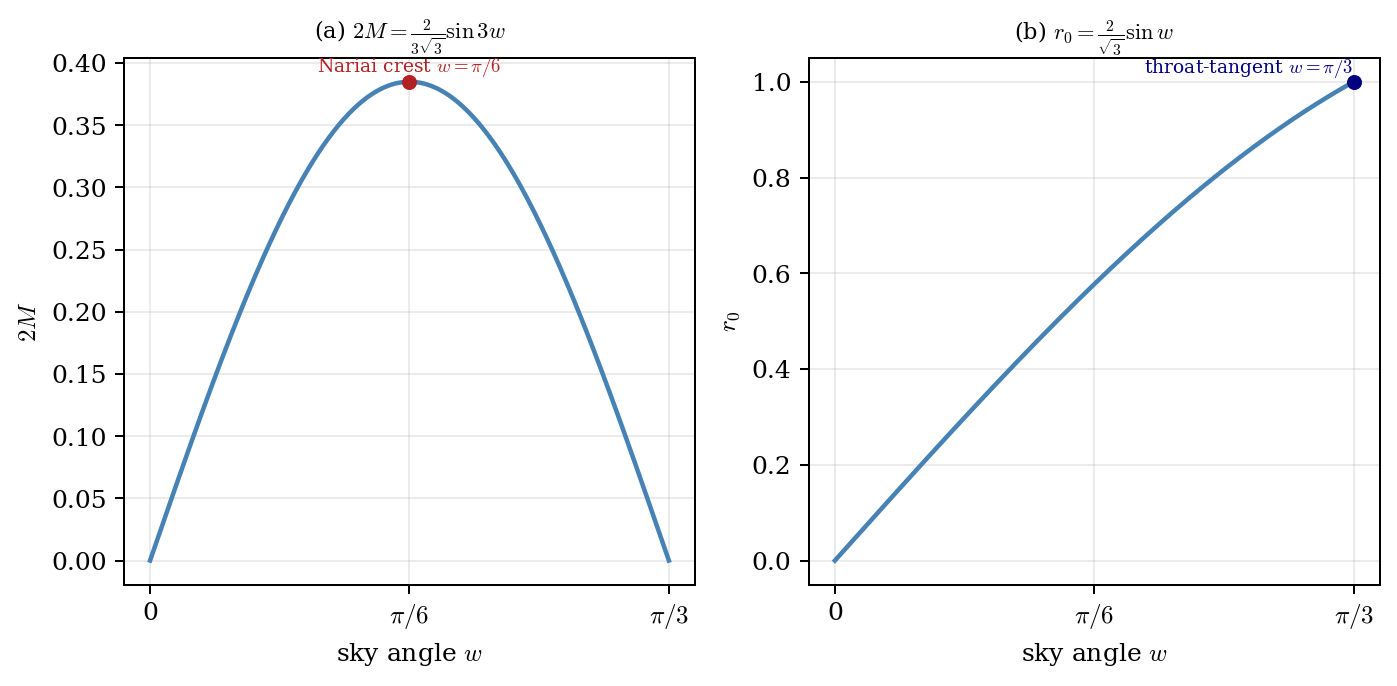
The throat circle carries a natural involution of its own: the reflection g1(x)=√1-x2 exchanging the two parities of a chart point, which in the throat angle is u↔π/2-u. The cubic involution σ is the reflection w↔π/3-w of the sky angle. Each is a genuine reflection of a genuine geometric angle, and the two are one involution in two coordinates.
The conjugacy is an exact trigonometric identity, not a numerical coincidence: the collapse 4-3χ2=4 cos2(2a/3) that makes it closed is itself a consequence of the forced slicing scale 2/√3. The construction carries a single involution presented two ways—the throat-circle reflection g1 and the cubic root-exchange σ—and χ is the exact map between them, the natural entry point for the group-theoretic treatment of the companion groupoid paper [JanzenGroupoid].
The two readings at the throat
Now swing the plane down toward w=0. The black-hole horizon shrinks until it merges into r=0 at the back; the cosmological horizon swings to the polar-opposite point and becomes the horizon, with 0 lt;r lt;2M wrapping the half-equator and the exterior opening out beyond it. The slicing mass has gone to zero—the black hole has shrunk away—and the cut is now one curve: the equator taken diametrically, which is exactly the companion paper's Schwarzschild curve, the meridian-hyperbola →\,equatorial-circle →\,meridian-hyperbola of the maximal analytic extension, r=M(1+ cos z) continued through both critical points.
This single w=0 curve carries two readings, and the map between them is the backward-radial vantage-swap—this is the de Sitter ↔\,Schwarzschild correspondence, exact, at fixed α, and it is neither a limit nor a mass relabelled to zero. Read from the pivot's perspective—the natural reading as the hinge settles to w=0, the curve seen from the swing-pivot looking down—it is Schwarzschild: the 2M/r term carried perspectivally (the companion paper's reading), the horizon and r=0 the two metric singularities of one genus, the curvature at r=0 belonging to the perspectival metric over r and not to the underlying manifold. Rotate the vantage through 180∘—look from the uphill side, the worldline staring straight up the r=0 axis—and the same curve is de Sitter: f=1-r2/α2, the cosmological geometry, r=0 now the axis rather than a mass-laden centre. One curve, one fixed α, two vantages the involution swaps. The underlying invariant geometry is de Sitter; the Schwarzschild mass is the perspectival reading's, carried by the vantage, not a second invariant. This vantage-swap is the mass-reflection R, the backward-radial reflection through the r=0 branch point; the groupoid paper [JanzenGroupoid] identifies it as the A2 diagram automorphism—the outer Z2 of the solution space's discrete symmetry Aut(A2)=D6—with the de Sitter geometry 1-r2/α2 and the Schwarzschild mass -2M/r its even and odd parts under the reflection.
We state plainly two routes the construction does not take, because each reaches this same throat in a way that breaks the construction. First, Schwarzschild is not the α→∞ limit: α is the fixed invariant the whole construction lives inside, and sending it to infinity dismantles the throat, the circle, and the family in one stroke; the correspondence is reached by swinging the hinge to w=0 at fixed α and reading the curve from the pivot, not by deforming the geometry. Second, r0=0 is not a “massless Schwarzschild.” A massless Schwarzschild is a contradiction in terms: Schwarzschild is the geometry with a mass and the cosmological term off, and M=0 with the cosmological term on is de Sitter, by definition. Proposition 3 is right that r0=0 carries two readings of one slicing—that is precisely the involution—but the Schwarzschild side is not a massless limit. The slicing mass is zero there because the underlying geometry is de Sitter; the Schwarzschild reading is the pivot-vantage of that same curve, its mass perspectival, α untouched.
Past the Nariai crest the same curve continues overcritically, by the same analytic continuation that joins the seam: sin θ→ cosh ψ, equivalently θ→π/2+iψ on the horizon angle, 3w=π/2+iβ. This is not a separate relation and not a redefinition of w; its geometry is Section 7.
Adding charge: mass is R-odd, charge R-even
Reading the eigenspace split of Section 5 on the charged cut settles, at the geometric level, where charge sitsP3R17 in the construction's one discrete symmetry. The Reissner–Nordström–de Sitter slicing function is
the charge entering, like the mass, on the matter side—a bend of the cut, m(r)=M-Q2/2r, sourced by the Maxwell field Ar=-(Q/r) dt and not a substrate datum [JanzenRange]. Under the mass-reflection R (2M↦-2M, flipping the geometry to the conjugate branch; Section 4) it splits as
so the charge term joins the de Sitter geometry on the even side while the mass remains the odd part the swap reverses. This is a sharp statement about charge, not a formal one. The reading-swap is precisely what exposes the Schwarzschild mass as perspectival—the R-odd content the vantage carries, a turning point and not a coefficient (Section 8)—and it leaves the charge fixed: Q2/r2 is reading-swap-neutral, the swap that reverses the mass touching it not at all. Charge is therefore the R-even matter datum and mass the R-odd one—both bends of the cut, but of opposite parity under the discrete symmetry the slicing owns, the charge sharing the parity of the invariant geometry while the mass shares that of the perspectival vantage. That the mass parameter itself is the odd one, 2M=α ((r0/α)-(r0/α)3) flipping under r0↦-r0 (Section 8), is the sky-angle face of the same fact; the charge, an independent parameter the reticle offset does not carry, is untouched by the swap.
Charge conjugation is then geometrically transparent. The slicing function depends on the charge only through Q2, so Q↦-Q leaves f—and with it the whole slicing curve and every one of its turning points—identical: the two signs of charge trace the one curve, the sign living entirely in the Maxwell potential A (linear in Q), off the curve. Charge conjugation is thus present on the slicing geometry only as this even Q↦-Q degeneracy—the geometric face of its being field-level—while the full charge conjugation C is antilinear, no geometric reflection at all, and closes from the matter field. And because it is a symmetry of the charge and not of the mass roots the A2 system realises—Q absent from the horizon cubic, so Q↦-Q fixes every root—it adjoins an independent Z2 to the solution space's Aut(A2)=D6 rather than sitting within it: the outer Z2 of D6 is the mass-reflection R, not charge conjugation. This is the geometric ledger of the boundary paper's second boundary [JanzenBoundary]. The boundary paper carries it one step further: composed with the antilinear reality involution τ↦ τ of the vacuum cosmogenetic bead, the mass-reflection R supplies charge conjugation's geometric kinematic (Feynman–Stückelberg) face, so that C factorises with only the charge sign closing from the field—and the eigenspace split above is the linear (R) root of that positive closure [JanzenBoundary, JanzenMatter].
The scope is exact, and worth marking as elsewhere in the construction. The parity result holds on f and its turning-point structure without remainder: the charged horizon relation -r4/α2+r2-2Mr+Q2=0 carries Q only as +Q2, so the charge shifts the turning points R-evenly and Q↦-Q fixes each. What the charge does not leave intact is the r=0 lap on which the vacuum slicing closes (Section 7): with Q≠0 the term Q2/r2 dominates as r→0, so f→+∞ rather than -∞, an inner (Cauchy) turning point appears, and r=0 becomes a timelike Reissner–Nordström singularity rather than the branch point through which the signed radius passes onto the conjugate branch. The charged closed loop is therefore a genuine extension—the electromagnetic case this paper's closing section names and does not build. One thing about that extension is settled without building it, and it bounds what the extension can be asked: the charged shells admit data only up to a threshold in Q2, beyond which the radial equation's turning-point quadratic has no real root at all. Its leading coefficient is negative, so no real root means it never changes sign and (dR/dτ)2 lt;0 at every radius rather than merely at small ones. So beyond that threshold no shell exists with that data, and there is no motion for the lap to do—the boundary is one of admissible initial data and not a third behaviour of the motion. And it sits at over-extremality, the charge-to-mass ratio reaching unity to four figures because the matter terms are negligible against M2 there; the indicator contains no dynamical variable, so no shell crosses the boundary during the lap eitherP3R71—whereas the discrete-symmetry reading of charge, mass R-odd and charge R-even with C its field-level closure, is established here at the level of the slicing function, where it is exact.
The angular tour: the family's discrete skeleton and the hinge geometry
Read across the full swing w∈[0,2π), the family visits three geometries under twelve designations, one every 30∘. With 2M=2/3√3 sin 3w and r0=2/√3 sin w, the mass vanishes (2M=0, de Sitter) at w=0,60,120,180,240,300∘, and reaches its Nariai extremes 2M=±2/3√3 (the double roots, κ=0) at the intervening w=30,90,…,330∘; between the marks the cut is undercritical, three distinct real horizons. Because |2M|≤2/3√3 on the real dial, the swing never leaves the undercritical interior except to touch its Nariai boundary. Read as rangefinding, the 30∘ is not a coincidence of the trigonometry but the hole's own angular size: the hinge stands at 2α and the throat has radius α, so the hole subtends (α/2α)=30∘ there. A sightline within 30∘ of the axis cuts the throat, one at 30∘ grazes it, and one beyond misses. So the dial's endpoint is the grazing sightline, and Nariai is the hole's limb—the extreme of the swing and the edge of the aperture being one angle read two waysL1. And the trichotomy the dial runs through is the conic trichotomy of that same sightline. Take the slicing plane at transverse distance d from the axis and cut the substrate -x02+|X|2=α2 with it. For d gt;α the section is a two-sheeted hyperbola whose vertex stands at height √d2-α2—and at the dial's end, d=2α, that vertex is √3 α, which is the hinge: the hinge is the vertex of the extreme sightline. For d lt;α the plane cuts the throat and the corresponding point is the secant's midpoint instead. And at d=α the section degenerates into two straight lines, and those lines are null—x0=±y, so ds2=-dx02+dy2=0—so the cut at Nariai is the substrate's two rulings. Miss, touch and cut are therefore two-sheeted hyperbola, two null rulings, and two horizons: one locus, one turning plane, and the same three outcomes the horizon cubic givesL1. What follows: the strict overcritical regime is reached by no real swing, but only by the imaginary continuation past a crest (Section 7).
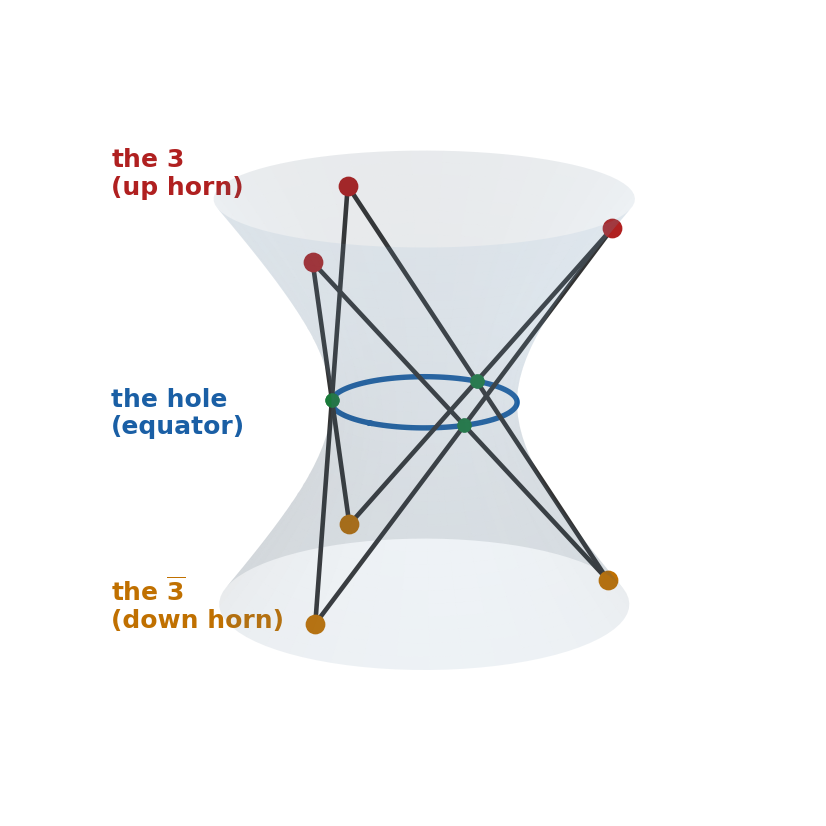
The six Nariai marks are the A2 hexad. The three at 2M=+2/3√3 (w=30,150,270∘) carry the root triple (-2,1,1)/√3, whose directions are those of a fundamental 3's weights taken at root normalisation—the triple has |v|2=2, the root length, against the weights' own 2/3, the two hexagons differing by a rotation of 30∘ and a factor of √3L18; the three at 2M=-2/3√3 (w=90,210,330∘) carry its negation (2,-1,-1)/√3, the antifundamental 3; and the parity R:2M↦-2M (equivalently r0↦-r0) exchanges them.Corpus convention: R denotes this orientation/mass-reflection parity—the A2 diagram automorphism, the orientation-reversing element O(5,1)∖SO0(5,1), realised on a cut spinor as γ5 in the matter-sector papers [JanzenGroupoid, JanzenBoundary]. It is not the areal spatial parity r↦-r (Clifford generator γ1γ2γ3, which anticommutes with γ5), for which the corpus reserves “P”; that spatial parity does not appear in this paper. The time reflection X0↦-X0 is T throughout.} The full automorphism group Aut(A2)=S3×Z2≅D6 acts on the dial as the symmetry of a regular hexagon—the rotation w↦w+60∘ (order six, 2M↦-2M) and the reflection w↦-w—with the six Nariai its vertices and fundamental domain [0,30∘]; its group-theoretic form is obtained in the groupoid paper [JanzenGroupoid]. Read as A2's own chamber structure the three counts on the dial are one fact rather than three: the discriminant vanishes exactly at the six marks, so those are the wall-crossings; the six arcs between them are the six Weyl chambers, |W(A2)|=|S3|=6; and the twelve designations are | Aut(A2)|=12, two to an arc. The sign of 2M is then the chamber's own Z2 label, which is why R is the diagram automorphism exchanging 3 and 3 rather than merely analogous to one.
The hinge geometry
Why there are three. The number is not put in by hand, and it is fixed before any of the geometry below is drawn. The horizon cubic of Section 4 has three roots, and a vantage is fixed by which of them it reads as its own black-hole horizon—the remaining two being read as the cosmological horizon and its backward-radial partner. Since the three roots are on the same footing, so are the vantages that designate them, and there are exactly as many of the latter as of the former: three. The root-exchange involution σ of Section 4 is then the step from one vantage to a neighbour, and the group permuting the roots is the group relating the vantages (Section 6). Their placement follows from the same footing: three vantages symmetric under that permutation and equidistant from the axis stand at the vertices of an equilateral triangle, 120∘ apart. So the count and the spacing come from the cubic, and the distance is what the next paragraph derives.
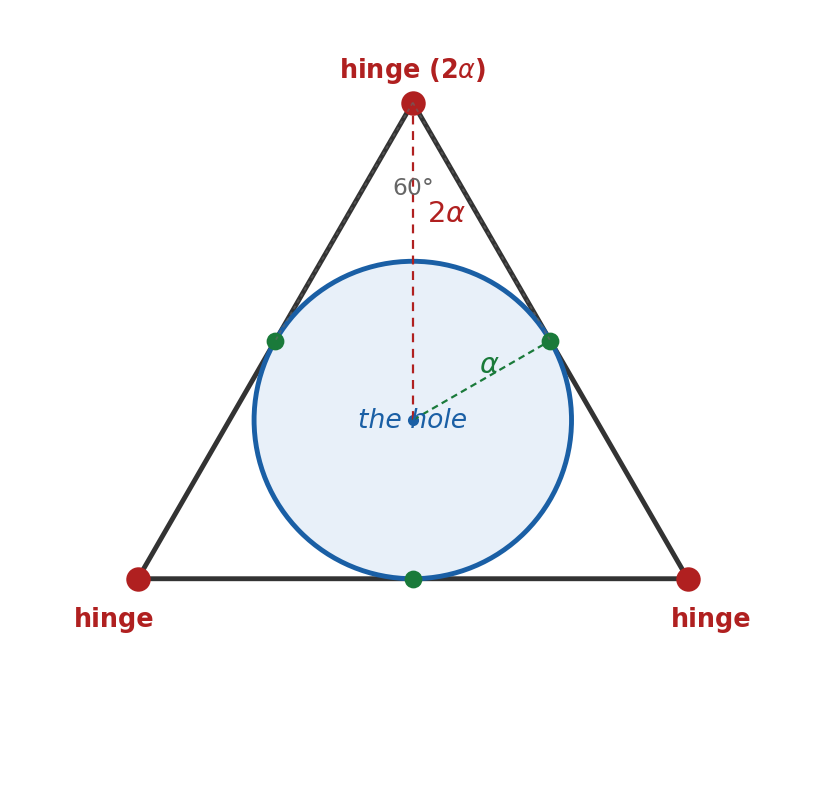
The swing-pivot of Section 2—the hinge—sits at transverse distance 2α from the hole's axis, the vantage from which the throat subtends exactly 60∘ (angular radius 12=30∘). The three hinges therefore form an equilateral triangle of circumradius 2α whose incircle, of radius α, is the throat itself: the hole is the incircle of the hinge triangle (Figure 5). Its three sides are not imposed but found—each is a null generator of the doubly-ruled substrate (Section 2), tangent to the throat at its midpoint.
The distance 2α is not chosen. Stated as above the hinge's placement reads as a stipulation, and it is not one: it is the only distance the hole itself names, and every other number in the figure follows from it.P3R6 Ask where a hinge could go. The construction has one input, the hole—a circle of radius α about the axis—and α is not a number but the gauge. The one circle the hole determines without further choice is the circle on its own edge through its own centre: centre (α,0), radius α, the hole translated onto its edge. That circle ends at 2α, and the hinge is its far end. So 2α is an output. The one input is the whole of it: what this paper reads off that circle—the hinge's placement, the 60∘ subtense, the incircle and nine-point relations, the tangency that returns Nariai, and the walls the signed radius sets on its rim—the geometric-core paper collects with the circle's other faces (its radius is the curvature; its tangents are the null rulings; the power of a point with respect to it is that point's height) as the seventh face of the substrate's maximal symmetry [JanzenGeometricCore].
- sep0pt
- R=2α;
- the throat subtends 60∘ at the hinge, i.e. (α/R)=30∘;
- the hinge triangle's sides are tangent to the throat at their midpoints—an equilateral triangle's inradius is half its circumradius, so midpoint-tangency holds iff R=2α;
- the nine-point circle of the hinge triangle is the throatP3R5L1—by Euler's theorem the nine-point radius is R/2 and its centre is the equilateral's own centre;
- the tangent length from the hinge to the throat equals the hinge's height in the embedding, both √3 α;
- writing s2 for the squared separation of two opposite-horn ends of a 120∘-separated triple of lines at transverse radius R, one has s2=4α2-R2, so R=2α is the unique transverse radius at which those pairs are nullP3R3.
The configuration's null relations are exhausted by the legs already listed. Item (vi) invites the question whether 2α is merely the first of several radii at which pairs go null, and it is not. Sweeping the causal character across the six overhead points at transverse radius 4α together with the six hinge-ends returns no null pair among the thirty-sixP3R41: the null relations the hinge triangle carries are the ones already named and there are no others. The set is null-inert without being causally inert, which is the more informative half—an overhead point above a hinge's own wall is spacelike from that hinge in both horns, while one above another's is horn-dependent. That is the own-wall relation of §6, read a second way and reached here without reference to it. The equivalences are verified in the receipts marked at each item and in the programme's figure-theorem ledgerL1, where the wider catalogue of classical theorems read on this figure is collected.
The placement then forces the Nariai configuration, by the triple angle and nothing else.P3R4 The subtended half-angle 30∘ is the sky angle w of Section 5, so sin w= 12, and the horizon relation 2M=2/3√3 sin 3w of Section 5 gives
its maximum. The tangent from the hinge is therefore the Nariai cut—not because two angles of 30∘ coincide, but because the identity peaks there of its own accord once the hole has placed the hinge. The chain from the single input runs
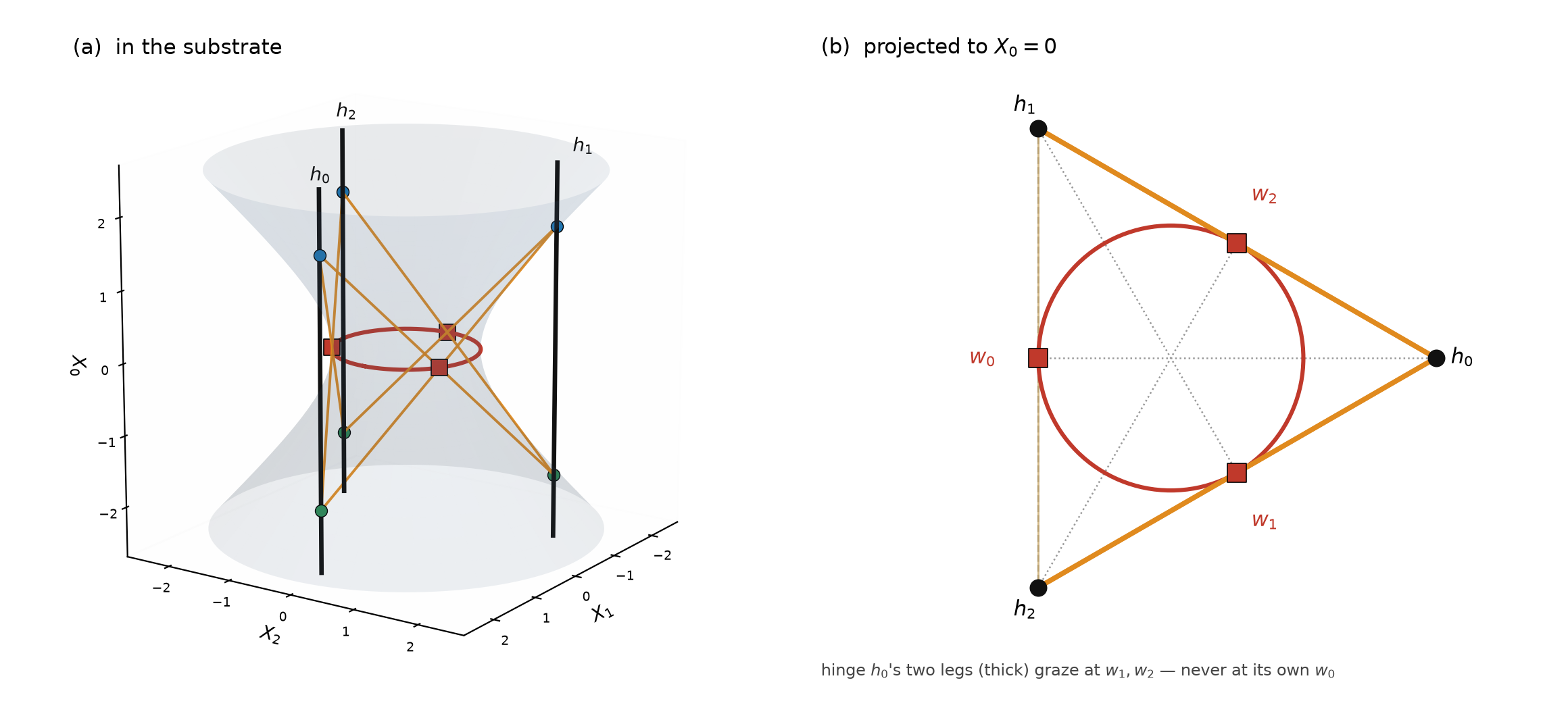
A word on what is being counted, since the construction's habitual phrase “the six hinges” names the piercings after the thing that makes them. The hinge is the line the door swings on (Section 2): a line parallel to the hole's axis at transverse radius 2α, which does not translate. There are three. Such a line is not contained in the substrate—its direction is timelike, so it is none of the substrate's null rulings—and it therefore pierces the hyperboloid rather than lying in it, once on each horn, at X0=±√3 α. The six points below are accordingly three hinges with two ends apiece, 3×2 and not 6 (Figure 6a), and the distinction is load-bearing twice over: it is why the construction has exactly one dial—the ambient planes containing a fixed line form a pencil, which is one-parameter, where a pivot that were a point would leave a two-parameter family—and it is what Remark 3 turns on.
Followed in the embedding rather than the equatorial projection, each such null ruling runs from a hinge's end on one horn, tangent to the equatorial throat, to the end of a different hinge on the opposite horn: the ruling through a throat point places the two ends it joins at transverse radius 2α and heights X0=±√3 α on the hyperboloid -X02+X12+X22=α2. The six hinge-ends—three upper (X0=+√3 α), three lower (X0=-√3 α)—close into a single skew hexagon of null rulingsL11—one hexagon and not two triangles, which is a statement about the null relation on the six ends and is verified by walking it: from any end the walk returns to its start after exactly six steps, visiting six distinct vertices,
The hexagon's own incidence structure is worth reading off, since it says why a hexagon is the only closed figure these rulings can make. Under the Klein correspondence a line of P3 becomes a point of a quadric and two lines meet exactly when their points are conjugate; carrying the six edges over, each meets three of the others—its two neighbours and its opposite—and the six split into two triples within which no two meetP3R29. That is the signature of the two ruling families: same family skew, opposite families meeting. So the alternation is forced, and with it the length: a closed circuit alternating between the families must have even length, and six is the least that visits all six hinge-ends. The three opposite-edge crossings then land at X0=0, on the throat itself, at the three points where the projected hinge triangle touches it—the midpoints of Proposition 10(iii), which the geometric-core paper independently identifies as the vertices of the figure's projective dual [JanzenGeometricCore]. One triple, and the faces it carries are worth listing in full rather than in part, since each was reached by a different route and no one of them mentions the others: the tangency points of the projection; the midpoints of the hinge triangle's sides (Proposition 10(iii)); the vertices of the dual figure [JanzenGeometricCore]; the crossings of the skew hexagon's opposite edges; the points at which the substrate's null generators through the punctures graze the throat; the loci at which the matter sector places its throat walls [JanzenMatter]; and the r=0 branch points through which the signed radius laps (§7).P3R46 Seven descriptions and one place. The last two are the ones that carry weight elsewhere in the programme, and the sweep places them at the same point as the first five.
These three hinges make the root-exchange involution σ (Section 4) physical. Each hinge designates one of the three horizon roots its swing produces as its own black-hole horizon; σ, which swaps which root is so designated, is the step to a neighbouring hinge—the vantage for which a point one hinge reads as cosmological is read as the black-hole horizon instead. A transposition of roots is a hop to a neighbour, the full three-cycle the tour around all three, and the Weyl group S3 that permutes the roots is thus not an abstract relabelling but the relation among the three vantages: reading the one geometry from the next hinge over. This is what the fermion sector reads: a spinor on the slicing structure binds one chiral zero-mode at each hinge's wall, one per vantage—identical in content, since every root returns the same 2M, and distinguished by which root each takes as its own hole, which is the same distinction as which wall each binds at [JanzenMatter]. What that three indexes is fixed in the sector that owns it: the matter paper reads these three vantages as a within-state index, not as the three generations, the generations' own threeness being carried by the turnaround's deck Z3—a three that paper proves affinely inequivalent to this one—while what the wall structure fixes is the number [JanzenMatter]. And both structures the substrate's discrete residue acts on are relations to the throat circle: the three roots are three special points on it—the offset line meets it at two, the third being r=0 fixed at the back (§6)—while the two null rulings are the lines tangent to it, tangency and nullity being one condition here [JanzenGeometricCore]. Since on and tangent are independent relations, the residue's two factors act on independent structures, which is why Aut(A2) is a direct product [JanzenAlgebroid]; and since a tangent is a line of the substrate while a root labels a different cut, they differ in kind, the reading stated on the sector where they become matter [JanzenMatter]. The mass-reflection parity R:r0↦-r0 (the A2 diagram automorphism), which carries 3 to 3, is geometrically a swap of the two null generators—distinct from the time reflection X0↦-X0 that exchanges the two horns, though both swap the rulings. The discrete symmetry of Section 4 and the observer-groupoid of Section 9 are the shadow this hinge relation throws.
That the maximally symmetric substrate carries this discrete A2 skeleton—the hexad, the 3⊕3, and its parity—is a structural fact of the construction. The bridge to matter this poses is built [JanzenMatter]: a propagating spinor on the slicing structure carries the parity R=γ5 as its chirality operator and realises the 3⊕3 as the fermion sector's content [JanzenMatter], so within CR the fundamental 3 the hinges designate is matter and the antifundamental 3=R(3) its antimatter, the two the substrate's one R-parity relates. What the geometry does not supply—on either side of that pair equally—is the charge structure, which is field-level [JanzenBoundary] (its reading-swap parity—charge R-even, joining the invariant geometry, C the field-level closure—worked out in Section 5); the parity supplies the discrete matter/antimatter skeleton, not the charge that closes C. Whether the continuous SU(3) whose fundamental and antifundamental share this abstract root system is the physical colour is the residual question: the geometric-isometry route to it is excluded (su(3)⊄ so(5,1)), but the boundary and geometric-core papers place that su(3) on the substrate's conjugate real form—the S5= SO(6)/ SO(5) the global Wick reaches—so what is left open is whether it is the physical colour, not its geometric home [JanzenBoundary, JanzenGeometricCore]; the discrete 3⊕3 matter/antimatter skeleton is not that question and does not wait on it.
The other three-ness, and where it differs on the inside
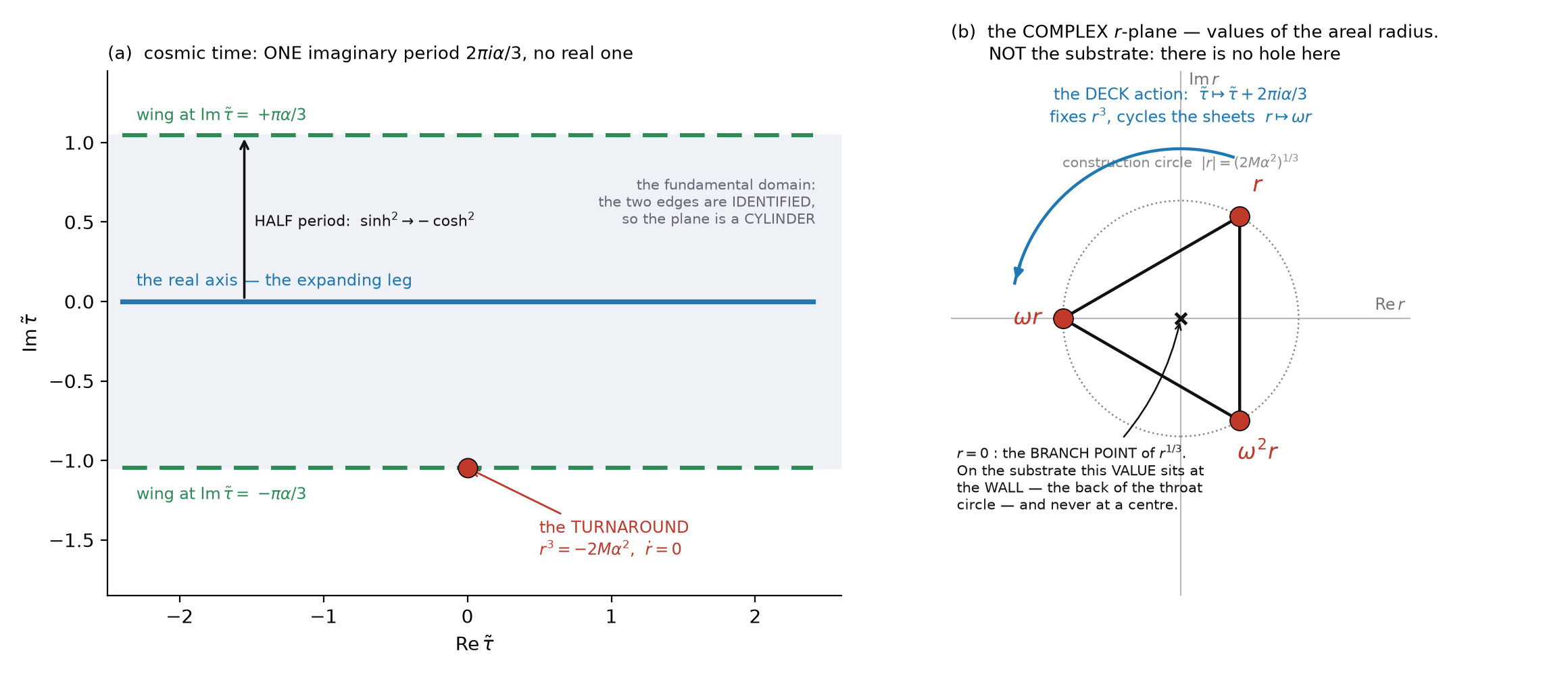
The hinges above are a spatial three-ness: three colinear-real horizon roots, permuted by S3, designated by the offset. The family's other cubic carries a three-ness too—the comoving turnaround of Figure 3, whose roots form an equilateral triangle—and the companion framework paper's lem:twoturnings establishes that no affine change of variable identifies the two root sets. That is a separating statement. What the turnaround's three-ness positively is can be said here, because it is read off the bead's outward law r3=2Mα2 sinh2(3 τ/2α) and this paper owns the geometry it lives in.
It is the deck action of cosmic time's own imaginary period (Figure 8). The shift τ↦ τ+2πiα/3 leaves r3 invariant and permutes the three cube-root sheets cyclically, r↦e2πi/3r: the turnaround cubic's Z3 and that period are one object.P3R11 The word period is exact and is worth holding to its exact sense, and holding it so answers a question the construction raises everywhere: why everything here closes in elementary terms. The period is a single one—sinh2 has the one period iπ in its argument, no real period, and none with both parts nonzero—so the quotient of the τ-plane by it is the cylinder C/⟨2πiα/3⟩≅C× and the law is a rational function of e3 τ/2αP3R33. That is the whole of it: a singly periodic meromorphic function is elementary, a doubly periodic one is elliptic, and no elementary closed form exists for the second. The same holds of the horizon side in its own variable, where sin 3w carries the single real period 2π/3 (§6) [JanzenGroupoid] and no imaginary one. Each of the construction's two three-nesses is one singly periodic elementary function composed with a three-fold—sinh2 with the cube root on the turnaround side, sin with the triple angle on the horizon side—and that, not any convenience of presentation, is why sinh2/3, sin 3w and the involution σ all admit closed forms where a doubly periodic structure would return elliptic functions in their place. The two periods moreover differ in kind as the two three-nesses do: 2πiα/3 is purely imaginary, along the clock; 2π/3 purely real, along the dial. So where the horizon triple is the slicing's spatial three-ness, this is the temporal one—not by analogy, but because its generator is a period of τ.
Two consequences follow, and the second is the sharper. First, the half of that period does definite work: τ↦ τ+iπα/3 carries sinh2↦- cosh2 exactly, turning the real expanding leg into the conjugate collapse law r=-(2Mα2)1/3 cosh2/3(3 Re τ/2α) on the negative branch. The two collapse wings at Im τ=±πα/3 are therefore not placed by choice; they are the half-period images of the real leg. And that placement is what the companion papers then read, in two registers this paper does not enter. The interval it fixes—the stretch at fixed Re τ along which the areal radius climbs from the comoving turnaround to the branch point—is the lift, and on it the conformal time is purely imaginary, so the areal rate is carried from zero at the turnaround to divergent at the branch point over no cosmic time at all: that is what supplies the initial expansion rate rather than postulating it [JanzenCRframework]. The same interval carries a marked locus this paper's geometry admits but does not name—the unit-speed point interior to the wing, at which the null condition |dr/ds|=1 is met for the third time on one lap, the two seam passes being the other two—so that the causal character of the whole excursion is well defined throughout. And the discrete skeleton classified here is the same object the description groupoid classifies algebraically: the involution σ's fixed point, proved there to be Nariai, is the seam the excursion crosses at unit speed without a change of causal character, which is why the family's five spans carry only four distinct characters [JanzenGroupoid, JanzenCRframework]. This paper builds the geometry in which all three statements live; it makes none of them. And the turnaround is not a point somewhere along a wing: at τ=-iπα/3 one has sinh2=-1 exactly, so r3=-2Mα2 and r=-(2Mα2)1/3 with vanishing τ-velocity. The kinematic turning is the half-period.
Second, this is an asymmetry between the two three-nesses that runs deeper than their affine inequivalence. The temporal Z3 factors through a half-period that exchanges the branches—matter leg to conjugate leg, r gt;0 to r lt;0. The spatial S3 carries no exchange inside itself: f=0 is a condition on r alone, carries no shift of τ, and nothing within the permutation of its roots exchanges the branches. The asymmetry is one of where the exchange sits, not of whether one exists—the spatial side has its branch exchange in R, which carries r0↦-r0 and so maps the triple (rN,rN,-2rN) to its R-conjugate twin (-rN,-rN,2rN): an exchange between the two Nariai members rather than inside one member's S3. The temporal case differs precisely there, its exchange being internal to the Z3's own generator. The two order-threes differ not only in how their roots sit but in what lives inside them. What is not claimed, here or anywhere in this paper: any identification of the two cubics' root sets, which the framework paper shows does not exist, not even as a relation between the two covers [JanzenCRframework], and any reading of the turnaround triangle as a weight diagram. The statement above concerns the interior of one three-ness, not a bridge between two.
One more thing the two seams do, and it is the 2:1 again in a different variable. Read along the closed slicing in the phase w=3c τ/2α (The tilde marks it as the bead's, not the sky's. This paper's w is the sky angle—the swing read on the observer's celestial sphere, a label for which cut—while w is the phase of the outward law along one worldline, a label for when. They are unrelated quantities and the tilde carries through from τ, as it does for T.) of the bead's outward law, the front seam sits where sinh w=1/√2 and the backward-radial root where cosh w=2; since cosh 2 w=1+2 sinh2 w, the first of those is cosh 2 w=2, and therefore
The 2:1 the two roots carry in areal radius appears as a 1:2 in phase, inverted, and by an identity rather than a coincidence: the ratio enters the radii as 2-1/3 against 22/3 and leaves the phases as a factor two, because one leg is read on sinh2/3 and the other on cosh2/3.P7R5 What the phases are and are not: w is set by the proper time of the fundamental observers, so these are intervals of that clock and not of the exterior static one, in which no horizon completes at finite time [JanzenBHcausality, JanzenCRframework].
One further thing follows once both cubics are on the table. That they meet at r=0 and nowhere else—H-T=-α2r, writing H=r3-α2r+2Mα2 and T=r3+2Mα2—is the framework paper's, where it does its work separating the two turnings as events [JanzenCRframework]. What can be added from this side is why their characters separate, and it is a reason that is read off the discriminants and nothing else. discH=-4α4(27M2-α2) can vanish—it does, at the Nariai mass M=α/3√3—and that is the double root, giving the ordered triple (rN,rN,-2rN) with rN=α/√3: the merged front seam and the backward-radial root at twice its magnitude, the 2:1 this paper reads off the ellipse's Nariai ordinate. discT=-108M2α4, by contrast, is strictly negative for every M≠0 and so never vanishes: the turnaround's triple is equilateral always, its roots can never merge, and it contributes a single lone real point rather than a coincidence. The seam's ability to merge and the turnaround's inability to are the same fact seen twice—the -α2r that separates the cubics is exactly what gives H a discriminant that can vanish, and its absence from T is why T's cannot.P3R10 So the flat term does double duty: it fixes where the two cubics meet, and it decides which of them can degenerate.
The equatorial seam, the overcritical continuation, and the conjugate branch
The turning points of the slicing curve are the horizons—the zeros of f, where dr/ dl vanishes (Proposition 1), read geometrically as the points at which the secant meets the throat circle. We call such a turning point a seam, and we now show that the seam's explicit, invertible analytic continuation secures the de Sitter ↔ Schwarzschild correspondence—witnessing the slicing's reversible membership in de Sitter—and that the continuation past the seam onto the backward-radial branch is what closes the slicing into a single object.
The two pieces
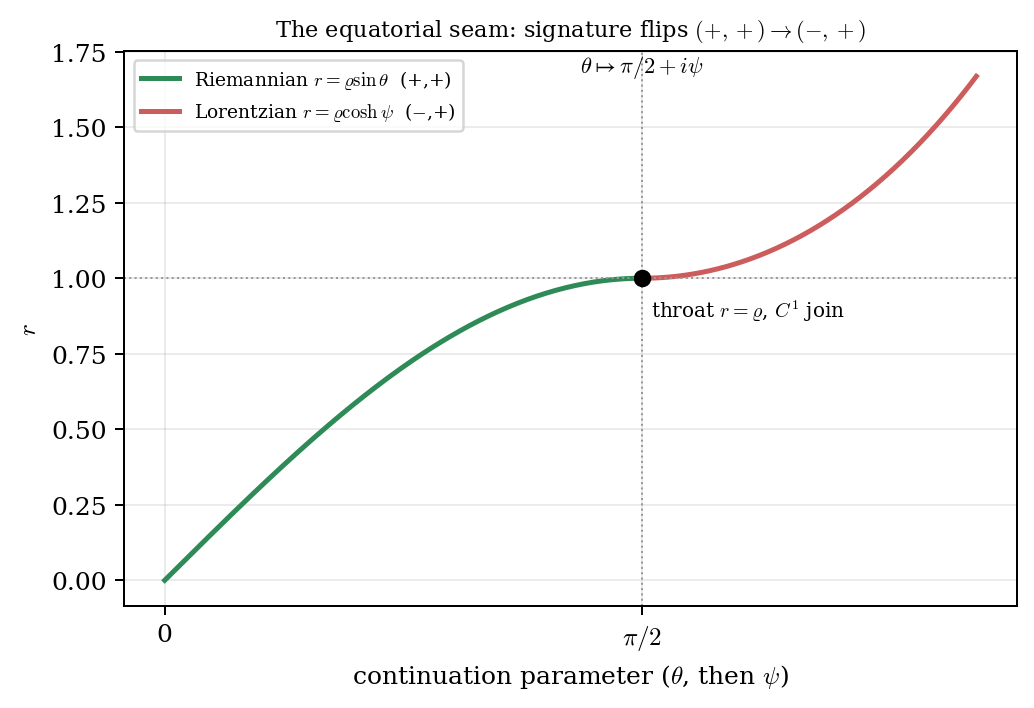
Near a turning point the slicing curve has a definite local form. Take the de Sitter slicing for concreteness, r=α sin θ with θ=l/α, and set α=1. For θ∈[0,π/2] the curve rises from r=0 to the seam at r=1; the relevant two-dimensional line element is the round spherical one,
of Riemannian signature (+,+). At the seam θ=π/2, sin θ reaches its maximum and d r/dθ= cos θ vanishes: the curve is tangent to the throat circle.
Continuation through the equatorial seam
The two pieces—spherical (20) and de Sitter (21)—are one analytic object. Since sin (π/2+iψ)= cosh ψ, the function r= sin θ continued from the real segment θ∈[0,π/2] onto the line θ=π/2+iψ is r= cosh ψ. The seam θ=π/2 is the join: the point at which the parameter turns off the real axis into the imaginary direction, at r=1. Both pieces meet there at r=1 with vanishing first derivative: the join is C1, the slicing curve tangent to the throat circle from both sides. Figure 9 shows the join.
The correspondence as a continuation
The companion paper carried out exactly this continuation at the two critical points of the Schwarzschild cycloid: z↦iρ at z=0 produced an exterior at r gt;2M (a front-seam continuation), and z↦π+iρ' at z=π produced the back-seam continuation onto r lt;0, with the trigonometric functions of the interior becoming the hyperbolic functions of the exterior. Proposition 11 is the same operation, identified now as the join between a Riemannian and a Lorentzian piece of one slicing curve. The signature that flips here is that of this two-dimensional slicing-surface metric: the radial direction the curve runs along reads spacelike on the spherical (hole-side) piece r lt;α and timelike on the de Sitter (cosmological) piece r gt;α, flipping as the curve crosses the throat. It is not the signature of the spacetime, which is Lorentzian throughout—the substrate is one Lorentzian manifold, and the continuation relates two real regions of it, never carrying the geometry off the real Lorentzian substrate onto a Euclidean one. This is worth marking against the distinct continuation the substrate also admits, and with which it must not be run together: the global Wick rotation x0↦ix0 does carry the whole Lorentzian substrate onto its conjugate real form—the compact S5= SO(6)/ SO(5), the two of them the real forms of the one complex group SO(6,C)—on which a continuous su(3), colour's, lives [JanzenBoundary, JanzenGeometricCore]. The seam continuation is not that operation: it is real-analytic, joining two real regions of one Lorentzian geometry (the slicing surface's Riemannian↔Lorentzian seam), where the global Wick carries the substrate to its other real form entirely (a Lorentzian↔Euclidean move). Colour therefore sits on the substrate's own conjugate face, reached by a continuation the slicing never performs—the two continuations distinct in kind, and conflating them the characteristic error the coupling guards against.
This secures the de Sitter ↔ Schwarzschild correspondence in concrete form. A slicing built by running sin θ out to the equatorial seam and continuing onto cosh ψ can be run backwards, because sin and cosh are one analytic function and the continuation θ↦π/2+iψ is invertible. The inverse is not a separate construction to be discovered: it is guaranteed by the analyticity of the continuation. A geometry obtained as a slicing of de Sitter retains, in the invertibility of that slicing, its membership in de Sitter. The cosmological-side continuation here—the Lorentzian de Sitter piece r gt;α onto which the slicing opens—is the geometric substrate of the cosmogenesis developed in the cosmological completion [JanzenCRframework], where the reading of the branch-point crossing as the reassignment of the radial direction to cosmic time is taken up; it is not asserted here.
Overcritical SdS: the same continuation past the Nariai crest
The undercritical/overcritical boundary of Section 4, |2M|=2/(3√3), is in the sky angle of Section 5 the crest of sin (3w). Overcritical SdS is reached by the same analytic continuation as the seam, applied now to the horizon angle itself.P3R16
By Proposition 8, 2M=2/3√3 sin (3w). The overcritical range |2M| gt;2/(3√3) requires | sin (3w)| gt;1, impossible for real w. Writing 3w=π/2+iβ gives sin (3w)= cos (iβ)= cosh βgt;1: the horizon angle is continued off the real axis into the imaginary direction, exactly as θ↦π/2+iψ at the seam. The Nariai crest 3w=π/2 is the Nariai point. Overcritical SdS is thus not a separate construction; it is the slicing of Sections 2–4 with the horizon angle continued past the Nariai crest, and the same sin → cosh mechanism that joins the Riemannian and Lorentzian pieces of the seam carries the geometry from the under- to the over-critical regime.
The root structure, read off the locus. The overcritical regime is read directly off the horizon locus of Section 4 with no separate algebra. That locus is the diagonal r=r0 together with the tilted ellipse r2+r r0+r02=1, and the three horizons at a given slicing are the intersections of the vertical line at fixed r0 with this locus. For |r0| lt;2/√3 the line meets the ellipse in two real points and the diagonal in one: three real roots. At |r0|=2/√3 the line is tangent to the ellipse: the double root, Nariai. For |r0| gt;2/√3 the line misses the ellipse in the real plane and meets only the diagonal: one real root, together with the complex-conjugate pair arising as the intersection with the analytic continuation of the same fixed ellipse into the complex (r,r0) plane. The ellipse does not disappear in the overcritical regime; the real slicing line simply ceases to meet it, and the two horizons continue, as a conjugate pair, on the ellipse's complex extension. This is the same continuation as the seam, now seen in the (r,r0) plane: sin → cosh at the seam, loss of real intersection here, one analytic fact in two guises.
The sign of the surviving real root follows from the diagonal. By Proposition 2 the diagonal root is r0 itself, and 2M=r0-r03; for 2M gt;2/(3√3) the real root lies at r0 lt;0, and for 2M lt;-2/(3√3) at r0 gt;0—the overcritical real horizon is the backward-radial root, the one carried by the major axis of the ellipse (Section 4).
The symmetry action, continued. The root-exchange continues with the geometry, stating the overcritical symmetries the locus above leaves implicit. In the sky angle σ is the reflection w↔π/3-w (Section 5); at the overcritical angle w=π/6+iβ/3 it acts as σ(w)=π/6-iβ/3= w—complex conjugation—so it exchanges the conjugate pair of horizons and fixes the surviving real backward-radial root, exactly as it exchanges the two real roots and fixes the third undercritically. The one involution thus acts across the Nariai crest at its fixed point w=π/6, swapping a real pair below and the conjugate pair above; and the backward-radial reflection r0↦-r0 (the outer Z2) carries between the two sign-halves overcritically as under. The full Aut(A2)=S3×Z2≅D6 is therefore the symmetry of the overcritical regime no less than the undercritical, realised there on the complex-conjugate root structure. This regime-dependent realisation—all of S3 on the three real roots undercritically, only the order-two complex conjugation of the pair overcritically—is read off the slicing here; the companion groupoid paper carries it onto the description foliation and casts it group-theoretically, as the monodromy group of the branched cover [JanzenGroupoid].
The slicing curve in the overcritical regime. It remains to carry the slicing curve itself, dr/dl=√|f(r)|, through the continuation. The defining equation does not refer to the number of real roots of the cubic; it is well defined wherever f is, and f(r)=1-2M/r-r2/α2 is real for real r whatever the value of 2M. The analytic continuation parametrises r0 through a complex sky angle—from r0=2/√3 sin w with w=π/6+iβ/3, r0=2/√3 (12 cosh β/3+i√3/2 sinh β/3)—but the curve r(l) it labels remains real: r0 is an algebraic label of the slicing, while the physical curve runs through real radial values.
On the forward branch r gt;0 the overcritical f has no zero at all: with 2M past the Nariai value, f(r) lt;0 for every r gt;0, so dr/dl=√|f| never vanishes there. The forward slicing curve therefore has no turning point—it is unbounded, with a single real turning point present only on the backward branch, at the negative root identified above. This is the precise overcritical statement of the turning-point correspondence: of the three horizons, one survives as a real turning point of the curve (on the backward branch) and two have left the real slice as the conjugate pair on the continued ellipse.
The asymptotic form of the unbounded forward curve follows at once. For large r, f(r)→-r2/α2, so dr/dl→r/α and
an exponentially growing branch—the global continuation of the same hyperbolic (cosh) piece that the seam construction initiates locally.
The lap and the conjugate branch
The negative-root horizon of Section 4 and the backward-radial real root of the overcritical regime are the same structure, and naming it correctly closes the slicing into a single object. The areal radius r is a signed coordinate: the angular part of (1) is r2 dΩ2, so gθθ=r2 is insensitive to the sign of r, and the curve may be run in the negative sense—the backward radial direction, the long way round from r=0—without leaving the geometry. The major axis of the locus ellipse (Section 4) is precisely this backward-radial direction r=-r0, and the third root the factorisation (5) always supplies lives on it.
This is what lets the slicing close. Ride the curve inward along a ruling to the equatorial seam; continue, by Proposition 11, around the throat through r=0 and out onto the negative branch; and the curve closes on the backward-radial root carried by the major axis. The point r=0 on this lap is the branch point at which the real radial value passes between the forward (r gt;0) branch and the backward (r lt;0) branch—the same branch point the companion paper reached by z↦π+iρ' at the conjugate critical point of the cycloid [JanzenCircle]. It is not a barrier. The substrate is the one smooth de Sitter manifold, which is C∞ across the locus the chart labels r=0; the divergence of the curvature reading there (Section 8) is a property of the perspectival areal coordinate, the same chain-rule artefact the companion paper identified [JanzenCircle], not of the manifold.
The region reached on the backward branch is therefore the conjugate region: the real r lt;0 branch of the one Lorentzian substrate, continued through the r=0 branch point. It is not a Euclidean excursion—the signature flip of Section 7 is that of the two-dimensional slicing surface, and the spacetime is Lorentzian throughout—and the conjugate horizons of the overcritical regime are its complex shadow on the fixed ellipse, the genuine backward-radial root its real representative. The slicing curve, run forward through the seam and backward through r=0, is one closed object on one manifold; the horizon, the curvature-singularity reading, and the cosmological horizon are its points—the horizons its turning points, forward and backward, and r=0 the branch point between them.
Read against the linearly-marching areal radius, the lap is oscillatory where the real legs are monotone. On the real ruling legs the embedding coordinate X1=α cos θ is linear in r; around the conjugate lap, where r marches as arc length through the three roots +α/√3,0,-2α/√3, it traces a single cosine arch, troughing at r=0 (the back of the throat circle, X1=-α) and closing the lap at the backward-radial root (Fig. 10). This is a property of the embedding coordinate read against the signed areal radius, not of the metric, which is regular across the lap as established above.
Read forward as physics rather than geometry, the lap is the cosmogenesis: the conjugate branch is a previous universe's collapsed matter continued through the branch point, its completion read by the framework as our own expanding cosmology—the two the framework proves one closed cosmogenetic bead, the curve established here its geometric skeleton [JanzenCRframework]—so that the primordial light-element abundances become a fossil of that collapse's thermal history—the quantity the companion cosmogenesis paper computes, and the loop this slicing opens by carrying the curve through r=0 is the loop it closes [JanzenCosmogenesis]. This single curve is the geometric skeleton of the cosmology: read inward it is the collapsing leaf's own self-gravitating dynamics, and read outward it is the expanding cosmology, the two being one congruence crossing the branch point rather than two regimes, exactly as the marginally-bound cosmological geodesic is dust collapse read inward and dust cosmology read outward [JanzenCRframework, JanzenCosmogenesis]. The light elements freeze out on the outward leg, as it cools past the branch point: freeze-out cannot fix a surviving abundance on the heating infall, and on the cooling leg it runs on the content's own rate, which carries the radiation that the foliation's stacking rate does not [JanzenCRframework, JanzenCosmogenesis]. And the member the framework's reassignment installs is fixed here, geometrically and not by fitting: it is Nariai, the one fixed point of the root-exchange involution (8), at which the two horizons the curve turns on merge.
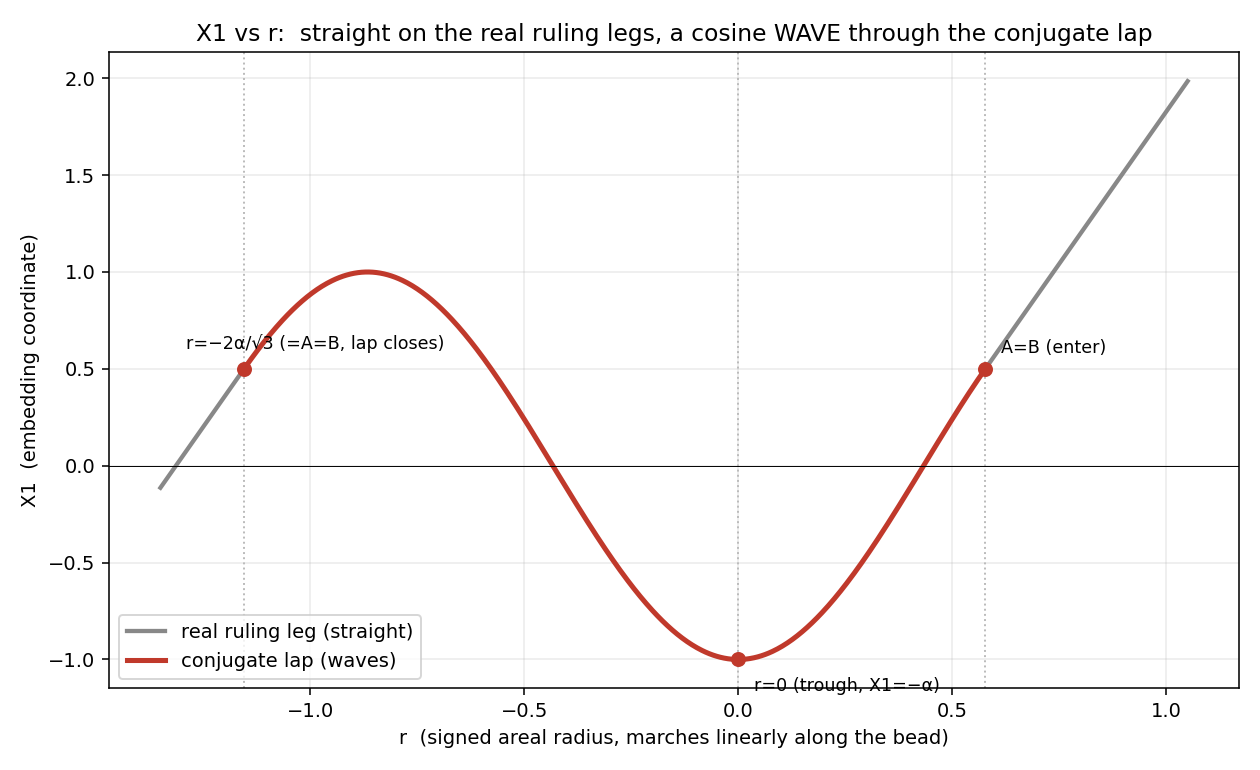
Winding on the equator, and the thirds that closure forces
The lap of Section 7 is a closed circuit, and a closed circuit admits a count. Section 6 placed three graze points on the throat at polar 60∘, 180∘ and 300∘, one directly between each pair of hinges, cutting the throat circle into three equal arcs; those are the only marked points the throat carries, and there are exactly three of them because there are three hinges. Define a constituent's winding as the signed number of graze points its equatorial route crosses, in units of one third of a lap.P3R49 Nothing further is stipulated.
One fact about routes then does all the work. Between two punctures at different hinges there are exactly two equatorial routes, and they cross one and two graze points in opposite senses; since 1+2=3, the two routes differ by exactly one lap. So a triple built on the three hinges has a head carrying some winding x and two partners carrying y, with x-y=1 forced by that difference and nothing else.
Impose now only that the configuration close—that a bound triple return to the branch it started on—for each of the two horn-headed arrangements. The upper-headed total is x+2y and the lower-headed total is y+2x, and substituting y=x-1 these are 3x-2 and 3x-1. Both are integers precisely when 3x is, so
and the thirds are forced rather than matched—the 3 being the number of constituents, of hinges and of graze points, which is one three entering three ways. Modulo a lap there are exactly three classes, and they are not assigned:
The count that carries the charge is not the count that acts on a bound mode, and the thirds are the difference between them. Because each vantage's radius vanishes at its own wall alone, a crossing acts on the crossing mode's own component only when the wall is that mode's; over the two routes that own-wall count is 0 and -1, integral, while the graze-point count is + 13 and - 23 of a lap. An integral label leaves closure satisfied identically and forces no denominator, so the acting count cannot be what the charge is read from—the quantisation in thirds is available exactly because one count runs over all three walls and the other over one.P3R61
The horn swap is then a lap. The upper-headed triple of the k=2 class totals 23- 13- 13=0 and the lower-headed one totals - 13+ 23+ 23=+1, so exchanging the horns costs exactly one lap, and the two closed arrangements form a doublet—with three of each, because there are three hinges.P3R50 Reading the fractional part and the integer part separately: the fractional part distinguishes the two conjugate classes, being 23 one way round the equator against 13 the other, and the integer part distinguishes the two members of a closed doublet, being one lap.
Closure is not an added rule, because the winding's transformation law is already the corpus's.P3R47 The areal radius on the lap is a cube root of an invariant—r3=2Mα2 sinh2(3 τ/2α), the bead's law—and Section 6 derives from cosmic time's single imaginary period that the deck action τ↦ τ+2πiα/3 sends r↦e2πi/3r. So r carries a sheet index in Z3 which advances by one at each passage through the r=0 branch point and returns after three: exactly the transformation law of a crossing count, obtained for reasons that have nothing to do with charge and before any of this was asked. To close is therefore to return to the same branch, and admitting a composite only when its total fractional part vanishes is a statement about the covering rather than a selection rule imposed on it. The branch in question is per-vantage, and that sharpens the condition rather than loosening it. The signed radius is defined relative to a vantage, so there are three of them and each vanishes at its own wall and at neither of the other two [JanzenMatter]; a crossing therefore advances the owner's sheet alone, and return demands it of each separately. Vanishing total fractional part is what that demands of the total—necessary, and not on its own sufficient: a single lap crosses each wall once and advances all three sheets together, which is the same fact as its acting by the centre rather than by the identity.
Read against the observed hadrons the rule agrees on every content tested: meson, baryon, antibaryon, tetraquark, pentaquark and dibaryon close and exist; a free quark, a diquark, q q q, qqqq and qqq q do not close and do not.P3R50 Confinement on this reading is a failure to close the lap, and the closed lap is the object the construction admits as a slicing at all.
The scope is exact and is the same one Section 5 already draws.} What the geometry fixes is the quantisation—that charge comes in thirds, and which classes exist—together with the sign, through R. It fixes no strength: a topological label quantises and cannot scale, and the coupling is not in this construction. And the classes are read here as a combinatorial structure of the lap; that the k=2 class is the quark doublet is a correspondence stated as the companion matter paper states it, not a derivation of the Standard Model's content from this figure [JanzenMatter].
The curvature, the two sweeps, and the mass
The intrinsic curvature of the slicing surface
The slicing curve, swept through one angular direction, generates a surface of revolution with line element ds2=dl2+r(l)2dφ2, l the proper radial distance. Its intrinsic curvature is a direct computation, and it is regular throughout the interior.
Three consequences follow, and together they close the question of the interior. First, KG=1/α2-M/r3 is finite and smooth for every r gt;0: the slicing surface is regular throughout the static region between the horizons. The sole divergence is the M/r3 pole as r→0—the Schwarzschild curvature singularity of the companion paper [JanzenCircle]—and it is absent when M=0, where (24) reduces to the constant KG=1/α2 of de Sitter.
Second, the curvature does not detect the horizons. At a horizon rh, where f(rh)=0, the curvature KG(rh)=1/α2-M/rh3 is simply a finite number; it neither diverges nor vanishes nor spikes there. The horizon is invisible to the intrinsic curvature—the precise statement, for SdS, that the horizon is a metric and chart feature and not a curvature feature, exactly as the companion paper found for Schwarzschild [JanzenBHcausality].
Third, the curvature changes sign once, at
being negative for r lt;rHE and positive for r gt;rHE.P3R15 The slicing surface is therefore Schwarzschild-like (negatively curved, mass-dominated) in an inner region and de Sitter-like (positively curved, Λ-dominated) in an outer region, with the crossover at rHE. This crossover radius is a distinct locus from the horizons—the horizons are the zeros of f, the crossover is the zero of f'—and the zero of f' carries a standard physical meaning: it is the static radius of Schwarzschild–de Sitter, the radius rHE=(Mα2)1/3 at which the inward gravitational attraction M/r2 and the outward cosmological repulsion r/α2 exactly balance, so that a static observer there feels no radial acceleration. The intrinsic curvature of the slicing surface therefore changes sign precisely at the classical gravitational–cosmological balance point—mass-dominated (Schwarzschild-like, negatively curved) within it, Λ-dominated (de Sitter-like, positively curved) without. This locus lies between the two positive horizons, inside the static region (Figure 11). The curvature structure and the horizon structure are independent features of the same surface.
This crossover carries a physical reading the wider construction turns to account, worth drawing out here and developed on the theory in the companions. The two terms of KG are not on the same footing: 1/α2 is the substrate's own de Sitter curvature—the global, cosmological term set by Λ—while -M/r3 is the local bend the mass adds, so KG is cosmological curvature minus local bend, and the flat locus KG=0 at rHE is exactly where the local bend cancels the substrate's cosmological curvature. That locus has a standard name and use: the static radius rHE=(Mα2)1/3 is the Hubble–Eddington radius [Eddington1933], RTA,max=(3GM/Λc2)1/3, the largest shell around a mass M that can stay gravitationally bound against the cosmological expansion—within it a test particle falls inward, beyond it joins the Hubble flow—proposed as a local, per-structure test of Λ from the largest bound structures, robust to cosmic epoch, dark-matter details, and baryonic effects [PavlidouTomaras2014]. That robustness is profile-independence given M—the radius depends on the enclosed total and not on how it is distributed—and it should not be read as settling which M. The two candidate masses are not close: a radius set by baryonic mass alone is smaller by fb1/3, so the choice is worth a factor of 1.85 in the radius and 1/fb≃6.4 in a Λ inferred from an observed oneP3R22. The construction is degenerate with the standard one here and predicts neither: m(r) is the bend, so whatever gravitates is in it, exactly as in general relativity. What the measurement discriminates is therefore the dark fraction and not the framework, and on the one cluster where the turnaround radius is located kinematically and the baryonic mass is measured independently of it, the direction is decided: four determinations of Virgo's turnaround radius all exceed the bound a baryon-only Virgo allows, by 19 to 33 per cent, and all lie inside the bound its dynamical mass allows, the bound-to-attained factor 0.74 to 0.82, so the radius tracks the dynamical mass unless the baryons inside the turnaround radius are 1.70 to 2.35 times those measured inside the smaller aperture the baryonic mass is taken inP3R23. It bears on this paper only through the input to the one-scale reading below, which on that evidence carries the dynamical mass. In the layered reading this boundary between a structure's gravitational hold and the cosmological flow is not a force cancellation computed after the fact but the intrinsic geometry of the existent slice: mass-dominated and negatively curved (Schwarzschild-like, bound) within rHE, Λ-dominated and positively curved (de Sitter-like, expanding) beyond it, the boundary appearing per structure and locally as the vanishing of the slicing surface's own Gaussian curvature—the local bend of the cut exactly cancelling the substrate's cosmological curvature. Its standing is a derivation and an explanation, not a re-description. The Hubble–Eddington radius, proposed from the equation of motion of a test shell, is reached here independently as the flat locus of the existent slice, and under the layered ontology explained one level deeper: the boundary is where the real evolving space is intrinsically flat, its curvature-sign is the boundedness/expansion dichotomy, and the test-particle balance is a consequence of that geometry rather than its definition. The value is general relativity's with Λ—necessarily, the framework leaving Einstein's equations untouched—so it discriminates no cosmology; the advance is the account, as sound as the layered ontology the programme holds to its tests. Gathered with the framework's other dissolutions, this boundary is one of the standing problems that paper's first synthesis resolves by the single distinction between the evolving existent and its maximally extended representation [JanzenCRframework], and the epistemic discipline weighs the convergence of its several descriptions on one existent fact as one of its own assessments—the discipline returning a novel consequence, not merely certifying one [JanzenShadowExistence]. One scope is marked: KG is the curvature of the two-dimensional slicing surface: carrying the reading to the full existent leaf and the actual bound dynamics—where matter is the bend of the cut [JanzenOperator] across the sector the substrate reaches [JanzenRange], and the cosmological term is the substrate's own Λ-set expansion rate [JanzenCRcosmology]—is developed on the theory in those companions rather than on the surface alone; the static radius itself is the idealized spherical vacuum-exterior maximum, an upper bound to which virialization and the dark sector add the rest. There is a second reading of the same locus, and it is an identity rather than a coincidence. Writing f=1-2M/r-r2/α2 for the metric function, f'=2M/r2-2r/α2 and KG=1/α2-M/r3 satisfy KG=-f'/2r identically; the factor never vanishes for r gt;0, so the flat locus of the slice and the stationary locus of the metric function are one locus, not two that agree.P3R13 The framework paper reads that same radius on the lap, where it is where the re-expansion is slowest [JanzenCRframework]—so the Hubble–Eddington radius is the rate minimum, for every member, and the two characterisations were never independent. And the identity says more than that the loci agree. On any comoving worldline of the energy family (dr/ d τ)2=E2-f, so differentiating gives d2r/ d τ2=-f'/2=rKG exactly: the comoving acceleration is the slice's own Gaussian curvature, up to the positive factor r. The sign of the intrinsic curvature of the existent slice is the sign of the cosmic acceleration—negatively curved while the expansion decelerates, flat at the turnover, positively curved while it accelerates—so the flat locus this section identifies is not merely where a structure's hold balances the expansion but the epoch at which the expansion changes sign of acceleration.P3R12 On the Nariai member that locus is the seam, and in the standard reckoning it is where ρm=2ρΛ: the same condition, since ρm/ρΛ= csch2(3c τ/2α) equals 2 exactly at sinh =1/√2, the seam's phase. It is therefore a recent, cosmological epoch rather than an early one—and it precedes matter–Λ equality, which sits later at sinh =1.
One member of the family reads that boundary differently, and the difference is forced rather than coincidental. The condition KG=0 is M/r3=1/α2, and substituting it into the potential gives f=1-3r2/α2: on the flat locus the mass term is absorbed and f takes the pure de Sitter form at scale α/√3. So f(rHE)=0 holds precisely when rHE=α/√3, which is 27M2=α2—the vanishing of the horizon cubic's discriminant. The Hubble–Eddington radius lies on a horizon for exactly one member of the family, and it is the double-root member: below it f(rHE) gt;0 and the crossover sits strictly inside the static region, as Figure 11 shows for the undercritical case; above it f(rHE) lt;0.P3R14 At the degenerate member itself rHE=rN=α/√3, the merged horizon of Figure 3's Nariai ordinate—so there the boundary between a structure's gravitational hold and the cosmological flow is the geometry's own horizon. The same radius carries a third reading on the closed slicing: it is the lap's unique inflection, where the signed radius advances at unit rate against arc length [JanzenCRframework]. What is not claimed: nothing here bears on why the cosmological reassignment selects the degenerate member—that selection is the framework paper's trichotomy and stands on its own. The statement is that the member so selected is the one whose structure-formation boundary coincides with its own merged horizon.
The dynamical content of rHE is exact, not approximate. The phrase “boundary between a structure's local hold and the cosmological flow” invites a coarser reading than the geometry supports, so it is worth writing down what the locus does. For the marginal congruence the areal acceleration is d2r/d τ2=-f'/2, and
vanishes exactly when r3=Mα2, that is at r=rHE. So the areal radius decelerates inside rHE and accelerates outside it, with the turn precisely there—and this is general in M, holding for every member of the family and not only the degenerate one. It is the same f' whose sign the Gaussian curvature reads, (24): the crossover of KG and the turn of the areal acceleration are one zero seen twice.
Read in the construction's own direction, this is not a claim about a cause. Nothing accelerates anything at rHE. The sign of d2r/d τ2 is a property of a fixed curve, read off where f' passes through zero, and the deceleration and acceleration are what continuous motion along that curve looks like from within. The curve is not a trajectory a universe follows but the classifier of a family: a member is fixed by where its cut sits, and the whole of its history is already present in the curve's shape. So the turn is not an event in a member's life; it is a feature of the curve, met by an observer at the moment their own areal radius passes rHE. Nothing changes at that radius—the curve is smooth there, f' merely passing through zero—and what an observer would record as a transition from deceleration to acceleration is the second derivative of a fixed function changing sign along the path they are carried on. Read in the generating direction the question inverts cleanly: one does not ask why an expansion began to accelerate, but where on the curve f' vanishes, and the answer is r3=Mα2, fixed by the member's own mass against the throat radius and by nothing else.
And the same length appears at a second scale, in a fixed ratio. The comoving turnaround—the amplitude at which a collapse's areal radius stops decreasing—stands at (2Mα2)1/3 [JanzenCRframework], so
exactly. The local balance radius and that amplitude are one length in the fixed ratio 21/3, with no dependence on M or α surviving the quotient—the two differing by the cube root of two and nothing else. That amplitude has a cosmological reading in the companion cosmology, where it is the areal radius at matter–Λ equality [JanzenCRcosmology], so the local balance radius of a structure and the scale at which the two energy densities cross are the same length in that fixed ratio. On the degenerate member, where rHE=α/√3 is the front seam, that places the amplitude at 21/3α/√3. So on that member the boundary between a structure's local hold and the cosmic expansion, the seam at which r changes causal character, and the scale of the turnaround are one locus and one number up to the cube root of two—a tighter statement than the general member gives, and one belonging to the degenerate member alone.
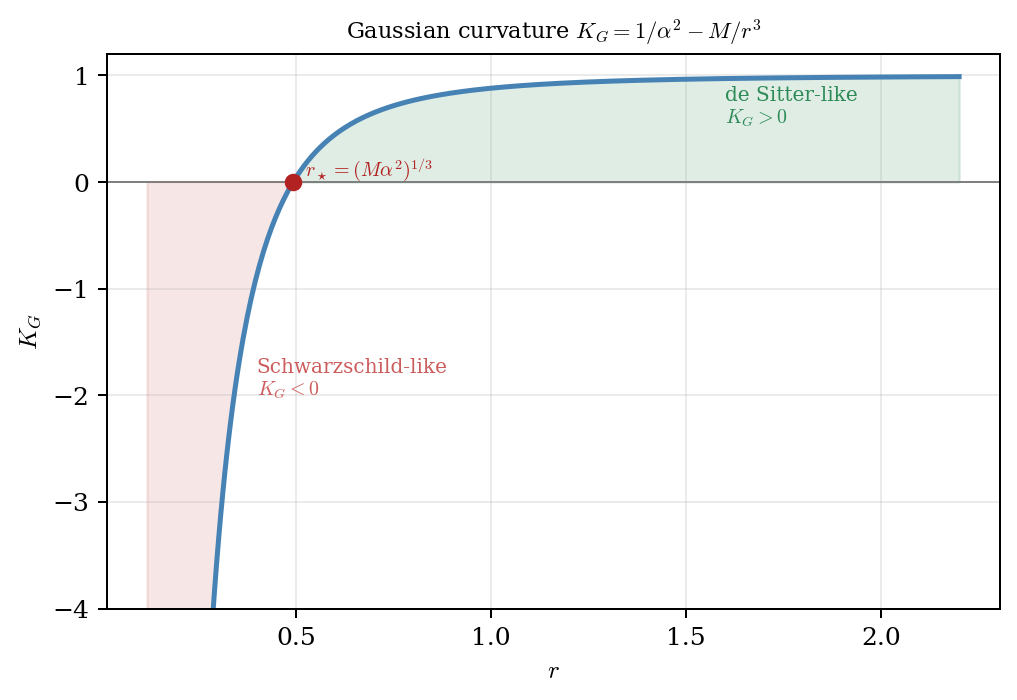
Schwarzschild and de Sitter as two sweeps
The de Sitter ↔ Schwarzschild correspondence of Section 7 is one slicing curve swept from two vantages. It must be held apart from a different operation, taken up in Section 9: changing the observer who charts a fixed swept geometry, under which the geometry is rigid (Proposition 13) and only its image moves. The correspondence here is the other thing entirely—the same curve generating two geometries, because it is swept from two vantages. Swept from the interior vantage—about the manifold's own axis of symmetry, the hyperbolic section that is the worldline of the observer at r=0, the equatorial ring wrapping the radial direction in stationary coordinates—the curve generates the dynamical de Sitter geometry. Swept from the exterior vantage, viewing the hole from outside (Section 8), the causal roles of r are flipped—r is timelike along the equatorial interval between the horizon and r=0—and the same curve generates the static Schwarzschild geometry. It is the seam's automatic signature flip (Proposition 11) that carries the one sweep into the other, turning the Riemannian spherical piece into the Lorentzian de Sitter piece without altering the curve itself. The two geometries are genuinely different geometries; the curve they are swept from is one. The whole Schwarzschild–de Sitter family is the exterior sweep taken across the slicing curves of Section 5; de Sitter is the interior sweep.
This is the loop of the paper closed. Section 7 established the correspondence as an analytic continuation, structurally invertible; the present section identifies what that invertibility is—the one slicing curve swept from two vantages, the interior and the exterior sweep carried into one another by the seam's signature flip, invertible because sin and cosh are one analytic function (Section 7) and the curve itself is untouched by the flip. This is a different move from the charting-observer morphisms of the rigidity groupoid (Section 9): there the charting vantage changes while a swept geometry is fixed; here it is the sweep itself that changes, the one curve generating the static geometry from outside and the dynamic geometry from within. Schwarzschild and de Sitter are not two unrelated spacetimes, nor two independent solutions of a field equation; they are two geometries swept from one curve, at the two vantages its seam joins.
This identification has a consequence sharper than its formal statement. The standard ontological practice treats the Schwarzschild spacetime and the de Sitter spacetime as distinct geometric objects, each with its own catalogue of horizons, singularities, and physical features. Under the perspectival reading this paper adopts (Section 1), that practice is a vantage error—grounded not in Proposition 13, whose invariance fixes one geometry under change of charting observer, but in the structurally invertible de Sitter↔Schwarzschild correspondence of Section 7, a change of causal orientation on one slicing. The two are not separate objects related by some embedding or limit; they are two geometries swept from one curve, at its two vantages. What presents as the static Schwarzschild geometry in the timelike, exterior orientation presents as the dynamic de Sitter geometry in the spacelike one, and the curvature singularity that the Schwarzschild reading carries is a feature of that static vantage's chart—the forced pivot of its sweep onto r=0 (Section 8)—not of the slicing and not of the manifold: it is absent from the dynamic reading of the very same slicing, and from the constant-curvature de Sitter manifold beneath both. The manifold has no horizons and no singularities; the readings do, and each reading's catalogue is a feature of its causal vantage, not of the manifold. (The Kretschmann scalar's coordinate-independence may seem to make its r→0 divergence a feature no description can remove; Section 8 answers this, once M is itself shown to be a projection.) This is the precise sense in which the SdS construction unifies black-hole and cosmological geometry: it does not relate them, it identifies them as one object differently read—one de Sitter manifold, one slicing of it, and, at the level at which CR individuates, one ontological layer of which the two causal readings are representations, not autonomous geometries on distinct realities. That the standard practice is here an error, and not merely a different bookkeeping, this paper draws on its own geometry: on the swept-from-two-vantages construction the two apparently independent objects, and the unexplained correspondence between them, collapse to one object differently read, a reading preferred—by the inference to the best explanation the sciences run on—over one that must posit the two objects and their correspondence as brute. That inference is the grounded discipline of theory choice a companion foundation later sets out in general [JanzenShadowExistence], and this reclassification is one of several places the present construction runs that discipline bespoke, on the geometry, before the general treatment exists. The de Sitter substrate is selected as the unique maximally symmetric real-Lorentzian manifold, every less symmetric candidate carrying an unforced modulus the appearances do not pin (Section 2)—the discipline's least-arbitrariness. The perspectival reading infers the one substrate the two charts are shadows of, rather than taking either chart for the world (Section 1)—its imperative. And the imaginary variables the construction reaches through are held as instruments over an everywhere-real geometry, never reified (Section 2)—its constructive ordering. Each is reached on the construction alone; that independence is exactly what lets the general account draw on these instances without circularity.
The horizon–singularity asymmetry is a sweep-pivot artefact
The previous subsection identified the de Sitter and Schwarzschild readings as two vantages on one intrinsic slicing curve. We can now say what each vantage does to that curve, and in doing so resolve a question the construction has so far only posed: if the two readings are one curve charted twice, why does one carry a curvature singularity and the other not? The answer is that the two descriptions are not merely two labellings of the curve—they are two sweeps of it, and they differ in whether the sweep can be taken about the manifold's own axis of symmetry or is forced off it. There are not two independent symmetry breaks here but one, cascading: as Section 5 found, the manifold's single broken symmetry is the hole, and an observer who takes the hole as reference is forced—not by any further choice—into everything that follows.
A description is built by taking the slicing curve and sweeping it through the angular symmetries of the throat 2-sphere to recover the full spatial geometry. The curve itself is radial; the sweep restores the two suppressed angular directions. What an observer obtains as “their” spatial geometry is the swept curve, and the sweep requires an axis.
Here the two vantages part. The de Sitter vantage sweeps the complete arc r=α sin θ, θ∈[0,π], through the manifold's own rotational symmetry: the arc runs from the throat at X=α down through the seam and out again, and the sweep about the manifold's symmetry axis returns the full de Sitter geometry. No symmetry of the manifold is broken in the sweep, because the axis swept about is the manifold's own.
The Schwarzschild vantage cannot do this. It views the hole from outside, in the timelike orientation, and in that orientation the symmetric manifold cannot be swept about its own axis of symmetry: the symmetric sweep is precisely the de Sitter, interior one just described, and it is unavailable here. The sweep still requires a pivot; denied the manifold's own axis, it is forced to take a selected point as the centre it sweeps about. The point it is forced onto is r=0—the off-axis critical point at the back of the throat circle, where the two branches of the slicing curve, having conjugated around the ring, meet (Section 2, Figure 1b). r=0 is a point of the manifold, and it is the pivot: the selected point about which the constructed spatial geometry is swept. This is not a second symmetry break standing beside the first; it is the cascade the first break forces. Locating the hole is the one break (Section 5); having located it, the exterior vantage cannot recover the manifold's symmetry, and the pivot onto r=0 follows of necessity.
From the pivot the rest descends. As the centre of a centred spatial geometry, r=0 is the centre of radial infall—the point to which the infalling worldlines converge and at which they end. The sweep hands it endpoint status, and the constructed manifold is, there, legitimately singular: the curvature diverges. The divergence at r=0 is the shadow of the forced pivot. This shows directly in the slicing surface's own Gaussian curvature, KG=1/α2-M/r3 (Proposition 12): a surface of revolution has KG=-r”/r, curvature divided by the distance out to the axis it is swept about, so the projected-mass term -M/r3 is the pivot's signature—it diverges at r=0, where the forced sweep brings the curve onto its own rotation axis, and is absent identically from the de Sitter sweep (M=0) about the manifold's true axis, whose curve reaches its r=0 pole with KG=1/α2 finite. The lopsided divergence is the projected mass the off-axis sweep carries, located by the 1/r of the sweep. The horizon, the other critical point, is not the pivot; worldlines pass through it rather than ending at it, and it carries no such divergence.
This forced pivot is the geometric origin of the asymmetry the companion paper found algebraically [JanzenCircle].
And the attribution divides into two questions with different answers, which is worth separating because only one of them is decidable. Does the inverse-cube term track the selected off-axis point? No, and that is settled by computation rather than left open. The Weyl reflection permutes the three horizon roots at fixed mass, so undercritically one mass is carried by three distinct offsets — at 2M=0.30, by r0=-1.125419, 0.338936 and 0.786483, each returning r0-r03=0.300000 and each a genuinely different sky angle. The slice's curvature is identical on all three, and it must be: KG=-f'(r)/2r, and the metric function carries the mass and the throat scale and nothing else, so the selected offset cannot enter. The test has content because offset-sensitive quantities sit beside it — the sky angle itself differs across the three while sin 3w does not, so a quantity carrying the selected pivot would behave like w, and this one behaves like sin 3w.
Does it track the cut's being off-axis at all? That is undecidable, and provably so rather than for want of a quantity. Since 2M=r0-r03, the mass and the offset vanish together, and the reflection is one operation carrying both signs rather than two that agree. No configuration has an off-axis cut at zero mass or an on-axis cut at non-zero mass, and a discriminating quantity would need one of them.
So the term is the reflection-odd part of the slice's own curvature, blind to which root the cut sits on and vanishing exactly when the cut sits on the axis — and the two attributions are one datum in two coordinates, related by 2M=r0-r03, with no quantity separating them. At the level where the two readings differ the mass decides it; at the level where the pivot reading would win, they are not two readings. In the companion paper the horizon at r=2M and the curvature singularity at r=0 were shown to be non-degenerate critical points of the cycloid r(z)=M(1+ cos z) of identical analytic character, the divergence of the Kretschmann scalar at r=0 arising as a chain-rule artefact of the chart's labelling of that critical point as r=0 rather than as a finite value. The companion paper's identification of both critical points as metric singularities of the same structural kind [JanzenBHcausality, JanzenCircle] is the algebraic counterpart of the present geometric statement. The present construction supplies the reason the labelling falls as it does. The two critical points are topologically identical on the substrate—two matching turning points of the one intrinsic curve, exchanged by its involution, two entry points to the conjugate piece continued through the seam. They are emphatically not metrically identical: the metric fixes not only the interval but, through its second derivatives, the curvature, and on the swept geometry that curvature is lopsided between the two—divergent at the pivot r=0, finite at the horizon. The identity is topological and lives on the substrate; it does not survive onto the geometry, where the sweep—pivoting on one turning point, off the manifold's symmetry axis—renders the two distinct, as endpoint versus crossing and in curvature alike. The topological identity is the invariant of the rigidity result (Proposition 13); the distinction is a property of the swept geometry, manufactured by the off-axis pivot—a feature of the vantage-dependent description, not of the substrate. The manufactured singularity at r=0 is the chain-rule shadow of the forced pivot: the asymmetric classification tracks the asymmetric sweep, not the analytic structure of the curve, which is symmetric.
The de Sitter description, sweeping about the manifold's own axis, needs no such pivot and manufactures no such singularity: the complete arc carries no selected point, and the recovered geometry is smooth de Sitter throughout. The two descriptions are thus not symmetric alternatives. They are one intrinsic curve swept two ways—once about the manifold's symmetry axis, once forced off it onto r=0 by the exterior vantage's locating of the hole—and the entire apparatus of horizon-versus-singularity asymmetry, present in the Schwarzschild reading and absent in the de Sitter one, is the signature of that single, cascading break.
So the construction produces singularities, and this is where. The reading above is usually stated as a dissolution, and it is worth also stating in the other direction, because it says how a curvature singularity arises here at all. The substrate is maximally symmetric, everywhere finite and smooth, and r=0 is a regular point of it—a point on the throat circle, at X1=-α (§6). But the geometry generated by slicing and then sweeping about that locus carries a curvature singularity there. A curvature singularity in this construction is therefore not a feature of the substrate but a product of the sweep about the areal origin—which is why none of them is fundamental, and why the construction has exactly one such locus to produce them at. And that locus has already been met twice in this paper for other reasons: it is where the signed radius branches (§7) and it is the fixed point of the swing, diametrically opposite the hinge (§6). These are not three facts about three places. The construction's singularity-generator and the fixed point its whole family swings about are one place.
Mass as a turning point, not a coefficient
We can now say precisely how the mass parameter M sits in the construction. Throughout, M has entered as a coefficient in the cubic (3), related to the slicing parameter by 2M=r0-r03 in the gauge α=1. Restoring the throat radius α=√3/Λ, and writing the dimensionless slicing parameter as r0/α (so that r0/α= sin u in the throat angle and r0/α=2/√3 sin w in the sky angle of Section 5), the horizon cubic r3-α2r+2Mα2=0 gives
The mass is the throat radius α multiplied by the pure-number slicing profile (r0/α)-(r0/α)3. The two factors have sharply different status, and that is the content of this section.
The throat radius α is the invariant of the construction. It is invariant under the reading-swap involution—α contains no slicing parameter, and the involution acts only on r0 (Proposition 4). It is fixed across the whole family of slicings: α is set by Λ, which is not a slicing choice. And it is invariant under the projection of Section 5: every observer sees the same hole, and the throat radius is a property of the manifold, not of the observer. The projection changes the throat's angular size on the observer's celestial sphere and the reticle offset r0; it cannot change the throat radius, which is the thing the sky image is an image of.
The mass M, by contrast, is the slicing-dependent factor. Through (28) it is the throat radius read through a choice of slicing—equivalently, through a choice of reticle offset, since r0 is fixed by the projection. The dimensionless profile (r0/α)-(r0/α)3 is the projection-dependent part: in the sky angle it is 2/3√3 sin 3w, a pure function of the angle the observer's reticle selects. As the slicing turns, M ranges over [0,α·2/(3√3)], the maximum 2M=α·2/(3√3) being the Nariai value, attained at r0/α=1/√3. The largest mass any slicing of a given de Sitter manifold can carry is therefore set by the throat radius itself.
This is the precise sense of the section title. M is not an intrinsic coefficient of a spacetime; it is the throat radius α projected through a turning of the slicing, bounded by α and vanishing at r0=0. The intrinsic quantity—the one every reading and every observer agrees on—is the throat radius α=√3/Λ.
This settles the one objection the standard reading can still press against the no-singularities result of Section 8. The objection is that the Kretschmann scalar is coordinate-independent, so its divergence as r→0 is a fact no relabelling removes. It is a fact—about the perspectival Schwarzschild metric, whose curvature scalar it is. But the mass M that metric carries is, by (28), the throat radius modulated by the slicing: a feature of the projection, not of the manifold projected. The de Sitter manifold the slicing charts carries no mass term and has constant curvature 1/α2; no invariant of it diverges anywhere. A computation on the cosmological branch makes the same point quantitatively, and independently of the argument just given. Along the bead's outward law the areal radius carries r∝M1/3, so r6∝M2 and the perspectival invariant K=48M2/r6 near the origin is 64/27 τ4: free of M and of α alike, the cancellation being the amplitude's exponent and nothing else, 6× 13=2 exactly [JanzenCRframework]. Read at a fixed proper interval from the origin the curvature does not know the progenitor's mass at all—which is what a projection-feature should do, and what an intrinsic one could not. The interior cycloid, whose amplitude instead carries r∝M, gives K∝M-4 [JanzenCircle]: the same invariant, two parametrisations, the mass-dependence tracking which of them is being read rather than the manifold underneath. The computation is banked with the circle paper's receipts.
The objection is therefore correct of the shadow and silent about the geometry—it treats the perspectival metric as fundamental—the very point this construction puts at issue, declined by the adopted reading on the strength of M's being itself a projection (above), not by the charting-invariance of Proposition 13, which holds within one fixed slicing.
We are explicit about the scope of this statement. What is established here is the status of M within the construction: how M depends on the slicing and the projection, and that α does not. A separate question—whether α, or a quantity built from it, is the correct intrinsic gravitational mass in the sense of the standard quasi-local or asymptotic mass definitions—is answered by those definitions, and they return M, not α. The Misner–Sharp quasi-local mass [MisnerSharp1964] of the SdS metric is mMS(r)=r/2(1-f)=M+r3/(2α2) and the Komar mass [Komar1959] is mK(r)= 12 r2f'(r)=M-r3/α2, each returning the parameter M as the central mass, with α entering only through the de Sitter background term; pure de Sitter (M=0) carries zero mass parameter, α being its curvature radius—a length, not a mass—and, since SdS is asymptotically de Sitter rather than flat, the asymptotically-de Sitter mass (in place of the inapplicable ADM) likewise returns M: the Abbott–Deser charge [AbbottDeser1982], evaluated on Schwarzschild–de Sitter, gives the mass parameter. That third leg is worth stating at its actual weight rather than in passing. Unlike the first two it belongs to a contested class—conformal and Kastor–Traschen constructions return the mass parameter times the cosmological scale factor, and a conserved charge in an asymptotically-de Sitter spacetime is widely held not to be well defined at all, there being no spatial infinity and no global timelike Killing vector. The argument here does not need the class to agree; it needs a construction that applies to SdS and returns M, and Abbott–Deser is one. And the disagreement is itself of a piece with the reading: the constructions differ over how to subtract a de Sitter background, which is precisely the step this programme declines to take—the de Sitter structure being the substrate rather than a background to be removed. That reading is gathered with the framework's other dissolutions, where it is the same distinction the perspectival status of curvature carries, read on the asymptotic machinery [JanzenCRframework]. So α is not the gravitational mass; the gravitational mass is the perspectival M that the standard definitions measure, computed in the Schwarzschild vantage. This does not soften the reading but sharpens it: what is conventionally the mass is exactly the projection this section identifies, and the invariant the construction isolates is a length, not a mass. The lone case in which a quantity built from α is the mass is the physical Nariai member, where the horizon cubic's double root locks M=α/(3√3) (equivalently ΛM2=1/9); for a general slicing M ranges freely over [0,α/(3√3)] and is independent of α. The result of this section is the structural one: in the slicing construction, α is the invariant and M is its projection—and the standard mass definitions confirm it, returning the projection.
The slicing curve is intrinsic: the rigidity groupoid
The construction of Section 4 was carried out from a fixed vantage—the observer of Section 5, viewing the hole pole-on. This section establishes what changes, and what does not, when that vantage is moved. The result closes the loop of the paper: the slicing curve is an intrinsic curve on the de Sitter manifold, the geometry it determines is rigid, and the de Sitter and Schwarzschild readings are two descriptions of one slicing rather than two constructions. It is a distinct move from the two sweeps of Section 8: there one curve is swept two ways into two geometries; here one swept geometry is charted from many vantages and does not move.
The slice is a curve on the manifold
We distinguish two observers, and the distinction is the content of this section. The observer of Section 5—call it the charting observer—fixes the projection: it views the hole and the gnomonic image on its celestial sphere is the chart in which the slicing parameter r0 is read. A second observer—the one whose slicing curve is the subject of Sections 2–7—lies on the de Sitter manifold. Its slicing curve is the radial curve r(l) of Definition 1: a curve traced on the manifold itself, the spherical de Sitter arc continued through the equatorial seam onto its Lorentzian piece (Section 7). The slicing parameter r0 is a position along that curve.
This is the decisive point. The slicing curve and the parameter r0 are intrinsic to the manifold: the curve is a locus of manifold points, and r0 marks a point on it. Neither refers to the charting observer. The horizon relation 2M=r0-r03 is read off the intrinsic curve, and the geometry it determines—the metric function f, the horizon cubic, the curvature of Section 8—is therefore a property of the manifold, not of any chart of it.
Moving the charting observer changes the description, not the geometry
The charting observer may be placed anywhere off the manifold from which the hole is visible: pole-on, off the polar axis, or displaced so that its sky carries a boost relative to the throat. Each placement gives a different image of the slicing curve on the charting observer's celestial sphere. Viewed pole-on the throat images as a circle; viewed off-axis it images as an ellipse; the slicing curve images accordingly.
The placements of the charting observer thus form a structure acting not on the geometry but on its descriptions. The objects of this structure are the admissible charting vantages; the morphisms are the maps between the images they produce of one fixed slicing curve. Composition of vantage-changes is associative, each is invertible, and identity is the unchanged vantage: the structure is a groupoid, and the geometry is its single orbit-invariant. We refer to it as the groupoid of observer descriptions. Its detailed morphism structure—and in particular its discrete symmetries—is taken up in Section 9.
The discrete symmetry of the groupoid
The groupoid of descriptions carries the discrete symmetry already established in Section 4. The reflection w↔π/3-w of the sky angle (the cubic involution σ, Proposition 5) and the chart involution g1, conjugate by the closed-form map χ (Proposition 9), are vantage-changes that permute the descriptions while fixing the geometry. With the periodicity of the sky angle they generate the symmetry of the horizon triplet—the three roots of the cubic as the three sky angles carrying one value of 2M (Section 5). These are the morphisms of the groupoid that act within a single geometry; they are exhibited here as the symmetry of the description structure, the same reflections and their composition that Section 4 obtained algebraically.
The combination of these results—rigidity (Proposition 13), the uniqueness of the involution (Propositions 7, 5, 8, and 9), and the periodicity of the sky angle—closes the description structure at the level of its generators.
The remaining content of the groupoid—the relations among these generators, the within-one-geometry reassignments at fixed α (in particular the overcritical slicings of Section 7, reached at fixed α past the Nariai crest), and the action of vantages between distinct de Sitter representations (different α)—lies outside this paper's scope and is established in full in the companion groupoid paper [JanzenGroupoid]. What this section establishes is the generator structure: the groupoid is rigid (no continuous moduli) and discretely generated by the unique involution together with sky-angle periodicity.
The discrete Aut(A2)=D6 this section classifies carries, read on a fermion sector, a matter shape—a threeness times two chiralities (Z2)—built as a fermion sector and forced within CR [JanzenMatter], that threeness seated on the turnaround rather than on these hinges (ibid., and §6 above), bounded by the boundary paper [JanzenBoundary]. We are explicit about scope. What is established in this section is the rigidity result (Proposition 13), the identification of the description structure as a groupoid with the SdS geometry as its invariant, the reading of the de Sitter ↔ Schwarzschild correspondence as a vantage-change within it, and the discrete generation of its morphisms (Proposition 14). The result of this section is the structural one: the slicing curve is intrinsic, the geometry is rigid, the descriptions form a groupoid, and that groupoid is discretely generated.
The coupled operations: the symmetry the slicing owns
The discrete symmetry of the construction is generated by operations the slicing owns, and each—the lesson of the three parametrisations of Section 3—is partial on its own, so the full symmetry is reached only by bearing them coupled. Collected in one place:
- the root-exchange σ (Proposition 5), the diagonal reflection of the fundamental ellipse, w↔π/3-w in the sky angle: it exchanges two roots at fixed mass, acting within one sign-half undercritically and, continued past the Nariai crest, as complex conjugation of the conjugate pair overcritically (Section 7);
- the backward-radial reflection R:r0↦-r0 (Section 4), the anti-diagonal reflection through the origin, 2M↦-2M: it carries between the two sign-halves, the complement σ needs to reach the whole;
- the conjugacy χ (Proposition 9): σ and the throat-circle reflection g1 are one involution in the two angles;
- the throat seam ξ (Proposition 11), the continuation at r=α—not a symmetry but the invertible continuation securing the correspondence, distinct from R (the r=0 crossing).
Together σ and R generate the full symmetry, and σ carries it across the Nariai crest—a real pair below, the conjugate pair above—so it holds in both regimes. Each parametrisation is a partial window (Section 3): the sky angle folds σ to a mere reflection, the throat angle is blind to which member is in play, and the signed offset r0—which the hinge fixes, resolving one throat-intersection at a time—is blind to the conjugate lap, reaching the rest of the root structure only through the coupled operations. An operation read in one window without its coupled complement is only a piece of the action, and taking that piece for the whole—a root-exchange restricted to one sign-half read as the general involution, or the undercritical real triple read without its overcritical continuation—is the characteristic error the coupling guards against. This is the symmetry structure the slicing owns. Its group-theoretic form—the monodromy of the branched cover, and Aut(A2)=S3×Z2≅D6 with σ the Weyl reflection and R the diagram automorphism—and its carriage onto the description foliation are the companion groupoid paper's advance of this structure [JanzenGroupoid], whence it passes through the constraint algebroid into the matter sector [JanzenBoundary].
Remark: proper distance is a derived quantity
The slicing curve was defined in Definition 1 through proper radial distance l, dl=dr/√|f|, and l has served since only as the variable that traces the curve. We close by recording why it is not the spine of the construction. At the Nariai configuration the two positive horizons merge into the double root, f acquires a double zero, and the integral l=∫dr/√|f| diverges logarithmically: the proper distance between the merging horizons grows without bound even as they coincide in r. This is not a pathology of the construction; it is correct physics, and it is exactly why l must be demoted. The Gaussian curvature KG=1/α2-M/r3 is finite at the Nariai radius (Section 8), the geometry there perfectly regular; yet the two horizons stand infinitely far apart in proper distance. A coordinate that runs to infinity where the invariant curvature is finite is reporting on the slicing, not on the manifold. The radial coordinate r—signed, and primary throughout (Section 7)—is the spine of the construction, and the swing angle w of Section 5 is its clock; proper distance l is the derived quantity, useful for tracing the curve and misleading if mistaken for its backbone.
What is established, and what is open
Established. The slicing curve r(l), dr/dl=√|f|, with f=1-2M/r-r2/α2, is a single construction at fixed throat radius α=√3/Λ, whose Schwarzschild and de Sitter forms are two readings of one slicing, exchanged by an involution (Sections 4, 5)—not two limits reached by deforming α or M to a boundary value. Its turning points are the roots of the horizon cubic, non-degenerate at simple roots and degenerate at Nariai (Proposition 1). The slicing surface has intrinsic Gaussian curvature KG=1/α2-M/r3 (Proposition 12): finite and smooth throughout the static region, invisible to the horizons, and changing sign once at rHE=(Mα2)1/3 between a Schwarzschild-like and a de Sitter-like regime. The cubic factors cleanly when the slicing parameter is one of its roots (Proposition 2); the three regimes are read off the single discriminant 4-3r02; the parameter map exchanging roots is an involution σ with fixed point at Nariai (Proposition 5); r0=0 is the de Sitter slicing and carries two readings of one slicing by that involution (Proposition 3), the Schwarzschild reading being the pivot vantage at the throat (Section 5) and not a massless limit; and the reading-swap is, for every r0, a symmetry of the line element—the involution exchanges which root is the designated mass-horizon while leaving f unchanged (Proposition 4), Schwarzschild and de Sitter separating as the two causal vantages at the throat (Section 5). The slicing parameter is fixed by the geometry of observation: the hole's image lies on the observer's celestial sphere, the planar chart is the gnomonic projection (orthographic excluded, Proposition 7), and the offset is r0=2/√3 sin w with w the genuine sky angle. In w the horizon relation is the pure triple-angle 2M=2/3√3 sin 3w (Proposition 8), the slicing scale 2/√3 forced as the unique value removing the residual harmonic, and the involution is the reflection w↔π/3-w. The throat circle carries a second genuine geometric angle u with sin u=2/√3 sin w; the chart involution g1 (a reflection of u) and the cubic involution σ (a reflection of w) are one involution in two coordinates, conjugate by the closed-form map χ (Proposition 9). The horizon locus over all slicing parameters is a line and a 45∘ tilted ellipse (Proposition 6), the ellipse's major axis being the backward radial direction that carries the negative-root horizon; the slicing closes through the seam and the r=0 branch point onto that backward-radial branch, the conjugate region a real branch of the one Lorentzian substrate (Section 7). The equatorial seam joins a Riemannian spherical piece to a Lorentzian de Sitter piece by the analytic continuation θ↦π/2+iψ, with the signature flip automatic and confined to the two-dimensional slicing surface, the spacetime Lorentzian throughout (Proposition 11); the de Sitter ↔ Schwarzschild correspondence is that continuation, structurally invertible; and overcritical SdS is the same continuation applied to the horizon angle past the Nariai crest (Section 7). There is a single under/over-critical threshold, |2M|=2/(3√3). The slicing curve is, moreover, an intrinsic curve on the de Sitter manifold: the slicing parameter r0 marks a point on it, and the horizon relation 2M=r0-r03 is read off the manifold curve, not off any chart of it. Moving the observer who charts the construction changes only the image of the slicing curve on that observer's celestial sphere, not the geometry, so the SdS geometry is rigid (Proposition 13); the admissible charting vantages form a groupoid of descriptions whose single invariant is the geometry (M included), its morphisms re-imaging one fixed slicing. The de Sitter ↔ Schwarzschild correspondence is a distinct move—one slicing curve swept from two vantages, the interior sweep giving the dynamical de Sitter geometry and the exterior sweep the static Schwarzschild geometry, the two carried into one another by the seam's automatic signature flip (Section 8). The morphisms of this groupoid that act within a single geometry are forced discrete by the rigidity, with the involution—unique by the gnomonic projection and the forced slicing scale—and the sky-angle periodicity as forced discrete generators; whether they generate the discrete structure in full is carried in the companion groupoid paper (Proposition 14) [JanzenGroupoid]. Under the perspectival reading, these results ground the load-bearing diagnostic: the horizon-versus-singularity asymmetry of the Schwarzschild reading is read not as a feature of the geometry but as the signature of the forced pivot onto which the Schwarzschild vantage's sweep is driven once the hole is located (Section 8)—the reading's interpretive payoff, the geometric account behind the algebraic asymmetry of Papers 1–2, rather than a further proposition of the construction. The geometry of a given sweep is rigid under charting; the de Sitter and Schwarzschild geometries are swept from one curve at its two vantages, the interior and the exterior sweep, and the asymmetric features that distinguish the static geometry are the geometric shadow of its asymmetric sweep. Finally, the mass parameter is the throat radius modulated by the slicing: 2M=α ((r0/α)-(r0/α)3) with r0/α= sin u, so the throat radius α=√3/Λ is the invariant of the construction—fixed under the reading-swap, across all slicings, and under the projection—while M is its slicing- and projection-dependent factor, bounded by α (Section 8).
One further statement is established here and belongs with the rest, because it is a property of the same triple angle. Written in D dimensions the horizon relation collapses to a single multiple-angle in the sky angle only at D=4 and D=5—the harmonics below the top number two or more from six dimensions upward, against one available scale—so from six dimensions the construction has no forced fold at all (Remark 2). The D-dimensional metric function is obtained from the operator rather than assumed (Remark 2), so the statement rests only on the two inputs recorded there, and what separates the two survivors is the fermion sector's business [JanzenMatter], not this paper's.
Three further questions the construction raises are settled, here or in the companion, and are recorded with the rest. Whether the throat radius α, established here as the invariant of the construction, is also the intrinsic gravitational mass in the sense of the standard quasi-local or asymptotic definitions: it is not (Section 8). The standard quasi-local masses (Misner–Sharp M+r3/2α2, Komar M-r3/α2) and the asymptotically-de Sitter mass all return the parameter M, with α entering only as the de Sitter background scale; α is the invariant curvature radius, a length, and the gravitational mass is the perspectival M—which confirms rather than weakens the reading, the conventional mass being the projection. The lone α-locked case is the physical Nariai member, M=α/(3√3). The groupoid of observer descriptions is rigid (Proposition 13), with the unique involution and sky-angle periodicity as forced discrete generators and no continuous moduli (Proposition 14). And the reading-swap at r0≠0 is a symmetry of the SdS line element (Proposition 4), with the Schwarzschild and de Sitter readings the two causal vantages at the throat (Section 5).
The relational content lies outside this paper's scope and is established in full in the companion groupoid paper [JanzenGroupoid]: whether the forced generators generate the discrete structure in full, the relations among them and the within-one-geometry reassignments at fixed α, and the action of vantages between distinct de Sitter representations. The coupled operations these turn on are collected and owned as the slicing's own in Section 9; their group-theoretic classification is that companion's advance—the within-geometry generators generate D3≅S3; the same-α between-member morphisms, the overcritical continuation among them, are the monodromy of the horizon cubic's cover branched at Nariai, generated by the root-exchange involution; the mass-reflection 2M↦-2M adjoins the diagram automorphism to give the solution space's full discrete symmetry Aut(A2)=S3×Z2≅D6; and the action between distinct α is the continuous homothety, under which that discrete structure is invariant.
The electromagnetic case's discrete-symmetry reading is given (Section 5): mass R-odd, charge R-even, charge conjugation the field-level closure that adjoins an independent Z2 to Aut(A2)=D6.
And the charged closed loop is placed rather than left hanging. The loop through r=0 is obstructed by the inner horizon the charge raises, so it is an interior reassignment: the range paper reaches the charged exterior as a cut of the substrate [JanzenRange], while the Kerr-inner and Reissner–Nordström interiors lie outside the symmetry-reducible sector that range classifies. Adding further charges—electromagnetic, rotational—is otherwise a natural extension not required for the closed-loop structure of this paper.
The charged closed loop, a stated limit. §7 states its obstruction on the stationary reading exactly: with Q≠0 the term Q2/r2 dominates as r→0, so f→+∞ rather than -∞, an inner turning point appears, and r=0 is a timelike Reissner–Nordström singularity rather than the branch point through which the signed radius passes onto the conjugate branch. So the charged closed loop has no branch point to close through. The limit is moreover singular: the inner turning point is M-√M2-Q2→Q2/2M and shrinks to zero with the charge, yet at any Q gt;0 the origin is timelike and only at Q=0 exactly is it the branch point, so the loop closes on a set of measure zero in Q. The function above is the eternal Reissner–Nordström–de Sitter geometry, and a collapse is a dynamical one—so whether that stationary structure is reached at all is a separate question, and it is answerable. The inner horizon's fate is set by the competition between the blueshift of infalling perturbations, going as eκ-v, and their decay: writing β for the ratio of the exterior decay rate to the inner-horizon surface gravity κ-, the horizon survives only for βgt; 12. The setting here is Λgt;0, and that is why the question needs a number rather than the usual intuition—with a cosmological horizon the exterior decay is exponential rather than power-law, so β is finite and near extremality the horizon does survive. On a progenitor of the framework paper's mass it does not, by a wide margin and in both readings of a residual charge: β≃10-251 for a charge of order e, and ≃10-15 for a per-baryon asymmetry at the laboratory bound, computed with a deliberately generous ceiling on the decay rate so that the figure bounds the horizon's chances from aboveP3R21. So the eternal inner horizon is not formed, and the obstruction stated above is a property of a stationary solution that the dynamical problem does not reach.
What that does not deliver belongs in the same breath. A Cauchy horizon failing to form means the maximal development is inextendible there; it does not by itself return a spacelike r=0 for the signed radius to pass through. So the charged case is not thereby rejoined to the uncharged loop of §7: what stands in the horizon's place, and whether a spacelike origin forms behind it, is the dynamical interior's question, and it is answered below on the interior the cosmogenesis paper solves [JanzenCosmogenesis]. That question has a sharper form than it looks, and the distinction just drawn supplies it. The closed loop is obstructed below because at any Q gt;0 the sign at the origin has switched—and that is read off the same stationary function, with M held constant. Dynamically the charge term survives the reading and the constancy does not. Gauss's law makes Q a conserved charge and its contribution to the Misner–Sharp mass is Q2/2r identically, so Q2/r2 is present whether or not anything is stationary; but m is then a function of r, and the sign at the origin switches only while 2m/r stays below it. So the obstruction holds exactly when the interior mass function is o(1/r) at the origin—writing m∼kr-p, for p lt;1 it holds, for p gt;1 it fails, and at p=1 the coefficient decidesP3R24. And the interior the companion cosmogenesis solves determines it. The closed dust-and-radiation ball has m(R)= 12A sin3χ+ 12B sin4χ/R along a comoving shell [JanzenCosmogenesis], so p=1 and the coefficient decides — the constant term the dust and the 1/R the radiation, which is that interior's parity split read at the branch point. Written in the quantities the two terms are made of, and using the same interior's determination of its radiation content, the sign at the origin switches only while Q2/2mtot gt;aeq sin χ: the charge's own inner radius against the progenitor's matter–radiation equality radiusP3R25. On a progenitor of the mass this framework's cosmology requires, the first falls short of the second by three orders in radius, so the charge does not reach the origin ahead of the radiation and the obstruction is not present there. The threshold is a charge-to-mass ratio of about 10-2, so what the closed loop meets is a condition on the progenitor and not a theorem about charge.
And the obstruction was never total in χ, whatever the charge. The comparison is not scale-free across shells: the charge enclosed falls faster than the radiation term as the centre is approached, so a central core reaches the origin for any charge at all, and obstructed cannot be read as obstructed everywhere. Mass inflation is a statement about the Cauchy horizon at finite radius rather than about the origin, and is untouched by either reading.
What the obstruction does and does not reach is worth separating, because the two have been carried as one. Obstructed is the closed loop on the stationary reading: at any Q gt;0 the sign at the origin has switched there and there is no branch point to pass through, and since the inner turning point shrinks to zero with the charge while the sign does not follow it, the neutral case is not recovered as a limit. Dynamically neither half of that survives: the obstruction is a condition on the progenitor's charge rather than a consequence of any charge, and it is in no case total across the shells. Untouched is the framework's cosmogenesis: its hypotheses are the horizon's causal structure, the forced foliation and a foliation-preserving morphism, none of which mentions charge, and a sub-extremal charged collapse still carries an event horizon of exactly the structure the first requiresP3R2. So whichever way the dynamical question falls, what is at stake is the closed-loop reading of the charged case and not the result that collapse continues as a cosmology. The case is therefore a stated limit of ordinary interior analysis rather than an open item of the programme: the condition that decides it carries no premise of this construction, and on this framework's own interior it is not met.
Status. This is the third paper of the sequence. Its constructions are established and verified at the stated scope; what it leaves to the dynamical interior is named and answered there. The programme of which it is part carries the group-theoretic and algebraic expressions of the same structure in their own papers—the group theory of the description groupoid in the companion groupoid paper [JanzenGroupoid], and the constraint-algebra realisation in the algebroid paper [JanzenAlgebroid]. The slicing curve, the horizon cubic and its throat-angle form, the involution and its conjugacy, the tilted-ellipse locus, and the seam are the load-bearing constructions on which that work builds. These are the geometric core the wider unification is read on. What the companions build on it can be said in the terms established above. The slicing curve is taken up as a generator of a wider class of vacuum geometries rather than a classifier of the SdS family alone [JanzenOperator, JanzenRange]; the discrete Aut(A2)=D6 residue of §6 is the structure a matter sector is built on [JanzenMatter, JanzenGeometricCore]; and the closed lap of §7 is the object a cosmological reading is carried on [JanzenCRframework]. The one curve is where those readings meet, and each of them is argued where it is made.