P17
Reached through the imaginary, real by construction
the maximally symmetric substrate as the geometric–ontological core of Cosmological Relativity
Abstract
The papers of this programme construct, read, and apply a single object: the maximally symmetric de Sitter substrate. This paper is about the object itself. We make explicit three facts the corpus has carried implicitly and never stated in one place. First, the substrate is everywhere intrinsically real by construction: it is a real manifold with a real coordinate basis—the five-dimensional dS5=SO(5,1)/SO(4,1) of the ladder below, of which the four-dimensional dS4 is the background its leaves carry—whose Lorentzian signature is an intrinsic property of its positive curvature, not a signature imposed on it from outside; the imaginary variables the construction uses to reach it—the fifth embedding coordinate, the conjugacy circle, the equatorial seam's analytic continuation—are instruments of visualisation and continuation over a geometry that is real at every point they land on. Second, that substrate is the universal standard of physics: its curvature radius α=√3/Λ and its locked null cone are the intrinsic length and causal structure against which every material structure is what it is—Eddington's reason the cosmological constant cannot vanish, here corrected (its timelike half as real as its spatial one) and grounded (a real intrinsic ground state, not a property of the operation of measurement); and, read at the last-scattering surface, this same standard dissolves the horizon problem—the microwave background's uniformity is the substrate's maximal symmetry, not the residue of an early causal contact. Third, the maximal symmetry of that substrate is a single fact from which the corpus's separately-established results descend as one: the parameter-free rigidity of the cosmology's rate, the fundamental constants standing as unit gauges over the substrate's single scale—a singleness with a consequence the ledger should state, since neither real form supplies a second invariant and a dimensionless magnitude needs twoP17R14: the global Wick rotation carries the defining quadric to S5 of the same radius, acting on the coordinate and leaving the right-hand side untouched, and every curvature invariant on either face is a pure power of 1/α2. So the construction cannot force a coupling, and its silence about magnitudes is a property of a one-constant theory rather than a gap awaiting work—the common root of three verdicts reached separately, that the winding quantises without measuring, the flat bundle selects without coupling, and the branch point filters without supplying—the necessity and sufficiency of the augmentation of general relativity, the universality of physics, and the wall against a continuous geometric matter symmetry are the same property seen at several rungs. Read at that constant rung, the single scale renders the traditional Planck values gauge-combinations rather than physical scales, and dissolves the cosmological-constant and coincidence problems by that one fact—no Planck scale for Λ to be small against, and no bare-Λ-versus-vacuum-energy split for the fine cancellation to act on—with Λ's value the ledger's one input scale, not predicted. We collect the source—a real coordinate basis in which the would-be timelike embedding coordinate is not a coordinate of the manifold at all, and a curvature radius that is the manifold's one scale—and we show that the straight null rulings of the surface, the light cone locked to the equilateral profile that maximal symmetry forces, are the visible peak of exactly this intrinsically real geometry.
That one scale has a classical name. Read projectively, the substrate is a Cayley–KleinL17 geometry [Cayley1859, Klein1871] whose absolute is the quadric η(X,X)=0—the null cone—and its geodesic separation is exactly the Cayley–Klein log-cross-ratio against that absolute, with the Cayley–Klein constant equal to α: timelike, τ=(α/2)| log CR|; spacelike, the corresponding angle; and the discriminant 4α4(u2-1) in u=η(P,Q)/α2 deciding which, according as the joining line meets the absolute or misses itP17R12. A second projective fact follows at once, and it settles how the ladder's second rung sits in its first.
Since a point P of the substrate has η(P,P)=α2 gt;0, its polar hyperplane with respect to the absolute, {X:η(P,X)=0}, carries signature (1,4), so the substrate cut by it is a totally geodesic dS4 of isometry SO(4,1)P17R13.
That subgroup is a sweep-subgroup of the substrate's SO(5,1), which is the criterion by which a four-geometry is a cut; and being the maximally symmetric such cut it is the dS4 background itself.
So polarity is how the background sits in the substrate—the background is the polar slice of a substrate point, one for each point and none privileged, the point a slice is polar to being what selects it.
The ladder and its embedding are stated here. That polar is taken against the absolute; the throat protocol runs on the polarity of the substrate quadric itself, {X:η(P,X)=α2}, the tangent hyperplane at P, and the two polars of a point are parallel. Since the scale is the only free constant a Cayley–Klein construction carries—signature, null structure and isometry group being fixed by the absolute's projective type—the one-scale reading is not merely the outcome of the constants audit but the classical statement about a geometry of this kind.
That null structure has a second face, and it is older than the geometry: read on the substrate's overhead projection, the power of a point with respect to the throat—Steiner's invariant, |X|2-α2, which for an external point is the square of the tangent length (Euclid III.36)—is, by the hyperboloid's own equation, the square of that point's height in the embedding. The tangent from any point of the substrate to the throat therefore runs exactly as far across as the point stands high, and is a null line: Euclid's tangent–secant relation and the null condition are the same equation, and the only thing that turns one into the other is the minus sign in the metric. The rulings are those tangents, so “doubly ruled by straight null lines” and “every tangent to the throat is null” are one statement, the classical register adding reach—every point of the overhead, not only the ones a ruling passes through. The identity is bounded exactly, and the bound is a statement about the substrate rather than about geometry: it is a fact about one circle, the waist, so a classical theorem whose quantity is built from the power with respect to the throat carries the signature for free, while one whose quantity is a chord, a bilinear relation among points, or a power with respect to any other circle carries no height at all. Two ingredients of this are modern and not one: the minus sign, and power itself—Euclid proves a relation among segments, and it was Steiner who shifted the focus from the chords to the point, the move this programme makes when it reads the cut's offset not as a coordinate but as the mass. And the reach of that identity is not a mystery to be marvelled at but a consequence of it: the classical theory of the circle speaks about causal structure exactly when it speaks about the power of a point with respect to this one circle. What the reading returns is, in every case, a result the construction already established—the horizon, the light cone, the Nariai configuration [Nariai1951], the throat's radius, the perspectival reading of the mass—reached by a route sharing no machinery with the one that established it. And the one-circle bound is not finally a limitation but the point: the circle is what the construction is built on.
Its radius is the curvature, α=√3/Λ, the one scale the exhausted isometry leaves; the power vanishes on the circle itself; and the tangents to it are the rulings, so the double ruling and the classical power law are one statement, set by α and by nothing else. That circle is the incircle of the hinge triangle and its nine-point circle besides, so the hinges stand at 2α as an output of the hole rather than a stipulation, the three sides are the Nariai double null rulings tangent at their midpoints, and the triple-angle identity returns the Nariai configuration of its own accord. The signed areal radius passes through zero at a point on it, so the three walls whose bound modes are the fermion sector's three chiral seats lie on it, their three-foldness the hole's own; and the slicing's lap runs around it, a black hole and a cosmology thereby one object and not two—the cosmological gravitational collapse of black holes in prior universes completing into the formation of universes like our own through the crossing it carries, matter and antimatter the two ends of one conjugation across that crossing.
The lines, the curvature, the placement, the count and the passage are read off the one waist. And the count's own structure is read off it too: the discrete residue is the direct product Aut(A2)=S3×Z2, whose factors act on the three roots and the two rulings—which are, on the waist, the points on the circle and the lines tangent to it. The residue factorises because those two relations are independent; and the factors differ in kind for the same reason, a ruling being a line of the substrate and a root a label of a different cut—so chirality descends as an isometry and the seats' S3 global. The Standard Model's pairing of a chirality carried by spacetime symmetry with a global flavour symmetry is, in this reading, the difference between being on the one circle and being tangent to it. All of which is why there is one circle to build on and not a family of them, and which we state as the seventh face of the maximal symmetry this paper's thesis identifies. One consequence of that reading is drawn in §5 and is deliberately not counted among the faces: written in a general dimension, the triple angle collapses to a single multiple-angle only in four spacetime dimensions and in five, and the mass-parity that grades chirality exists only in even dimension, so four is the only dimension carrying both a generation count and a chirality. It is excluded from the list because it does not come from maximal symmetry—the substrate is maximally symmetric and moduli-free in every dimension—but from the matter sector's own content, and the two are statements about different objects.
It is therefore offered as a second way of seeing the object and not as evidence for it; a reading that returned new physics from a theorem about circles would be an object of suspicion, and one that returns what was already proved, from unrelated directions, is doing what a faithful dictionary does. The frame is a physical theory of beautiful symmetric core structures whose broken symmetries are the physics: the maximally symmetric substrate dS5, the background dS4 its leaves carry, and the exact solutions as symmetry-breaking cuts read as shadows off a wall.
The paper is written as the space the rest of the corpus lands in: the slicing curve, the description groupoid, the constraint algebroid, the cosmology, and the matter boundary each descend from this core and return their consolidated content to it.
The core is the seed the corpus grew from and the hub it returns to: the papers descend from it and consolidate their content back into it, the connections their propagation reveals gathered in as they are worked.
Introduction: the object, not its uses
Across the corpus one geometry does all the work. The event horizon is a metric singularity of it [JanzenBHcausality]; the Schwarzschild circle and the Schwarzschild–de Sitter slicing curve are curves drawn on it [JanzenCircle, JanzenSlicing]; the description groupoid charts it from many vantages [JanzenGroupoid]; the cosmic foliation is measured to be its own congruence [JanzenModernParallax]; the constraint algebra of general relativity is its symmetric-space grading [JanzenAlgebroid]; the flat-ΛCDM cosmology is its clock [JanzenCRcosmology]; the boundary at which local structure yields to the cosmic expansion—the Hubble–Eddington radius [Eddington1933]—is the flat locus of its slice, one scale reaching both ranges [JanzenSlicing, JanzenCRcosmology]; and the Standard-Model boundary is the limit of what its symmetry can carry [JanzenBoundary]. Each paper builds or reads or applies the substrate. None of them is about the substrate itself—about what kind of object it is, and why the two things most easily misread about it are in fact one thing.
This paper is about the object. Its claim has three faces that turn out to be one:
- Real by construction (§1, §3).} The substrate is a real manifold with a real coordinate basis—dS5, the ladder's top rung, not the four-dimensional background dS4 its leaves carry. Its Lorentzian signature is intrinsic to its positive curvature. The imaginary variables the construction reaches it through are bookkeeping over an everywhere-real geometry, never a rotation into a different, unreal space.
- The universal standard of physics (§2).} Its curvature radius α=√3/Λ and its locked null cone are the intrinsic length and causal structure against which every material structure is what it is—the vacuum's “measuring stick throughout space and time.” This is Eddington's reason the cosmological constant cannot vanish, corrected and grounded: the universality of physics is the maximal symmetry, one real standard the same at every point. The standard is legible in the expansion's own dynamics as well. On a comoving worldline d2r/ d τ2=rKG with KG=1/α2-M/r3 [JanzenSlicing]: the substrate's standard and the material structure enter the acceleration as its two terms, with opposite signs, and the expansion turns from decelerating to accelerating exactly where the material structure's contribution falls to the substrate's. Set Λ=0 and the first term is gone, the acceleration is -M/r2 throughout, and there is no turn—so the sign change is the standard's own signature in the dynamics, which is Eddington's point read where he did not read it. And that causal structure is legible in Euclid's own quantity (§4): the power of a point with respect to the throat is the square of its height, so the tangent from any point of the substrate to the throat is a null line, and the classical theory of the power of a point is—on this one circle—a theory of the substrate's causal structure. Which bounds it exactly: the identity is a fact about one circle, the waist, and a classical theorem is blind to the signature unless its own quantity is built from that power. A second bound is drawn, and it separates this identity from the classical relations that accompany it. Written at a general dimension the hinge figure is a regular (D-1)-gon with the throat as its incircle, and of the equivalent statements that hold at the hinge, two survive and three do not. The tangent length equalling the hinge's height survives, because both are √R2-α2 whatever the vertex distance R; so does the sides' touching the throat at their midpoints, which is a property of any regular polygon's incircle. What does not survive is the placement R=2α, the 60∘ subtense, and the identification of the throat with the triangle's nine-point circle—the last not because a number changes but because Euler's nine-point circle is a theorem about triangles and has no analogue at a square. So the identity this section rests on is the substrate's, and the classical relations that arrive with it at four dimensions are the equilateral triangle's [JanzenSlicing]. They coincide there, which is why they read as one fact.
- Maximally symmetric, and that is one fact worn several ways (§5).} The rigidity that lets the cosmology hide nowhere against the data, the geometric relations that lock the constants, the necessity and sufficiency of the augmentation, the universality of physics, and the wall against a continuous geometric matter symmetry are the maximal symmetry of the substrate seen at different rungs. The recursion the corpus runs on closes on a fixed ontological core, and the core is maximal symmetry itself.
The picture this opens onto, and the frame the paper is written in, is a physical theory of beautiful symmetric core structures whose broken symmetries are the physics. There is a ladder of symmetry: the maximally symmetric substrate dS5=SO(5,1)/SO(4,1); the maximally symmetric four-dimensional background dS4 its leaves carry; and, below these, the exact solutions—Schwarzschild, Nariai, the Friedmann geometries—each a symmetry-breaking cut of the one substrate, matter the bend no symmetry holds in place. What we observe as gravitation, mass, and cosmic history are the manifestations of those broken symmetries, read as shadows off a wall (§6)—perspectival descriptions of one intrinsically real, maximally symmetric object. The geometric core is the standard; the physics is what the standard looks like when its symmetry is cut.
A word on why this is its own paper and not a remark in an existing one. The result that fixes it—the real coordinate basis in which the would-be timelike embedding coordinate is not a coordinate at all—predates the programme; it is proved in the 2012 dissertation whose chapter three this paper takes up at source [JanzenThesis]. The corpus carries the seam-side instance of it as a guard [JanzenSlicing, JanzenBoundary], and rediscovered the null-ruling face of it as a mechanism [JanzenCRcosmology]. But the general statement—that the whole substrate, seam and cosmogenesis and the phase structure at the seam included, is everywhere intrinsically real, and that this reality is the same fact as its maximal symmetry—has never been made in one place. It is load-bearing enough, and connected to enough, to be the geometric–ontological heart the applications hang from.
The substrate is a real manifold
The maximally symmetric manifolds, intrinsically
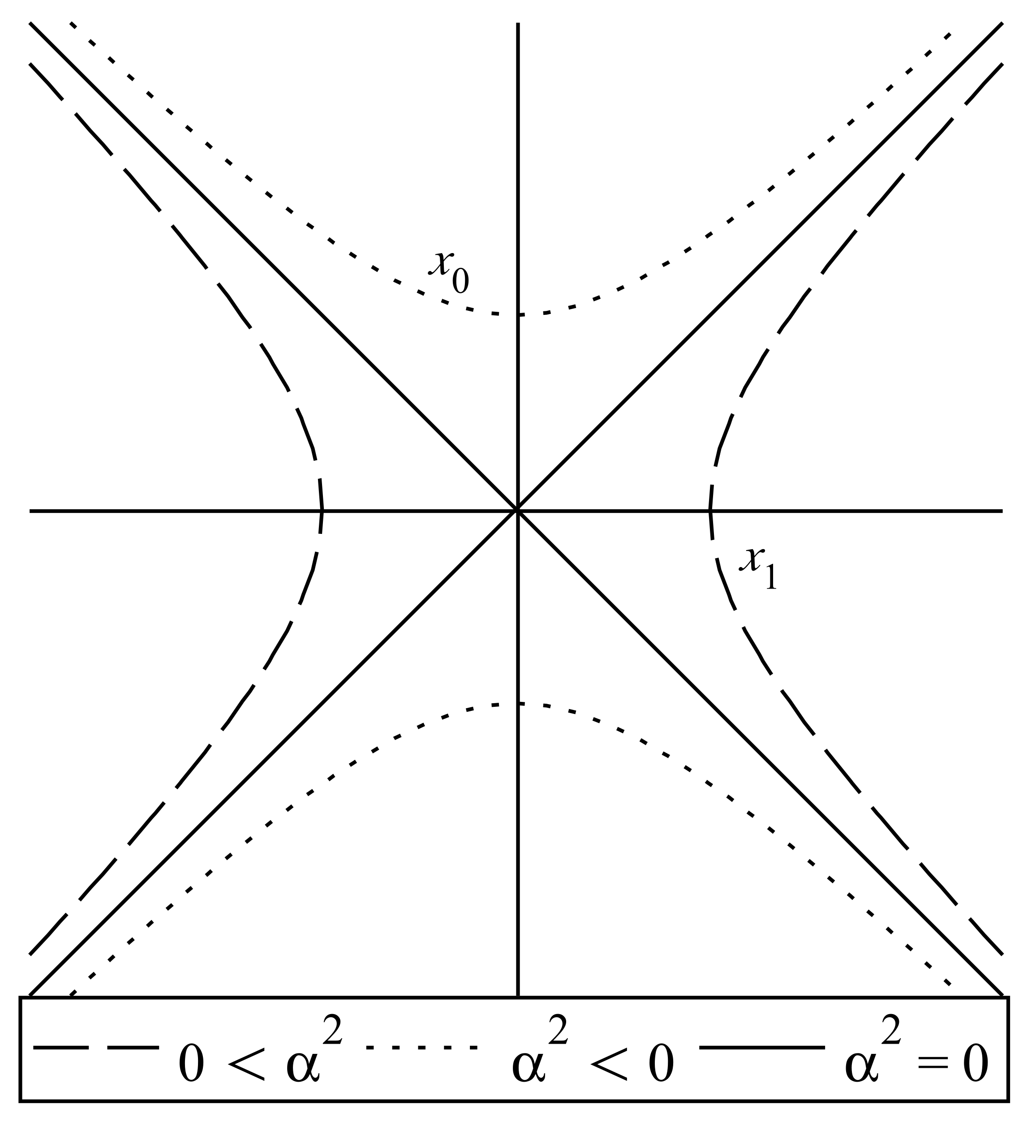
The maximally symmetric solutions of Rμν=Λgμν—the geometries isotropic about every point—are, up to the sign and magnitude of Λ, a one-parameter family fixed by the single signed scale α2≡3/Λ [JanzenThesis, § sec_RPT]—positive for the de Sitter member, negative for anti-de Sitter, and infinite at Λ=0, with α itself the curvature radius wherever α2 gt;0. They are usually met as hypersurfaces embedded in a flat five-dimensional space,
which is a convenient picture but not the manifold. Solving (1) for the fifth coordinate and substituting back gives the intrinsic four-dimensional line element,
in which x is a real four-vector in the tangent space [JanzenThesis, Eq. (sphere3)]. Equation (2) with -∞≤α2≤∞ describes every maximally symmetric four-dimensional geometry; the whole family is one intrinsic object read at different values of the single scale α2=3/Λ.
The fifth coordinate is not a coordinate of the manifold
Here is the fact the paper turns on. For every case other than the Riemannian cap of the positively curved member (α2 gt;0 and α2 gt; x2), the embedding coordinate x0=±√α2- x2 is purely imaginary, and the embedding is written in an imaginary “Minkowskian” space M5≡C×R3 by the replacement x0↦ix0. But x0 is not a coordinate of the four-dimensional manifold. By (2) the manifold is coordinatised by the four real xi, which are real regardless of the value of α2 [JanzenThesis, § following Eq. (sphere3)]. The imaginary fifth coordinate is a property of one embedding picture of the surface, not of the surface. This is established in [JanzenThesis], § sec_RPT.
\subsection{The Lorentzian signature is intrinsic to the positive curvature}
The metric read off (2),
has three positive eigenvalues always, and a fourth eigenvalue λ whose sign is fixed by the real data α2 and x2: λgt;0 (Riemannian) when α2 lt;0, when Λ=0, or when α2 gt; x2 gt;0; λ=0 (null) when α2=0; and λlt;0 (Lorentzian) exactly when x2 gt;α2 gt;0. The signature is thus read from the real metric of the real manifold; no imaginary coordinate is doing the work. And the two ways that sign can turn are of different kinds, which is worth separating. At fixed α2 gt;0 the Riemannian–Lorentzian crossing occurs at x2=α2, where λ passes through a pole: |λ|→∞ and the sign flips, the numerator being the constant α2 throughout. So the metric does not degenerate at the crossing—a signature change through λ=0 would send det g to zero and leave no metric there, and that is not what happens here. The one place λ does vanish is α2=0, the null cone: not a crossing within one member of the family but the family's own singular leafL19. This yields the proposition the programme's ontology stands on:
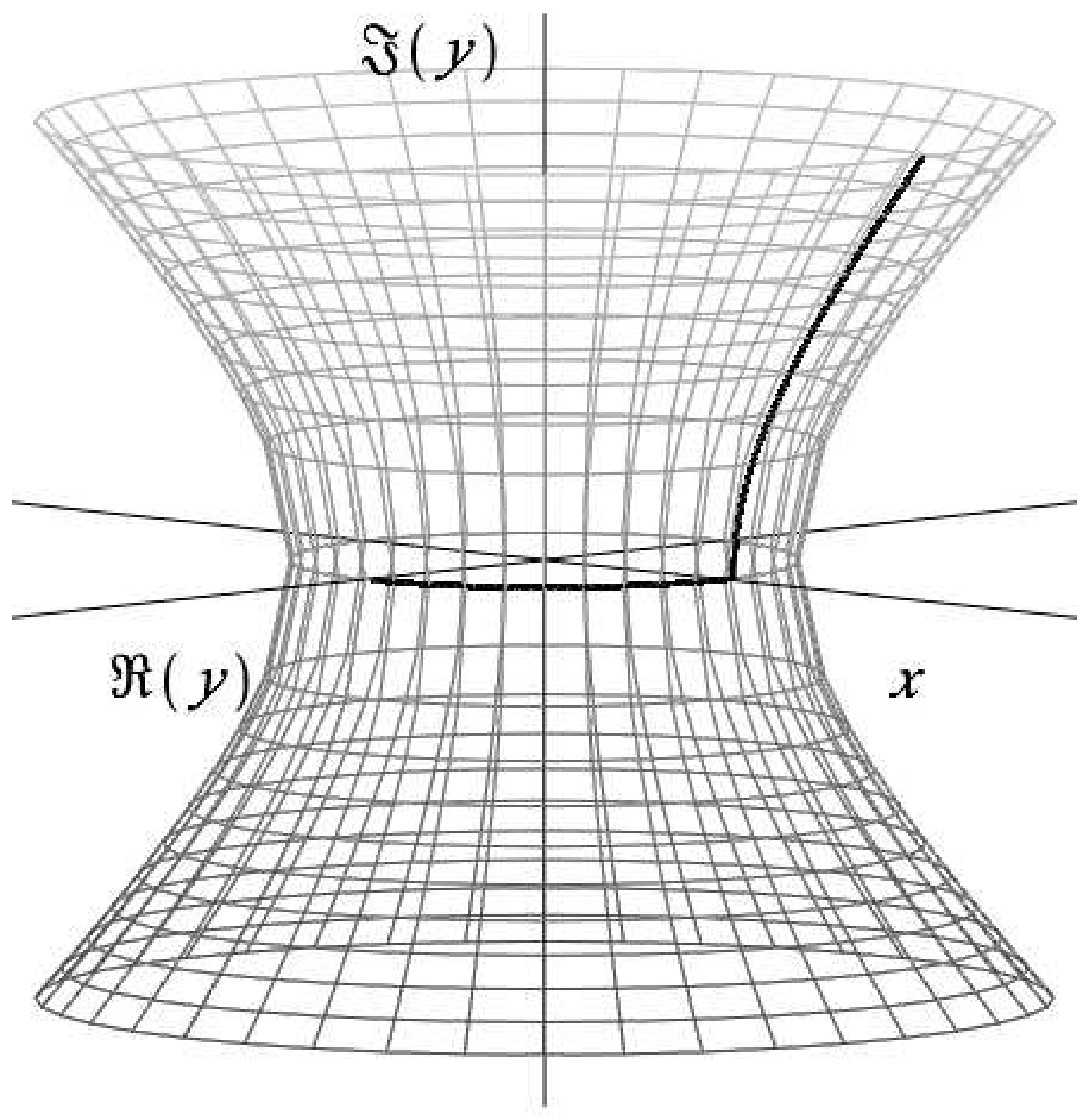
The corollary is the one the dissertation flagged as a speculation and then proved: the minimum radius of the surface and its Lorentzian signature are intrinsic properties resulting specifically from the positive curvature [JanzenThesis, § near Eq. (max_symm_cont)]. The locus r=α where a spherical chart of (2) appears singular is a coordinate singularity: the curvature is finite there, the line-element “pivots ninety degrees” and continues, and what changes is the chart, not the manifold (Fig. 1). De Sitter is the one-sheeted hyperboloid with a minimum radius; the signature and the throat are what its positive curvature is, intrinsically, when read on the real manifold rather than imposed by hand.
The one scale, read projectively: the Cayley–Klein absolute
That one scale has a classical name, and giving it settles what kind of object α is. Read projectively, the substrate is a Cayley–KleinL17 geometry [Cayley1859, Klein1871] whose absolute is the quadric η(X,X)=0—the null cone—and its geodesic separation is exactly the Cayley–Klein log-cross-ratio taken against that absolute, with the Cayley–Klein constant equal to α: for a timelike pair, τ=(α/2)| log CR|; for a spacelike pair, the corresponding angle; and the discriminant 4α4(u2-1) in u=η(P,Q)/α2 decides which, according as the joining line meets the absolute or misses itP17R12. So α is not a length inserted into a metric but the constant of a projective geometry whose absolute is the light cone, which is the same fact the signature proposition above states metrically.
A second projective fact follows at once, and it settles how the background sits in the substrate. Since a point P of the substrate has η(P,P)=α2 gt;0, its polar hyperplane with respect to the absolute, {X:η(P,X)=0}, carries signature (1,4), so the substrate cut by it is a totally geodesic dS4 of isometry SO(4,1)P17R13. That subgroup is a sweep-subgroup of the substrate's SO(5,1), which is the criterion by which a four-geometry is a cut [JanzenRange]; and being the maximally symmetric such cut it is the dS4 background itself. So polarity is how the background sits in the substrate—the background is the polar slice of a substrate point, one for each point and none privileged, the point a slice is polar to being what selects it. It is the polarity of the absolute, and the throat protocol runs on the other one the construction carries: the polar of P with respect to the substrate quadric, {X:η(P,X)=α2}, is the tangent hyperplane at P, parallel to the absolute's polar through the origin (Remark 1).
\section{The Λ-completed vacuum as the universal standard of physics}
The real manifold of §1 is not an inert stage. Its curvature radius α=√3/Λ is the one length the vacuum carries intrinsically, and it is against that length—and against the null cone locked to it (§4)—that everything else is measured. This is the physical content of the cosmological constant, and it is why the substrate is the object it is. The argument is Eddington's, sharpened by the century since and by this corpus's results.
Eddington's intuition, at weight
Eddington read Einstein's law Rμν=Λgμν as the statement that the radius of curvature of empty space is a constant length √3/Λ in every direction at every point [Eddington1923]. He then made the move that matters: length is not absolute, so “constant length” can only mean constant relative to the material standards of measurement. Inverted, the law reads The length of a specified material structure bears a constant ratio to the radius of curvature of the world at the place and in the direction in which it lies. So the electron's radius in any direction is a numerical constant times the radius of curvature of spacetime in that direction, and—his phrase—
This is the intuition Eddington packed into “to drop the cosmical constant would knock the bottom out of space” [Eddington1933]—a remark a later generation dismissed [Chandrasekhar1983], and which Proposition 1 vindicates precisely: setting Λ≤0 removes the one real maximally symmetric manifold whose Lorentzian signature is intrinsic, and so knocks the relativistic metrical structure out of the vacuum.
Where the intuition was right, foggy, and wrong
Eddington reached the right object and misread its status, in ways the present construction lets us correct sharply.
Right, and now unified. He had two standards—a length standard (the radius of curvature) and a symmetry standard (the light cone)—and left them side by side. The equilateral-pseudo-sphere result unifies them: for the one-sheeted hyperboloid, maximal symmetry forces the equilateral profile a=b, whose asymptote is locked at the null cone and whose waist is the curvature radius, so c (the null-ruling gauge) and Λ (the scale) are the asymptote and waist of a single surface, meeting in the rate H=c√Λ/3 (§4; [JanzenCRframework]). Eddington's length standard and light-cone standard are one standard, because the substrate that carries them is one maximally symmetric object.
Foggy, and now overturned. Eddington concluded that “the symmetry and homogeneity expressed by Einstein's law is not a property of the external world, but a property of the operation of measurement”—the anisotropy of a skewed world would enter both the measured structure and the measuring rod and cancel. That deflation is the one thing the corpus directly overturns. By §1 the maximally symmetric substrate is the real intrinsic ground state of the vacuum ([JanzenThesis], whose maximal-symmetry result is stated for the four-dimensional background; the void's basic state a real maximally symmetric manifold), not an artefact of comparison. The symmetry is a property of the world; and it is because it is a real property of the world—one standard, the same at every point—that measurement is universal. Eddington had the dependence backwards: universality of measurement is the consequence of a real symmetric substrate, not the source of an apparent one.
Wrong, and now corrected. Eddington held that there is “no radius of curvature in a timelike direction” (he was working in Euclidean coordinates with x4 imaginary time), and drew from it that an electron, having no temporal standard to measure itself against, “just goes on existing indefinitely.” The error is exactly the imaginary-time misreading §3 dissolves: de Sitter's Lorentzian signature is intrinsic (Prop. 1), its time-dimension as real as its space-dimensions, so there is a radius of curvature in the timelike direction. The vacuum is a consistent measuring stick throughout space and time [JanzenThesis]—and that intrinsic temporal standard is the objective cosmic-time lapse the programme later measures directly from the redshift isotropy [JanzenModernParallax]. The electron's persistence is not the absence of a temporal standard; the temporal standard is there, and it is the same maximal symmetry.
The universality of physics is the maximal symmetry
Collecting the corrections gives the physical statement the geometric core carries. The Λ-completed vacuum equation Rμν=Λgμν furnishes, in its unique intrinsically Lorentzian maximally symmetric solution, the complete universal standard: the intrinsic length α, the intrinsic null structure c, and—
The horizon problem, properly stated
The same result settles, in the language cosmology already has a name for, a problem usually posed the wrong way round. The horizon problem is standardly stated as: why is the cosmic microwave background uniform to a part in 105 across regions that, on the standard expansion history, were never in causal contact? So posed, it demands a mechanism to communicate a common condition across a horizon, and inflation supplies one. But the deeper form of the question is not about temperature: it is why the electrons and photons at the last-scattering surface are the same electrons and photons, obeying the same physics, as those on Earth—how a causally distant patch knows how to be what our patch is. That is precisely the question the preceding subsection answered for an electron bound for the Coma cluster: a specified material structure is the same structure everywhere because there is one intrinsic standard everywhere, which is the statement that the substrate is maximally symmetric.
On the geometric core there is nothing to communicate. The universal standard—the curvature length α, the null cone locked to it, the real temporal extent—is an intrinsic property of the one maximally symmetric substrate (Prop. 1), present at every point by the symmetry itself, not a condition that had to propagate from region to region and could therefore fall foul of a horizon. The uniformity is not the residue of an early causal contact; it is the maximal symmetry of the substrate, the very fact that makes physics universal. CR thus does not solve the horizon problem by finding a faster channel; it dissolves it, by locating the uniformity in the intrinsic standard rather than in a shared past—there was never a gap to bridge. The uniformity of the microwave background is read here as an instance of the substrate's maximal symmetry, which places it at the same altitude as the universality-of-physics identification above: the intrinsic standard is established (Prop. 1), and the identification is the same reading in a second application rather than a further result.
Reached through the imaginary, real everywhere it lands
Proposition 1 recasts every imaginary variable in the construction as an instrument, not an ontological ingredient. Each of the instances below is already in the corpus, and each is the same move:
The embedding coordinate. x0↦ix0 makes the surface easy to see as a hyperboloid in M5; by §1 it adds nothing to the manifold, which is the real (x) surface either way. The Riemannian and Lorentzian members differ by their extrinsic embedding curvature (Fig. 2); intrinsically each is a real manifold whose signature (3) reads off its own real metric.
The equatorial seam. Where the slicing curve runs tangent to the throat, the Riemannian cap joins the Lorentzian horn by the analytic continuation θ↦π/2+iψ, sin θ↦ cosh ψ; the signature of the two-dimensional slicing surface flips because dθ=i dψ squares the continuation factor to -1 [JanzenSlicing, prop. flip]. The guard the slicing paper states, and that this paper generalises, is decisive: the spacetime is Lorentzian throughout; the flip is confined to the 2-surface, and the continuation is a real analytic continuation (sin and cosh one function), not a Wick rotation into a Euclidean spacetime. The seam is a real feature of the real manifold, reached through an imaginary angle.
The conjugacy circle. The circle paper's ring r(z)=M(1+ cos z) has the horizon and r=0 as its two poles, and the continuation that opens the first into the two exteriors, z↦±iρ, opens the second by the same step: z↦π±iρ' carries the curve through r=0 onto two regions at negative areal radius [JanzenCircle]. On the substrate that continuation is the lap. The signed areal radius runs through the branch point onto the conjugate branch, a real branch of the one Lorentzian manifold and not a Euclidean excursion [JanzenSlicing]; along the lift, from the comoving turnaround to the branch point, the cosmic time of the bead law r3=2Mα2 sinh2(3 τ/2α) leaves the real axis, its imaginary part bounded by πα/3 and reaching that bound at the turnaround, while r stays real at every point [JanzenCRframework]. The two imaginary readings are exchanged by the reality involution τ↦ τ, antilinear and geometric, whose fixed set is the real axis; the phase structure it carries at the seam is decided in §8. An imaginary parameter, then, and a real curve: the conjugate branch is reached through the conjugacy and lands on real points of the one substrate.
The cosmogenesis reassignment. The correspondence that makes collapsed matter a universe is a signature-preserving causal reassignment on the real Lorentzian horn; the compact Wick face, where a continuous su(3) would live, is real by construction but is not a co-equal existent (it carries no clock) [JanzenBoundary, § decoupling, § face-status]. The matter rides the real horn; the imaginary face is a face, not a second reality.
The horizon radii, where the instrument is not optional. The paragraphs above are places the corpus chooses an imaginary route and a reader may fairly answer “then do not take it”. There is one further instance where that answer is unavailable, and it is the construction's own central algebraic object. Over the field Q(2M) of the mass parameter the horizon cubic r3-r+2M is irreducible—by the Gauss's-lemma argument the groupoid paper gives, which is a statement about degree in 2M and is indifferent to whether the base is taken real or complex [JanzenGroupoid, § galois]—and below the Nariai mass its discriminant 4-27(2M)2 is positive, so its three roots are real and distinct. That is exactly the hypothesis pair of casus irreducibilis, whose conclusion is that no root of such a cubic lies in any real radical extension of the base: the three real horizon radii admit no expression in real radicals as functions of the mass, and every radical route to them passes through C. So for this object the imaginary is not an instrument of visualisation but the only available road, and the roots it lands on are real—which is the law of this section, met in the one case where it could not have been arranged.RL16 The regime dependence is the same asymmetry the groupoid paper reads off the monodromy: above the Nariai mass the discriminant is negative, one horizon is real, and its radical expression is real again—so the forcing belongs to the under-critical side, where the family's S3 acts on real labels, and not to the other, where only the transposition does [JanzenGroupoid, prop. deck]. No selection is claimed from this. The specialised cubic is reducible with real-radical roots at M=0 and at the Nariai mass, but also at 2M=3/8 and at every rational r0 through 2M=r0-r03; the reducible masses are dense in the parameter and pick out nothingR. The forcing is a statement about the family over Q(2M), where there is no specialisation to escape through.
The straight null rulings: the light cone is the visible peak
The most visible face of the intrinsically real geometry is its null structure, and it was drawn in the same dissertation chapter. On de Sitter the null condition 0=-dx02+i dxi2 makes the null-lines straight lines on the curved real surface in the flat embedding: a null particle traverses an angle π/2 on αlt;r lt;∞, and two null-lines separated by π at the throat run parallel through the embedding and never meet [JanzenThesis, Eqs. following (null_eom)]. The surface is doubly ruled by straight null lines, and the rulings are the reassigned generators the null-boundary correspondence acts on [JanzenCRcosmology].
This is the geometric substrate of the c–Λ result the framework paper now carries [JanzenCRframework, § 662-region]: for a one-sheeted hyperboloid, maximal symmetry forces the equilateral member a=b—the profile whose rulings meet perpendicular at the throat and whose asymptote is locked at the null cone—so c is the null-ruling gauge, Λ the sole free scale, and the two meet only in the expansion rate H=c√Λ/3, with the curvature–tilt relation tan θ=a√-K specialising to the locked cone. What §1 adds is the ontological reading of this: the rulings are real straight lines on a real surface; c fixes their slope, the throat curvature 1/α2 their scale, and both are intrinsic to the one real equilateral pseudo-sphere. Maximal symmetry has a dynamical reading too, and it is the strongest available. A maximally symmetric D-manifold carries the largest isometry algebra any D-manifold admits, of dimension D(D+1)/2, and each Killing vector contributes one linear first integral of the geodesic flow: fifteen integrals for the substrate's five degrees of freedom, ten for the background's four. Liouville integrability asks for D in involution and maximal superintegrability for 2D-1; both are met with room to spare, 15≥9 and 10≥7. So the substrate's geodesic flow is not merely integrable but maximally superintegrable—the dynamical face of having no distinguished point or direction, since the isometry group then acts transitively on the unit tangent bundle and all geodesics are one geodesic seen from different vantages. Every cut lowers the count: the isotropy strata of the algebroid paper are that descent, from fifteen here to the wall's zero, where only the norm survives [JanzenAlgebroid]L14. The c–Λ structure of the framework paper is the tip; the intrinsically real ruled geometry is the iceberg beneath it. The rulings are established in [JanzenThesis]; the equilateral-forcing and c–Λ [JanzenCRframework]; the ontological reading is collected here.
The power of a point is the height: the null structure in Euclid's own quantity
The rulings are the substrate's null structure seen from outside. There is a second face of the same fact, and it is older than the geometry: the null condition on this surface is a classical theorem about circles, and the theorem is about the throat.
Read the substrate's overhead projection—the equatorial plane, on which the throat is a circle of radius α. For a point P of the projection at distance |X| from the axis, the power of P with respect to that circle is
the invariant Steiner attached to a point in 1826 [Steiner1826]: the constant value of PA· PB along every line through P meeting the circle at A,B, and, for P outside, the square of the tangent length (Euclid III.36 [Euclid])L1. But the hyperboloid -x02+|X|2=α2 says that the same combination is the point's own height,
So pow(P)=x02: the power of a point with respect to the throat is the square of its height in the embedding. The tangent from P has length √ pow(P)=|x0|; it therefore runs exactly as far across as the point stands high, and in a metric of signature (-,+,…,+) that is ds2=-x02+|x0|2=0.
power_of_a_point.pyP17R4, power_is_null.pyP17R5.) □This is the rulings of §4 in a second register, and the two identify: a ruling meets the throat tangentially, so the rulings are the tangents Proposition 2 describes, and “doubly ruled by straight null lines” and “every tangent to the throat is null” are one statement. What the classical register adds is reach: the proposition is about every point of the overhead, not only the ones a ruling happens to pass through. The sightlines of the projection that touch the throat are light rays; those that cut it are not, and the distinction is Euclid's own—the power theorem is about secants, and the null condition is its degenerate case, where the secant's two points merge. The null character is the embedding's, and it is worth being exact about where it lives: the equatorial plane carries a positive-definite restriction of η, so no displacement within the plane is null. What is null is the corresponding displacement on the substrate, from the vantage lifted to its own height X0=√ pow to the point of tangencyP17R10. The planar figure is the shadow of that null line, which is why the power of a point reads the light cone at all. The tangent is exactly where the light cone is.
Two ingredients of (5) are modern and it is worth marking both, since the temptation is to count one. The first is the minus sign—the Lorentzian signature, without which the tangent's length and the point's height are two numbers that happen to agree. The second is power itself: Euclid proves a relation among segments; it was Steiner who shifted the focus from the chords to the point and named |d2-r2| an invariant belonging to it [Steiner1826]. Equation (5) needs the invariant, not the relation. That second move is the one this programme makes everywhere: it is the same move as reading the cut's offset r0 not as a coordinate of the construction but as the mass itself [JanzenSlicing, JanzenOperator]. (4)–(5) and Proposition 2 are identities, verified; the one-circle bound of Remark 1 is established by the identity's own dependence on the waist; the historiographic reading is collected here. The bound of Remark 1 is where the classical catalogue stops returning causal structure. The pole–polar relation, the radical axis of the throat and the circle that places the hinge, and inversion in the throat each return the same object—the chord of contact of a point's two null tangents, which is that point's horizon on the throat—by three routes sharing no machinery; Ptolemy, La Hire's reciprocity, and Casey's bitangent identity [CoxeterGreitzer1967, Coxeter1987b, Casey1866] each hold on the figure and return nothing, for the three reasons the remark names. The catalogue, its receipts, and the failures that drew the boundary are recorded in the programme's figure-theorem ledger (L1, with storyboard_receipts/); what is carried here is the identity, its bound, and what the catalogue returns.
Two things about that boundary are worth stating together, because they are the reason to trust the reading rather than merely to admire it. The first is that it is measured, not posited: the classical catalogue read against the throat theorem by theorem returns causal structure exactly where the remark predicts and nothing elsewhere. The second is what it returns where it does. The pole–polar relation gives the chord of contact of a point's two null tangents; the radical axis of the throat and the circle that places the hinge gives the same line without mentioning a tangent; inversion in the throat gives it a third time, as the image of that circle. Three classical constructions sharing no machinery, one line—and the line is the vantage's horizon. None of the three is confined to the equatorial figure. The pole–polar relation is the quadric's own, and returns there what (5) already givesP17R11; inversion in the throat extends as the algebraic identity η(P,P*)=α2 for P*=α2P/η(P,P), holding off the equatorial plane and at either signature of η(P,P), an involution whose fixed set is the whole substrate of which the throat is the equatorial sectionP17R7. The bound of Remark 1 therefore governs all three routes in the full space exactly as it governs them in the projection. Euclid's tangent–secant theorem, read on the same figure, locates the light cone: along a sightline through the throat the near intersection is timelike-separated from the vantage and the far one spacelike, and the interval vanishes at the geometric mean of the two segments—exactly the quantity III.36 identifies as the tangent length. The triple-angle identity returns the Nariai configuration. The nine-point circle of the hinge triangle is the throatL1.
None of that is new physics, and that is the point. Every one of those results is already established in this corpus—the horizon, the light cone, Nariai, the throat's radius, the perspectival reading of the mass—and each is reached here by a route sharing no machinery with the one that established it. A reading that returned new physics from a two-thousand-year-old theorem about circles would be an object of suspicion; one that returns what the construction already proved, repeatedly and from unrelated directions, is doing what a faithful dictionary does. The classical geometry is therefore not evidence for the physics, and is not offered as any: it is a second way of seeing an object the construction arrived at first, and the agreement of the two readings is the only thing either can honestly be cited for. Nor is the reach of the agreement a mystery to be marvelled at. That so much of the classical theory of the circle turns out to speak about causal structure is accounted for entirely by Remark 1: it speaks about causal structure exactly when it speaks about the power of a point with respect to this one circle, and this one circle is the waist of the substrate.
Maximal symmetry, worn seven ways
The reality of the substrate is the reality of the maximally symmetric Lorentzian manifold (Prop. 1); its standard-hood is that same manifold serving as the universal measure (§2). We now state the third face: that maximal symmetry—the isometry group SO(5,1) complete and exhausted—is the single root of seven results the corpus establishes separately. And the list has a geometric substrate of its own worth naming before it is read: the four-geometries it ranges over are the polar slices of the substrate's own points (§1), one background for each point and none privileged, so the many ways the substrate is read are indexed by the substrate itselfP17R13. The seven are each established; reading them as one fact is this paper's thesis, decidable by the test in §8.
- Necessity and sufficiency of the augmentation. CR is the necessary and sufficient augmentation of general relativity for a description of structural existence, the necessary half measured [JanzenModernParallax, JanzenCRframework]. Maximal symmetry is what makes the substrate the least-arbitrary vacuum such a description can be cut from—least-arbitrariness being the programme's own criterion of necessity (Rule 2 of [JanzenShadowExistence], read in the ontological register): a symmetry-breaking modulus is the adjustable parameter that criterion rejects, and maximal symmetry the unique structure that requires its configuration, so the substrate's selection is an instance of the discipline's own load-bearing rule rather than an added axiom.
- The constraint algebra is the symmetric-space grading. General relativity's own hypersurface-deformation (Dirac) algebra is the symmetric-space grading so(5,1)= h⊕m of the substrate—two normal deformations bracketing into a tangential one being exactly two coset directions bracketing into the isotropy, term for term—and the “wrong-sign” structure function standardly recognized at the root of the problem of time is the substrate's own Lorentzian coset metric, so the obstruction dissolves into a single geometric fact: the base-dependence of that metric [JanzenAlgebroid]. Named in the standard language the chain is shorter still: for a homogeneous space the action algebroidL5 of G on G/H is the Atiyah algebroid of G→G/H, so the grading is the exact sequence 0→h→so(5,1)×C→T C→0 with h the kernel of the anchor and m its image—and a splitting of that sequence is what a connection is, so a choice of lapse and shift is a connection in the standard sense. The problem of time is then the statement that this bundle carries no flat one: the structure function varies over the space of cuts C, so no splitting is integrable, and there is no canonical time because there is no canonical horizontal distribution. Maximal symmetry, read at the canonical rung, is what GR's constraint algebra already was and what dissolves its problem of time—established on the symmetry-reducible sector, the finite so(5,1) reduction.
- One scale; the constants are gauges. The hinge figure makes the point before the constants do: its incircle is the throat, at α; its circumcircle passes through the hinges, at 2α; its excircles stand at 3α. Those are one scale read at 1:2:3, not three—each is α times a dimensionless constant of the equilateral triangle, so neither 2α nor 3α carries information α does notL1. The substrate carries a single dimensionful scale, Λ; the constants through which physics is written on it are unit gauges. c is the null-ruling slope of the equilateral pseudo-sphere (§4), meeting Λ dimensionally only in H=c√Λ/3; G never appears alone but only as the source's gravitational radius GM/c2, the mass M perspectival and fixed to the Nariai value by Λ in the cosmology (ΛG2M2/c4=1/9) [JanzenCRframework]; ℏ enters only at the seam, scaled by Λ alone, the de Sitter horizon's thermal state [GibbonsHawking1977] closing the scale factor's lone self-adjoint-extension freedom without a free parameter [JanzenCanonicalTime]—and lone there is a dimension count rather than a manner of speaking, the radial operator having deficiency indices (1,1) so that von Neumann's extension theory gives a U(1) of self-adjoint extensions and exactly one real parameter, which is the parameter the horizon's thermal state spendsL10; and kB converts that horizon temperature to energy. So the gravitational–cosmological–quantum sector spends no free dimensionless constant in its geometric ledger—every would-be free parameter is a unit gauge or a freedom maximal symmetry has already spent (the perspectival mass fixed at Nariai, the quantization closed by the horizon). The claim is about those constants and carries one scope, which is stated here rather than discovered later: the graviton tower's mode sums are regularised, and their log-scale coefficient is computed and does not vanish [JanzenCanonicalTime]. So the sums spend one dimensionless constant. What is measured above — the unit gauges over the one curvature scale — stands untouched by that; what does not follow is that nothing in the sector spends one. And the count that decides this reading has been run. The sector's non-symmetric residue is one and is already counted: maximal symmetry leaves a one-dimensional quotient which is the scale, so no constant it fails to reach remains, and the matter sector spends none of the geometric budgetR. What the count leaves is not a constant but the matter's own content—the composition the corpus carries as empirical, exactly as flat ΛCDM carries η. The source facts are each established and cited, the sector's free-data count of zero is carried by that count, and the theory's remaining free datum is the matter's.
- The cosmology's rate is parameter-free. With Λ the sole scale, the low-multipole deficit, the transmission character, and the geometric expansion rate carry no tunable freedom. What the cosmology takes from the data is its epoch and its expansion rate, fixed together by the baryon-acoustic distances and the acoustic angle [JanzenCRcosmology]. The rigidity is two-sided, and that is its discriminating power: the rate matches the distance ladder and the abundances, and the acoustic shape is a falsifiable prediction: the full-spectrum likelihood holds the computed temperature spectrum short of the control on shape, the disagreement sitting in the one assignment of the rate the projection's distance is built on, the low multipoles a cosmic-variance-limited wash and the damping-scale signature a Gaussian residual of the joint fit [JanzenCRcosmology].
- The continuous matter symmetry is excluded. su(3)⊄ so(5,1) precisely because SO(5,1) is exhausted; the same completeness that locks the constants leaves no room in the continuous isometry for a geometric colour [JanzenBoundary]. The complement is not empty, and the same completeness fixes it: the substrate dS5=SO(5,1)/SO(4,1) is topologically R×S4, hence spin with a unique spin structure, inherited by the four-dimensional cut; and the one orientation parity R∈O(5,1)∖SO0 [JanzenAlgebroid] reflects the cut-normal (r0) direction, acting on the cut's natural spinor as the chirality operator γ5 itself—the cut-normal being the transverse mass-modulus (the offset r0 that is the mass), whose Cl(1,4) generator is γ5—so the substrate's single orientation Z2 is the chirality grading, measuring left against right as it carries the graviton's helicities. And the discrete residue is larger than the orientation parity alone, by a route that uses only what the substrate already carries. The horizon roots carry surface gravities, hence a residue pairing on the triple; that pairing has a holonomy about the Nariai points—the per-root resolution of a square root the Galois statement takes in the product—and adjoined to the monodromy symmetry it closes the Weyl group of so (6,C), this substrate's own complexified isometry algebra [JanzenGroupoid, JanzenAlgebroid]. The A2 the corpus reads off the cubic is the sub-root-system obtained by deleting one node of that A3, so the discrete structure is not an addition to the object but a fuller reading of it—which is this paper's thesis applied to itself. So the exhausted isometry does not merely wall a continuous matter symmetry; it fixes a discrete one, the fermion chirality identified with the substrate's own orientation parity. What the residue supplies is the fermion sector's arena, its chirality grading, and its discrete generation-structure—built and forced within CR rather than conjectured; the content it grades—the mass values, the electroweak scale—is the ordinary route, not the geometry's, so CR's claim is a gravitational–cosmological unification, not a geometric unification of matter [JanzenBoundary]. The residue's discrete content is moreover a linear orientation skeleton—the parity P, a time reflection T, the γ5 grading, and the R-parity carrying the fundamental 3 to its antifundamental 3—whereas charge conjugation, antilinear where those act linearly, is field-level like the charge it acts on (the substrate carrying it as a symmetry and not a datum—the metric even in the charge, its sign the bend of the cut [JanzenRange]); so a geometric CPT is not auto-yielded, the geometry supplying the orientation skeleton of matter and its antimatter—the discrete 3⊕3 the R-parity relates, matter and antimatter on one footing within CR [JanzenMatter]—and not the charge, which is field-level on both branches alike—the same partition once more, the residue the arena, the grading, and the skeleton, the content and the charge the ordinary route [JanzenBoundary]. The antilinear structure is not, however, exhausted by the field level, and the boundary the residue draws encloses a positive shape: the reality involution τ↦ τ on complexified cosmic time is antilinear and geometric, so charge conjugation factorises into a geometric kinematic (Feynman–Stückelberg) face—carried by the bead's own r=0 crossing, so that the cosmogenesis carries C's kinematic content—and the field-level charge sign alone, a geometric CPT staying unyielded because only the charge closes from the field, and this face realised on the built fermion sector's zero-modes [JanzenBoundary, JanzenMatter]. The spin structure and the γ5-action are grounded: the parity measures chirality (the exchange reading excluded by explicit computation, since R reflects the transverse cut-normal and fixes the four spacetime legs), detailed in the boundary paper [JanzenBoundary]; the same parity grades mass in both faces—the geometric mass-reflection r0↦-r0 (whence 2M↦-2M) and the R-odd fermion mass term—so mass, geometric or fermionic, is the substrate's one R-odd datum. And that identification carries further, so we develop it here rather than leave it in a clause. Read at the electroweak sector it says that what the Higgs mechanism breaks is this parity: the R-symmetric sector is the offset-free, massless configuration and mass is the R-odd departure from it. What is thereby claimed is a mechanism and not a magnitude—the vacuum expectation value, the electroweak scale and the individual masses stay the ordinary route, as this paper says throughout and as the one-constant structure requires. But three further things follow, and each is a property of the slicing relation the companion paper already carriesP17R16, 2M=r0-r03 in the gauge α=1 [JanzenSlicing]. First, the mass-reflection above is an identity of that relation rather than a further assumption: the cubic is odd, so r0↦-r0 sends 2M↦-2M exactly. Second, the symmetric sector is the bare substrate. 2M=0 at r0=0,±α, and the metric function is 1-r2/α2 at all three—one massless geometry read at three offsets, so the unbroken phase of this breaking is de Sitter itself and not a separate configuration. Third, and this is the part that distinguishes the geometric statement from the field-theoretic one it is being set beside: the order parameter is bounded, and its bound is the degenerate member. Over the admissible offsets |r0|≤2α/√3—the regime range the slicing paper reads off the discriminant 4-3r02—the mass satisfies |M|≤α/3√3, with equality at r0=±α/√3 and at the range endpoints, and that value is the Nariai mass, obtained independently as the double root of the horizon cubic. A quartic potential is unbounded in its field; this order parameter is not, and it saturates exactly at the configuration a collapse reaches [JanzenCRframework]. And the breaking has a cause here rather than a chosen minimum. The companion paper does not posit the offset: it derives that a manifold observer cannot be assumed to sit at r0=0, because the reference such an observer actually has is the hole's image on their celestial sphere and there is no marked point on that image for a reticle to land on [JanzenSlicing]. So on this reading the symmetry is broken because of what a reference is, not because a potential was written with its minimum away from the origin. We state the limits of that with the same care. No vacuum expectation value, no scale and no mass value follows from any of it; nothing here derives the Higgs field, its potential, or the gauge group it breaks—and if that group were ever promoted from described to forced, the relation this paper draws to it would have to be re-examined rather than inherited [JanzenBoundary]. One candidate centrepiece stands here: the residue's full automorphism Aut(A2)=S3×Z2≅D6, read on a fermion sector, carries the shape 3×2—three chiral seats times two chiralities—the Z2 the γ5 grading just fixed, the S3 permuting the three mass-tied roots of the offset-mass cubic (the discrete su(3)-Cartan–Weyl shadow [JanzenAlgebroid]), a 2M-degenerate triplet on three seats whose splitting would be a separate breaking; the chirality factor grounded, and the seat factor built and forced within CR [JanzenMatter], with the generations themselves seated on the comoving turnaround's cyclic three (ibid.); and the descent onto a propagating spinor sector is built on the chiral member, which is the unpolarised one, a Dirac field there propagating on the light cone and carrying the twist on γ5 alone [JanzenDynamics], the chirality-asymmetric action on it permitted and not selected [JanzenMatter]. The same A2 skeleton is realised in the geometry itself: the slicing paper draws the hexad as a skew hexagon of null rulings across the substrate's two horns, each horn's three vantage-hinges designating the three roots [JanzenSlicing]. Whether that geometric six-fold is the same hexad as the seat triplet here—the one exchanged by the geometric time reflection, the other by the offset parity R, two distinct O(5,1) reflections that both swap the null rulings—or a resonance of shared abstract type, is settled rather than open: the slicing paper establishes it as a resonance and not an identity—the horn-swap T (timelike, horn-flipping) and the offset parity R (spacelike, horn-preserving) being distinct reflections that share the fundamental triple and complete it distinctly [JanzenSlicing], verified on the six points. The chiral content this parity would grade is not built here.
- One circle: the equator is what the construction is built on. The substrate has exactly one waist (Rem. 1), and its radius is the curvature: α=√3/Λ, the sole scale (§2). What the construction is built from is a set of facts about that one circle, and they are one fact. The power of a point with respect to it is the square of the point's height, (5), so the tangent to it from any point of the substrate is null (Prop. 2) and the rulings are those tangents (§4): the double ruling and the classical power law are the same statement, set by α and by nothing else, and the power vanishes identically on the circle itself (x0=0). That circle is the incircle of the hinge triangle and its nine-point circle besidesL1, so the hinges stand at 2α as an output of the hole rather than a stipulation, the three sides are the Nariai double null rulings tangent at their midpoints, and the triple-angle identity returns the Nariai configuration of its own accord [JanzenSlicing]. The signed areal radius passes through zero at a point on that circle, so the three hinges' walls lie on it as a Z3-orbit whose three-foldness is the hole's own, and the fermion sector's three chiral seats are those three walls [JanzenMatter]. The generations are a different three: the walls carry the index that distinguishes constituents within a bound state, and the matter sector seats the generations on the deck Z3 of the comoving turnaround instead [JanzenMatter]. The slicing's lap runs around it, and through it the cosmological gravitational collapse of a black hole in a prior universe completes into the formation of a universe like our own—collapsed matter cannot terminate but continues as a cosmology—matter and antimatter the two ends of one conjugation across the crossing it carries [JanzenCRframework, JanzenBoundary]. And the count is not a fifth thing read off that circle but a statement about the circle's own two relations. The substrate's discrete residue is the direct product Aut(A2)=S3×Z2, whose two factors act on independent structures—the Weyl S3 on the three roots, the inversion on the two rulings [JanzenAlgebroid]. Read on the waist, those structures are the two things a figure can be to a circle: the three roots are the three special points on it (the offset line meets it at A and B, with r=0 fixed at the back) [JanzenSlicing], and the two rulings are the lines tangent to it (§4). So the residue factorises because on and tangent are independentL6, and the factors differ in kind for the same reason: a ruling is a line of the substrate, so exchanging the two is a motion of it—an isometry, acting on the cut spinor as γ5, and chirality descends as an isometry; a root labels a different cut, so permuting the three moves through the solution space and is no motion of the substrate—the monodromy symmetry of that cover, which is the Weyl S3 and not the turnaround's Z3 the generations bear (the two threes distinguished below)—and the seats' S3 is global. In this reading the Standard Model's arrangement—a chirality carried by spacetime symmetry beside a global flavour symmetry—is the difference between being on the one circle and being tangent to it. Maximal symmetry is why there is one such circle and not a family of them, and why α is the one length the exhausted isometry leaves to set it: the lines, the curvature, the placement, the count, and the passage are all read off the same waist.
- The universality of physics. One maximally symmetric substrate is one standard the same at every point; that a material structure is the same structure everywhere is that constancy of the standard (§2). Universality is not a postulate over the geometry but the maximal symmetry read as the invariance of the measure [JanzenThesis, JanzenModernParallax].
A consequence of the fifth face is drawn, and it is worth stating here precisely because it is not an eighth face. The residue's mass-parity—r0↦-r0, whence 2M↦-2M, the substrate's one R-odd datum—and the triple angle that fixes the discrete generation index are both statements about the cut, and written in a general dimension they cease to hold. The metric function in D dimensions is not assumed but obtained: the slicing operator's vacuum condition, which is the kernel of its matter functional on a cut in the construction gauge, reads rf'+(D-3)(f-1)+2Λr2/(D-2)=0 in D dimensions, and its entire solution space is the Tangherlini–de Sitter family f=1-2M/rD-3-r2/α2 with α=√(D-1)(D-2)/2Λ and M the single constant of integration [JanzenSlicing]. With that function the mass is 2M=r0D-3-r0D-1; the horizon relation collapses to a single multiple-angle in the sky angle only at D=4 and D=5, since the harmonics standing below the top one number two or more from six dimensions upward against a single available scale; and 2M is odd in the signed offset only when D is even, so at D=5 the parity fixes each geometry instead of exchanging it with its conjugate and there is no R for the residue to be. Four dimensions is therefore the only one carrying both a generation count and a chirality, and the corpus's three is its D-1 [JanzenSlicing, JanzenMatter]. The reason this is not a face of maximal symmetry is that it does not come from maximal symmetry. The substrate is maximally symmetric and moduli-free in every dimension, so the criterion of necessity has nothing to grip on the dimension itself; what selects here is the matter sector's own content, and the two statements are compatible only because they are about different objects—the cut's dimension is settled, the substrate's remains bounded below and not above. Reading this as a ceiling on the substrate would re-make exactly the error the distinction is drawn to prevent.
So the property that makes CR decisive against the world—no knob at any rung—is the property that makes its matter sector geometrically hard: maximal symmetry, having spent everything, leaves the cosmology nothing to tune and leaves the geometry no continuous structure to build matter from. The rigidity and the wall are one fact—and the count of free data makes it exact: with the gravitational–cosmological–quantum sector spending no free dimensionless constant in its geometric ledger—the graviton tower's mode sums spend one, computed at the frontier item [JanzenCanonicalTime], which is a regularisation and not a gauge—the theory's entire free-data budget—the composition and the fermion sector's own content—is carried by the matter, so matter is the residue maximal symmetry leaves not in field content alone but in free data. The descent onto a spinor sector [JanzenMatter] makes this precise at the discrete rung: the fermion sector's discrete structure—the generation multiplicity, the chirality, the seats' S3 and the generations' cyclic family symmetry—is forced within CR, drawn from the substrate rather than tuned, so it leaves the free-data budget for the residue; the budget then carries the fermion content alone—the gauge assignment and the mass values, the ordinary route, whose deeper structure is the open search. Those two entries do not stand alike. The gauge assignment is part delivered: twelve of a generation's fifteen Weyl fermions factor by the construction's own sheet index as colour, the horn and the ruling, the count agreeing state by state while the multiplet structure differs from the Standard Model's on exactly one right-handed pair [JanzenMatter]; and the three that do not appear are not merely missing, their absence following from the welding of unbranchedness to the colour index, which holds exactly at odd hinge count and so in even dimension. The mass values are in a different position: what is established there is where they do not come from—a Dirac eigenvalue on the Euclidean face is not a four-dimensional mass, there being neither a product to separate over nor a time for a mass to be the eigenvalue of—which relocates the entry without closing itP17R19. So the budget is smaller in structure than in count: tracing where a quantity is not fixed is not fixing it. The discrete half of matter is thus the stone's and the content half the search. The residue the wall leaves—developed from the discrete orientation parity into that full skeleton where matter's one geometric opening lives—is taken up in §6.
The geometric content of the ledger, and the fine-tuning problems the one scale dissolves
The constant rung is not bare unit-counting. On this fully determined geometry each gauge is a specific geometric feature: c is the null-ruling slope of the equilateral hyperboloid (§4), Λ the waist, and G the cut's offset—the mass is the offset of the section from the central geodesic, 2M=α ((r0/α)-(r0/α)3) [JanzenOperator, JanzenSlicing], so G enters only as the offset-length GM/c2 and is the identification of the mass-label with that offset, not a coupling of independent matter. That the members are sections of one substrate and a family of distinct solutions are not alternatives: the vanishing of the stress in this gauge is a first-order linear equation whose entire solution space is that one-parameter family [JanzenOperator], and the members are physically inequivalent — the offset changes the induced curvature invariants and the horizon radii, which no re-parametrisation of one geometry can do. So a variation along the family is a variation through solutions and not a re-slicing, which is what a first law asks of it. These three—c,Λ,G—are the gauges of the real Lorentzian geometry, each a nameable feature of the substrate and its cuts. ℏ and kB enter a different register: the de Sitter horizon's standard Gibbons–Hawking thermal state (period β=2πα) [JanzenCanonicalTime], a Euclidean continuation distinct in kind from the real-analytic imaginaries of §3. So whether “the constants are gauges” is mere unit-counting has a structured answer: the real-geometric gauges c,Λ,G carry CR-specific geometric identifications; the thermal gauges ℏ,kB are standard horizon thermodynamics, their CR-specific content the ledger's closing of the one quantum freedom, not a new geometric feature. The identifications and the register split are established at the cited sources; reading them as one partition is this paper's consolidation of them.
This settles what the Planck values are here. The traditional Planck length, mass, and time—ℓP=√ℏG/c3, mP=√ℏc/G, tP=√ℏG/c5—are combinations of these gauges, and cross-register ones, mixing the thermal ℏ with the real-geometric c and G. Since the ledger leaves exactly one physical scale (Λ, equivalently α=√3/Λ), a Planck value is not a physical scale but what unit-counting yields when it has only gauges to count. The one physical length is α, not ℓP; their ratio α/ℓP∼1061 (from ΛℓP2≈3×10-122 [JanzenCRcosmology]) is the size of the universe in gauge-units—a number, not a tuning.
One thermodynamic quantity belongs here, because its number is this one and a reader arriving from horizon thermodynamics will compute it. The de Sitter horizon whose Gibbons–Hawking state supplies ℏ above has area A=4πα2, so the Bekenstein–Hawking value carried on it is
which is the gauge-count just stated, squared, and nothing furtherP17R18. So the horizon thermodynamics introduces no scale the ledger has not already entered: S is a pure number built from α/ℓP, and ℓP enters it as the gauge it was shown to be rather than as a physical length the entropy is measured against.
And it is not merely of the same magnitude as the number the next paragraph meets; it is the same number. The cosmological-constant problem's factor is the ratio of the field-theoretic vacuum estimate to the observed ρΛ=Λ/8πG, which is 8π/(ΛℓP2); the entropy is 3π/(ΛℓP2). The two differ by 3/8 and by nothing else—both are 1/(ΛℓP2) read with a different numerical coefficient, and the 10122 of the one is the 10122 of the other rather than a coincidence of sizeRL21. So the reader who arrives with the entropy and the reader who arrives with the fine-tuning are holding one quantity, and the dissolution given below for the second is already the dissolution of the first: there is no physical scale for the ratio to be a tuning between, ℓP being a cross-register gauge-combination and not a length the world is built to.
This also says why the corpus takes this horizon's temperature and never its entropy, which is a structural difference rather than an oversight. The temperature is built from α and the thermal gauges together and carries a dimension; the entropy is a ratio of α to ℓP and is dimensionless, a pure count taken across the register split above. That asymmetry bears on which quantity the framework may quote and not on whether either holds, and what the cross-register quantity returns is the ledger's own number back. Whether the area law carries is settled per member rather than once, and the horizons this corpus uses do not fall alike. At the substrate's own horizon the Noether-charge construction has its hypotheses—a Killing horizon with non-vanishing surface gravity and a bifurcation surface—and a variation that reaches the horizon term, so the law carries there. At the forced member it cannot: the double root makes the surface gravity vanish identically, and at vanishing surface gravity the first law admits no solution for the entropy variation at all. That is undetermined rather than false, which is the sharper statement, and it is why the question has no single answer for the two objects. And at a collapse horizon there is no entropy to be determined: it is not a bifurcate Killing horizon and carries no distinguished cross-section, so the construction has no surface to evaluate the charge on. Its area is computable all the same—through the ledger's own 2M=α(u-u3) the ratio to the substrate's is (u-u3)2, largest at exactly 4/27 on the forced member—and an area is not an entropyP17R21. So the construction licenses exactly one entropy, the substrate horizon's, which is the one quoted here; and the horizon whose area does change across the family is the one carrying none. Were it to fail to carry, that would be a result and not a gap—a one-scale ledger forbidding a thermodynamic relation rather than merely accommodating one. The ledger, the register split and the Planck-value reframe are established above, and S=π(α/ℓP)2=3π/(ΛℓP2) together with its coincidence with the cosmological-constant factor is computed P17R18. What that leaves unclaimed is the value itself: the clause states what the number is if the standard expression is taken.
One consequence of that declination belongs with it, because it makes the branch consequential where this paragraph leaves it costless. A topological term—the Gauss–Bonnet combination—contributes no field equation in four dimensions [JanzenCanonicalTime], so a coefficient multiplying one is not read off any dynamics; its one remaining observable is a horizon-entropy contribution, and that contribution is topological, going as the Euler characteristic of the horizon cross-section [JacobsonMyers1993] and so contributing an area-independent constant. And the ledger has no absorber for a constant entropy shift as it has the one curvature for a constant vacuum energy: S=π(α/ℓP)2 is fixed once α is. And the branch is neutral to this ledger, which is worth establishing rather than assuming in either direction. A renormalisation condition is a constant of the quantum register, and this ledger's quantum content is stated above and is specific: the closing of the one quantum freedom, which is the self-adjoint extension. Three freedoms are distinct here—that extension, which the ledger closes; the regularisation of the mode sums, which spends one constant and is not the ledger's subject; and the finite part of a counterterm coefficient, which neither speaks to. A topological term's coefficient is of the third kind, so the declination above costs this ledger nothing either wayP17R2. What is particular to it is only where it would become visible: its one observable is an additive shift in the entropy, which is the quantity singled out just above as a count taken across the register split—so the register structure would be showing itself at the place this section says it does, which is a confirmation of that structure and not a debit against it.
This is where the framework renders its verdict on the two deepest fine-tuning problems of cosmology: the one scale dissolves both at once. Two results of projective geometry sharpen what “one scale” means here, and they belong with the claim rather than after it. First, the substrate's metric is not merely compatible with a single scale: read projectively it is the Cayley–Klein construction on the absolute η(X,X)=0, whose scale constant is α (§1)—and a Cayley–Klein geometry carries the scale as its only free constant, signature, null structure and isometry group all being fixed by the absolute's projective type.
The one-scale reading therefore has a classical mechanism and is not only the outcome of an exhaustive audit. Second, α is precisely what the causal structure does not fix: the group preserving the absolute is O(5,1)×R+, one generator larger than the substrate's isometry group, and that extra generator is the dilation carrying α↦λα [JanzenGroupoid].
So the null cone determines the geometry up to the scale, and the scale is the one thing it leaves—which is why there is a single dimensionful input and nothing for a dimensionless tuning to hide in. And the family that dilation sweeps out has a shape worth naming, because it makes the light cone structural rather than a limiting case.P17R3L17L8
The substrates of every α are the level sets of one quadratic form on the ambient, so the family is a foliation and the null cone is its singular member—the leaf at α=0—rather than an object of a different kind sitting beside the family. One expectation about that family fails, and its failure is structural rather than a gap. A confocal family of quadrics carries a classical orthogonality theorem, and in the equilateral case—which is what this substrate is—the confocal family is the dilation family, so the theorem looks applicable.
It is vacuous here: the theorem is not that confocal quadrics meet orthogonally, but that through a generic point pass three members, one of each type, and that those meet pairwise orthogonally. The confocal equation is cubic in its parameter generically and linear in the equilateral case, so exactly one member passes through any point and there is no second for it to be orthogonal to.
The hypothesis fails, not the conclusion—and the same fact without the machinery is that a point assigns one value to the quadratic form, which is what makes the family a foliation. And that same one-member-per-point fact fixes where this construction's harmonic analysis can live: a confocal family through which three surfaces pass at each point supports separation in ellipsoidal coordinates, and one through which a single surface passes does not. There are therefore no ellipsoidal harmonics to be had on the substrate, and the corpus's harmonic analysis is leafwise throughout—on the spatial leaf, in its own spherical harmonics—not by choice of method but because the ambient offers no other separationL12.
The cosmological-constant problem—that Λ is some 10122 times smaller than the quantum-field vacuum estimate ∼Mpl4—rests on two premises the framework rejects.
First, that the Planck scale is a physical scale Λ must be small against: it is a gauge-combination (above), so there is nothing physical to be small against.
Second, that a bare Λ and the matter vacuum energy are distinct quantities whose sum must be finely cancelled to the observed value. Here Λ is the geometrically primary substrate curvature—the maximally symmetric ground state's own scale, the single scale of the ledger—and a constant vacuum energy is not a source held against a bare Λ but is absorbed into that one observed curvature: a constant density gravitates as a curvature scale, so it enters the profile's Λr2/3 term, not as a 2m/r bend, and there is no bare-Λ-versus-vacuum-energy split for the 10122 cancellation to act on—the substrate carries only the total, the observed ground-state scale. The substrate/bend distinction separates Λ from inhomogeneous matter, a genuine bend that breaks the maximal symmetry, not from the maximally symmetric vacuum energy the ground-state curvature already carries. The first premise is defused on established ground; the second is defused on the profile structure—and it must be, since reading vacuum energy as a 2m/r-type bend overreaches for precisely the constant vacuum energy the problem concerns. The coincidence problem—why Λ is comparable to the matter density now—is already answered: the framework has one timescale, ∼1/(√Λc), and any observer observes at a time of its order [JanzenCRframework]. That both of the deepest fine-tuning problems fall to the same one-scale fact—the substrate's maximal symmetry read at the constant rung—is a strong suggestion of coherence at the most fundamental level. The coincidence dissolution is argued in the framework paper [JanzenCRframework] and the Planck-scale reframe above; the cosmological-constant dissolution—that there is no bare-Λ-versus-vacuum-energy split for the cancellation to act on—rests on the profile structure and on Λ being geometrically primary.
The register split is the substrate's two real forms, and this is where the ledger opens onto the physics. The real-geometric gauges c,Λ,G are features of the Lorentzian real form dS5=SO(5,1)/SO(4,1): the existent, temporal geometry whose cuts are the solutions of general relativity, whose indefinite signature is the “wrong sign” the constraint algebra carries as the problem of time [JanzenAlgebroid], and on whose cuts the one discrete residue is read once as that solution space and again, on a fermion sector, as the three chiral seats [JanzenMatter].
The thermal gauges ℏ,kB enter through the horizon's Gibbons–Hawking Euclidean, and that continuation is the substrate's other real form—the global Wick x0↦ix0 carrying dS5 to the compact S5=SO(6)/SO(5), the same compact face of §3 on which a continuous su(3) can live, real by construction but carrying no clock [JanzenBoundary].
These are two of the real forms of the one complex group SO(6,C), meeting at the horizon where β=2πα.
So the thermal and the gauge registers are not two entries in the ledger but one tenant of one real form: colour requires the full SO(6)—the smallest faithful real representation of su(3) is R6, so it cannot sit in the SO(5) of the seam continuation—and the horizon's β=2πα Euclidean rides that same S5, so the quantum of action and the colour symmetry share the one Euclidean real form exactly as c,Λ,G share the Lorentzian one.
Read this way the ledger's own partition is the corpus's deepest divide seen at the constant rung. The Lorentzian real form is the existent world: general relativity, the cosmology whose fluctuations are inherited classical content rather than a substrate quantum vacuum [JanzenCRcosmology], the matter, and the seats and generations the residue grades. The Euclidean real form is the atemporal structure that world carries—the gauge group and the quantum scale together—real but not a co-equal existent, because it holds no clock (§3; [JanzenCanonicalTime]). The maximal symmetry this section has worn seven ways is here worn once more and most simply, as the pair of real forms itself: one substrate, one complex group, the temporal world and its timeless structure its two real slices. On this reading the two divides the last century drew—general relativity against the quantum, and gravity against the gauge forces—are not theories to be joined but the one substrate read on its two real forms, the join already present in the complexification the substrate was reached through; the physics of that reading is drawn in the boundary paper, the corpus's physics-synthesis [JanzenBoundary], and its geometric closure is this. The register split and the two real forms are established (§3; [JanzenBoundary, JanzenAlgebroid, JanzenCanonicalTime]), and the co-location of the thermal and gauge Euclideans—su(3)⊂so(6) but ⊄ so(5)—is computedP17R6.
Physics as broken-symmetry shadows
If the maximally symmetric substrate is the universal standard (§2), then the physics—the exact geometries, the masses, the warping, the cosmic history—is what that standard looks like when its symmetry is cut. This is the frame the paper is written in, and it is already the corpus's, stated here in one place.
The ladder of symmetry. The substrate is dS5=SO(5,1)/SO(4,1), maximal symmetry complete. Its physical leaves carry the maximally symmetric four-dimensional background dS4—the empty cosmology, the clock running on Λ alone.
Below these are the exact solutions: Schwarzschild, Schwarzschild–de Sitter, Nariai, the Friedmann geometries, each obtained by a cut that breaks some of the substrate's symmetry, with matter the bend of the cut that no continuous symmetry holds in place [JanzenSlicing, JanzenOperator, JanzenRange]. Each descent down the ladder is a symmetry broken; the standard above is exact, the geometry below is the standard read through the break. What kind of relation the word “cut” names is worth fixing here rather than leaving to be inferred, because the two available readings part company one rung down and the parting is computable.P17R15 The first descent is linear: a hyperplane section {X:η(n,X)=c} of the substrate returns, on splitting X=cn+Y with η(n,Y)=0, the locus η(Y,Y)=α2-c2—a de Sitter four-space of radius √α2-c2, for every admissible n and c, a quadric cut by a linear space being a quadric.
The polar hyperplane above is the c=0 member, and the computation shows it is not one example among many but the only kind: since Schwarzschild–de Sitter has Kretschmann scalar 48M2/r6+24/α4, which is constant only at M=0, a plane section of the substrate is Schwarzschild–de Sitter exactly when the mass vanishes. Below that rung the relation is therefore not a section, and it is not an isometric embedding either. Imposing on a would-be hypersurface only what the slicing construction already carries—a round areal two-sphere, and staticity as the ambient boost the pencil turns on—makes the substrate condition fix one radial function and the induced metric fix its derivative, two determinations of one function; they disagree, and the boost rate they would require is radius-dependent, which a Killing flow's rate cannot be. The closure defect factors with an overall factor of M: the amount by which a cut fails to close as a hypersurface is the mass it carries, which is this framework's “matter is the bend of the cut” as an identity rather than a reading. This is consistent with the classical embedding class—Schwarzschild needs two flat dimensions above four and the substrate supplies one—and it fixes the usage: “cut” is the group-theoretic relation the companion papers define, a geometry whose isometry group contains a sweep-subgroup of the substrate's [JanzenRange], fixed by an orientation datum together with a causal-vantage datum [JanzenAlgebroid], with the derived metric read through that break. The isometric-embedding reading coincides with it at M=0 and nowhere else, and nothing in the programme rests on the stronger reading. Among those cuts are both the black holes and the cosmologies, so a black hole and a cosmos are not two objects but one—the substrate read through two breaks—and the collapse of one is continued through the branch point as the expansion of the other, the cosmogenetic bead the framework proves one closed curve of the substrate [JanzenCRframework]. The corpus's deepest single identity is at bottom a fact about the one object: collapse and cosmology are the same substrate seen twice.
The cosmological rate rule is this frame, computed. When the cosmology carries out a calculation on this ladder it reads three things off the one object, and they are the shadow-reading made operational. The layer is the existent—its rate of advance, the lapse, the foliation stacking rate set by the geometry alone, because the standard is exact and the content is what the set rate carries, not a term that sources it. The projection is the shadow the observer reads—the synchronous appearance through which that advance is seen as distance and redshift, a chart and not the object. The bend is the matter, the leaf's departure from the round standard. So the three-level rule the cosmological papers compute on—the observable expansion riding the geometry-set rate, the plasma's diffusion and sound horizon carried on the layer and then projected, never the shadow's machinery run as the existent—is not a separate device but this section's frame at the level of a rate [JanzenModernParallax, JanzenCanonicalTime, JanzenCRcosmology, JanzenCosmogenesis]. The rigidity that makes the standard exact is what leaves the cosmology no knob (§5); the same exhaustion of continuous symmetry that walls the matter sector is what fixes the rate from the geometry, so the geometric rate and the geometrically hard matter sector are the one maximal symmetry read at two rungs.
Warping as perception — the shadow off the wall. The dissertation reached the reading this makes precise: the possibility that the void does not dynamically warp in the presence of mass at all, but is de Sitter space with the universe moving uniformly through it, the apparent warping of spacetime around massive objects being “the perception of things therein,” by the principle of equivalence [JanzenThesis]. The corpus makes this a discipline rather than a suggestion: the exact geometry a given observer charts is a projection of one intrinsically real substrate, the perspectival appearances read off the wall by the shadow-reading epistemology, with what is literal and what is perspectival separated exactly [JanzenShadowExistence, JanzenCRframework]. Schwarzschild mass is the cleanest instance: it is the perspectival label a particular swept vantage manufactures on the fixed-α manifold, real by construction and observer-dependent, not a property the substrate carries in itself [JanzenSlicing, JanzenGroupoid]. The warping is a true shadow—
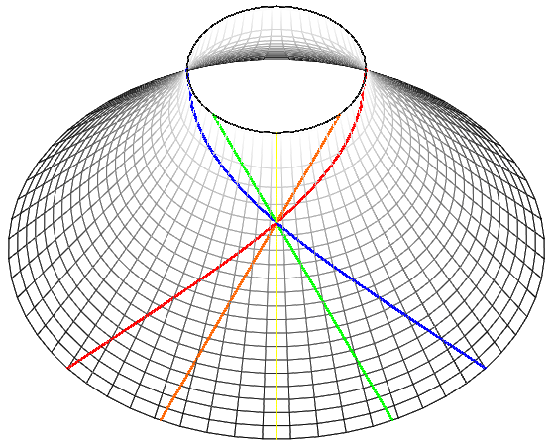
Matter's one geometric home. The break has a residue. Maximal symmetry, exhausting the continuous isometry, leaves over exactly the discrete orientation parity O(5,1)∖SO0(5,1)—the Z2 that threads the mass-reflection, the graviton helicities, and the chirality of the turning polarisation plane past the wall of the symmetry-reducible sector [JanzenGroupoid, JanzenDynamics, JanzenAlgebroid, JanzenBoundary, JanzenRange]. That discrete residue is the home of the fermion sector the matter paper builds [JanzenMatter]: not the continuous isometry the boundary paper's wall closes, but the discrete parity that wall cannot reach. The ordinary route — a matter bundle placed by hand — is untouched by it.
The families' discrete skeleton, as a within-CR result. One reach on that residue is worth stating whole, because its parts are grounded in several registers at once. The reading, and what stands behind it. The discrete skeleton of the Standard Model's families is the substrate's own three-fold slicing structure, read on a spinor sector—three chiral seats at the three mass-tied roots of the one R-odd offset-mass cubic (the A2 weights), equivalently the three 120∘-separated hinged vantages of the one sliced substrate, carrying the chirality γ5=R, with the generations themselves seated on a second three, the cube-root sheets of the comoving turnaround, whose family symmetry proper is the cyclic Z3 [JanzenMatter]. What is grounded, in three registers:
- Geometry, the multiplicity. The count is forced to three: the offset-mass relation is the pure triple-angle 2M=2/3√3 sin 3w, driven to a single harmonic only at the unique slicing scale 2/√3 the gnomonic image of the hole fixes, so the three roots are the three preimages of 3w [JanzenSlicing]. Not fitted—forced. The audit behind this count, its receipts, and the splits that cut its law are collected in the programme's combinatorics ledgerL6.
- Representation theory, the kind. Of the residue's full D6=S3×Z2, only the Z2 is a substrate isometry (the parity R, acting on the cut spinor as γ5), so chirality descends as an isometry; the S3 is the monodromy (Weyl) symmetry of the solution space and no isometry (su(3)⊄ so(5,1)), so the seats' S3 on this structure is global—the kind the Standard Model gives its flavour symmetry, beside a chirality carried by spacetime symmetry, not assumed but following from which factor is an isometry [JanzenBoundary, JanzenAlgebroid, JanzenGroupoid].
- Geometry again, the seats as vantages. The S3 is realised concretely as three 120∘-separated hinged vantages: shifting the sky angle by 2π/3 fixes 2M and cycles the designated root through all three (the cyclic Z3), σ swapping the other two within a hinge—three readings of the one substrate, converging from the geometry with the representation-theoretic verdict that the seat factor is a description structure, not field copies [JanzenSlicing].
The breaking is the slicing's own (the r0-singling 2+1 factorisation), the mass values the ordinary route. The descent is built. It asks whether a spinor sector inherits this three-fold count—whether three vantages of the one substrate are the three physical seats a single observer sees. That construction is built [JanzenMatter]: a spinor on the slicing structure binds exactly one chiral zero-mode at each throat wall as a bound mode of the existent leaf (normalizable in the leaf's proper measure, whereas in the conserved spacetime Dirac norm the same static mode is not)—its chirality the parity R=γ5—and the maximally-symmetric matter construction, the one this programme's own principle selects over any single-hinge truncation (which would carry an unfixed arbitrary modulus), places a wall at each of the three hinges. The count is three, and the S3 permuting the walls is the within-state index that distinguishes the constituents of a bound state; the family symmetry proper, acting on the generations and on nothing else, is the turnaround's cyclic Z3 [JanzenMatter]. For the discrete structure of the families—the generation count, the chirality, the seats' S3 and the generations' Z3—the physical identification is therefore a result, forced within CR: it rests on the maximal-symmetry principle that defines the programme and on the fermion sector being set by the matter construction, which the wall calculation makes concrete, and on nothing further. Beyond the discrete skeleton the propagating Dirac sector is built on the chiral member, which is the unpolarised one [JanzenDynamics], the chirality-asymmetric action on it permitted and not selected [JanzenMatter], the leaf-bound modes and the propagating field being two sectors; what stays the ordinary route is the gauge content, excluded from the continuous isometry [JanzenBoundary], and the mass spectrum (electroweak). For the discrete skeleton this is a result rather than a conjecture.
One principle, worn three ways. Step back from the descent to the shape of the whole. The three-fold built there [JanzenMatter] is the innermost of three nested registers of maximal symmetry the construction carries. The substrate is maximally symmetric—dS5, its isometry SO(5,1) exhausted (Prop. 1). The evolving three-space it presents is maximally symmetric—the closed S3 of the cosh-law cosmology, SO(4)—the de Sitter presentation's layer, which is the substrate's own slice at zero mass, the cosmology's Nariai mass carried into the observer's presentation by the reassignment [JanzenOperator, JanzenCRcosmology]. And the discrete symmetry the slicing breaks out of the substrate is itself maximally symmetric—the hexagonal Aut(A2)=D6, the 3⊕3 worn on the two horns, the fundamental 3 matter and its R-image 3 antimatter, on one footing within CR [JanzenMatter, JanzenBoundary]. Read this way the candidate synthesis widens past the generations: the Standard Model's apparent arbitrariness—why three families, why a chirality, why any discrete family structure at all—is, with the descent built [JanzenMatter] and forced within CR, not a list of inputs but the shadow of one principle broken symmetrically: a maximally-symmetric breaking of a maximally-symmetric substrate, carried in a maximally-symmetric space. The grounded floor is the three registers, and the discrete structure they carry is counted and built [JanzenMatter], not conjectured: three chiral seats related by S3, the generations on the turnaround's cyclic three, forced within CR. What is not claimed—and stays the ordinary route—is a geometric origin for the gauge content or the masses; those are excluded from the isometry, and electroweak. For the discrete skeleton of the families, then, this is the thing the one principle reaches—within CR, at the scope the matter paper states in full.
The two readings: general relativity and the Standard Model's families, one discrete structure. Stated at its sharpest, the synthesis is one claim about one discrete structure read two ways. The residue Aut(A2)=S3×Z2≅D6, read as cuts of the substrate, is the organising symmetry of general relativity's symmetry-reducible solution space [JanzenRange]—the three horizon roots, the vantages that permute them, the mass-reflection R, the two null rulings; read on a fermion sector it is the discrete skeleton of the Standard Model's families—a threeness against two chiralities, an S3 and the parity γ5=R [JanzenMatter]. The matter sector distinguishes two threes here and this paper follows it: the S3 among these vantages is the within-state index, and the generations' threeness is the turnaround's deck Z3 (ibid.). One structure, two readings, one slicing operator: the vacuum sector and that skeleton are not two theories to be reconciled but two perspectival shadows of the one substrate's discrete symmetry—the reading, not the read, in the exact sense of §6. Two boundaries bound this, and both are load-bearing rather than caveats. What the two readings share is the discrete residue, not the continuous symmetry: the continuous isometry SO(5,1) generates the cuts and is excluded from the Standard Model (su(3)⊄ so(5,1) [JanzenBoundary]), so it is the residue the exhausted continuous isometry leaves that both readings share, the gravitational reading keeping the continuous part to itself. And it is that skeleton, not the gauge structure: the Standard Model's defining SU(3)×SU(2)×U(1) is exactly the part not read off the substrate [JanzenBoundary], the mass spectrum stays electroweak, and the reading delivers the generation count, the chirality, the seats' S3 and the generations' Z3, and those alone. Nor does the synthesis unify the quantum with gravity: what the two readings share is a discrete geometric symmetry, neither quantum nor classical in itself, while “the quantum” enters the corpus separately, in the horizon-thermal register of the ledger (ℏ the Gibbons–Hawking gauge, §5)—so the old divide this synthesis bears on is between general relativity and the Standard Model's discrete content, not between general relativity and the quantum. A gravitational–cosmological unification whose matter reach is the discrete skeleton of the families, asserted nowhere as more. The parts are established across the corpus [JanzenSlicing, JanzenGroupoid, JanzenOperator, JanzenDynamics], and the two-reading statement is their consolidation.
The space the corpus lands in
This section collects, paper by paper, where the geometric core reaches into each of the seventeen and where each reaches back—the connections that belong to no single paper, gathered in one place:
- P1, the metric singularity [JanzenBHcausality]} — forward: P1's scope note points here, reading its metric-singularity boundary as the structural forcing on which the substrate's everywhere-real boundary rests (P1 standing on general relativity alone, needing none of the substrate ontology). Reciprocal, into §3 and the augmentation rung of §5: P1 supplies the structural forcing complementary to P4's empirical one — the event horizon is a metric singularity (a null hypersurface along whose generators the spatial extent also contracts to zero), occurring only as the null future boundary approached at infinite exterior time, so the layered, cosmically-timed ontology the augmentation reads is forced structurally as well as measured. It is the finite-curvature species of the boundary genus (the infinite-curvature species and the genus in P2), the real boundary of §3 at its first exemplar. The two forcings — structural (P1, from general relativity alone) and empirical (P4, measured) — are independent and co-equal, neither resting on the other.
- P2, the Schwarzschild circle [JanzenCircle]} — forward: P2's introduction points here, its two-species genus and perspectival curvature the foundational-geometry instance of the substrate's everywhere-real boundary and shadow-reading. Reciprocal, into §3 and §6: P2 supplies the genus — the event horizon and r=0 are the two r-poles of one homogeneous circle, metric singularities of one genus differing only at second order (curvature), so P1's finite-curvature species and the conjugate infinite-curvature species are one object; and the curvature divergence at r=0 is the curvature of the perspectival metric, real as that metric's and reading the chart's labelling — the first, sharpest instance of the shadow-reading of §6 (a real feature of a vantage-dependent description, built-and-real, not an artefact in the pejorative sense). The everywhere-real continuation through the seam (§3) is the circle's own analytic completion. Sbierski's inextendibility concerns the maximal analytic Schwarzschild spacetime, the Λ=0 object this construction does not contain; on the substrate the geometry runs through the locus the chart labels r=0, C∞ across it [JanzenCRframework].
- P3, the slicing curve [JanzenSlicing]} — forward: P3's substrate-and-cut section carries the
substrate-level statements this paper owns — the Lorentzian signature
intrinsic to the positive curvature, the straight null rulings its own
“ruling legs” run along, and the equilateral-pseudo-sphere c–Λ
mechanism — pointing here for the full development. Reciprocal, into this
paper: P3 supplies the worked instances of the core — its slicing
curve is the cut of §6 realised; its
prop:flipand conjugate branch are the seam instance of §3 (the flip confined to the 2-surface, the conjugate region a real branch of the one Lorentzian substrate); its two-sweeps/vantage-swap and its α-invariant/M-perspectival result are the shadow-reading (§6) and the constant-locking (§2) at their first concrete rung. What P3 hands forward: the coupled operations it collects and owns—the root-exchange σ and the backward-radial reflection R, coupled across both regimes, generating the substrate's full discrete symmetry—are the geometric base this paper reads at substrate altitude (the orientation Z2 of §6 being the R-factor of that coupled whole, advanced group-theoretically by P5); and the overcritical/lap conjugacy is the geometric base of the phase structure at the seam, which is decided in both halves (§8). - P4, the modern parallax [JanzenModernParallax]} — Forward: P4's exclusion section points here, reading the
augmentation it forces as the empirical rung of the substrate's maximal
symmetry (carrying its own Copernican scope). Reciprocal, into
§5 (the first and seventh rungs): P4 supplies the
empirical rung — the redshift-isotropy floor (accumulated-redshift
scatter ∼10-2, some two hundred times the entire measured anisotropy
of the microwave background) forces the cosmic foliation as a measured
feature, and
thm:augmentationestablishes CR as the necessary and sufficient augmentation of general relativity for a description of an existing, evolving world (the lapse the objective rate of advance, the shift the relativity of synchrony). So the necessity of the first rung is not posited but measured — the empirical counterpart of P1's structural forcing, which stands on causal structure alone and needs none of this evidence. Under the Copernican principle the same datum reaches the maximal symmetry of the slices (the seventh rung, universality as the invariance of the measure), which P4 marks as an extrapolation beyond the directly constrained region — a scope §5 inherits, not softens. - P5, the description groupoid [JanzenGroupoid]} — forward: P5's
rem:orientationreads its orientation-parity Z2 through this paper's lens — the discrete residue the exhausted continuous isometry leaves unspent, and the home the matter paper builds its fermion sector on — pointing here. Reciprocal, into §6: P5 supplies the residue's concrete realisation — the Z2 is the SdS solution space's own Aut(A2)=S3×Z2≅D6—the coupled operations the slicing paper owns, advanced here into their group-theoretic form—the mass-reflection 2M↦-2M realised as the reticle reflection on the horizon-cubic roots (rem:orientation), and the su(3)-guard from the gravitational side (rem:a2-distinct: this A2 is su(3)'s abstract root system in a different realisation, no colour via a continuous isometry — whether the shared abstract type is significant left open). The discrete residue of §6 is thus not an abstraction but a worked group acting on a concrete family. - P6, the shadow of existence [JanzenShadowExistence]} — forward: P6 points here (from its closing placement in the programme), its theory-choice discipline the epistemic ground on which this paper's unification is held as a conjecture rather than an established result. Reciprocal, and it fixes the standing of the whole paper: P6 supplies the epistemic engine — the shadow-reading (infer the world that casts the appearances) of §6, the four rules with require over permit (Rule 2) the load-bearing one, the modal fallacy, and the constructive ordering (ontology from evidence). The unification of §5 is a structure the programme's rules favour, and reading its several established rungs as one fact is a theory-choice, decidable by the test of §8 as the discipline's first programme.
- P7, the framework [JanzenCRframework]} — Forward: P7's null-boundary-correspondence section cites this paper for the
intrinsic-Lorentzian result and the c–Λ mechanism, and its synthesis section
points here for the maximal-symmetry reading that gathers its structural
recoveries. Reciprocal, and it is the deepest of the rounds: P7 supplies the
established rungs of §5 and the discipline that
holds them. Its central theorem (
thm:augmentation-p7,thm:cosmogenesis) is the necessity-and-sufficiency rung as a formal result; its synthesis reads three standing features of general relativity as one substrate's — the Carter constant [Carter1968] as the substrate's own maximal symmetry surfacing—a sentence that is true for a reason worth stating, since on Kerr the same words are false: there the Carter constant comes from an irreducible rank-two Killing tensor, one provably not built from the Killing vectors, which is why Carter's separation was a discovery rather than bookkeeping. On a maximally symmetric space the theorem runs the other way: constant curvature leaves no room for an irreducible Killing tensor, so every one is a symmetrised product of Killing vectors and a quadratic first integral cannot be independent informationRL13, the problem of time dissolved, the Dirac constraint algebra as the symmetric-space grading [m,m]⊂h of SO(5,1)/SO(4,1) — which is the maximal-symmetry unification already at work at the structural rung. P7's synthesis section carries the same reading at the structural rung, where general relativity's solution space closes on one substrate; the unification here is likewise a conjecture, held to the one test the programme puts to the world—the confrontation of the cosmology with the data [JanzenCRcosmology]. - P8, the slicing operator [JanzenOperator]} — forward: P8's introduction points here, its covariance-of-geometries substrate the geometric core's substrate. Reciprocal, into §1 and §6: P8 supplies the operator that realizes the substrate's cuts — the slicing curve promoted from classifier to a generating operator for the whole static spherically-symmetric sector, with two derivations at the heart of the core's picture: straight cuts are vacuum (the SdS family is exactly the kernel of the matter functional) and matter is the bend of the cut (ρ=m'/4πr2, the curvature of the cut off the vacuum profile). The covariance is lifted one level — the de Sitter substrate held invariant under change of geometry as general relativity holds one geometry invariant under change of chart, “many geometries, one substrate” — the operational form of §1; the reading grounded on the results, not entailed by them (P6).
- P9, the range [JanzenRange]} — forward: P9's introduction points here, its range the reach of the substrate's maximal symmetry. Reciprocal, into §5 and §6: P9 supplies the reach of the construction — the range of the slicing operator is exactly the symmetry-reducible sector of general relativity (every reachable geometry carries a sweep-subgroup of SO(5,1)), filled across all Petrov types [Petrov1954], so what the substrate's maximal symmetry reaches is the constrained, non-radiative skeleton of general relativity; the wall is where the last symmetry able to anchor a sweep is lost — genuinely inhomogeneous matter, the onset of free gravitational radiation — the matter-boundary face (P13) read from the range side. And the Carter constant general relativity carries as an unexplained gift is the substrate's maximal symmetry surfacing in the separable corner, one of the maximal-symmetry recoveries the unification gathers (with P7). The reachable catalogue is one substrate read through a vantage groupoid over a moduli family of cuts.
- P10, canonical time [JanzenCanonicalTime]} — Forward: P10 points here (from its dissolution section), its dissolution of the problem of time the canonical face of the substrate's maximal symmetry. Reciprocal, into §5 (the algebroid rung): P10 is the canonical complement to P12's structural account of the problem of time — where P12 identifies the obstruction (the “wrong-sign” structure function is the substrate's coset metric, its base-dependence the obstruction), P10 supplies the resolution: selecting the cosmic foliation the augmentation forces (empirically by the CMB [P4], structurally by the horizon [P1]) deparametrizes the frozen constraint into a true Hamiltonian, the frozen and evolving readings the same canonical content differing only in whether the manifold is granted existence — so the problem of time is dissolved, not solved, by the same ontological correction the whole augmentation makes. The closed-S3 graviton tower deparametrizes to unitary cosmic-time evolution and projects to the flat-ΛCDM graviton, matter the bend of the slicing, not ontological content.
- P11, why the cut bends [JanzenDynamics]} — Forward: P11's chirality section points here, the graviton's handedness the radiating-sector face of the substrate's discrete residue. Reciprocal, into §6 and the wall of §5: P11 supplies the dynamics — why and how the cut bends in time (the confined Gowdy–de Sitter wave, its energy and momentum the shear of the leaf, deparametrized to P10's true Hamiltonian), located at the two-Killing-vector edge (Petrov type I), the last confined stratum before the wall — the generative boundary (a Type-N plane wave, not a metric singularity) where generation-by-symmetry hands off to ordinary inhomogeneous evolution, the dynamical face of P9's range boundary. And the chirality: past the wall the graviton's two helicities settle a genuine handedness (the turning of the polarization plane), the substrate's orientation parity surfacing in the radiating sector — the disconnected Z2 of §6, beyond the chirality obstruction (P13), the dynamical face of matter's one geometric residue. Cosmic no-hair makes the de Sitter background an attractor; the continuous dynamics admits rather than forces a quantum structure, any forcing isolated to the discrete root structure (P12).
- P12, the constraint algebroid [JanzenAlgebroid]} — forward: P12's scope section points here,
reading its symmetric-space recognition as one rung of the substrate's
maximal symmetry (as a reading; its own result standing on the
symmetry-reducible sector). Reciprocal, into §5 (the
second rung) and here: P12 supplies the deepest structural rung —
general relativity's own hypersurface-deformation (Dirac) algebra is
the symmetric-space grading [m,m]⊂h
of SO(5,1)/SO(4,1) (
prop:closure, term for term), and the “wrong-sign” structure function at the root of the problem of time is the substrate's Lorentzian coset metric, its base-dependence the obstruction — so the problem of time dissolves into a single geometric fact of the maximal symmetry, established on the symmetry-reducible sector. The orientation-parity Z2 of §6 is realised here as the central inversion / double-ruling swap, and the su(3) exclusion carried with its own scope (SU(3)⊄ SO(5); the A2 the discrete Weyl shadow only, no continuous colour isometry). - P13, the matter boundary [JanzenBoundary]} — Forward: P13's closing programme-significance section points here, reading its wall as one face of the substrate's maximal symmetry. Reciprocal, into §5 (the fifth rung) and §6: P13 supplies the matter-boundary rung — the continuous matter symmetry is excluded because SO(5,1) is complete (su(3)⊄ so(5,1); the geometric-isometry route closed four ways — the σ-lift a real Weyl reflection not the Wick rotation, the cascade dropping the gauge at the real cut, the A2 skeleton discrete-only, and the compact face carrying no massless content for a fermion sector to occupy—the index route lapsing there on dimension, and the positive-curvature one supplying the conclusion instead), so the exhausted symmetry that locks the constants leaves no room for a geometric colour. The mechanism is complementary: the index acts on the connected gauge group, the gravitational chirality on the discrete orientation parity O(5,1)∖SO0 the index cannot reach, so observed fermion chirality is forced non-geometric — and that same discrete parity is the discrete residue of §6, the single geometric opening the wall leaves, which the fermion sector occupies [JanzenMatter]. The compact (Wick) face is real-by-construction but, atemporal, no co-equal existent, by CR's existence criterion.
- P14, the fermion sector [JanzenMatter]} — forward: P14 points here, reading its three chiral seats as the innermost of the three registers of maximal symmetry — the maximally-symmetric discrete breaking the slicing takes from the substrate. Reciprocal, into §6 and the matter rung of §5: P14 supplies the built discrete residue — the boundary's single geometric opening realised, three chiral seats related by a global S3 with R=γ5 chirality, forced within CR as the maximally-symmetric slicing of a maximally-symmetric substrate, the gauge and mass content external, and the generations seated on the comoving turnaround's cyclic three. The count is the substrate's discrete symmetry worn as matter.
- P15, the cosmology [JanzenCRcosmology]} — Forward: P15's introduction points here for the everywhere-real substrate-and-boundary ontology, and its discussion for the root of its rigidity — Λ the maximally symmetric substrate's sole scale. Reciprocal, into §5 (the fourth rung): P15 supplies the observational rung — with Λ the sole scale the cosmology's rate carries no tunable freedom (the parameter-free low-multipole deficit set by Λ through r0 and DC; the geometric rate; the transmission dichotomy — no inflationary scale-invariant attractor, no consistency relation, no substrate-sourced B-modes), its discriminating power returned on the data — the genuine-Boltzmann low-multipole shape a cosmic-variance-limited wash (a smooth deficit bottoming at ℓ=4, neither the sharp observed quadrupole dip nor a sharp falsification), while the geometric rate fits the baryon-acoustic distances and the primordial abundances return deuterium and helium within measurement on the corpus's own hot dense history. The full-spectrum likelihood is run as well: the acoustic transfer, run end to end on the background the distance data fix, reproduces the comb to a part in six hundred and the heights to a few per cent, and on shape sits at 2.57 times the control's distance from the data, the disagreement lying in one assignment—the projection's distance built on the leaf rate rather than the stacking rate, radiation restored, takes the arm below the control—so the identification of light's path is the cosmology's frontier. The cosmic beginning is the cosmogenesis branch point—the substrate finite in curvature across it, the geometry read over the areal chart divergent there—reached through the conjugacy yet real.
- P16, the cosmogenesis [JanzenCosmogenesis]} — Forward: P16 points here, reading the Big Bang as a synthesis of the corpus's deductively forced consequences over this maximally symmetric substrate — the hot dense era the far side of a collapse the substrate's own geometry already carries through the branch point, finite in the substrate's curvature whatever the areal chart reports there. Reciprocal, into §3 and §6: P16 lands the lap — the conjugate branch of the slicing curve, reached through the imaginary yet real, read forward as a previous universe's collapsed matter, the cosmogenetic bead the framework proves one closed curve [JanzenCRframework] and a concrete instance of this paper's reached-through-the-imaginary principle (its cosmic time runs off the real axis through a bounded contour while the areal radius stays real at every point it lands on) — and returns the one quantitative consequence the synthesis adds beyond the corpus's established results: the infalling matter, heated above the deuterium bottleneck and re-expanded through it at the standard rate, runs a standard nucleosynthesis that produces the primordial light-element abundances (helium-4 and deuterium at their observed values, the lithium problem shared with ΛCDM). The Big Bang is thus no initial edge of the substrate but a broken-symmetry shadow cast within it — the substrate's maximal symmetry read at the cosmogenesis rung, the abundances its fossil; its open edge the last-percent precision of the nuclear rates.
- P18, the synthesis [JanzenSynthesis]} — Forward: P18 gathers the corpus as one object and cites this paper for what that object is — the substrate's uniqueness, the one scale its exhausted isometry leaves, and the constants read as gauges over it. Reciprocal, into §5 and §5: P18 carries the corpus-wide statement of the same maximal symmetry, the dissolutions read together rather than paper by paper, so that what this paper states about the object P18 states about the programme built on it.
Frontiers
One item stands here as a falsification test of the unification rather than as unworked ground, and both of its sides have been run; two further questions the programme raised are decided, and are recorded after it as results.
- The free-data-count test of the unification. The framework's count of genuinely free data should equal the substrate's non-symmetric residue—maximal symmetry, spent, leaving the matter's own measured content as what is not fixed by it, and each constant-relation a locked parameter. Decisive: a hidden geometric freedom in the cosmology, or a genuinely free constant where the reading says it should lock, falsifies “rigidity and wall are one fact.” The test has two sides, and each has been run. On the constant side, §5 states that the gravitational–cosmological–quantum sector spends no free dimensionless constant of its geometry, and the reason is structural rather than counted—neither real form supplies a second invariant and a dimensionless magnitude needs twoP17R14, so there is a single dimensionful input and nothing for a dimensionless tuning to hide in. That argument is about the geometry's own invariants, and it does not reach the regularisation of a mode sum: the graviton tower's log-scale coefficient is computed and is not zero [JanzenCanonicalTime], so one dimensionless constant is spent there, and what the structural reason does not establish is that no constant enters by any route at all. And the falsifier's second clause was met rather than asserted: a place where a genuinely free constant could have lived was checked and it locked—the metric function follows entirely from Ttt=0, a first-order linear equation whose whole solution space is the Tangherlini–de Sitter family with M the single constant of integration [JanzenSlicing], obtained rather than assumedP3R38. On the datum side, ρr/ρm is a matter initial condition and not a constant, so it is not in the geometric residue at all, and it is a clock reading rather than a datum a handover transmits. It cannot be derived from the progenitor collapse, for a structural reason rather than for want of workR. Radiation dilutes as a-4 and matter as a-3, so ρr/ρm∝1/a—a quantity that changes along the leg has no single value for a handover to transmit, and the progenitor's value at its own maximum is a reading taken at one point on a curve. Nor does the crossing supply one: a factor multiplying both components alike leaves the ratio unchanged, and only a species-resolved factor could rescale it, while the crossing is lossless for every species [JanzenCRframework]. So ρr/ρm is where the observable leg's own clock is read, and a clock's zero is not the sort of thing a handover carries. The companion cosmogenesis paper reaches the same line from the other side, on a different ground: what a handover carries is what a conservation law protects, so η crosses the compression peak because baryon number is conserved through it, while the progenitor's composition is erased there because nuclear binding is not—“two kinds of thing,” in that paper's words [JanzenCosmogenesis]. Two independent reasons, agreeing: the ratio is not carried because it is not constant along either leg, and it is not carried because the crossing destroys what would have fixed it.P17R17
The maximal-symmetry ledger is complete. The geometric relations among the fundamental constants that the substrate forces are enumerated in §5—c–Λ and Nariai among them—each read as a spent parameter, and no constant remains that maximal symmetry fails to reach: the sector's non-symmetric residue is one-dimensional and is the scale, so the constant-side analogue of the discrete-parity matter opening does not existR.
The phase structure at the seam is decided, in both halves. It is real structure and not interpretation at the level of the object: the antilinear face K and the reflection R are the two axis-symmetries of one analytic object, whose composite supplies every kinematic datum of charge conjugation, with the self-conjugate photon congruence as K's fixed set; the reading is neither a second labelling of matter and antimatter, which R already performs linearly, nor a continuous interpretive parameter, reality admitting exactly two values. And it does not attach to trajectories: a mass enters the mode equation as m2a2, and the branch point annihilates that term while |aH| diverges, so ω/|aH|→0 independent of m—a massive trajectory freezes like every mode, so the phase cannot be attributed to a failure to freezeR.