P16
Cosmogenesis
the Big Bang as a synthesis of Cosmological Relativity's deductively forced consequences, and the primordial light-element abundances it produces
Abstract
In Cosmological Relativity (CR) the cosmic beginning is not a singular origin but a cosmogenesis: the collapse of matter in a previous universe, continued through the branch point r=0 at the close of the lift—singular for the r-chart metric, smooth on the substrate and re-expanding as our own, with the Einstein field equations unchanged. This paper does two things. First, it exhibits the Big Bang as the deductively forced synthesis of consequences the corpus already establishes—the measured foliation forces the augmentation; the augmentation forces that collapse cannot terminate but becomes a universe; that completion is the branch point r=0 at the close of the lift, crossed by a foliation-preserving causal reassignment that re-founds the horizon's null direction as the cosmic time of the expanding phase; the degeneracy the reassignment uses is the forced Nariai member's—the horizon cubic's double root, at which the substrate's isotropy jumps and the geometry is dS2×S2 [JanzenAlgebroid]—a property of the geometry rather than an event on any worldline, and to be kept apart from the crossing itself; the reassignment fixes a geometric flat-ΛCDM rate and carries the leaf's matter across as inherited content; the discrete matter sector and the acoustic peaks follow—each arrow a result proved elsewhere in the corpus, the Big Bang their conjunction rather than a separate posit. Second, it carries that synthesis to a quantitative, falsifiable edge: the primordial abundances of the light elements, read as a fossil of the previous universe's collapse.
The result is that the observed pattern is produced, not fitted. The infalling matter compresses adiabatically—the plasma is optically thick, so the photon bath compresses with it—and its peak temperature is bounded below by the infall energy at the horizon, of order the rest mass per nucleon, independently of the progenitor's mass: far above the deuterium bottleneck (TD≃0.07 MeV) for every progenitor—though `every progenitor' carries a condition worth making explicit, since a ball that does not recollapse never reaches the peak at allP16R19. For a closed interior with dust and Λ a turnaround exists exactly when A≤2α/3√3, which is identically the Nariai mass parameter—a threshold this paper elsewhere obtains from the horizon cubic's double root, recovered here from whether the ball turns around, with no step in common. So a progenitor capable of seeding a universe is necessarily sub-Nariai, which is precisely the regime the slicing construction already requires, and a super-Nariai ball never turns around and never reaches a branch point. The bound holds for every progenitor that does, the end-of-time, cluster-scale final holes the corpus's own forward reading supplies included. Past the branch point it becomes the expanding universe and cools back through the bottleneck; the effective rate through the nuclear window is exactly the standard Friedmann rate, so the expanding leg is a standard big-bang nucleosynthesis run from a dissociated hot start. These are distinct rate-objects—the window rate the infalling congruence's own leaf-level expansion scalar, radiation included; the observable rate the new foliation's geometry-set stacking law—so radiation never sourced the cosmological rate and no seam decoupling mechanism is demanded (carrying the stacking law into the window is quantitatively fatal and the radiation-sourced law is excluded from the distances structurally, and the scoping is what the reassignment itself is, not an assumption; Sec 5). It therefore reproduces the standard pattern with the inherited baryon-to-photon ratio η—the composition datum, the one quantity the handover supplies [JanzenCRcosmology]: helium-4 at its observed Yp≃0.25, and deuterium at its observed D/H≃2.5×10-5—the freeze-out temperature the data demands being exactly the bottleneck the standard rate delivers, un-tuned. Lithium-7 comes out at the standard value and so carries the standard threefold over-prediction: CR shares the lithium problem, neither dissolving nor worsening it. On the light elements CR is thus neither better nor worse than flat ΛCDM—two successes and one shared problem—but obtains them from the collapse rather than from a posited initial hot phase.
We mark maturity throughout. Established: the synthesis spine; the finite-curvature seam and the κ=0 reassignment; the standard effective rate; the time-reversal character of freeze-out; the adiabatic heating above the bottleneck; that a freeze-out exists for every progenitor—forced by a mass-independent floor on the peak temperature three and a half orders above the deuterium bottleneck (Sec 7), so the composition is synthesized, not inherited, and the lithium verdict and the in-situ character follow; The progenitor interior's own structure is developed in the body (Sec 8): its exact closed solution and the parity split by species, the two monodromies, the interior-to-observed mode map, the determination of the progenitor composition, and the bounds under which the leading-order interior is adequate; and the standard-BBN character of the cooling leg with He-4 and D at observed; and the full multi-abundance network itself, integrated explicitly on that cooling leg and returning deuterium, helium-4 and helium-3 at their observed values with lithium-7 at the shared over-prediction, jointly from the single inherited η, and reproducing standard nucleosynthesis to sub-percent on evaluated light-nuclide rates (stable across two independent rate libraries); confronted with data at the Planck η, deuterium and helium-4 fall within 1σ of the measured primordial values (Sec 9, 10). Argued (a physical bound, not a full computation): the thermalization of the infall energy that sets that floor—grounded in the metric coincidence of the converging worldlines and robust to the four-order margin, but not computed exactly. Computed: the regulated peak, a density of ρPlanck/6π one Planck time before the branch point and free of the progenitor's mass, with no temperature claimed (Sec 7); and, on the interior's own exact solution, the crossing itself, carried through the branch point as a dynamical problem—an involution for dust and, with radiation, an involution on the family that reverses the sign of the radiation amplitude, a sign no observable reads (Sec 8). Open: one item, and a precision frontier the title does not stake itself on—not the computation but its last-percent precision against the measured abundances—the specially-evaluated light-nuclide rates, a data-confrontation the produced pattern exposes rather than a computation still to be run, and not a debt (Sec 9, 10). Closed rather than open: a derivation of the inherited data (η, the radiation amplitude ρr/ρm, and the progenitor spectrum's amplitude and tilt) as against their inheritance—η because it is transmitted unchanged and nothing in the lap acts on it, the radiation amplitude because it changes along the leg and a quantity with no single value has no handover to transmit, and the spectrum because it is the progenitor's own classical content, handed across a crossing that stamps no scale and measured as flat ΛCDM measures its η [JanzenCRcosmology]. The data-confrontation is done: the network meets the measured deuterium and helium-4 within 1σ at the Planck η, with lithium the standard several-σ miss (§10, Fig. 3).
Introduction: the Big Bang as a conjunction of results
The received account of gravitational collapse ends it. Matter within its horizon proceeds to a curvature singularity at r=0, an inextendible boundary at which the classical description—and the matter with it—terminates. Cosmological Relativity (CR) does not add to that account; it reads it without flinching from what the geometry actually permits. The event horizon is a metric singularity of the comoving foliation, met only at infinite exterior time; the densities of the central singularity therefore never form at any finite exterior time, each infalling element asymptotically approaching its own horizon, and no finite cosmic layer ever carries the infinite-density locus (the causality paper, P1 [JanzenBHcausality]). The standard inference from the curvature divergence at r=0 to an inextendible boundary is then refuted by counterexample: the very analytic continuation universally accepted as removing the coordinate horizon carries the curve smoothly through r=0 (the circle paper, P2 [JanzenCircle]), and on the Schwarzschild–de Sitter slicing that same continuation runs on through the throat onto the conjugate branch (the slicing-curve paper, P3 [JanzenSlicing]). The throat is the de Sitter radius α—the substrate's defining constant, not a floor it declines to fall below—and α fixes the gauge of everything downstream; the r=0 singularity is the artifact of the comoving reading laid over it (the slicing-operator paper, P8 [JanzenOperator]). So continuing past r=0 is not a licence the construction takes but a step it has already been granted: unflattened in this way the seam is a passage, not a wall, and the collapse does not stop—it continues as an expanding cosmology. One posits nothing. One traces the curve, and the expanding universe is what lies past the throat.
The consequence for the cosmic beginning is structural. The Big Bang is not an initial condition to be supplied but the conjunction of consequences the corpus has already established, each proved in its home paper: it is a synthesis, deductively forced, not a separate hypothesis. This paper makes that synthesis explicit (Sec 2) and then carries it to the one place it becomes a number one can read off the sky—the primordial abundances of the light elements (Secs 4–9)—read as a fossil of the collapse in the previous universe (Sec 3). The register is recognition, not proposal. The field equations are Einstein's, unchanged; the nuclear reactions are the ordinary ones; only the reading—that the hot dense era is the re-expansion of a previous universe's collapsed matter—is CR's. The result (Sec 10) is that the observed light-element pattern is produced, not fitted, and that on it CR stands exactly where flat ΛCDM stands: two successes and one shared problem, obtained here from the collapse rather than from a posited hot phase.
The synthesis spine: the deductive chain
The synthesis is a chain of eight links, each a result established elsewhere in the corpus; the Big Bang is their conjunction.
The conclusion this chain reaches was stated as a conjecture in the original derivation, and stated there with the reason it could be no more than one. Reasoning that a causally coherent collapse cannot have interior particles cross an inner horizon before exterior ones, that work concluded the particles must universally collapse with subsequent cosmic evolution occurring radially, and closed: “rather than trying to talk about all of the reasons that this should be incorrect … without the clarity that would be afforded by an analytical solution, it seems best to simply end this discussion with a conjecture: that the product of this collapse is a 3-sphere in de Sitter space, similar to our universe, which may also be described globally by the over-critical SdS line-element” [JanzenThesis, §4.4]. The analytical solution whose absence was the stated obstacle is the slicing curve, and the links below are what it supplies: the conjecture is discharged as Theorem B of the framework paper, and the 3-sphere in de Sitter space is the layer.
- The foliation is measured. The cosmological redshift is the path integral of the expansion rate, ln (1+z)=∫H dt, so the observed isotropy of the microwave background—a region-by-region matter-tracking expansion would accumulate a scatter of ∼10-2, some two hundred times its entire measured anisotropy, an exclusion by more than two orders of magnitude—measures an objective cosmic rest frame and a uniform expansion directly, forcing a preferred cosmic foliation from the bottom up, logically prior to space, isotropy, and homogeneity rather than assumed alongside them (the modern-parallax paper, P4 [JanzenModernParallax]).
- The augmentation is necessary and sufficient. Read ontologically, that foliation is the rate of advance of an existing spatial layer; the resulting CR augmentation is necessary and sufficient for general relativity to describe a world that exists and evolves, altering no equation—the two coherent ways to decline it both closed: taking the four-manifold itself to be the existent smuggles a fifth, meta-temporal dimension and is a category error, and reading the relativity of synchrony as the absence of an objective present is a modal fallacy, the latter falsified outright by the measured redshift isotropy of link 1 (the framework paper, P7 [JanzenCRframework]).
- Collapse becomes a universe. On that augmentation, gravitational collapse cannot terminate: the limiting null direction the event horizon selects, reassigned on the forced foliation, is the fundamental timelike congruence of an expanding cosmology, so the collapse horizon and the cosmological seam are one ontological layer and collapsed matter continues as an expanding cosmology. Because that correspondence is causal and structural rather than metric, it holds for collapse of any symmetry—non-spherical collapse dissolved, not left as a separate case (P7, central theorem). The scale-free locus is reached on no finite cosmic layer (P1).
- The completion is the branch point, a reassignment. That completion is the branch point r=0 at the close of the lift—finite in the substrate's curvature, divergent in the geometry read over the areal chart—where cosmogenesis lives, distinct from the wall at which free gravitational radiation begins (the dynamics paper, P11 [JanzenDynamics]); crossing it is a foliation-preserving causal reassignment that re-founds the horizon's null direction as the cosmic time of the expanding phase (and the degeneracy is what the reassignment uses—a property of the geometry, not an event on any worldline: the seam radius is the one radius at which f=0 on this member, and f≤0 everywhere else on the matter branch, so the static region between the two horizons has closed in areal radius—to zero coordinate width, and the proper separation read across it in the areal chart diverges rather than settling on a figure: ∫dr/√|f| diverges logarithmically at the double root, a double root making |f| vanish quadratically where a simple pair makes it vanish linearly, which is the same contrast that leaves a non-degenerate horizon at finite proper distance. The finite figure πα/√3 belongs to the family, and to the rescaled limit the family defines, rather than to the member read in this chart—between two still-distinct roots that same integral is πα/√3 to leading order in their separation, independently of how small the separation is, which is why the limit carries a throat of that length while the degenerate member itself carries no static region to carry one. So what has gone is the separation of the roots and not the throat, and the throat that survives is identified by its areal radius α/√3 and by the geometry standing on it rather than by a length read off this chart. The stratum is identified in the companion algebroid paper, and the identification is what makes it a property of the geometry rather than of a chart: at the double root the substrate's isotropy jumps from Rt×SO(3) to SO(2,1)×SO(3) and the geometry is dS2×S2 [JanzenAlgebroid]}P16R1). A separate reading of the same radius is worth keeping apart from it. Because the double root sets f=0 and f'=0 together, the seam radius is also the zero of the slicing surface's Gaussian curvature, and hence the epoch at which the expansion turns from decelerating to accelerating [JanzenSlicing]—and the two readings are one locus by an identity rather than by agreement, the areal acceleration on any member of the energy family being d2r/ d τ2=-f'/2=r KG, so the sign of the slice's Gaussian curvature is the sign of the comoving acceleration and the flat locus is the turnover, which in standard terms is ρm=2ρΛ. At 7.06 Gyr on the comoving worldline at the directly measured H0, on Ωm=0.307, the worldline crossing it at dr/ d τ=1 exactly, in finite proper time—and the dating inherits the rate rather than the geometry, the same locus standing at 7.65 Gyr on the calibrated oneP3R12. These are two readings of one radius and not one event: the κ=0 degeneracy is what makes the reassignment possible, while the crossing is an event on our own worldline, and the co-location holds because the member is Nariai and for no other reason—a morphism of the description groupoid, acting on the causal reading of one fixed geometry rather than on the geometry (the groupoid and slicing-operator papers, P5, P8 [JanzenGroupoid, JanzenOperator]), one of the vantage changes that supply the apparent multiplicity of the reachable catalogue rather than a new solution (the range paper, P9 [JanzenRange]), and signature-preserving on the real Lorentzian substrate—a null congruence promoted to the fundamental timelike one, the manifold and its signature held fixed, so the matter rides the real Lorentzian horn while colour su(3) lives across the signature seam (the matter-boundary paper [JanzenBoundary]).
- The rate is geometry-set flat ΛCDM. The reassignment fixes the expansion rate to the flat-ΛCDM sinh2/3 law set by Λ alone, with radiation and matter inherited content read off the cosmic clock—whose advance is generated by a true Hamiltonian, unitary in cosmic time (the canonical-time paper, P10 [JanzenCanonicalTime])—rather than terms that source the rate; the acoustic scale is computed from that rate, which the distance data and the acoustic angle fix together (the cosmology paper [JanzenCRcosmology]).
- Matter is inherited—a corollary, not a posit. The slicing operator separates the cut into three independent data—the leaf (the spatial cut, whose bend ρ=m'/4πr2 is the density), the stacking (the time-lapse), and the vantage (the radial signature)—with the density leaf-carried and lapse-independent (P8). The reassignment acts on the stacking, fixing the Λ-set rate, and not on the leaf; so the leaf-carried density crosses as inherited content, and matter-inheritance is a corollary of what the reassignment is, not an added assumption (P8; the matter-sector paper [JanzenMatter]).
- The discrete matter crosses. The discrete matter skeleton the substrate forces—three chiral generations, their chirality the diagram-automorphism parity R=γ5, forced within CR (the matter-sector paper), the relating S3 being a within-state index and not the family symmetry, with the generations' own threeness the turnaround's deck Z3 and the wall structure fixing the number at either seat—rides the same reassignment inherited-unaltered as leaf-carried content, while the gauge and charge sector is external by a forced mechanism (the matter-boundary paper).
- The driving is the expanding leg's own. Every acoustic mode arrives at the branch point outside the horizon and frozen, so nothing oscillatory crosses and the driving happens on the expanding leg, each mode re-entering there while radiation dominates—the driven amplitude being the resonant Fourier magnitude of the potential's evolution, exactly invariant under time reversal, so a driving on the contracting side would have been the same size and the crossing carries no imprint of which side the driving is on. What that theorem carries about the peak heights is measured rather than inferred: run end to end on this cosmology's own background, the driving's measured size is within four per cent of the flat-ΛCDM control's and slightly weaker rather than stronger, and the full-spectrum likelihood, with the projection's distance on the stacking rate the reassignment derives for it on any cut, leaves a contrast residual that the leaf-rate distance removes, so that radiation's absence from the stacking rate is what the spectrum tests (the cosmology paper [JanzenCRcosmology]).
Links (1)–(8) are the Big Bang. No link is posited here; each is a theorem or a measurement in its home paper, and their conjunction is the hot dense beginning—deductively forced, not assembled. What the conjunction does not yet fix is the content of the inherited plasma: the one quantity the handover supplies—the baryon-to-photon ratio η (Sec 7)—and the light-element composition it sets. The remainder of this paper computes the second, and finds it produced rather than free.
The lap as a fossil: what is to be computed
The conjugate branch of the slicing curve—the lap through the throat onto the far side of r=0—is drawn in the corpus as pure geometry (P3, §“The lap and the conjugate branch”). There the areal radius is a signed coordinate, and the curve, ridden inward to the seam where it runs tangent to the throat circle, continues around the throat through r=0 and out onto the negative branch, closing on the backward-radial root the horizon cubic always supplies; r=0 is the branch point at which the real radial value passes between the forward (r gt;0) and backward (r lt;0) branches, not a barrier, the substrate being one smooth de Sitter manifold C∞ across the locus the chart labels r=0.
Read forward, that closed lap—the single closed cosmogenetic bead the framework proves one curve [JanzenCRframework]—is a fossil record. Our universe formed at the event horizon of a black hole in a previous one; the matter of our hot dense era is that previous universe's collapsed matter, continued through the branch point. The horizon named there is the forced member's merged one, and the identification is at the level of the substrate: read locally on the sheet the collapse runs on, the same point presents as the cosmological horizon of the mass, that sheet carrying no black-hole root at all [JanzenCRframework]. In the framework's signed-radius reading that progenitor sits on the conjugate (r lt;0) branch of the bead, which is the antimatter branch—so the black hole from which our universe issued was an antimatter black hole, our matter and its antimatter progenitor the two ends of one standing R-conjugation and no branch-point-made asymmetry [JanzenCRframework, JanzenMatter]. That standing R-conjugation is, composed with the antilinear reality involution τ↦ τ that reaches the conjugate branch (the imaginary continuation named below), the geometric factor of the charge-conjugation closure the boundary paper draws, C=(Q↦-Q)field∘(R∘K)geometric: this very r=0 crossing is the seat of C's kinematic (Feynman–Stückelberg) face, only the electric-charge sign left to close from the matter field [JanzenBoundary]. That the crossing makes no asymmetry can be checked in the action rather than argued from structure alone. The imaginary segment is a solution of a variational principle whose Euclidean action in the gravitational normalisation is finite [JanzenCanonicalTime]; its integrand, r [f(r)-1]=-2M-r3/α2 up to the constant prefactor, is odd under the standing conjugation, which acts on the offset and the mass together, r↦-r with 2M↦-2M [JanzenMatter]. The two branches therefore carry equal and opposite action, 0.0481 α2/G on the forced member, summing to zero identicallyP16R14. Neither branch is weighted above the other by the crossing: the asymmetry we observe is not manufactured there, and any account of it must come from the matter field's own charge-conjugation factor rather than from the geometry that carries it. We note that the oddness fails if the mass is not conjugated with the offset—flipping r alone leaves an even remainder -4M—which is a way of seeing that the offset–mass relation's oddness is doing the work here as well as in the chirality parity it fixes elsewhere. The naming bears on identity, not on the thermal history the abundances record, which is what this paper computes. The primordial abundances of the light elements are therefore not free initial data but a trace of that collapse's thermal history—a number, read off the spectra of the oldest, least-processed gas, that records how hot the handover was and how it cooled.
Deuterium is the sharpest such window. It is the most weakly bound of the light nuclei (BD=2.22 MeV [AME2020]), so its abundance is the most sensitive to the thermal history of the handover; the fossil that survives least tells the most about the collapse that made it. That the lap onto the conjugate branch is reached by an imaginary continuation of the slicing curve—a substrate reached through the imaginary yet real at every point it lands on (the geometric-core paper, P17 [JanzenGeometricCore])—while the real infalling worldline reaches r=0 in finite proper time (P2, P8), is the geometric statement that the crossing is a chart feature of a smooth physical layer, not a physical divergence: the matter's own local temperature is finite and set by its compression, and it is that local history—not the comoving chart's T∝1/a→∞—that a nuclear network sees.
What must be computed is therefore concrete: the infalling matter's own local thermal history—its temperature T(τ) and density ρ(τ) along the collapse worldline—and an ordinary nuclear network run upon it. The next three sections establish the facts that fix the outcome: the effective rate through the nuclear window (Sec 4), the direction in which a freeze-out can occur (Sec 6), and the peak temperature the collapse reaches (Sec 7); the network then follows (Sec 9).
The effective nuclear-window rate is the standard Friedmann rate
The collapse worldline is the marginally bound (E=1) radial geodesic, the Painlevé–Gullstrand comoving frame whose constant-time slices are flat (P8). Along it the enclosed density and the expansion rate are related by the Friedmann readout of the slicing operator, H2=8πG/3ρ+Λ/3, which at nucleosynthesis densities is | H|=√8πG ρr(T)/3 to the same accuracy as in the standard hot big bang. A contracting layer at density ρ has the same | H| as an expanding layer at the same ρ; the two differ only in the sign of a. The rate a nuclear reaction competes against—the Hubble rate at the temperature where its cross-section is evaluated—is therefore identical to standard big-bang nucleosynthesis at every temperature in the window. The determinant of the outcome is thus not the rate but the crossing structure: on which leg the matter passes the window, and whether a cooling pass exists at all.
The scoping of the two rates, derived
The preceding section runs the window on the local Friedmann readout, radiation included; the cosmology this paper hands over to runs on the geometric rate fixed by Λ alone [JanzenCRcosmology]. These are not one rate obeying two laws, and what separates them is not a boundary in time at all. The slicing operator's kernel theorem forces the split outright: the vacuum kernel is the SdS family exactly—Λ and the cut's offset 2M, and no more [JanzenOperator]—so the straight cut integrates to the stacking rate c2Hstack2=(c2/α2) (1+2(1+z)3/x03), both of whose terms are geometric. Radiation is not in the kernel: it requires m'(r)≠0, a bend of the cut, hence content. The decomposition is therefore exact and epoch-independent, Hleaf2=Hstack2+H02Ωr(1+z)4—the two rates differ by the radiation term alone—and the rule is kinematic: a comoving separation read across leaves takes the stacking rate, a process running in the content takes the leaf's, at every epoch. The scoping appears temporal only because Ωr(1+z)4 is negligible below z∼10. Three further structural facts, each already in the corpus, corroborate it.
First, the two rates are different objects. The window rate of Sec 4 is the expansion scalar of the matter's own congruence—a leaf-level quantity, read from the local geometry along the E=1 worldline, in which every bend of the cut, radiation included, appears [JanzenOperator]. The cosmological rate is the stacking rate of the new universe's cosmic foliation—a foliation-level quantity, the lapse structure of the deparametrized layer [JanzenCanonicalTime], with the leaf's content read off the clock it defines [JanzenCRcosmology]. The excursion of Secs 3–7 is progenitor-side history—a local gravitational process in the previous universe, on which the local readout is the valid phenomenological reading of general relativity; that is the LTB grounding of Sec 4, the collapse the FLRW time-reverse at equal density.
Second, the transition law fixes both sides and locates where the reassignment acts. The reassignment acts on the time-stacking—fixing the Λ-set rate—and not on the leaf: the density is leaf-carried and lapse-independent [JanzenOperator], so content and composition cross as inherited progenitor data while the stacking is reset (the structural transition law, the cosmology paper [JanzenCRcosmology]). Everything leaf-level is continuous at the seam; the one thing reset is the one thing the reassignment acts on.
Third, that location is unique, because the causal reassignment is the correspondence locus. Along the excursion the matter's worldlines are timelike and regular, and their expansion scalar evolves continuously under the actual local content: no rate carried by that history can be reset along it. The reassignment does not modify that history; it installs a new causal assignment, and the Null–Boundary Correspondence [JanzenCRframework] is the theorem that a collapse event-of-events and a cosmic-entry slice are one layer under two assignments—the seam is the one locus the two assignments share. A handoff “below the window,” or anywhere along the regular excursion, is not merely unmotivated but unavailable: there is no second layer at which a new time begins.
The question this scoping is usually asked—what mechanism decouples radiation from the rate at the seam—therefore dissolves rather than answers: radiation never sourced the cosmological rate; it sources the local scalar of a progenitor-side process. Demanding a decoupling mechanism presupposes one rate-object whose sourcing law changes, the same category error the cosmology paper names against the perturbation objection, met here at the background level.
The checks are quantitative. Evaluated on the same layer, the two objects differ by the finite factor [(ρm+ρr)/ρm]1/2—√3 where ρr=2ρm, and closer to unity at every later epoch—not a discontinuity in any single quantity, and nothing observable rides it: the abundances are fixed in the window, deep on the excursion side, where the local rate is standard to nucleosynthesis accuracy; the observable cosmology rides the stacking rate from the branch point onward. And the scoping is load-bearing rather than bookkeeping, in two directions that bear the load differently. Carrying the stacking law into the window gives a rate ∼300 times below standardP16R9 at TD (H0√Ωm (TD/T0)3/2 against 1.66√g* TD2/MPl), destroying the freeze-out; carrying the local radiation-sourced law across to the distances would pin them to a radiation-era density the foliation's own rate does not carry, which excludes it structurally rather than by a measurement—and the one quantitative test of that direction, the microwave spectrum, prefers it, which is where the cosmology's disagreement with the sky sits [JanzenCRcosmology]. The two sectors stand together on exactly one reading—the reassignment-located scoping it is.
Three levels are in play, and naming the third completes the rule. The two rate-objects above are the leaf-level local dynamics (L2, the self-gravitating excursion, radiation included) and the foliation-level stacking rate (L1, set by the geometry, what the observable cosmology rides from the branch point onward); the third is the E=1 projection (L3), the reassigned shadow through which an L1 or L2 quantity is read as distance and redshift—the Projection Principle of the framework paper [JanzenCRframework], its geometric origin the second ruling of the slicing [JanzenOperator], which the epistemology forbids reading as the existent [JanzenShadowExistence]. The decision rule is then complete: a self-gravitating local excursion runs on L2, diffuse content riding the global foliation on L1, and every observable is an L1 or L2 quantity seen through L3. Applied outward, past the branch point, the same rule fixes recombination. Photon diffusion at last scattering is, like the sound horizon, the plasma's own process: the Silk random walk [Silk1968] accumulates on the leaf's rate, radiation included, where its Thomson microphysics runs, and what rides the stacking rate is the distance both lengths are read across. This is the window's determination applied again—there the excursion sets the rate radiation is included in, here the plasma accumulating its own scales takes that same rate [JanzenCRcosmology]. The geometric rate is ∼13% below the radiation-included one at recombination, but a rate the two lengths share cancels from their ratio, so that gap is a statement about the two rates and not the signature. The signature is a genuine, modest, computed and non-reabsorbable CR-specific effect in the diffusion scale: its size is fixed by the handover epoch and its sign by the common endpoint both lengths are carried to, under a per cent at the adjudicated endpoint [JanzenCRcosmology]. The end-to-end branch-point-to-recombination transfer is run, and the joint fit locates the signature as a Gaussian residual in ℓ that no tilt removes; whether the displacement of the tilt it induces is a tension needs a constraint on ns that does not run through the damping tail (the cosmology paper [JanzenCRcosmology]). The projection-independent ratio θD/θ* is where it lives, the common L3 distance cancelling.
Freeze-out is time-reversal violating: it lives only on the cooling pass
Which leg matters, because nucleosynthesis is not time-symmetric. A freeze-out—the departure of an abundance from equilibrium when its governing reaction rate falls below | H|—is a cooling phenomenon. On a cooling history the reaction rate falls through the Hubble rate and the abundance freezes at a relic value above its (vanishing) equilibrium; on a heating history the reaction rate rises, equilibrium is maintained, and no relic is left. A Boltzmann two-species toyP16R13 confirms the asymmetry directly: run it cooling and a relic survives; run the same network heating and the abundance tracks equilibrium to zero. The consequence for the collapse is decisive. The heating leg—the infall—cannot fix a surviving light-element abundance; only a subsequent cooling pass through the window can. The crossing from collapse to expansion is therefore not incidental to the abundances: it is the event that makes them, the expanding leg beginning at unbounded temperature and cooling through the window.
The peak: adiabatic heating above the bottleneck
The turnaround exists; the question is whether the matter is hotter than the deuterium bottleneck when it reaches it. Two facts settle this.
First, the compression is adiabatic. The infalling plasma is optically thick: at the collapse scale the Thomson optical depth across the region is of order 1020, and the photon-diffusion time exceeds the free-fall time by some nineteen orders of magnitude, so the photon bath is trapped and compresses with the gas. The local temperature therefore tracks the density as T∝ρ1/3—justified, not assumed. What that justifies is the absence of radiative loss, which is what an optical-depth argument settles. Adiabaticity can also fail by entropy being produced dynamically, with nothing leaving anywhere—a possibility it is no longer reasonable to set aside by default, finite-time singularities being now established for the smooth-forced equations of an ideal fluid in the flat non-relativistic setting. The peak does not depend on the difference, and it is worth saying why rather than leaving it to be inferred: what follows is a lower bound assembled from an energy budget and from convergence, not from integrating a flow, and a dissipative episode raises the temperature it bounds. It pushes the way the bound already points, into a margin of three and a half ordersP16R2.
Second, the peak clears the bottleneck—for every progenitor, with no mass condition beyond the one that makes it a progenitor at all. That one is worth making explicit, since a ball which does not recollapse never reaches the peak: for a closed interior with dust and Λ a turnaround exists exactly when A≤2α/3√3, which is identically the Nariai mass parameterP16R19—a threshold obtained elsewhere in this paper from the horizon cubic's double root and recovered here from whether the ball turns around, with no step in common. So a progenitor capable of seeding a universe is necessarily sub-Nariai, which is the regime the slicing construction already requires. The compression does not stop at horizon crossing: the infalling worldline continues past the horizon to the r=0 branch point in finite proper time (Sec 3; P2, P8 [JanzenCircle, JanzenOperator]), so the mean density at horizon crossing, ρhor=3c6/32πG3M2, is a floor on the compression, not its peak. The distinction is not pedantic. The progenitors this synthesis actually has are the collapses whose horizons occur—and by the causal structure of P1 [JanzenBHcausality], those are the end-state of the merger trees: cluster-scale and larger final holes, every lesser hole having merged upward before any horizon happens. For such masses the horizon-crossing average is orders of magnitude too dilute to reach the bottleneck, and for the most massive it falls below the present cosmic density itself—a peak pinned at ρhor would place the hot dense era in our future, which is the reductio of reading the horizon-crossing average as the peak.
The physical peak is set instead by an M-independent scale: the infall energy. At the horizon GM/Rsc2= 12 identically, so the kinetic energy the convergence delivers is of order the rest mass per nucleon—a few hundred MeV—and its thermalization is not a further assumption but what the convergence is: worldlines arriving metrically coincident (P1) cannot remain cold coherent dust. The peak temperature is therefore bounded below by a scale some three and a half orders of magnitude above the deuterium bottleneck—the infall energy ∼ 12 mN c2 per nucleon, itself 3.8 orders above it, thermalizing to Tpeak≃174 MeV, which is the QCD–hadronization scale to within the estimate's own accuracy [Borsanyi2016] (receipt: peak_temperature.pyP16R8)—
so the matter peaks fully dissociated and, past the branch point, cools back through the window: a freeze-out exists, for every progenitor.
That mass-blindness is not isolated, and the company it keeps is worth recording, because it bears on how much of the bound is an artefact of the estimate. The corpus establishes a second mass-independence on the same collapse, by an unrelated route: the perspectival Kretschmann scalar 48M2/r6, read at a fixed proper interval from the origin along the bead's outward law, is 64/27 τ4—free of the progenitor mass, the amplitude's r∝M1/3 cancelling the M2 through 6× 13=2 exactly [JanzenCircle, JanzenCRframework], and on the cut itself the mass cancels identically [JanzenBoundary]. The two share their structure and not their derivation: both are readings referred to a marker the collapse itself defines—the horizon there, the proper interval here—and both lose the blindness when referred instead to a fixed areal radius, where K carries M2 and the specific infall energy carries M.P16R3
The mass sets a scale and the marker carries it. A third instance sharpens the grouping rather than merely lengthening the list: the lap's own turnaround offset, τ=-iπα/3—where sinh2=-1 and r3=-2Mα2, the collapse branch's extremum, the imaginary period itself being twice it at 2πiα/3 [JanzenSlicing]—is fixed by the exponent and free of M [JanzenCRframework], and that shares its mechanism with the curvature case—M enters r3=2Mα2 sinh2(3 τ/2α) as a pure amplitude factor and never in the argument, so anything read in the phase is mass-blind while the radius at which it is read carries M1/3.
The horizon identity above is independent of both. So these three are two of one kind and one of another, and the floor here rests on the kind that does not depend on the amplitude at all. What this does not show, and is asserted nowhere: that any of these results implies another, or that the pattern extends to a quantity on which it has not been computed. Its weight here is narrow and real—the floor above is argued rather than computed, and a second, independently derived mass-blindness on the same collapse is evidence that the blindness belongs to the geometry rather than to the estimate.
A fourth instance is computed, by a fourth mechanism, and it is asserted as an instance and not as a pattern: the exact regulated peak—how deep the compression runs on the smooth substrate through the branch point. At the branch point the substrate law has exactly the Oppenheimer–Snyder marginally-bound free-fall time, and neither feature of the substrate one might expect to stop the compression can: the throat and the collapse branch's extremum both lie outside the horizon radius, at 1.54 and 1.92 Rs for this paper's worked progenitor, so a peak at either would be less compressed than horizon crossing. What regulates the compression is the proper-time budget. Equating the time remaining with a response time t gives ρ=1/6πGt2, in which the progenitor mass cancels identically, and at one Planck time of remaining proper time—the last epoch the classical description is entitled to—that is exactly ρPlanck/6πP16R4. It is a density and not a temperature: the infall-energy expression the floor above rests on leaves its regime inside the horizon, so the infall-scale temperature above is neither confirmed nor contradicted by it. And it is downstream-irrelevant here: once dissociation is total, the memory of the peak is erased, and the abundances are fixed by the conditions in the window on the cooling leg (Secs 4, 9), not by the peak's value. The same erasure raises a question this paper answers in effect but does not state: why η survives a passage the composition does not. The two are not distinguished by being more or less primordial, nor by the depth of the compression, but by a conservation law. Total dissociation destroys nuclear binding, so the progenitor's composition is erased and the abundances are made afresh in the window. It cannot destroy baryon number, which the network integration carries through unchanged (§9); and η is a ratio of baryon number to photon number.
And the ratio needs one term the conservation law does not supply, which is worth stating because it is what makes the crossing quantitative rather than categorical. Baryon number protects the numerator; photon number is not conserved, and the peak is precisely where the bath is reprocessed. What protects the ratio is the adiabatic invariance of the specific entropy s/nb, established in the compression above — optically thick, T∝ρ1/3, nineteen orders between the diffusion and free-fall times. An adiabatic invariant, not a conservation law.
And the invariance is quantitative. Thermalising the infall energy adds 43 E/T≃3.60 kB per baryon at the peak temperature, and erasing the composition adds a few bits — 2.77 kB at four — against a standing s/nb≃1.15×1010 kB per baryon. So the peak destroys every bit of the composition information while perturbing η by 5.5×10⁻¹⁰. η survives the erasure because η is small, which is the licence the argument needs and is stated here rather than assumed. So η crosses the peak because it is protected, and the abundances do not because they are not.
Stated once in the language that makes it general: the peak is an erasure, and what an erasure returns is exactly what a conservation law protects. Pushing several very different initial compositions through one thermal lap returns a single final ratio—zero bits of the available information about the input—while the baryon number, carried as a state variable rather than asserted conserved, exits unchanged; and the same machinery run with a sub-binding peak transmits the composition instead, so the erasure belongs to the totality of the dissociation and not to the modelP16R29L21. This is a reading of the paragraph above and adds nothing to its physics: the conservation law is the argument, and naming it a channel only says why the two fates are the only two available.
That draws the line between what this sector inherits and what it predicts, and the line is not arbitrary. A quantity carried by a conservation law is a datum of the handover; a quantity fixed by nuclear binding is a consequence of the cooling leg. Which is why the abundances can be a prediction while η remains an inheritance—not two different attitudes to the same kind of thing, but two kinds of thing. And it says what a derivation of η would need: it would have to reach a conserved charge of the progenitor, and cannot be obtained from anything the peak erases.
One consequence of that should be stated here rather than left to be assembled, because the peak is not the only passage baryon number makes. The branch point exchanges the species regions, so the same conserved number is read with opposite sign on the two sides of it. That is a relabelling and not a violation: the crossing is lossless for every species, and the segment along which the conjugate branch is reached carries an action whose integrand is odd under the same conjugation, so the two branches carry equal and opposite action summing to zero identically (§10; [JanzenRange]), and the geometry weights neither side. So the two things a derivation might be asked for are not the same kind of thing. The magnitude of η is carried through both passages and inherited here — and it is not derivable, for the same kind of reason the radiation amplitude is not, with the sign reversed. The radiation amplitude is closed because it changes along the leg: a quantity with no single value has no handover to transmit it. η is closed because it is transmitted unchanged. It enters the progenitor from the ambient universe by the composition-sharing of §8, and leaves the branch point altered by one part in 2×10⁹ — so nothing in the lap acts on it, and there is nothing here for a derivation to be about. What a lap determines it cannot transmit; what it transmits it cannot determine.
One consequence is worth stating in its own right rather than as a corollary. Baryon number is never created here: it crosses conserved and the branch point relabels its sign, so the asymmetry is a labelling and not a production. This construction has no baryogenesis and needs none — what it owes is not a mechanism but a datum at the head of a genealogy. Its sign is not a quantity to be derived at all: it is which region the reading is taken in, and by the discrete CPT structure of the substrate the progenitor's own observers make the conjugate statement of us [JanzenCRframework]. The asymmetry enters through the charge sign and cannot be manufactured by the geometry [JanzenRange].
The progenitor interior: parity, monodromy, and what crosses
The peak erases the composition and the cooling leg remakes it (Sec 7); what the same interior does to a perturbation is a separate question, and it is settled on the same exact solution. This section carries it, and its results feed the transfer the companion cosmology runs [JanzenCRcosmology] rather than the abundances below.
One structural feature of that interior is worth stating here, because it is what carries the composition into the perturbation problemP16R15: the closed dust-plus-radiation ball is solved exactly in conformal time by a=A/2(1- cos η)+√B sin η, whose parity splits by species with no cross terms—the dust term is the entire even part and the radiation term the entire odd part—and that split is forced rather than fortunate: in conformal time the closed dust-plus-radiation ball obeys a”+a=A/2, a driven harmonic oscillator, whose general solution is the constant particular part together with the two homogeneous modes cos η and sin η. The equation is linear, so the even and odd modes cannot mix, and the dust amplitude fixes the even one while the radiation amplitude fixes the odd. The same equation carries the vacuum interior—the companion's cycloid obeys r”+r=M [JanzenCircle], which is this at B=0—so the pure-dust interior is the even member of one family and radiation is what switches the odd mode onL14, and whose leading behaviour at the branch point is the radiation one, since ρr/ρm∝1/a diverges there. So an interior carrying any radiation at all is radiation-dominated in its last moments and its background is odd there, which is the property the mode-selection question at the branch point turns on: the vacuum leg has no odd part on any determination, and the content that supplies one is radiation, with coefficient √B. The consequence is sharper than a broken symmetry and is worth carrying explicitlyP16R16: at the crunch the two derivatives separate by species, a'=-√B being the radiation amplitude and a”=A/2 the dust one, so p≡a”/a'=-1/ρ with ρ=2√B/A; and that moves the indicial exponents from (-1,2), differing by three, to (0,1), differing by one, where the potential's 1/σ term lands on the resonance at the first step and forces a logarithm. The jump is discrete, so the pure-dust background is a measure-zero exception rather than the leading term of a series in the radiation content, and the resulting monodromy is unipotentL7 with off-diagonal 2πip. Its residue differs by sector, and the difference shows only in the true perturbation variable. For tensors zT=aMPl/2 exactly, so zT”/zT=a”/a and the off-diagonal is -2πi/ρ—verified against the exact background to better than one per cent with no fitted constant.
For scalars the hydrodynamical variable on a closed interior is zS=a (a+4B/3A)/a', which is proportional to a at both ends but differs from it at second order, giving zS”/zS→2/(ρx) where a”/a→1/(ρx): the scalar off-diagonal is -4πi/ρ, twice the tensor'sP16R24, a difference that is a property of the perturbation variable rather than of the background and survives at any A and any ρ.
The same variable has a simple pole at turnaround, where H=0; that singular point is apparent, as continuing around it in the complex plane confirms, and contributes no monodromy of its own.
A progenitor carrying more radiation therefore mixes less, and the contracting leg's spectrum reaches an observer in inverse proportion to that radiation—which turns the observed spectrum into a constraint running the other wayP16R17. At the crunch the surviving mode receives both a direct contribution and a leaked one, in the ratio 2π/(ρcsk); that ratio is a pure number, the interior being closed and k an integer harmonic index, so there is a crossover at k×=2π√3/ρ above which the survivor's own blue spectrum shows through. Near scale-invariance across the observed range therefore requires the crossover to lie beyond it, which bounds the progenitor's radiation fraction at maximum expansion to ρr/ρm≲10-5 on the identification of the interior's harmonic index with the observed multipole—an identification this paper does not establish, so the figure is an order of magnitude with a stated assumption rather than a measurement. And the identification it rested on can be replaced by a map, both halves of which the corpus already carriedP16R18: the spatial section is S3 throughout and the mode equation is diagonal in the harmonic index, so that index passes the branch point unchanged—an integer eigenvalue label has nothing to rescale—while on this side the companion paper's closed-S3 projection sends mode L to ℓ=√L(L+2) DC/r0 with both lengths fixed and no new parameters.
The joined map is checkable rather than assumed: it must carry the lowest physical mode to the multipole at which the companion paper's parameter-free deficit sits, and it does, returning 7.78 against a stated 7.8. With the stretch factor included the observed range reaches interior mode 909 rather than 2500, and the bound relaxes to ρr/ρm≲4×10-5 at maximum expansion. What the composition admits is not a bound of that kind but a determinationP16R18P16R21, and two things about the observable fix why.
The measurable quantity is not where a spectral knee sits but what curvature such a knee leaves in the range where the spectrum is actually measured, and those are not the same question.
And the surviving mode is not fed by a leaked branch whose ratio to the direct one falls as 1/(ρcsk)—that is the WKB value for an incoming free oscillation. This construction supplies no free oscillation, and it says what it supplies instead. The progenitor of §3 is an overdensity in a universe like this one, so what it carries into collapse is a nearly scale-invariant adiabatic spectrum processed by ordinary structure formation—a fully specified input, available from standard cosmology, and not an idealisation to be chosen. What that input does to the transfer is the question this overview closes on, and a bound is available from it that runs in the construction's favourP16R27. The mode content of the inherited spectrum is the standard adiabatic-against-isocurvature question, and it is the objection the literature raises against any non-inflationary origin for the acoustic phases, because the causal and defect mechanisms it was developed against seed isocurvature. Computed on the same cosmology through a Boltzmann code and scored on the Planck plik_lite bandpowers: a pure adiabatic spectrum puts the first peak at ℓ=220 and returns χ2=206 over 215 bins, while a pure CDM-isocurvature spectrum puts it at ℓ=294 and returns χ2=3.3×10⁵P16R27. The amplitude is fitted in closed form in both cases, so the separation is not one a rescaling can close: the peaks are in the wrong place, and Planck caps any admixture at βiso lt;0.038 [Planck2018Inflation]. The premise the composition identity above rests on therefore has two independent supports rather than none: the data demand it at Δχ2∼3×10⁵, and this construction inherits it from a progenitor in a universe like this one rather than seeding it—which is the sentence two above, and is what places the standard objection outside this construction's reach rather than answering it. What is not claimed is that the framework predicts adiabaticity: it inherits it, which is weaker, and is the point. The composition below is fixed by structure rather than by the sky, so nothing here depends on the answer either way.
With the knee gone the composition is fixed by structure rather than bounded by the sky. There is one bead and one integration constant, so A=2M is the same on both legs; and the photon–baryon plasma crosses, which is what the cooling-leg network below assumes and confirms at the observed η.
Together these fix ργ/A across the branch point, so the progenitor's matter–radiation equality radius is the observable leg's, aeq=r0/(1+zeq)=1.49 Mpc, and with aeq=Aρ2/4 this gives
One bound survives and is independent of all of the above: the parent's equality temperature follows from its own A and ρ through ρm(aeq)=3c2A/8πGaeq3 with no import of our own Teq, and demanding that helium synthesis at T∼1 MeV run on a radiation-dominated background requires ρ 3.8×10⁻⁶.
The determined value satisfies it by four orders. What a passage does to a mode turns on which variable the sector propagates, and it is not the scale factorP16R24. The variable the scalar sector actually propagates is not a but the hydrodynamical zS=a (a+4B/3A)/a', which for a closed dust-plus-radiation interior is available in closed form, and it differs from a in two ways that both matter: the sound speed runs from 0.018 at turnaround to 1/√3 at the crunch, so the sound horizon over the collapse is an order of magnitude shorter than the a-based estimate; and zS”/zS→2/(ρx) against a”/a→1/(ρx), which doubles the scalar monodromy to -4πi/ρ against the tensor's -2πi/ρ.
The tensor value is exact for any content whatever, since zT=aMPl/2 identically; the scalar one is specific to this interior. zS also has a simple pole where H=0 at turnaround, and that pole is apparent: continuing around it returns a real transfer with the Wronskian preserved, so it contributes no monodromy of its own. No periodic reading of the passage is available on this construction, and three independent things stand in its wayP16R23. A band structure and a per-passage multiplier would come from propagating the progenitor's full lap—from a closed ball's own a=0 to its crunch—composing with the monodromy, and reading the eigenvalues of the resulting one-cycle map.
The first obstacle is arithmetic: such a map must be run on zS”/zS, on the scalar residue 4π/ρ and on the running sound speed, and the idealised substitutes—a”/a, the tensor 2π/ρ, and cs frozen at 1/√3—put the band period an order of magnitude out: over such a lap ∫cs dη=0.304 against the frozen value's 3.565, a factor of 11.7. The other two are structural, and neither is repairable by computing more carefully.
The construction contains no such background: the progenitor of §3 is an overdensity in a previous universe, so its own a=0 is not an epoch of its own but the ambient universe's beginning, at the same cosmic time. And composing a monodromy there would presume that the previous universe's branch point acts on the patch's modes, in the patch's harmonic labelling, with the patch's ρ and M—an identification nothing in this construction establishes, and which self-similarity supplies for the numbers but not for the labelling. So the construction says nothing of the three things such a map would deliver: that a passage is phase-only above the first acoustic peak, that the bands close across the acoustic range, and that a structured low-multipole excess would betray an inherited spectrum. No bound on ρ was ever load-bearing for the determination above, which rests on the single bead and the crossing plasma, so nothing in the composition depends on it; the transfer's shape is simply not a claim this paper makes. Two things follow from what the progenitor is, and the second is a question this paper poses rather than answers. The progenitor of §3 is a black hole in a previous universe—an overdensity in that universe which turned around and collapsed—and in the standard spherical-collapse description such a patch is a closed Friedmann solution whose a=0 is the background's a=0, at the same cosmic time. The first consequence is a derivation of something asserted above: a small perturbation shares its background's composition, so the patch's matter–radiation equality is the ambient universe's, which is exactly the identity that fixed ρ. And the same argument on the same premises reaches the composition: a small adiabatic perturbation shares its background's, so η in the progenitor is the ambient universe's to first order, on the top-hat uniformity and δr≃δm already assumed here — which is where §7's inherited datum comes from. Two premises are doing work there and the passage stated only one. “A closed Friedmann solution” is the constant-E top-hat case, which is the uniformity premise; the composition claim needs the further condition that the perturbation be adiabatic.
The patch-to-background ratio is (1+δr)/(1+δm)=1+(δr-δm)+O(2), so it is inherited to first order exactly when δr≃δm—and an isocurvature mode is δr≠δm, a composition perturbation.
We state it because of where the premise comes from: the mode content is the part of the primordial sector this construction inherits rather than derives, so the composition identity is drawn from inherited data and not from the geometry.
Adiabatic primordial perturbations are strongly favoured observationally and are the standard case; the condition is named here rather than assumed silently. The word carries a different sense elsewhere in these papers—the WKB parameter of the branch-point filter, and adiabatic compression on the infall leg—and is not that one. The arithmetic closes to four figures, Aρ2/4=1.4904 Mpc against the observable leg's 1.4905, and two physical numbers follow: it turns around at z≃1.5 in its own universe—an ordinary structure-formation epoch—with a mass 4.17×1052 kg, comparable to this universe's own matter content, as `that previous universe's collapsed matter' requires.
The second is the construction's recursion, and it does not run on modes. Each universe here issues from a branch point and later collapses parts of itself into new ones, so for a mode observed today one may ask in whose harmonic basis its history runs, through how many passages, and with which monodromy at each. The first clause of that question has no object, and once that is seen the other two answer themselves.
There is no map—fixed, deferred, or otherwise—between the patch's closed-S3 harmonics and the ambient universe's, because there is no spacelike datum for such a map to be about: the correspondence this construction establishes is null boundary to null boundary, “with no spacelike slice entering the map” [JanzenCRframework], and the collapse interior it works on is the Schwarzschild interior, whose homogeneous form is Kantowski–Sachs on R×S2 [JanzenRange] and carries no closed-S3 harmonic basis to be identified with anything. So the identification a one-cycle map would need is not merely unestablished: it has no object at all, which is the stronger of the two statements and the one this construction supports.
The second sub-question is moot, and computably so.
Whatever a mode's history, it arrives at the branch point frozen: |aH|=|a'/a| diverges as 1/x at the crunch while cs saturates at 1/√3, so csk/|aH|→cskx→0 for every k, and every mode in the observed range—from ℓ≃28 to ℓ≃2475—exits the comoving sound horizon strictly before the crunch, the highest with a fifth of a per cent of the collapsing leg still to runP16R25. Sub-patch or not, it crosses as a constant.
And a constant carries an amplitude and no phase, so there is no mode label left for a previous monodromy to act on: the third sub-question is answered in the negative, and the -4πi/ρ and -2πi/ρ above are local statements about this branch point's indicial structure, not operators composed once per generation.
The structure is one lap and not a tower—this construction collapses its repeated passages rather than stacking them, the two seam passes being one substrate point met a lap apart, and “the imaginary length is a length of contour, not of history: it makes nothing periodic” [JanzenCRframework]. What the recursion is, then, is a genealogy of universes and not a recursion on modes: every passage is entered with frozen data and left with frozen data, and no mode is traced across one.
This unblocks the perturbation problem rather than closing it—what is left is one collapse leg on one background—a computation rather than a question about a tower—and it fixes that the crossing carries no species selection rule: a filter acting on oscillatory content has nothing to select from when nothing arrives oscillating, so the crossing is lossless for every species rather than for cold ones alone [JanzenCRframework]—and the one thing it does that depends on the species, set out below, is a sign that nothing reads. What does not wait on that computation is the determination, ρ≃5.4×10⁻², and the local structure of the branch point itself: exponents (0,1), with off-diagonal -4πi/ρ for scalars and -2πi/ρ for tensors.
And the background itself is carried through the branch point on the same exact solution, as a dynamical problem rather than a transmitted datum. For dust alone the scale factor has a double zero at η=0 and is even, so it touches zero and never goes negative, and the crossing is an involution, carrying the density and the areal rate at each step before the branch point to the density and the reversed rate at the mirrored step after it, and applied twice it is the identity: nothing is lost and nothing is added, and the turn from collapse to expansion comes out of the parity rather than being put inP16R5. Radiation makes the zero simple and leaves the solution neither even nor odd, and then the reflection is an involution on the family rather than on the member: a(-η) is identically a(η) with √B→-√B, so the crossing hands out the member with the radiation amplitude reversed in sign. The map is still invertible, so nothing is lost there either, but it is not species-blindP16R6. No observable reads that sign. Multiplying a”+a=A/2 by a' and integrating from the branch point gives the first integral a'2=B+Aa-a2, so every quantity written on the scale factor carries B and never √B; and ten are checked—both densities, ρr/ρm, H2, the areal acceleration, cs2, the sound-horizon and particle-horizon integrands, the turnaround scale factor, and the acoustic phase the companion cosmology's transfer reads—with none reading itP16R7. The sign is the label on which direction along η is called forward, the same choice as the involution itself. So no sector is left free by the crossing: the composition is fixed on the approach and erased by total dissociation before the branch point (§7), and the one thing the crossing changes is determined by it and read by nothing.
The lower end carries a mass dependence the upper end does not—Teq∝A-1/2ρ-3/2, so a lighter progenitor tightens it—and is quoted at the recollapse cap. All of this runs on a closed ball with dust and radiation, no anisotropy and no dissipation, and whether that is good enough is a question the account owes rather than assumesP16R22. Two things could spoil it.
The first is nonlinearity: ζ grows as |σ|-3 on the contracting leg, so the perturbations are largest exactly where the interior is being trusted.
The margin can be read off the sky rather than assumed, by running the transfer chain backwards—ζ(σ)/ζout=(2/3π)(ρ/|σ|)3—and the density contrast δ= 110k2σ2ζ then peaks where matter domination ends, at ∼10-6; below equality the growth reverses, δ∝|σ|, and falls to zero at the crunch. The peak value is independent of the composition, since k2ρ2=1 at the break mode. Linear theory therefore survives the whole passage with six orders to spare, in both sectors.
The second is anisotropy, and it is the standard killer of bouncing cosmologies: a Bianchi shear enters as +Σ2/a2 in (da/ dη)2 and wins as a→0, giving a∝|σ|1/2, z”/z=-1/4σ2 and a degenerate indicial pair (12,12)—a logarithm at zeroth order rather than at the first step, and hence a different singular point rather than a correction to this one. But the shear is not a free datum, and that is what makes this a bound rather than a hope.
At k=0 the tensor equation is h”+2(a'/a)h'=0, so h'∝a-2 and Σ=a2h'/2 is constant: the Bianchi shear simply is the long-wavelength growing tensor mode, and the tensor sector has just been bounded.
With h∝|σ|-3 on the matter leg, Σ= 38M2|σ|3h, against the threshold Σ M2ρ3/2 at which shear would beat radiation at equality; granting the progenitor the largest tensor amplitude the sky permits puts the induced shear six orders below that thresholdP16R22, and the amplitude this construction actually predicts, PT=144π(ℓP/M)2ρ-6≃5×10-111 [JanzenCRcosmology], puts it fifty-six. And a genuinely homogeneous shear is not a perturbation of a closed ball at all—the S3 tensor tower starts at L=2 and has no k=0 member—so it would be a change of background class, from FRW to Bianchi IX. That tower is this construction's own and the exclusion is arithmetic rather than conventional: on the unit S3 the transverse-traceless rough Laplacian has eigenvalues L(L+2)-2, so k2=0 would need L(L+2)=2, which no non-negative integer gives, and the lowest member of the spectrum is 6 at L=2—L=1 would need 1 and L=0 would need -2, and neither occurs. The degree multiplicities are 2(L+3)(L-1), each assembled from the two chiralities, and no member of the tower is pure gauge—the transverse-traceless space meets the image of ξ↦Lξg in zero at every level, so the floor is not an artefact of a coordinate choiceP16R32. The closed cosmology's scalar tower floors at the same degree for an unrelated reason—there the two lowest degrees exist and are excluded, the monopole as the background and the dipole by a traceless Hessian that vanishes identically [JanzenCRcosmology]—so the two floors are one number carrying two statements, and neither stands in for the other. The construction selects the former by its matching: the exterior is Schwarzschild–de Sitter and the branch point is a locus of that exterior's Nariai member—not its merged-horizon radius, which the lap reaches elsewhere—a spherically symmetric statement throughout, and one may not drop the symmetry and keep the locus. So what remains here is a scope statement and not an open question: this account works in the spherically symmetric class, and that class is a premise of the construction rather than a gap in it.
The cooling leg is a standard BBN: the abundances
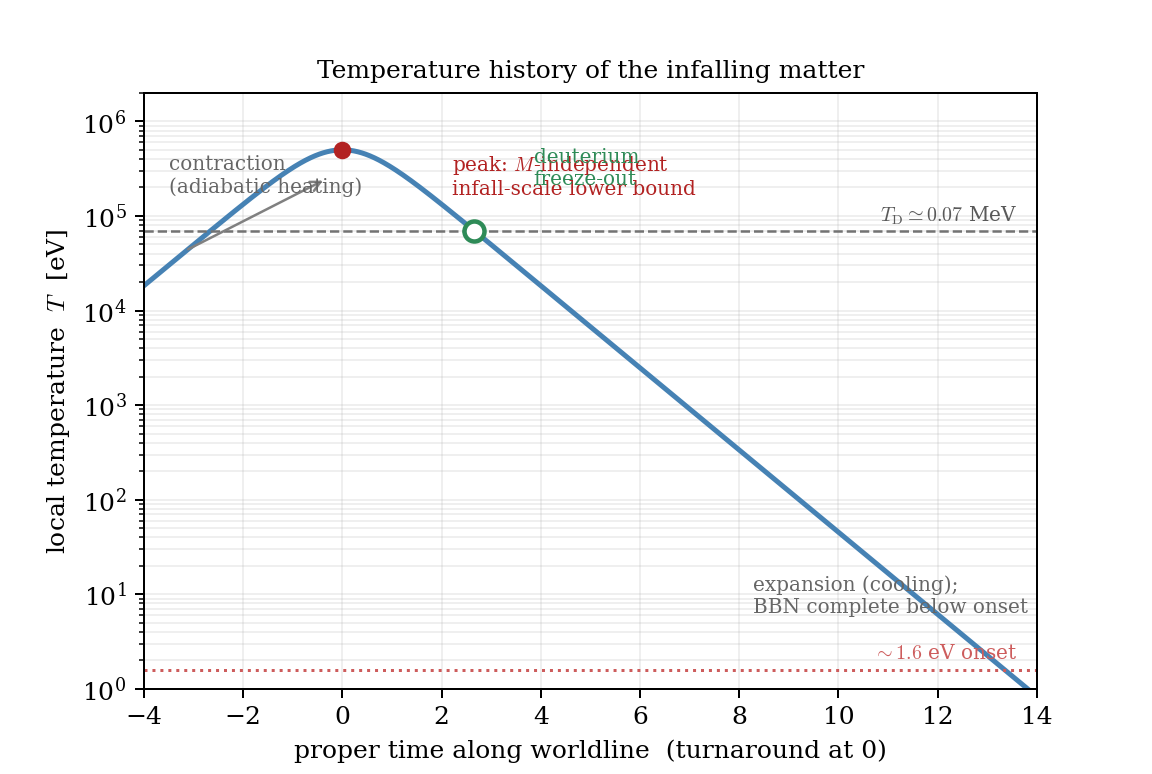
On the expanding leg the situation is fully specified: matter cooling through the nuclear window, at the standard Friedmann rate (Sec 4), from a fully dissociated hot start (Sec 7). The dissociation is what the crossing supplies. The window is crossed twice—once on the way in, once on the way out—and at the branch point the temperature is unbounded, exceeding the binding thresholds of deuterium and helium-4 by any margin: with of order 109 photons per baryon the Planck tail destroys a nucleus well below B/k, at T9≃1.2 for deuterium and 15.8 for helium-4. So nothing the infall built survives to be counted, and the expanding leg begins from free nucleons.
That is precisely the setup of standard big-bang nucleosynthesis. The expanding leg therefore is a standard BBN, and reproduces its pattern with the inherited baryon-to-photon ratio η—the same standard datum that fixes both the light-element abundances and the microwave-background peak heights (the baryon loading), and the one quantity the handover supplies [JanzenCRcosmology]:
these being the values a genuine multi-nuclide network returns when integrated explicitly on the cooling history (Fig. 2), not read off the standard-BBN correspondence alone.
The displayed numbers are the StarLib evaluation: they are the rate-library cross-check's outputP16R12, not the column of the network validationP16R10, whose own computed entries on the REACLIB rates are 2.5671×10⁻⁵ and 4.4611×10⁻¹⁰.
One input of that network is used everywhere in this paper and named nowhere, and it is worth naming because a reader will ask what this framework predicts for it.
The network carries three thermalized neutrino species with the standard post-annihilation temperature ratio (4/11)1/3—that is, the effective number Neff=3.046 [Mangano2005], the Standard Model value including the small non-instantaneous-decoupling correction, and it is adopted here rather than derived. The question a reader arrives with is whether this framework's fourth grading changes it, and the answer is that it cannot, for a reason this programme states repeatedly in another context. The gauge content has no geometric origin here: su(3) is not a subalgebra of the substrate's isometry algebra, and the geometric core declines a geometric origin for the gauge sector outright [JanzenGeometricCore, JanzenBoundary]. So what the construction fixes for a right-handed neutrino is a place in a grading, and not a coupling—and Neff counts species that thermalize, which is a statement about interaction rates and is exactly what the network computes, from a decoupling temperatureP16R26. The Standard Model already admits a gauge-singlet right-handed neutrino and keeps 3.046 for precisely that reason: the existence of the state has never by itself moved the count. This framework therefore makes no Neff prediction; the standard value is adopted, and is consistent with the fourth grading rather than in tension with it—which is worth saying because the sector is otherwise sharp enough to invite the question, and because Planck's Neff=2.99±0.17 [Planck2018] is the number a departure would have to move. And the dependency is under an existing trip-wire rather than a new one: the framework's falsifier (F1) fires if the gauge group is ever promoted from described to forced, and if it were, the right-handed neutrino would acquire couplings and this consistency argument would have to be re-run [JanzenCRframework].
The quoted values are the evaluated light-nuclide set (StarLib [Sallaska2013]); an independent compilation (REACLIB [Cyburt2010]) run on the same network gives D/H 2.8% higher and 7Li 13% lower, a spread comparable to the propagated nuclear-rate theory error below rather than a modelling ambiguity. StarLib lands D/H on the canonical standard-BBN value to sub-percent and 7Li 3% off, and the two libraries differ on lithium by four times that. (Yp is quoted with the standard ∼1.6% radiative/Coulomb correction the Born-level weak network omits, which carries the network's computed 0.2432 to 0.2471P16R10; it is set by the neutron lifetime [PDG2022] and η, not the nuclear rates.) The standalone weak-freeze-out receipt returns 0.2506 on a Born-level two-species network, agreeing with the standard value from the other side; the figure quoted here is the network's. Helium-4 and deuterium land at their observed values.
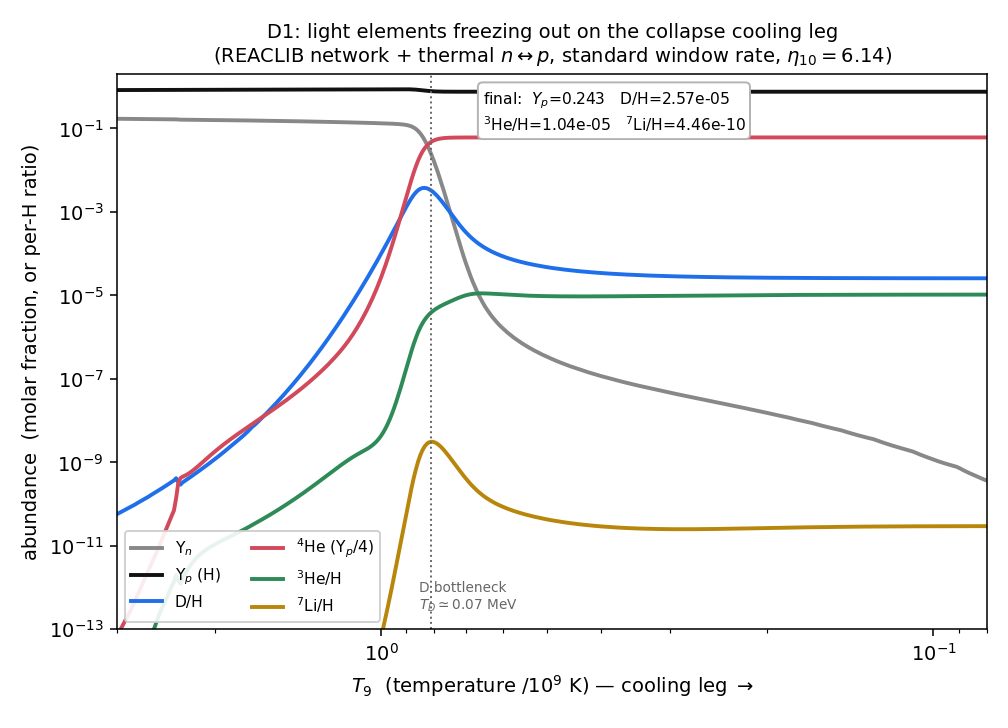
sense worth stating: the freeze-out temperature the observed D/H demands is the standard bottleneck, ≃0.07 MeV, and that is exactly the temperature at which the standard rate (Sec 4) delivers a freeze-out—target and mechanism coincide without adjustment.
The same leg carries a second load, developed in the cosmology paper: the acoustic modes' driving. Because the cooling leg is a radiation-dominated Friedmann leg, the potential that drives them is elementary and even in its argument, so a contracting radiation leg would carry the same closed form; every mode re-enters on the cooling leg from the frozen state the branch point hands over, the driving envelope computed there is flat above ten times the seam's horizon wavenumber, and its turnover sits at the equality the matter density fixes [JanzenCRcosmology]. So the thermal history integrated here and the perturbation driving are two readings of one leg—the abundances record its temperature and the acoustic envelope records its rate.
What standard carries here is worth stating rather than leaving to the network, since the reader cannot see the code: the run assumes the ordinary relativistic background of a hot big-bang nucleosynthesis, three neutrino species sharing the plasma temperature until electron–positron annihilation and decoupling thereafter to (4/11)1/3 of it, with Fermi–Dirac leptons and neutrinos in the weak rates that set the neutron-to-proton ratioP16R11. That background is not a free choice: the helium-4 fraction is sensitive to the expansion rate at freeze-out and so to the relativistic content, and the abundances come out at their observed values on it. So the light-element agreement reported here is also, read the other way, a measurement of that content—the progenitor handover delivers the standard relativistic background, and the abundances are the evidence.
Lithium-7 comes out at the standard value and so carries the standard threefold over-prediction: the lithium problem. Taking the light elements as inherited rather than synthesized would hold that over-prediction dissolved, but the concrete thermal history of Sec 7 forces synthesis: the deep re-expansion from Tpeak down through the bottleneck does the nucleosynthesis, on the leaf's own Friedmann rate with radiation included. Because it is a standard BBN it produces lithium standardly, and the problem is present—exactly as in flat ΛCDM, neither dissolved nor worsened. These abundances are established, not conjectured: the network is integrated explicitly on the cooling history—a genuine multi-nuclide network (the published REACLIB reaction rates, forward and detailed-balance reverse, with the finite-temperature weak n ↔p conversion) run at the standard window rate of Sec 4 from a fully dissociated start, seeded by the weak-freeze-out neutron fraction. It returns the pattern above, reproducing standard big-bang nucleosynthesis at the inherited η to a few percent (Yp to 1.5%, D/H to 2%, 3He to sub-percent, 7Li at the standard several-fold over-prediction), with the correct baryon-density dependence—d ln (D/H)/d ln η=-1.6 and the lithium valley both recovered—and baryon number conserved through the integration. What remains open is not the computation but its last-percent precision: the specially-evaluated (as against REACLIB) light-nuclide rates—a precision frontier the title does not stake itself on (Sec 10), not a debt. The scoping of those rates is derived in Sec 5: the heat–turnaround–cool excursion is progenitor-side history on the local Friedmann readout (radiation included, standard at the window), the foliation's geometric rate is the observable universe's from the branch point on, while the nucleosynthesis, like the plasma's own lengths, is read off the leaf's rate with radiation included.
Verdict, reckoning, and the open edge
The question this paper set out to answer—whether the observed light-element abundances arise naturally from the collapse in the previous universe, rather than being inserted as free data—is answered. Deuterium and helium-4: yes, produced at their observed values by the standard-rate cooling leg with the one inherited composition datum. Lithium-7: the standard problem, shared, not dissolved. On the light elements CR is thus neither better nor worse than flat ΛCDM—two successes and one shared problem—but it obtains them from the collapse rather than from a posited initial hot phase.
The confrontation is quantitative, and it is a joint one. Run at the baryon-to-photon ratio Planck reads from the microwave-background peak heights [Planck2018] (η10=6.13±0.04, Ωbh2=0.02237), the network's abundances meet the independently-measured primordial values: deuterium at -0.5σ and helium-4 at +0.5σP16R12 of the metal-poor-DLA [Cooke2018] and helium-recombination [Aver2021] determinations (Fig. 3)—the same single η threading the CMB and the light elements, the theory errors propagated from the reaction-rate uncertainties through the network's own sensitivity coefficients (the deuteron-burning rates for D/H, 3He(α,γ)7Be and 7Be(n,p)7Li for lithium). Lithium-7 sits high, at the several-σ level (∼6–8σ on the evaluated rates)—the standard lithium problem, carried unchanged. So “produces the abundances” is earned against the data and not merely against the standard-BBN correspondence: one forced hot phase, one CMB-fixed η, deuterium and helium-4 in concordance, lithium the shared open edge. And the three outcomes do not weigh alike. Deuterium and helium-4 at their observed values are reached by any network running standard rates at the Planck η, so agreement there discriminates weakly between candidate histories; a lithium over-prediction of the standard size is reached only by a network that is the standard one. Since what is argued here is an identity—that the cooling leg is a standard big-bang nucleosynthesis rather than one resembling it—a network reproducing D and Yp while missing the standard lithium excess would be evidence against that identity. The shared miss is thus the outcome that discriminates, and it tells in the identity's favour: it is the one result that cannot have been selected for, since no case is assembled out of a failureL25. That lithium remains an open problem in the standard theory is unchanged by this, and is not a problem this paper claims to solve. That the concordance is obtained from a hot phase the corpus requires, rather than one posited to yield it, is the reckoning below.
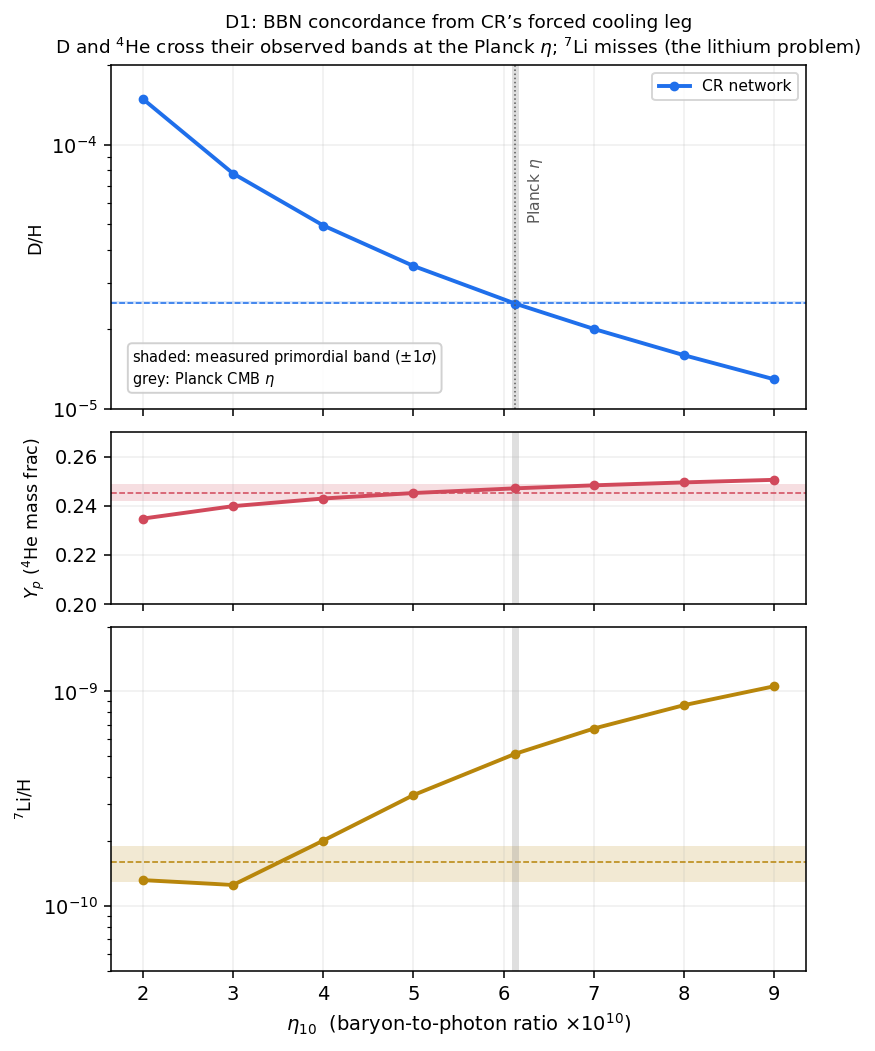
The reckoning is on the theory-choice axis. The hot dense era is not an initial condition added to the theory; it is the re-expansion of a previous universe's collapsed matter, required by the corpus's structure (Sec 2) rather than introduced to yield nucleosynthesis—the distinction the programme's epistemology makes decisive, that a framework which requires a phenomenon is preferred to one that merely permits it, and against which the historical record calibrates such preferences (the shadow-of-existence paper, P6 [JanzenShadowExistence]). The abundances are then a consequence of ordinary nuclear physics on that history, not of a sector tuned to produce them. What flat ΛCDM supplies as an initial hot phase, CR supplies as the far side of a collapse it already had.
On the data axis the synthesis stands level with the standard model on the light elements and the distance ladder, and against it at the acoustic peaks. The falsifiable demand beyond the anchors—whether one progenitor handover, one value of η, fits deuterium, helium-4 and helium-3 together—is met at the level this paper's network reaches: the multi-abundance pattern comes out jointly from the single inherited η, and confronted with the measured primordial values at the microwave-background baryon density, deuterium and helium-4 fall within 1σ (§10), with the shared lithium over-prediction the one miss. Taken with the companion cosmology's fit of the distance ladder on the same geometric rate [JanzenCRcosmology], the reading meets those data at the standard model's level from a structure that requires its hot phase rather than positing it—the sharp edges that remain being the last-percent abundance precision and the microwave-background peak structure, where the companion cosmology's full-spectrum likelihood rejects the computed temperature spectrum on its shape [JanzenCRcosmology]. The inherited data are closed rather than open (Sec 7): measured boundary data, the progenitor spectrum's amplitude and tilt among them, that no lap transmits a derivation of. And the crossing supplies no asymmetry, which is why the magnitude of η is inherited rather than made. The crossing itself cannot supply the asymmetry: the imaginary segment's Euclidean action is odd under the standing conjugation acting on offset and mass together, so the matter and antimatter branches carry equal and opposite action and neither is weighted above the other by the passage (Sec 3). The balance is exact rather than approximate, and it is traced to the same offset–mass oddness that fixes the chirality parity and the progenitor's antimatter identity—so it is not a coincidence that could be lifted by a refinement of the crossing. Whatever supplies the observed asymmetry must therefore be carried by the matter field's own charge-conjugation factor, or be genuinely inherited as content, and not produced by the geometry of the handover. That removes the most natural place one would look first.
What the title claims. This paper's title stakes it at that criterion of necessity: the Big Bang a deductively forced synthesis, and the abundances it produces. That bar is met in full for the synthesis—each arrow proved elsewhere in the corpus, the conjunction forced, not posited—and for helium-4, computed from the freeze-out on the window rate; deuterium follows on the reduction of the cooling leg to a standard nucleosynthesis, and lithium-7 shares the standard problem. What the title's “produces” promises for the whole pattern at that same bar is that one collapse handover requires deuterium, helium-4 and the metallicity floor together, not merely permits values that fit them. It does. The multi-abundance network, integrated on T(τ),ρ(τ) with CR's rate at each epoch and run on the standard-rate cooling leg from a fully dissociated start (Sec 9), returns deuterium, helium-4 and helium-3 at their observed values and lithium-7 at the shared standard over-prediction, jointly from the single inherited η, to sub-percent fidelity on evaluated rates; the metallicity floor follows from total dissociation at the peak (Sec 7). The pattern is required, not permitted, and the title's “produces” is earned at the criterion of necessity.
Distinct from it are the inherited data, and they are measured boundary data and not derivable: η is carried through both passages and inherited (Sec 7); ρr/ρm is a clock reading with no single value for a handover to transmit [JanzenGeometricCore]; and the progenitor spectrum's amplitude and tilt are the progenitor's own classical content, handed across a crossing that stamps no scale [JanzenCRcosmology]—each carried, exactly as flat ΛCDM carries its own η, at no cost to the synthesis. The criterion that tells a debt from a boundary datum, requirement against permission, is the same one the reckoning above turns on [JanzenShadowExistence].