P15
The cosmology of Cosmological Relativity
the expansion history from causal reassignment on a de~Sitter background, the cosmogenesis branch point, and the scalar perturbation sector
Abstract
Cosmological Relativity (CR) obtains the observed cosmological expansion by a causal reassignment on a de Sitter background at the cosmogenesis branch point, with the Einstein field equations unchanged. This paper develops that cosmology and completes it with its scalar perturbation sector. The reassignment selects the Nariai member [Nariai1951] of Schwarzschild–de Sitter, whose proper frame is a homogeneous, observationally isotropic, non-synchronous cosmology with areal radius r(τ)∝ sinh2/3—exactly the flat-ΛCDM scale factor—its rate fixed by the cosmological constant alone, with radiation and matter inherited content read off the cosmic clock rather than terms that source the expansion. The cosmic beginning is the branch point r=0—a genuine curvature singularity of the SdS metric read over the r-chart [JanzenCircle], and not a singularity of the underlying substrate, whose throat is the defining constant α; the divergence of the r-chart invariants there is the areal coordinate degenerating; the constant-proper-time slices are exactly Euclidean (Ωk=0) while the cosmological layers are a closed S3—spatial curvature and dark energy one Λ read on two slicings. The acoustic scale follows from that rate rather than calibrating it: with the plasma handed over at the branch point there is no early-universe parameter to carry the angle, so the angle is computed, and it and the baryon-acoustic distances fix H0 together at ≃68.6. The light-element composition is produced on the same footing: the infalling matter heats above the deuterium bottleneck and the expanding leg cools back through it, so that leg is a standard big-bang nucleosynthesis run from free nucleons, fixing the composition with the inherited baryon-to-photon ratio η—the one boundary datum of that handover. Helium-4 and deuterium sit at their observed values—the freeze-out temperature the data demands being the bottleneck the standard rate delivers, un-tuned; the near-zero metallicity of the oldest systems follows from the handover; and because the run is standard, lithium-7 carries the standard threefold over-prediction, the lithium problem shared with flat ΛCDM rather than dissolved.
On this cosmology the primordial scalar spectrum factorizes. The de Sitter substrate determines its structure—the coherence of the acoustic phases, fixed by the frozen state the collapse geometry hands over at the branch point (a super-horizon freeze-out forced by the geometry rather than produced by an added epoch), the classical non-vacuum character of the fluctuations (the substrate vacuum lies some 10113 below the observed As), the throat's isotropization, a parameter-free low-multipole discreteness floor, and the faithful transmission of the spectral shape—while the progenitor collapse supplies its content, the amplitude As and tilt ns, inherited as boundary data exactly as flat ΛCDM inherits the baryon-to-photon ratio. The transmission is supported by a mechanism rather than by the absence of a scale alone (§3): on the contracting leg aH grows without bound as the branch point is approached, so the comoving horizon shrinks to zero and every mode exits it and freezes before the crossing; the imaginary-time segment's Euclidean kernel damps oscillatory content and has nothing to act on in a frozen mode, so amplitude and tilt cross unaltered while the collapse-leg acoustic phase does not—which the observed peak positions independently require, excluding a transmitted leg phase by a factor of 21–41 in the required distance [JanzenCRframework].
The decisive result is a transmission dichotomy: a non-degenerate horizon's exponential near-horizon approach imprints a scale-invariant spectrum (the inflationary de Sitter-horizon mechanism), whereas the degenerate Nariai double root's power-law approach carries no scale, and the branch point where the modes cross—a third case, f diverging so that the tortoise coordinate stays finite—accumulates no phase at all; the super-horizon transfer across it is computed and scale-invariant, so the progenitor spectrum is transmitted unaltered and CR has no inflationary scale-invariant attractor, no consistency relation, and no substrate-sourced primordial B-modes.
Because the distance slicing is flat, the discrete closed-S3 source projects through the flat transfer to a parameter-free low-multipole deficit (ℓ≲8)—mild, and on a genuine Boltzmann transfer a dip whose minimum falls at ℓ=4 (0.36 of the ΛCDM expectation there, 0.487 and 0.435 at ℓ=2 and 3; the shape and the depth both cross-validated between two independent transfers, which agree to three per cent at worst once the post-recombination source is carried to the present), and non-discriminating in sum: scored against the measured multipoles with cosmic variance carried, the quadrupole favours this construction and ℓ=3 to 5 favour the standard model, the two nearly cancelling at Δ(-2 ln L)=+1.6 over 2≤ℓ≤10.
Taken together, these results carry a reckoning the paper draws in full: what flat ΛCDM assembles from added, tunable apparatus—inflation for the horizon, flatness, coherence, and near-scale-invariance, a dark-energy component for the late-time acceleration, added early-universe physics for the tensions—this cosmology recovers from the cosmological constant alone, each feature required by structure already present rather than produced by a sector introduced to yield it. By the economy of assumption that distinguishes a required structure from a merely permitted one, that comparison is settled on the theory-choice axis in this cosmology's favour; and on the data axis it is split: the expansion history fits the low-redshift distance ladder on the SDSS DR12 consensus and, at the current state of the art, the DESI DR2 dataset (thirteen measurements across seven tracers) at χ2/ dof≃1, which fixes Ωm≃0.30 and H0≃68.6 and leaves the discrepancy with the local distance ladder where the standard model leaves it; the light-element abundances are confirmed within 1σ at the microwave-background baryon density (the cosmogenesis paper [JanzenCosmogenesis]); and the acoustic peak structure, computed from that same background with nothing fitted to it, reproduces the comb to a part in six hundred and is still rejected on shape—at 2.57 times the control's distance from the data as computed, and 1.57 times once both arms' parameters are refitted; what it leaves is about one multipole at each peak. What the sky prefers differs from the construction in exactly one assignment, the rate on which the projection's comoving distance is built: built on the leaf rate, radiation restored, the arm's unreachable χ2 falls from 278.8 to 184.989, below the control's own 186.007, while the construction holds that distance on the stacking rate through one identification, that the projection's distance is the one measured across the observer's own flat slice (§4).
The cosmology's exposed edges are named: a signature in the diffusion scale, the two rates differing by the radiation term alone so that the plasma's Silk scale and the foliation's distances do not share a rate [Silk1968]—a computed effect, non-reabsorbable by the baryon density, whose size is fixed by the handover, read with both lengths carried to the peak of the visibility function, and which the joint fit locates as a Gaussian residual in ℓ that no tilt removes, a refit absorbing a Gaussian only window-locally (the low multipoles being a mild, non-discriminating
deficit rather than a sharp edge either way); and the acoustic peak structure, whose shape disagreement sits in that one assignment. The full-spectrum
likelihood is run on the computed spectrum: scored against Planck 2018 plik_lite over the
full-range lensed configuration, with one amplitude fitted so that what is compared is shape, this arm sits
at 2.57 times the control's distance from the data (§4). That is a spectrum
computed on a background fitted to the distances and then confronted, which is a different statement from a
refit of the spectrum's own parameters to the microwave data; the second is the comparison the standard model
is usually judged by, and it is reported in §4 beside the first.
We mark maturity throughout. Established: the cosmological derivation, the transmission dichotomy, the amplitude floor, the throat, the flat slice, the flat-projection transfer, the data confrontation, and the time-reversal driving equality as a Fourier theorem. Argued: the coherence mechanism. Measured: the peak heights, which this arm's own instrument returns within a few per cent of the sky's first two ratios on the polarisation path and above them on the fluid path, so the heights are the path's and the positions are the construction's.
Run, and returning a partial agreement: the end-to-end branch-point-to-recombination transfer, the standard line-of-sight integral across a visibility of finite width, validated on its control to 0.23% in the first-to-second height ratio in the configuration this construction's arm is read in, and carried through to that arm, which returns the peak spacing to one part in six hundred and the first three peaks within a grid step of the measured ones, with the fourth not resolved against the sky once the likelihood's own covariance is propagated; the likelihood rejects the arm's spectrum on TT shape nonetheless. Boundary data, and not a debt: As and ns, measured as the progenitor's boundary data in the sense flat ΛCDM measures its baryon-to-photon ratio, so that deriving them would be a bonus rather than a debt owed. The cosmology carries no early-universe parameter of its own—its inherited data, the baryon-to-photon ratio and with it ωb, and As and ns, are measured as flat ΛCDM measures them—and what it does carry should be stated plainly: the plasma is handed over at the branch point, where every acoustic mode is outside the horizon and the potential sits at its regular value, so the sound-horizon integral has no lower endpoint to fit and the acoustic angle is an output of the rate rather than a calibration of it. The background is fixed by the late-time data alone—the epoch x0 (equivalently Ωm=2/(x03+2)) and H0, from the baryon-acoustic distances together with that angle, which agree with one another within a twentieth of a unit at H0≃68.6. Matter–radiation equality is then fixed by the same epoch, 1+zeq=ωm/ωr with ωr measured, so one quantity carries the expansion history and the acoustic driving together and the computed spectrum is a test of the background rather than a further fit to it. The substrate's single Λ is shown to govern both the global expansion and, per structure, the local scale at which structure resists it—the Hubble–Eddington radius—one constant read at two ranges.
Introduction: the cosmological theory and its scalar perturbation sector
Cosmological Relativity (CR) recovers the flat-ΛCDM expansion history by a causal reassignment on a de Sitter background at the cosmogenesis branch point: the expansion rate is fixed by the cosmological constant alone, radiation carries no term in it, and the present matter density is a reading of the cosmic epoch rather than an independent quantity [JanzenCRframework, JanzenModernParallax]. The cosmic beginning is the branch point r=0—a genuine curvature singularity of the SdS metric read over the r-chart, and not a singularity of the substrate, whose throat is the defining constant α, and the construction makes the constant-proper-time slices exactly flat while the cosmological layers are a closed S3. This paper develops that cosmological theory in the form its observational tests require (§2) and completes it with the scalar perturbation sector the framework paper's outlook named open—“perturbations within the Schwarzschild–de Sitter representation”—the primordial density perturbations and their imprint on the microwave background (§§4–8), closing on the open frontier the construction sets up (§10). Across these sections one comparison recurs and is drawn together at the close (§9): the causal contact, flatness, coherence, isotropy, and near-scale-invariance that the standard picture obtains from an added, tunable inflationary sector are here read off structure already present and fixed by Λ alone—an economy-of-assumption difference the paper argues is decidable on the theory-choice axis, where it falls to this cosmology—and on the data axis the expansion history fits the low-redshift distance ladder, which fixes H0 alongside the epoch, and the light-element abundances are confirmed against the data (§2), while the exposed edge is the acoustic peak structure—where the transfer, run on that background with nothing fitted to it, reproduces the comb to a part in six hundred and is still rejected on TT shape, a rejection that sits in the one rate the projection's distance is built on (§4)—and the damping-scale signature, a computed, non-reabsorbable effect whose size the handover fixes, read with both lengths carried to the peak of the visibility function, and which the joint fit locates as a Gaussian residual no tilt removes, the low multipoles a mild, non-discriminating deficit rather than a sharp edge either way. The companion dynamics paper develops the perturbation sector's tensor half—the propagating graviton as the leaf's shear, a massless de Sitter mode on the cosmic foliation [JanzenDynamics]; the scalar half is here.
The result is organized by one thesis, which we state at the outset because it controls everything below.
The CR primordial scalar spectrum factorizes: the de Sitter substrate geometry determines its structure, the progenitor collapse supplies its content, and the branch point's null geometry assigns each its job.
Substrate-determined, and developed here: the coherence of the acoustic phases (§4); the classical, non-vacuum character of the fluctuations (§5); the isotropizing throat (§6); a parameter-free low-multipole discreteness floor (§7); and the faithful transmission of the spectral shape (§8). Progenitor-supplied, and inherited rather than derived: the amplitude As and tilt ns. This is the same division of labour by which flat ΛCDM carries the baryon-to-photon ratio η as a measured datum from a baryogenesis it does not model; this cosmology carries that same η from the hot handover of the progenitor collapse, and the transmission result of §8 routes As and ns through the same handover. There is one boundary-condition supplier, not two.
A word on what is settled before the spectrum. The acoustic scale (the peak spacing) is settled in the cosmological development above (§2): it is computed from the rate, with the sound speed the ordinary baryon-loaded value of pressureless branch-point matter, and the Hubble constant is fixed alongside it by the baryon-acoustic distances. The sky's own side of that comparison is measured here rather than quoted. Locating the acoustic peaks of the Planck 2018 plik_lite binned TT spectrum [Planck2018] by parabolic fit to each hump above ℓ=100 returns ℓ=220.4, 537.7, 817.3 and 1123.9, which reproduce the standard quoted values to better than one per cent without having been fitted to them. Fitting ℓn=ℓA(n+φ/π) to the first three gives the sky φ/π=-0.2404 against -0.2361 for a ΛCDM control measured by the identical procedure—an offset of 0.0043, so the control stands in for the sky on this quantity to within seven parts in a thousand. The move has a name and the name is worth stating, because it is what licenses the comparison: this is matched-procedure differencing—the control is passed through the identical extraction, so whatever bias the procedure itself carries appears in both arms and cancels in their difference, and what survives is attributable to the physics rather than to the instrument. The same discipline governs every control in this sector: a residual is credited against CR only once the control, run through the same machinery, has been shown not to produce it. What this construction's own arm returns against that measured comparison is reported in §4}, the two-arm transfer being validated on the control and carried to convergence on both arms.} These are settled there and are not reopened in the perturbation sector; in particular, the standard radiation-governed sound horizon laid on this cosmology's rate is a calculation belonging to neither framework, and any “tension” it produces is an artifact, not a CR result. What is genuinely downstream is the spectrum—the peak heights, measured below against this arm's own transfer (§4), and the full oscillating-medium transfer, run on both arms in §4—which is where this paper's substance lives.
The register is the programme's [Janzen2025, JanzenCRframework]: the field equations are Einstein's, unchanged; the existing object is the evolving three-dimensional layer; “the substrate determines” and “the branch point transmits” are statements about a real geometry and its real boundary [JanzenGeometricCore, Janzen2012], not about a modification of the dynamics.
The cosmological theory the perturbations complete
This paper develops the cosmology of Cosmological Relativity from first principles and carries it to its empirical confrontation, completing it with the scalar perturbation sector. It takes from the companion framework paper [JanzenCRframework] the general primitives—the layered ontology, the projection principle, and the representational freedom by which one fixed manifold admits distinct Lorentzian metrics—together with the Null–Boundary Correspondence theorem, the structural result (grounded in the metric-singularity causal structure of gravitational collapse [JanzenBHcausality]) that a collapse event-of-events and a de Sitter cosmic-entry slice are one ontological layer under two causal assignments. The cosmology proper is built here: the causal reassignment that selects the Nariai member, the proper-frame expansion law, the branch point at which the collapse leg becomes the expansion leg—the beginning, reached a lap on from the horizon the Correspondence anchors—and the computation of the acoustic scale and the confrontation with the distance data; the perturbation sector (S4–S8) is its completion.
The causal reassignment and the Nariai member
The vacuum solution of Rμν=Λgμν with a localized source is Schwarzschild–de Sitter (SdS),
whose areal radius r is timelike in the cosmological regime ΛG2M2/c4≥1/9. Building the cosmology, we reassign causal roles on the de Sitter substrate—a move licensed by the representational freedom of the framework, distinct Lorentzian metrics on one fixed manifold sharing its foliation [JanzenCRframework]: the de Sitter null rulings whose causal sense matches a collapse horizon's generators are promoted to the timelike fundamental congruence, the at-rest comoving worldlines become the null photon congruence, and the foliation by expanding 3-spheres is preserved. This selects the Nariai member ΛG2M2/c4=1/9, M=c2/(3√ΛG)—the unique non-pivoting tilt, fixed by Λ alone—at which the two positive horizons merge at rN=α/√3, α=√3/Λ the de Sitter 3-sphere size (a scale distinct from the merged-horizon radius α/√3 and from the areal-radius amplitude below; we keep the three apart throughout). The selection is geometric—the fixed point of the slicing curve's root-exchange involution, equivalently the limiting tangent orientation a collapse selects—not a fitted mass [JanzenSlicing]. That the selection is moreover unique is a structural fact about the description groupoid rather than a fitting: the generic vantages fall into two-cycles of the involution, the Nariai member is its one fixed point, and the reassignment promoting a null direction to the fundamental congruence is forbidden at every generic vantage, so it selects Nariai and no other [JanzenGroupoid].
The proper-frame cosmology, derived
In the proper frame of the fundamental observers the SdS metric is a homogeneous, non-synchronous cosmology. The derivation [Janzen2015] proceeds from (1) in five steps. (i) A timelike radial geodesic has a conserved energy E (the metric being independent of t); eliminating dt/dτ in the normalization L=-1 gives the radial equation (dr/dτ)2=E2-Veff(r), with Veff=(r-2GM/c2- Λ3 r3)/r. (ii) The fundamental congruence is the worldlines whose motion in r is produced purely by the field—those at rest exactly where Veff≡1 and the metric reduces to Minkowski—which is E=1; this fixes the rest frame by the field rather than by stipulation, and it is worth saying where that locus is: Veff=1 is r3=-2GMα2/c2, so the rest frame is defined at r=-(6GM/c2Λ)1/3—a negative areal radius, on the conjugate branch of the lap, between the progenitor's horizon and the branch point [JanzenCRframework]. An earlier derivation carried that locus as a formal one—“a negative mathematical abstraction that lies beyond a singularity at r=0… simply a matter of algebraic consistency” [JanzenFQXi2012, App.]—and on the lap it is a place. The same locus fixes the sign, since t=τ there if and only if E=+1. (iii) With E=1, integrating the radial equation gives, along one worldline, r(τ)∝ sinh2/3(32√Λc2/3 τ). That this integration closes at all is a second thing the same condition buys. Writing the radial equation as (dr/dτ)2=2GM/c2r+r2/α2-k with k=1-E2, the quadrature ∫dr/√ · is elementary at k=0—it is 2α/3 arcsinh (r3/2/√2GMα2/c2), which inverts to the sinh2/3 above—while for k≠0 the substitution r=u2 carries it to a sextic under the root and it is not elementary. So E=1 fixes the rest frame by the field and, by the same stroke, is the one non-degenerate energy at which the cosmology integrates in closed form; the only other elementary cases are the degenerate ones, Λ=0 giving the dust cycloid and M=0 giving pure de SitterL14. (iv) Labelling the congruence by a comoving coordinate χ through the integration constant r(0), the areal radius across the congruence depends on τ,χ only through their sum, r(τ,χ)=r(τ+χ), with ∂χr=∂τr. (v) Fixing the transformation t(τ,χ) by requiring the comoving coordinate orthogonal to proper time, gχτ=0, forces the integration function to be χ itself, and the remaining components follow (gττ=-1, gχχ=(∂χr)2). The result is the proper-frame line element
with cosmic time τ≡τ+χ (by Weyl's principle the congruence issues from a common origin and the constant-cosmic-time slices are those of constant τ), areal radius
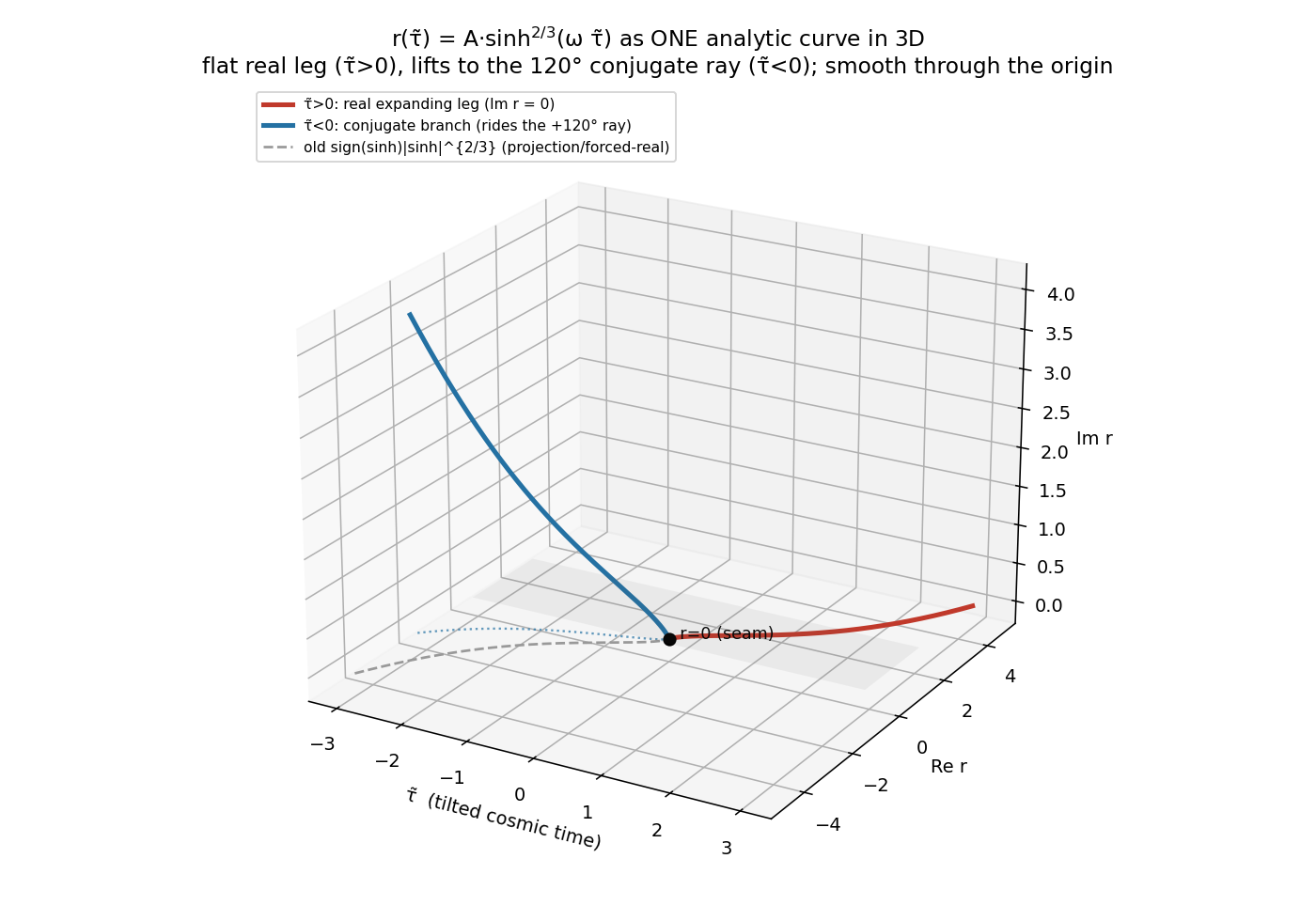
and redshift 1+z=r(τ0)/r(τe). The constant-τ slices sit at 45∘ to the fundamental rest frame: the cosmology is homogeneous and observationally isotropic, yet non-synchronous—the constant-τ slices are exactly Euclidean (S7) but are not the cosmological ones. Two presentations of this one geometry are in use and it is worth saying plainly how the cosmological layer appears in each, because the second is easy to misread. In the de Sitter presentation the layer is the S3: the at-rest geodesics are the photon bundle, one of the two null bundles on the cosmological horn carries the late-time matter geodesics, and the universe is an S3 in which all matter falls uniformly along null lines at constant velocity in the expanding sphere's Hopf fibration. Under the reassignment that gives (2), that same null bundle becomes the constant-χ geodesics and the other becomes the constant-τ ones}—both straight lines in the τ–χ plane, with constant τ the 45∘ lines. So in this chart a constant-τ surface is not presented as a sphere: it is that line together with an S2 of directionality, the Hopf direction having been traded into χ, and reading its induced metric returns R×S2 accordingly. That is what the reassignment does and not a statement that the layer is other than the S3—the uniformity of matter across cosmic-time slices is the same fact read either way, since matter stationary within an expanding S3 and space spinning uniformly along the Hopf direction are one description. Of the FLRW kinematic assumptions—(i) a geodesic congruence, (ii) hypersurface orthogonality, (iii) homogeneity, (iv) isotropy—this construction keeps (i) and drops (ii); Lemaître's reading [Lemaitre1949] of the Euclidean slices as “space ejected from r=0” is causally incoherent and is not the physics. Equation (3) is moreover a single analytic function of τ (Fig. 1): the expanding cosmology is its real branch τgt;0, and the cosmogenesis branch point at τ=0, where r→0, is the branch point of the scale factor rather than a real r=0 boundary—and it is not a seam: the seams are the two unit-speed loci of the lap, r=-2α/√3 and r=+α/√3 [JanzenCRframework], and r=0 lies strictly between them, at the close of the lift—the analytic counterpart of the beginning at the branch point, where the substrate's curvature stays finite while the geometry read over the r-chart diverges [JanzenBHcausality], and the cosmological reading of the slicing curve's closed lap—the cosmogenetic bead the framework establishes as one closed object [JanzenSlicing, JanzenCRframework], of which this scale factor's real branch τgt;0 is the expansion leg and its analytic continuation the prior universe's collapse—on which r=0 is a branch point and not a barrier, the substrate smooth across the locus the chart so labels [JanzenSlicing].
Exact recovery of flat ΛCDM, and the amplitude fixed by Λ
What fixes this rate is worth stating before what it recovers, and the count is smaller than it looks. The rate this cosmology computes on is set by the substrate's geometry and by nothing else. It has one parameter—the substrate curvature radius α=√3/Λ, an invariant length—and one epoch. At the Nariai member the mass is no longer free (5), so the amplitude and the rate of the expansion law are both set by Λ and the scale factor is one function of it; what remains is where the present sits on that one curve. The quantity x0 carries that: it is the present areal radius in units of the Nariai radius, x0=r(τ0)/rN, and since rN=α/√3 is fixed by Λ the number is a clock reading and not a second geometric datumP15R14. The geometry's own offset is fixed twice over: it is the double root of the horizon cubic at the Nariai mass, and it is the constant ledger's 2M=α ((r0/α)-(r0/α)3) with M at that mass [JanzenSlicing, JanzenGeometricCore]—so "the offset" names the unit, and x0 the reading taken against it. So the ratio it fixes is a reading of cosmic epoch, which is what (7) says of the density ratio directly. Neither the parameter nor the epoch is a content of the universe:
The offset is measured directly and calibration-free—zacc=x0-1, (17) below—without a distance ladder, without the microwave background and without any density. What the rate is a rate of is the stacking of the foliation, and content does not enter it: radiation is absent from the slicing operator's vacuum kernel, requiring m'(r)≠0, a bend of the cut; and the second term is the offset itself rather than a density supplied by hand [JanzenOperator, JanzenCRframework].
The familiar cosmological form is accordingly a coincidence of form, and saying so is the substance of this subsection. Written in the fitted pair the same rate reads H2=H02 [Ωm(1+z)3+ΩΛ], with Ωm=2/(x03+2) and ΩΛ=x03/(x03+2) following identically—a translation between parameter sets, and not a decomposition into components. In the standard reading cosmic time is orthogonal to the three-dimensional world and the expansion is driven: by initial conditions, and by whatever densities obtain at each moment, through the field equations. Here it is read off a fixed background whose foliation is not orthogonal to the proper time of observers at rest, so that such observers move through the universe over cosmic time in a geometrically fixed manner. The two readings agree on the function and share nothing beneath it.
Where the field equations act is the leaf, and they act there in full. All stress-energy gravitates, by the ordinary Friedmann readout of the self-gravitating congruence; the perturbations, the plasma's sound horizon and its diffusion length are processes running in the content and take that rate, while a comoving separation read across leaves takes the stacking rate (§2). What the layered framework keeps apart is not two physics but one physics and its projection: a quantity is computed on the level it belongs to, carried on the layer and then projected.
Equation (3) is exactly the flat-ΛCDM scale factor. At Nariai the mass is no longer free, and the amplitude becomes a pure Λ-length,
so both factors of the expansion law are set by ΛP15R39: the rate 12√3Λ c is the standard late-time rate and the amplitude is the third Λ-scale (distinct from α and α/√3). The Friedmann equation the sinh2/3 law satisfies,
makes the density ratio a clockP15R39,
so Ωm,0 records the cosmic epoch τ0 at which we observe rather than an independent density, and the coincidence problem becomes the observation that we exist at a time of order the geometry's single timescale. The densities are bookkeeping for one Λ-set geometry; radiation, like matter, is inherited content read off that clock, not a term that sources the rate, and the stacking rate has no radiation-dominated era [JanzenModernParallax], the leaf, where radiation gravitates, carrying one (§4). The objection that a perturbing radiation fluid “must gravitate and so alter the rate” is a category error against a construction that reads (6) leftward: the rate is set, and the fluid's energy is among the contents the set rate carries. The acoustic scale follows from this rate, and H0 is fixed with it by the distance data; this is developed next (§2).
The acoustic scale, the expansion rate, and where the ruler comes from
The two frameworks reproduce the late-time expansion identically and part in the early universe, where radiation carries no term in the foliation's own rate (6) while the plasma's scales accumulate on the leaf's, which carries it. What follows from that one structural fact is not that the standard model's tensions dissolve but that the acoustic ruler has a different provenance, and the two lengths the observed angle is built from sit on opposite sides of the split.
The three levels, and which rate each quantity uses. The reading of every rate-bearing quantity below is fixed by locating it on one of three levels, which the geometry keeps apart and whose conflation is the standing error the layered framework names [JanzenCRframework]. (L1) The foliation stacking rate: the Λ-set sinh2/3 law (6) read leftward in the sense the slicing paper fixes [JanzenOperator]—the cut is primary and ρ is the name of its bend, not its cause, the rate-side of the slicing operator's reading whose content-side is matter is the bend of the cut [JanzenOperator]—the layer's own geometric expansion, set by α and the offset x0, and empirically forced rather than modelled: the microwave-redshift isotropy floor forces uniform expansion to some three orders of magnitude, so a matter-tracking (radiation-sourced) rate is already excluded by data [JanzenModernParallax].
This is what the observable cosmology rides at every epoch, the branch point included: it is the rate the foliation stacks at, not a regime that begins somewhere. (L2) The leaf-level local dynamics: the expansion scalar of a self-gravitating congruence, the ordinary Friedmann readout H2=8πG/3ρtot+Λ/3 with radiation gravitating normally—the valid phenomenological reading of general relativity on the progenitor's collapse excursion, where nucleosynthesis runs [JanzenCosmogenesis]; it is the same single E=1 geodesic read inward as dust collapse that L1 reads outward as cosmology [JanzenOperator, JanzenBHcausality]. (L3) The E=1 projection: the reassigned shadow the observer reads, through which an L1 or L2 quantity appears as distance and redshift—the Projection Principle of the framework paper, its geometric origin the second ruling of the slicing (the synchronous space is the second ruling) [JanzenCRframework, JanzenOperator]; reading this appearance as the existent is precisely the naïve-realist collapse the epistemology forbids [JanzenShadowExistence]. The decision rule is structural, not a choice: a self-gravitating local excursion runs on L2, diffuse content riding the global foliation on L1, and every observable is an L1 or L2 quantity seen through L3; and there is no L1/L2 boundary in time. The distinction is kinematic and holds at every epoch: the vacuum kernel of the slicing operator is the SdS family exactly—Λ and the cut's offset 2M, and no more [JanzenOperator]—so the stacking rate is c2Hstack2=(c2/α2)(1+2(1+z)3/x03), while radiation, requiring m'(r)≠0, is a bend of the cut and therefore content. The decomposition is exact, Hleaf2=Hstack2+H02Ωr(1+z)4: the two rates differ by the radiation term alone. A comoving separation read across leaves takes the stacking rate; the scales the plasma itself accumulates—rs and rD—take the leaf's, together with recombination's microphysics and the perturbations, because they are accumulated by a fluid running in the content whose own radiation gravitates in its own expansion. The two must take the same rate, and the peak spacing the construction computes is the leaf accumulation: fitted to the computed peaks, the comb reproduces that integral to two per cent and the stacking one not at all. The assignment looked temporal only because Ωr(1+z)4 is negligible below z∼10 [JanzenCRframework, JanzenBHcausality]. Each mis-assignment is quantitatively fatal—the geometric L1 rate carried down into the nuclear window is ∼300× too slow, and the radiation-sourced L2 rate carried into the distances would pin them to a radiation-era density the foliation's own rate does not carry [JanzenCosmogenesis]. Crucially L1 is the layer's own ontological expansion, not the L3 shadow: computing a process against the stacking rate is reading the geometry, not the appearance. Every rate-bearing quantity below carries its level, so the reading is settled by the geometry rather than defaulted to the synchronous machinery.
The Hubble constant. The late-time expansion is reproduced exactly, so H0 enters this cosmology as it enters the standard one: through the distances. With the plasma handed over at the branch point there is no early-universe parameter left to carry the acoustic angle, and the angle and the baryon-acoustic distances then fix the rate together, at H0≃68.6—the angle alone and the distance data agreeing to a twentieth of a unit. So this construction does not dissolve the discrepancy with the local distance ladder [Riess2022]: it leaves it where the standard model leaves it, as a disagreement between the ladder and the early-universe inference, and what it supplies in its place is stated in §4—the acoustic spectrum computed from that background with nothing fitted to it.
The acoustic scale, computed. Recombination is observable cosmology from the branch point onward, and the two lengths its angle is built from sit on opposite sides of the rate rule: the comoving distance DM is a separation read across leaves and rides the stacking rate, while the sound horizon rs is accumulated by the plasma and rides the leaf's. The observed angle θ*=rs/DM is their projection.
The robust ingredients are in hand: DM is the standard observable, and H(z) is the fixed sinh2/3 law (6) with radiation absent from the rate.
The sound horizon rs=∫zrec∞(cs/H) dz—whose baryon-loaded cs is ordinary content microphysics and whose expansion is the leaf rate the plasma runs on—carries no early-universe parameter at all once the plasma is handed over at the branch point, where every acoustic mode is outside the horizon and the integral converges at its upper end.
The branch point is a locus at which the areal chart's invariants diverge—r=0 is a genuine infinite-curvature locus of that chart—while the curvature of the manifold the cut is taken on is set by α everywhere, so the divergence is the areal coordinate degenerating and not a scale of the geometry [JanzenCosmogenesis, JanzenGeometricCore]. And it is the substrate reading of the branch point that makes the integral well posed: the modes are outside the horizon there and the plasma's own expansion carries them, so the sound horizon converges at its upper end without a floor having to be placed under it by hand. Taking cs the ordinary baryon-loaded value—the matter the plasma carries is pressureless, and the geometric throat ratio √3 does not set it—the acoustic scale is computed rather than met: integrated on the leaf rate from the branch point, it returns an angle whose comb sits at 298.0 against the sky's 298.4 with the background fixed by the distance data alone. This is where the two rates part, and it is not where the standard model's radiation sits. There the whole expansion carries radiation and the ruler is pinned by the matter density's physical value; here the foliation's own rate carries none, so the distances are radiation-free while the plasma's scales ride a leaf rate that is not, and the two lengths the angle is built from sit on opposite sides of that split. The beginning is well posed: the branch point—finite in the substrate's curvature, whatever the r-chart geometry does there (§2)—carries every acoustic mode outside the horizon and the potential at its regular value, so the sound-travel integral converges at its upper end and needs no lower endpoint placed by hand.
What the construction fixes, and what it does not. The empirical forcing of the cosmic foliation bears on the rate, not the matter content—the matter density being the bend of the spatial cut [JanzenModernParallax, JanzenOperator, JanzenRange]—so the content the plasma carries is measured rather than set by the geometry; the cold seam (Gibbons–Hawking temperature [GibbonsHawking1977] ∼10-30K, some thirty orders below recombination) confirms there is no geometric source to set it instead.
The quantities this cosmology actually uses are the epoch x0 (equivalently Ωm=2/(x03+2); x0 is the expansion read in units of the geometry's own fixed offset rN, not the offset itself, which the Nariai condition fixes at α/√3), which the rate carries and the baryon-acoustic data fix; H0, fixed by the same data together with the acoustic angle; and ωb and ωγ, which the sound speed carries and which are measured directly and framework-independently. There is no early-universe parameter among them: with the plasma handed over at the branch point the sound horizon has no lower endpoint to place, so the angle is an output of the rate rather than a calibration of it.
The physical matter density ωm=Ωm h2 then does enter, and it enters once, through equality. Matter–radiation equality is 1+zeq=ωm/ωr with ωr measured, so the epoch the distance data fix also fixes how long the plasma spends radiation-dominated, and with it the driving that sets the peak heights and the wavenumber at which the envelope turns over. One quantity carries the expansion history and the acoustic driving together, which is why the spectrum below is a test of the background rather than a further fit to it.
One thing about Ωm is worth stating plainly, since the construction's matter sector invites the question. The dust the rate carries exceeds the baryons by about a factor of six, Ωm≃0.31 against ωb/h2≃0.05, so most of it is non-baryonic. That is not a component this cosmology introduces, and it is not one it derives. What the matter sector fixes is the number of families, their chirality, the S3 relating the three walls and the cyclic Z3 relating the generations, and nothing about their internal content [JanzenMatter]; abundances are measured content throughout, the matter density being the bend of the spatial cut. So the non-baryonic fraction stands with η, As and ns: inherited, not set by the geometry. What the construction does supply is a place rather than an abundance. Its correspondence with the Standard Model's content carries a right-handed neutrino as the sixteenth Weyl fermion of each generation, and fixes that state's place while fixing none of its couplings [JanzenMatter]; a species that is never thermalized contributes nothing to Neff, so nucleosynthesis is untouched and no prediction is made or needed here. The point of the paragraph is the division of labour: a candidate the construction already contains, an abundance it does not claim, and no third thing wedged in between.
The radiation amplitude at a start placed by hand, ωr(1+zstart)/ωm, is that start read in units of a density rather than an inheritance; with the plasma handed over at the branch point there is no such start and no such amplitude. And the epoch the distance data fix lands where the microwave background's own matter density sits: the rate's Ωm at the H0 the angle and the distances return together gives ωm=Ωm h2 within a couple of per cent of the standard inference, so equality falls within a couple of per cent of flat ΛCDM's with nothing fitted to a spectrumP15R25.
What this cosmology does carry from outside is the composition: the baryon-to-photon ratio η, exactly as flat ΛCDM carries it from a baryogenesis outside the model proper—measured, not derived—and with it the light elements, synthesized from the hot handover of the progenitor collapse, this universe having formed at the event horizon of a black hole in a previous one, equally outside the construction and equally measured.
That the composition is measured rather than derived is no defect: a framework is credited for requiring the structure it explains—here the rate, and the acoustic structure that follows from it—not faulted for measuring the boundary data it does not. One naturalness argument about the handover fails, because it compares a quantity with itself at two epochs nine orders apart.
Complete collapse does liberate binding energy of order the rest mass (GM/Rc2= 12 at the Schwarzschild radius), and it is tempting to read that as making a handover carrying radiation of order the matter density the natural scale—order unity, rather than the small value η takes. But ρr=ρm occurs at T≃0.8eV, whereas the handover sits four orders above the deuterium bottleneck at 0.07MeV, since that is what the nucleosynthesis computed on it requires [JanzenCosmogenesis]: at the bottleneck the ratio is already ∼9×10⁴ and at the handover proper ∼9×10⁸. A handover carrying radiation merely of order the matter density would be a handover with η≃0.5, which leaves neither light elements nor acoustic peaks. So the naturalness question runs the other way: what the progenitor must deliver is a plasma with of order a billion photons per baryon, and the binding-energy scale offers no head start toward it. One route to that derivation is closed from the geometry's side: the constituent count the matter sector carries is exactly conserved on this history, its parity-odd source vanishing on the spherically symmetric class the cosmogenesis premise fixes, so what such a derivation needs is a chiral state on the spatial layer rather than a chiral memberP15R152—and that state is not available on this layer, the same thermal regularity that fixes the tower's boundary condition carrying no helicity label, so the two helicity towers are populated alike and the parity-odd content cancels between themP15R154. And the amplitude a start placed by hand would carry is not a feature of this construction either: given η and the measured matter-to-baryon ratio, both of which the composition inherits regardless, it follows from standard thermodynamics alone, [1+ν](π4/30ζ3) T/[η(ωm/ωb) mN]. So what the handover supplies is one composition datum (receipt: the_two_data_are_one.pyP15R26). η may remain a measured boundary condition indefinitely at no cost to what this paper computes. And the inheritance has a structural reason rather than being a gap left standing [JanzenCRframework, JanzenCosmogenesis]: the infall thermalizes four orders above the deuterium bottleneck, so the progenitor's composition is erased and the abundances are synthesized in the window rather than inherited, while what survives that passage is baryon number, which no dissociation destroys. So η is inherited and the abundances are predicted, and the asymmetry is worth stating exactly: baryon number protects the numerator, while what protects the ratio is the adiabatic invariance of the specific entropy — the peak perturbing it by 5.5×10⁻¹⁰ of a standing 1.15×1010 kB per baryon, so that η survives the erasure because η is small [JanzenCosmogenesis]. And a derivation of η is not needed, because there is nothing here for one to be about. It enters the progenitor from the ambient universe by composition-sharing and leaves the branch point unchanged to one part in 2×10⁹: transmitted, not determined — which is the exact dual of the radiation amplitude's closure, that one turning on a quantity with no single value to transmit. So the neighbouring statement strengthens from may to must: η remains a measured boundary condition, at no cost.
The synthesized composition. The same collapse fixes the light-element composition, and the geometry sharpens how. The infalling matter compresses adiabatically—the plasma is optically thick, so the photon bath compresses with it—and heats far above the deuterium bottleneck (TD≃0.07MeV) for every progenitor: the compression does not stop at horizon crossing but continues to the branch point, and the peak is bounded below by the infall energy at the horizon, of order the rest mass per nucleon, independently of the progenitor's mass (the cosmogenesis paper [JanzenCosmogenesis]); and across the branch point the expanding leg cools back through the window. The window is therefore crossed twice, and at the branch point the temperature exceeds the binding thresholds by any margin, so nothing the infall built survives to be counted. Because the effective rate through the window is the standard Friedmann rate, the expanding leg is a standard big-bang nucleosynthesis run from free nucleons [JanzenCosmogenesis]. On a first sample this is favourable, and on one element advantageous. The helium-4 fraction Yp≈0.245 sits at the observed value; the near-zero metallicity of the oldest systems follows from the handover photodissociating the progenitor's processed composition back to light elements; and because the run is a standard nucleosynthesis, the lithium-7 abundance carries its standard threefold over-prediction—the standing lithium problem shared with flat ΛCDM, neither dissolved nor worsened. Deuterium sits at the observed D/H≈2.5×10-5: the freeze-out temperature the data demands is the standard bottleneck, and that is exactly the temperature at which the standard rate delivers a freeze-out—target and mechanism coincide un-tuned. The peak calculation that forces this synthesis reading over an inherited one, and the full multi-abundance account, are given in the cosmogenesis paper [JanzenCosmogenesis], where the network is integrated explicitly on the cooling leg and returns deuterium, helium-4 and helium-3 at their observed values with lithium-7 at the shared over-prediction, jointly from the single inherited datum—so one progenitor handover does fit the pattern together; what stands as its open edge is the last-percent precision against the measured abundances, a data-confrontation the produced pattern exposes rather than a computation still to be run.
The load-bearing claim. The acoustic scale is computed from the rate rather than calibrated against it; the standard cs it uses presumes the inherited medium to be an ordinary photon–baryon plasma, which the abundance comparison confirms—helium-4 and deuterium at their observed values, lithium-7 the shared standard problem (the cosmogenesis paper). The load-bearing, falsifiable claim remains the prior one—that radiation carries no term in the foliation's own rate—of which the split between the two rates, and with it the whole acoustic reading below, are the consequences. The sound horizon is where a purely geometric expansion history and the standard radiation-governed one are told apart in the data.
The expansion history, confronted with the late-time data. The distances and the ruler do not share a common factor: DM and DH=c/H carry the stacking rate's 1/H0, while the sound horizon is accumulated on the leaf rate, which carries the radiation the stacking rate does not. So the baryon-acoustic observables DM/rs and DH/rs constrain H0 here as they do in flat ΛCDM, and the fit returns it: against the DESI DR2 dataset the rate fits at χ2/ dof≃1 with Ωm≃0.30 and H0≃68.6, and the acoustic angle alone, from independent data, agrees within a twentieth of a unit. What the two frameworks still do not share is the ruler's provenance: there it is pinned by a radiation-era physical density, here it is the plasma's own accumulation on a rate whose geometric part carries no radiation at all. The two rulers make the constraint differently, and the difference is where the radiation sits. In flat ΛCDM the ruler is pinned in physical length by the radiation-era matter density, so the same distance data tie the fit to one H0; here the ruler is the plasma's own accumulation on the leaf rate and the distances ride the stacking rate, so the two enter the fit through different quantities and the constraint is the joint oneL9.
The confrontation carried to the state-of-the-art DESI DR2 dataset [DESI2025]—thirteen distance measurements across seven tracers (0.3≲z≲2.3), with the full per-tracer DM/rs–DH/rs correlations—returns χ2/ dof≃1 at Ωm≃0.30 and H0≃68.6P15R157, and the acoustic angle computed on the same background agrees with that H0 from independent data. The determination is the leaf ruler's: on a radiation-free ruler H0 would cancel algebraically from the ratios and the data would not see it, while the leaf rate carries ωr/h2, so the same thirteen measurements pin the rate here as they pin it in flat ΛCDM.
One thing about Ωm is worth stating exactly. It is fitted from the distance data here rather than taken from the microwave background, and the invariant is the offset x0, read as Ωm, and not ωm—holding the physical density fixed instead imports the ΛCDM reading. The expansion history the fit returns is a property of the whole redshift range rather than of one angle, and it rides the very rate whose branch-point-located scoping keeps the nucleosynthesis window standard [JanzenCosmogenesis]. The cosmic chronometers [Moresco2016], which read H(z) directly, test the shape of that history independently of any ruler.
Where the acoustic modes stand when the plasma is handed over
The cosmological beginning is the branch point r=0 at the close of the lift, where the conjugate branch becomes the matter branch [JanzenCRframework, JanzenSlicing]. The curvature invariants of the r-chart diverge there because the areal coordinate degenerates, while the throat itself is the substrate's defining constant α and the bead continues through by analytic continuation [JanzenCircle]. The lap's seams lie elsewhere, at the two unit-speed loci r=-2α/√3 and r=+α/√3. We record the consequence that organizes the perturbation sector.
The two loci a reader may run together are distinct, and the distinction is load-bearingP15R79. The branch point is the locus r=0, which no finite cosmic-time layer reaches and which therefore carries no finite redshift at all; a configuration that instead starts the plasma at a finite redshift on the expanding leg is starting it somewhere else, and there the census is the opposite one—modes inside the horizon, and a state handed over mid-oscillation.
What this settles is a premise and not a mechanism: it fixes what the plasma is handed and where each mode stands when it starts, and it does not measure how much of the comb the subsequent driving supplies. That measurement is the transfer of §4, which computes the driving directly; the census above is what the transfer is carried from.
What crosses, and what does not
The transmission dichotomy above is an argument from the absence of an imprinted scale. A mechanism is given for it, and it also settles which content the branch point does not carry.
The imaginary-time segment preceding the branch point acts on a perturbation as a Euclidean kernel [JanzenCanonicalTime], damping a mode of frequency ω by e-ω|Δη|. The segment's conformal length is known in closed form rather than by quadrature: on the bead's own conformal time dη=d τ/r the lap closes as an exact 1:√3:2 right triangle whose imaginary leg is c0B(16,12)/2=3.33874 with c0=2/(√3 21/3)—a pure number, carrying neither mass nor epoch—so |Δη|≃1.7×10⁴ Mpc on this construction's scalesP15R245. What the kernel's exponent is, as against its length, is a factor and not a detail, and it is settled rather than left to the reader: the kernel has one frequency slot, and the two rates the construction can put in it—ω=kcs at the plasma's sound speed, and the substrate field whose equation the lift carries, which has no sound speed in it at all—differ by √3 on this one segment. The segment's own field is the substrate one, and the ground is empirical rather than geometric: a transfer carrying the plasma's sound speed shifts the spectrum by 2csk|Δη|, some 7.6×10³ times the tilt budget the refit leaves, so the sound-speed reading cannot deliver the tilt it would be invoked to carry (§8). The figures immediately below are quoted at the sound-speed value because it is the weaker damping of the two and the argument they serve is a reductio—what the kernel would do to an oscillating mode, which on the settled reading is harsher still—and the reductio is defused by the freezing and not by the choice of rate, which is why the choice reaches nothing this section concludes from the crossing. Where the two rates do reach a quoted figure is §7}, and what the difference costs there is read off exactly rather than re-run. Taken naively this would annihilate everything: at ℓ=220 the factor is 10-68. But ω is the frequency of an oscillating mode, and at the branch point no mode is oscillating. The comoving Hubble scale aH=|dr/d τ|=√|1-f| grows without bound as r→0—normalised at the seam, where it is exactly unity, it is 1.96 at |r|=0.1 α and 19.6 at 10-3α—so the comoving horizon 1/aH shrinks to zero and every mode exits it and freezes before the crossing. A frozen mode has no oscillation for the kernel to damp. So the amplitude and the tilt cross unaltered, and the argument from the absence of a scale is recovered as a consequence of horizon exit rather than assumed. One limit of that census should be stated where it is used rather than left to be discovered: it is computed on the branch where 2M/r is positive, on which the rate has no turning point at all, while the branch carrying the imaginary segment turns around at |r|=(2M)1/3—the areal radius A identically—where the rate is zero and every mode is inside the horizon instead. Which of the two the freezing argument should be run on is a second question of the same kind as the exponent above—both ask which of two objects is the segment's own—and the settlement of the first does not carry to it: the exponent is fixed on empirical ground, by what a sound-speed transfer would do to the tilt budget, and that bears on which rate enters the kernel rather than on which branch of the lap the census is taken along. So the census stands on one branch and is reported as such: what is computed is the vacuum curve's own rate on the branch the lift is not onP15R244. And the two branches are not each other's image, which closes off the identification a reader would reach for first: the lap's own closure is the translation r↦r+√3 α, which is what carries the back unit-speed locus to the front one, -2α/√3+√3 α=+α/√3 exactly, whereas the reflection that |r| implements carries neither locus to a locus at all. The two agree at one point of the lap and nowhere on the imaginary segment—at r=-√3 α/2, the antipode of the branch point—so the census's stretch and the segment's are two distinct places on one closed lap rather than one place read twiceP15R248. What separates the two is the radiation content itself, which is what makes the question a determinate one rather than a matter of presentation: written on the areal radius, the propagation equation on the radiation-carrying congruence and on the vacuum curve differ by Ar times the radial Laplacian of the perturbation and by nothing else—wavenumber-independent, exactly linear in the radiation constant, and vanishing only where that constant does. So the two are not one equation re-timed: the same equation carried to the areal radius by the proper and the conformal clock agrees on both congruences up to the measure factor, so no monotone re-timing reaches the differenceP15R250. And on the construction's own inherited datum that added term is not a correction but the larger of the two: the ratio of the radiation term to the matter term is 2rN/r exactly, so it is 2 at the seam, 22/3 at the turnaround, and falls to unity only at the lap's other unit-speed value. That last coincidence is forced rather than fitted—equality sits at Ar/2M, which the datum places at 2rN, and the two unit-speed radii stand in the exact ratio 2:1 about the branch pointP15R251.
What does not cross is the oscillatory content itself, and that is the collapse leg's acoustic phase: a mode that was sub-horizon earlier carries an oscillation, and the kernel annihilates it—an exponent of -152 at the first acoustic peak, integrated across the segment's own sound-speed profile rather than at the single value the estimate above usesP15R80P15R245. This is required independently by the observed peak positions, which exclude a transmitted leg phase by a factor of 21–41 in the required distance [JanzenCRframework], and it is what leaves the comb to be set on the expansion side from the frozen state of §4. The two results are one statement: the crossing transmits what is frozen and destroys what oscillates, so the progenitor supplies the spectrum's amplitude and shape while supplying none of its phase.
The exponent has two factors, and the argument above varies only one of them. It is e-k cs|Δη|: holding cs at the plasma's value and varying k reads it as a scale criterion, frozen against oscillating, which is the reading just given. Holding k and varying cs reads the same inequality as a species criterion, and that reading supplies something the first does not. A pressureless component has cs=0 identically—not small, not slowly varying—so its exponent vanishes at every wavenumber; on the segment its mode equation is ψ”=0, whose constant solution the kernel leaves untouched with no approximation at all. The matter sector's inheritance is therefore exact rather than adiabatic: it does not rest on horizon exit and it does not degrade at small scales, where the frozen-mode argument does. The two arguments agree wherever both apply, and only the pressureless one is available everywhere. Neither reading carries a constraint the other lacks. On this geometry the exponent at the first acoustic peak is ≃1.6×10² cs/c, so a component arriving oscillating with a per-cent sound speed would be suppressed by e-1.6 and one with ten per cent by e-16 (receipt: the_filter_is_a_sound_speed_filter.pyP15R80). But the exponent has nothing to act on. The kernel acts on oscillatory content—a frozen, zero-frequency mode is a fixed point of it—and on the progenitor's own interior nothing arrives oscillating: |aH|=|a'/a| diverges as 1/x at the branch point while cs saturates at 1/√3, so csk/|aH|→cskx→0 for every k, and every mode from ℓ≃28 to ℓ≃2475 exits the comoving sound horizon strictly before the crunch—the highest with a fifth of a per cent of the collapsing leg still to run [JanzenCosmogenesis]. So the two readings do not divide the work between them: the scale criterion is satisfied by everything, and the species criterion selects nothing. The crossing is lossless for every species rather than for cold ones alone, and the pressureless argument's positive content—that the inheritance is exact rather than adiabatic—holds of every species and not of dust alone.
One consequence of that freezing bears on the acoustic sector rather than on the crossing, and it is computed rather than left as an inference. Every mode is outside the comoving horizon at the branch point (Prop. 1), so each re-enters on the expanding leg at its own time, and what it meets there is fixed by the rate the perturbations run on. On the leaf rate that re-entry is an event: the plasma carries radiation, the potential decays on the sound-crossing time, and the modes entering while radiation dominates—everything above ℓeq≃144 at the epoch the distance data fix—are driven. That driving is not an inference about the potential's form but a shape read off the two arms: subtracting an undriven reference that calibrates at unity, the control's acoustic phase at first turnover is flat in wavenumber to 2.1% while this arm's varies by a factor of 3.9 across the same bandP15R64, and §4 carries the same driving in closed form.
What the rate rule closes is the alternative reading, on which the modes re-enter under pressureless matter and nothing is imprinted: the potential equation for a pressureless component, Φ”+3 H(1+w)Φ'+[2 H'+(1+3w) H2]Φ+wk2Φ=0, contains no k at all once w=0, so on a radiation-free rate the problem is scale-free and a scale-free problem imprints nothingP15R62. That is the stacking rate's answer, and the perturbations do not take it: they take the leaf's, which carries the radiation term and therefore the driving.
What the geometry determines: coherence from the frozen handover
The acoustic peaks are sharp because the modes of a given wavenumber share a common phase at last scattering. Inflation produces this coherence dynamically, by freezing modes while super-horizon during an epoch added to produce it. CR obtains it from the collapse geometry, with no epoch added.
At the branch point every acoustic mode is outside the horizon (Prop. 1): approaching r=0 the comoving Hubble scale grows without bound, so each mode exits and freezes before the crossing, and what it carries onto the expanding leg is the frozen adiabatic state, the effective temperature at an extremum with no velocity. The data that determine the future are therefore one amplitude per mode, rather than a field and an independent momentum. A single datum per mode is a single phase per mode; there is no second, independently specifiable quantity to randomize the relative phase.
Coherence is therefore not imposed: it is what a frozen handover is.
This is borne out quantitatively, and the scope of the demonstration is stated exactly.
Evaluating the tightly-coupled mode function at last scattering with a common phase gives a sharp regular comb, whereas drawing the phase independently per mode—the second, free datum a mode handed over with a velocity would carry—washes it out entirely, leaving flat power (peak-to-trough contrast ∼1 against the coherent comb's many orders of magnitude; receipt: verify_coherence_comb.pyP15R18). That establishes the mechanism—one datum per mode is one phase per mode, and coherence follows—and it establishes nothing about where the peaks fall. The receipt writes the mode function down as cos (krs) with rs and DC as literals—and the rs it writes is the standard 147.0 Mpc rather than any value this construction derives; no mode is propagated in it, as its own scope note says, so the spacing Δℓ≃πDC/rs≈296 is the arithmetic of an assumed expression on an imported ruler rather than an output. It is not the result of propagating the modes, and is not offered as oneP15R61.
What the peak spacing lacks here is not agreement but a derivation: this receipt asserts it, and it is the propagated modes of §4 that compute it—started from the frozen state with nothing chosen per mode, they return the comb to a part in six hundred, which carries the coherence through the full transfer.
The frozen handover admits nothing more: one datum per mode is one phase per mode.
The peak heights are then carried by a structural argument rather than a bespoke transfer. The driven acoustic amplitude is the resonant Fourier magnitude of the potential's evolution, | Ψ(ω=1)|—exactly invariant under time reversal, | Ψ(x)|=| Ψ(-x)|, a Fourier theorem confirmed numerically on the radiation-era transfer function and on a random controlP15R20.
The equality is a theorem about Fourier magnitudes and holds whichever side the driving lives on. Which side it lives on is fixed by the rate rule: the perturbations run on the leaf congruence, whose matter–radiation equality is fixed by the epoch the distance data fix, so the plasma's early history is radiation-dominated and the modes carrying the first peak enter the horizon while it is. The driving is therefore on the expanding leg, and the collapse leg's contribution to the state that meets it is an amplitude and not a phase.
What the state at the handover is has to be said at one locus, and the construction supplies one.
At the branch point every acoustic mode is outside the horizon and the leg's closed-form potential has returned to its regular value, so the state arriving there is the ordinary frozen adiabatic one: the effective temperature at half the potential with no velocity, the potential unspent, and the collapse leg's contribution surviving as an amplitude alone—the wavenumber-independent 0.4835 Ψi, within three per cent of the frozen value Ψi/2 the free oscillator carries at every wavenumber. Specified that way the radiation-era driving is applied exactly once, and the specification carries no free choice, the other three codings each making one. It is a limit rather than a parameter: carried back over two decades in starting redshift the peaks hold to the grid step and the height ratios to half a per cent, while a start an order of magnitude later has not converged.
The expanding-leg driving carries a qualification of its own receipt: a mode is driven within the radiation-dominated stretch only if it re-enters before the horizon maximum at r*=1.53 rseam, entry on the rising branch being earlier the higher the wavenumber, so the acoustic band is on the safe side of that boundary by construction and the low-k end is where it would biteP15R48; what a Boltzmann reference returns for flat ΛCDM's own heights is P1/P2≈2.2, P2/P1≈0.45, P3/P1≈0.44 (camb_reference.pyP15R21)—those are the reference's values, not this arm's, and what this construction's own instrument returns is set out above. The damping tail (ℓ 1000) is fixed by the three-level rule (§2) rather than left to judgement. Recombination is observable cosmology from the branch point onward, and the photon diffusion length rD—like rs—is a scale the plasma itself accumulates, so it takes the leaf's rate: the random walk runs in the content, whose own radiation gravitates in its own expansion, its Thomson microphysics ordinary content physics and its expansion the leaf's (§2).
This is the same scoping the cosmogenesis paper derives for the nucleosynthesis window [JanzenCosmogenesis], and the two windows fall on the same side of it rather than on opposite sides: there the self-gravitating excursion sets the leaf rate radiation is included in, and here the plasma accumulating its own scales takes that same rate. What differs between the two is not the rate but what is read off it—an abundance there, an angle here—and the angle alone is divided by a distance read across leaves, which is where the rate radiation is excluded from enters.
This is forced by consistency: one may not take the rate geometric for the peak spacing and radiation-included for the diffusion—and the peak spacing this construction computes is the leaf accumulation, which is measured rather than assumed (§2), so the demand puts both lengths on the leaf and not on the foliation's rate. The two rates are far apart: the geometric one is ∼13% below the radiation-included one at recombination (ρr/ρm≈0.3) and further below it earlier, where the inherited radiation is a larger fraction, and the closed-form derivation of §4 puts 10.8% of that gap into the diffusion length by itself. But a rate the two lengths share cancels from their ratio, and what the sky reads is the ratio, θD/θ*=rD/rs. So the rate gap is not what the signature is made of. What it is made of is what §4 derives on the leaf assignment—where the plasma is handed over, and how far the diffusion integral is carried—with the handover fixing the size and the common endpoint at the visibility peak fixing the sign. One consequence of the signature being that small should be stated rather than left implicit: the reference the instrument is validated against agrees on rs to 0.28% (144.0 against 144.4), which was a comfortable margin against a signature of several per cent and is a third of this one, so the word validated here carries a thinner margin than it did and the figure is quoted with that in viewR. What a stated tolerance carries anywhere in this corpus's computational layer is measured rather than assumed: every \verb|abs(...)<tol| comparison in the receipts rewritten twice, once to displace the compared quantity above its tolerance and once to collapse it below, so that 243 of the 245 receipts that pass are shown to have at least one such comparison that actually gates their verdict, the two exceptions being a display filter and a skip that prints its own reasonRL22.
This is a genuinely CR-specific piece of the height pattern, and what makes it so is the handover and not a rate: a rate the two lengths share cancels from their ratio, while the epoch at which the plasma is handed to the expanding leg is fixed by the construction and is not a parameter. So the signature is not an artefact of laying the standard radiation-governed rs on a rate it was not accumulated on, the calculation belonging to neither framework this paper warns against (§1).
One thing about this signature is settled and one is not, and it is essential to keep them apart.
Settled: the effect in rD is genuinely CR-specific and does not dissolve under the density that would ordinarily rescale it—rD∝ωb-0.31, so a percent-level ωb (fixed by primordial deuterium and the peak-height ratio) shifts it by well under a percent (receipt: damping_reabsorption.pyP15R23). And what the signature does to the observed high-ℓ power is measured, with a verdict that is neither of the two a reader expects. Scaling the diffusion length by the instrument's own measured ratio multiplies the damping by a Gaussian in ℓ, and a tilt is a power law — so over a restricted high-ℓ range the one is well approximated by the other. Refitting amplitude and tilt therefore absorbs the signature almost entirely in shape, and what it costs is a shift in the inferred tilt. Both scale with r2-1, and at the adjudicated ratio that factor is small: with both lengths carried to the visibility peak, r=0.9918, the signature costs 1.70 in χ2 over the 185 full-range bins—under a hundredth per bin—and a tilt of +0.0034 absorbs seven tenths of it. Terminating the diffusion integral at a sharp recombination cut instead, r=1.0231, gives 12.6 and a tilt of -0.0093, and a ratio of 1.082 gives 160 and -0.034 on the same base and the same damping scaleP15R168. So the hundredfold collapse is the configuration moving and not the fit improving. So the signature does not vanish under a refit — it moves out of the spectrum's shape and into an inferred parameter. What a refit buys in shape it pays for in parameters, and that direction is the robust part.
And how local that approximation is can be stated exactly, which settles what a joint fit would actually meet. The signature's own logarithmic slope is d ln (ratio)/d ln ℓ=-2(r2-1)(ℓ/ℓD)2 — not a constant, but growing as ℓ2: across the likelihood's own ℓ=30–2508 it runs from -0.0002 to -1.31, a factor of seven thousand, which is exactly (ℓ/ℓ)2P15R3. So a single tilt is a one-parameter fit to a function whose slope varies by that factor over the data it is scored on, and the displacement quoted above is the signature's true slope at ℓ=381 and at no other multipole. The consequence is the useful part: a joint fit does not encounter a shifted tilt but a residual whose shape is a Gaussian in ℓ, and no tilt removes a Gaussian — so what such a fit weighs is the shape residual, which is the quantity already bounded from above. And a displacement in ns is not by itself a tension here, the tilt being inherited boundary data rather than predicted: a different value of an inherited input is a different input. What could be a tension is a constraint on ns that does not run through the damping tail, and that constraint is measured and the comparison run. Off the tail—plik_lite's TT, TE and EE to ℓ=800, with lensing and the optical-depth prior—the tilt is 0.9611±0.0063; on the tail alone, all six parameters free and the baryon density among them, ℓ=1000–2508 returns 0.9639±0.0158, where the signature predicts a shift of +0.025 and its absence none. No window decides: separating the two predictions needs 2σ, the nearest window, ℓ=700–1760, reaches 1.94, and each of the four windows sits 0.1–0.4σ from no shift and 1.0–1.5σ from the signature's, all four leaning the same way. So the question is decidable and not decided: it waits on damping-tail data 1.25 times as precise as Planck's on that window, which is a measurement and not a computation this paper can supplyP15R324.
Two bounds travel with that and neither can be left to a reader. The shape residual is an upper bound: freeing only the named degeneracy is the least absorption a fuller refit could achieve, so a wash is a wash a fortiori. The tilt displacement is not a bound, because more free parameters would share it — the baryon density moves the diffusion length itself. And the magnitude is fixed on the faithful route, the two routes being reconciled. Imposing the ratio on the measured spectrum gives the figures above, and at a ratio of 1.174 it gives 0.30 in χ2 per bin over ℓ=100–1760, while applying it inside the instrument's own source gives 0.92. The difference is the exponent: inside the source the ratio damps the photon amplitude, which the power sees through its square and the Doppler term through a derivative, and the instrument's own banked pairs measure the effective exponent of (ℓ/ℓD)2 as 1.70 rather than the one the imposed form applies—1.82 over ℓ=500–1200 and 1.37 over 1200–2000, softened from the square by the projection and the Doppler term, and the same to 0.4 per cent on a second pair. Imposed with that exponent the measured spectrum returns 0.78 against the source route's 0.92, the remainder being the shape a single exponent cannot carry. So the source route is the faithful one, and on it the signature at the adjudicated ratio costs 1.48 in χ2 over the 171 bins from ℓ=100 to 1760—under a hundredth per bin, with a tilt of +0.0059±0.0033—so the wash stands at its faithful bound, about 2.9 times the imposed form's shape residual on the same window and 1.7 times its tiltP15R325.
The joint fit returns the residual this reading predicts. Fitting amplitude and tilt together against the signature-carrying spectrum, on plik_lite's own bandpowers and covariance, the residual left after the fit is the analytic Gaussian-minus-power-law shape to a correlation of 1.000000 — not merely non-zero, but the predicted form. The residual's form is the finding and its size is the configuration's: at the adjudicated ratio it is under a hundredth in χ2 per bin, and 1.50 per bin at a ratio of 1.0926 on the same window. And the displacement is not one number: fitted over ℓ=100–1760 and over ℓ=1400–2508 it differs by a factor of 6.3 across windows of the same data, so a displacement is the value of nothing without the window it was fitted over. And the tilt takes a fixed share of it rather than a variable one: seven tenths at the adjudicated ratio and seven tenths at 1.0926, so what the refit can and cannot do is a property of the shapes and not of the sizeP15R4.
Not settled by that run: whether a displacement of that size in the inferred tilt is a tension. The tilt is inherited boundary data here, not predicted, so a different value of it is a different input; what would make it a tension is the off-tail constraint, which this fit does not supply and the comparison above does, returning a question that the damping tail can decide and has not yet decided. The observable is θD/θ*=rD/rs, and translating it into a spectrum requires the full acoustic transfer, which is run (§4) and does not return high-ℓ peaks tracking flat ΛCDM's. A leading-order pass that simply assumes the high-ℓ peaks equal ΛCDM's and applies the extra damping produces a large high-ℓ deficit (receipt: full_transfer_verdict.pyP15R27)—but that assumption may not be imported for free: the same handover that fixes rD also fixes where the high-ℓ driving starts, every mode re-entering on the expanding leg from the frozen state the branch point hands over, so CR's high-ℓ spectrum rests on its own driving rather than on one imported from flat ΛCDM.
And the observable ratio is read at one epoch on both lengths, which is what fixes it. The two-arm transfer measures the raw diffusion length at the visibility peak, and the sound horizon is carried to the same place, because a ratio of integrals taken to different epochs is not a ratio of anything (§4). The endpoint is therefore not a free choice, and the difference between terminating the two lengths together and terminating them apart is larger than anything the cosmological parameters do to the signature.
That driving is computed below (§4), and the calculation removes the licence the shortcut lacked: the envelope is derived on the expanding leg from the handed-over state rather than imported.
Diffusion on the leaf rate therefore constrains, but does not by itself determine, the high-ℓ shape; the net effect is computed in §4; whether it is a tension, a wash, or a distinctive but consistent feature turns on a parameter refit and on the early integrated Sachs–Wolfe term. Two confrontations are to be distinguished and both are run. The spectrum computed on the background the distances fix is scored as it stands, one amplitude fitted so that what is compared is shape, and sits at 2.57 times the control's distance from the data. Refitting the spectrum's own parameters to the microwave data—the comparison the standard model is usually judged by—leaves it at 1.57 times: freedom closes about a third of the gap and leaves the rest (§4). The control reproduces the sky essentially perfectly, which is what makes the comparison readable at all; and the verdict it returns is that the spectrum derived here, with the projection's distance on the stacking rate the construction assigns it, is disfavoured against the standard model on this data; built with that distance on the leaf rate the arm falls below the control's own (§4). We state it as it stands. The effect the fit is run on is separately established: a real, computed, non-reabsorbable CR-specific diffusion-scale signature, under a per cent at the adjudicated endpoint and fixed by the handover rather than by a rate (§4), its observable consequence derived rather than entangled (§4). What the fit does not reach is the join: it weighs the five-parameter spectrum construction, and what carries that construction back to the geometry is the transfer work of this section, which is where the open end lies. The structural point that stands is the mechanism of phase: where inflation freezes the phase dynamically, CR fixes it geometrically on the single null layer; how the amplitudes are driven is what the transfer of §4 measures.
The expanding-leg driving envelope
The driving named above can be carried out in closed form, and doing so removes the entanglement the previous subsection had to leave standing. Every mode starts on the expanding leg from the frozen state the branch point hands over (Prop. 1), and on the radiation-dominated stretch of that leg, with η measured from the branch point, the potential obeys Ψ”+(4/η)Ψ'+(k2/3)Ψ=0, whose regular solution is elementary, Ψ=3Ψi( sin x-x cos x)/x3 with x=kη/√3, taking the frozen value Ψi at the branch point, and which is even in xP15R47—so a contracting radiation leg would carry the same closed form pointwise, a sharper statement than the Fourier-magnitude equality of §4 and consistent with it. Writing Θ=Θ0+Ψ removes the source exactly, Θ”+(k2/3) Θ=0: the effective temperature oscillates freely, and the k-dependence rides entirely in the amplitude at horizon entry and in the decay of Ψ.
Horizon entry is fixed by the construction rather than fitted. The comoving Hubble radius is built from the slicing paper's own turnaround function, (rH)2=(1-f)+A/r2 [JanzenSlicing], and has a single turning point on the whole excursion, at r*=1.53 rseam on the corpus's inherited datum; the seam sits just inside that turning point, on the rising branch, so the acoustic modes are already within the comoving horizon there—a property of the turnaround function's geometry rather than a numerical accident of the background, and a statement about the seam that Prop. 1, being about the branch point, does not makeP15R48; the seam meant is the front chart value r=+α/√3, which that turning point's ratio picks out and which lies on the expansion legP15R247. The two loci give opposite censuses, and both are read: the branch point lies at the start of the same rising branch, where 2M/r→∞ carries aH up without bound and the comoving horizon to zero, so there every mode is outside it (§3); between the branch point and the seam each mode re-enters, and that re-entry is the driving—the inversion derived from the metric function rather than assertedP15R79. On the leg the radiation term dominates because it is constant while the others vanish, so η=r/√A to about two per cent at the entry radius of the lowest mode in question and better the deeper the mode enters—sub-percent from k 30 ksP15R49, and entry then occurs at x→1/√3 in the deep sub-horizon limit—the radiation era's own scale invariance, recovered here from the substrate geometry. The envelope is therefore flat to the accuracy of that limit: a mode at k≃10 ks enters within 2% of 1/√3 and one at 300 ks within 0.1%, all of them reaching the seam with the same driving amplitude Ψ(1/√3)/2, and the residual potential is below a percent on average while oscillating up to some seven per cent of it where cos xseam is near an extremumP15R50. Both are qualifications rather than identities: the limit is a limit and the average an average. Its turnover sits at equality, and the equality is the background's own, Ωm/Ωr on the leaf rate: at the epoch and rate the baryon-acoustic data fix it falls within a couple of per cent of flat ΛCDM's, and it moves with the matter density rather than being assumedP15R53.
Two corrections that might have been expected do not enter. The baryon loading is proportional to the scale factor and the driving happens where the scale factor is smallest, so R≲0.1 where the driving happens and orders below that at entry; the odd/even asymmetry is imprinted afterwards, on the expansion side at R≈0.6, which is ordinary content physics on the observable leg. The sky's own value, located by parabolic fit on the Planck binned spectrum, is P1/P2=2.2564±0.0772, and flat ΛCDM's is 2.200; what this construction returns for the same quantity is 2.264 on the polarisation path, on the transfer of §4 with its wavenumber integral converged, since a peak height is exactly what an unconverged integral misreports}P15R70P15R51. The structural point stands without it: the loading is the same in both because it is imprinted on the expansion side, and the argument is at the level of contents rather than of the driving—where the loading ratio alone would give 3.5.} And the free-streaming neutrinos the cooling-leg nucleosynthesis requires do carry anisotropic stress at these temperatures—the branch point is far below their decoupling—but their deep sub-horizon effect is a constant phase shift and a constant suppression, and a k-independent correction leaves a flat envelope flatP15R52. The transfer carries the effect, and what it carries is a composite: removing the anisotropic stress at both of its dynamical sites—the neutrino Euler equation and the shear term in Ψ—leaves the sector a perfect fluid at the same background density, and pushes every peak on both arms to larger multipole, the direction the free-streaming pull has, with the amplitude moving separately—its envelope by about a quarter. But that operation removes the constant phase shift and the change in the potentials' decay together, so what it measures is not the deep sub-horizon constant the argument above is about, and no value for that constant is read off hereP15R178. What it does not leave is the closed form for Ψ itself, the equation becoming integro-differential; the closure is a property of the skeleton, and the flatness is what survives.
What the envelope buys, and what remains
With the envelope derived rather than assumed, the diffusion signature can be stated without the entanglement. The diffusion length reduces to a single integral over the scale factor in which every microphysical constant sits outside, 1/kD2∝∫da g(R)/(Hxe), so in the ratio the Thomson physics and the ionisation history cancel identically and the whole difference is carried by H(a)—which is the division of labour this section has argued for throughout. Both integrals close in elementary form, and on the inherited datum the geometric rate gives a diffusion length 10.8% longerP15R54. That is a statement about the two rates and not about the observable: the plasma accumulates both lengths on the leaf's rate (§2), so a difference common to them cancels from θD/θ*, and the figure is quoted here because it sizes the rate gap the division of labour turns on rather than because it sizes the signature. The elementary route and the code-validated one agree on it to about a point and a half, which is the relationship an elementary derivation should bear to a code-validated one. The sound horizon is the same kind of integral, and it must be taken from the branch point: there is no observable expansion below it. Doing so returns rs=146.4 Mpc against 145.4 on the radiation-included rate—within 0.7% of each other, the exact crossing sitting a little lower at z≃6.7×10³P15R55—the acoustic-scale calibration, met from the other end and to that accuracy rather than exactly. Both are the elementary integral; carried through a full recombination history the radiation-included one comes out at 144.0 against a Boltzmann reference's 144.4, a per cent lower than the elementary valueP15R22. The observable, in which the common distance cancels, is then θD/θ* moved by under a per cent, its size fixed by the handover and its sign by the common endpoint both lengths are carried to (§4), and ℓ*=πDM/rs=302.2 against the measured 301.76P15R44.
The high-ℓ consequence follows with no free parameter: CℓCR/CℓΛCDM = exp [-(ℓ/ℓD)2(r2-1)] with r=θD/θ*—the same ratio the preceding paragraph derives, and nothing else—so with both lengths carried to the peak of the visibility function, r=0.992, it is a rise of about two per cent at ℓD and four at 1.5 ℓD, where terminating the diffusion integral at a sharp recombination cut instead, r=1.023, turns it into a fall of four and tenP15R168, the sentence and the ratio it defines being checked against each other rather than corrected separatelyR. Whether that is a tension is not settled from these numbers: a confrontation refits the cosmological parameters, which is a likelihood analysis and not a closed-form calculation—run on the tail alone with every parameter free, it does not yet decide (§4)—and asserting exclusion from these numbers would repeat, at one remove, the error of holding everything else fixed while varying one thing. What has changed is the standing of the signature. The signature is a requirement of the construction, following from the level assignment and the handover and nothing else, with its sign fixed by the endpoint the diffusion length is carried to.
The early integrated Sachs–Wolfe contribution is present here, and the step that once denied it is worth setting out because the denial was an inference and not a measurement. The rate at recombination is matter-dominated to nine orders, the substrate term being utterly negligible thereP15R46: that is true, and it is a statement about the rate. The geometric rate carries no radiation term, radiation being inherited content read off the clock rather than something that sources the rate.
But the effect is driven by the radiation content through the perturbation source, not by the rate. The content enters the source under either rate assignment, and at recombination this cosmology's content is 21.7% radiation, ρr/ρm=0.2765 at z=1088 — which no statement about the rate's composition bears on. So the inference from a radiationless rate to an absent term does not hold, and the term is present.
Measured, as the integrated |e-τ(Φ'+Ψ')| after recombination in units of the Sachs–Wolfe amplitude there: 0.348 on the leaf congruence the rate rule assigns the perturbations to, and 0.229 on the stacking rate. Non-zero on both. The leaf assignment makes the term half again larger; it does not create it.
One scope qualification is owed here, and it narrows the claim without touching the conclusion. The constancy argument runs on Φ”+3 HΦ'=0, which is the super-horizon equation: it drops the k2Φ term. For the acoustic modes—inside the horizon through the observable leg—that term does not vanish, and the potential does decay on the observable leg, by a factor of order two across the first few peaksP15R45. The decay is not a radiation effect: zeroing the radiation fractions in the constraint makes it larger, and the rate responsible is k2/(3 H), which grows with k and refers to no content at all. So the statement that survives is that the substrate rate supplies no early integrated Sachs–Wolfe term—which is what the leftward reading delivers and what the comparison with flat ΛCDM turns on—while the sub-horizon potential decay is an ordinary consequence of the perturbation's own scale, present in any cosmology.
Whatever difference in that term remains between the arms cannot offset the diffusion signature, and the reason is structural rather than numerical. It sits near the first peaks and dies away well before the damping tail begins, so the two live at opposite ends of the spectrum; and the first peak is where the amplitude is anchored, by an As this construction inherits rather than predicts. A few per cent there is absorbed by that inherited normalisation, exactly as it would be in a framework carrying η from outside. The diffusion signature is not so absorbed: it is a change of shape at high multipole, and rescaling the amplitude to restore the first peak would worsen the tail rather than repair it. What stands between the derivation and a verdict is therefore the likelihood confrontation—a parameter refit, not a further calculation of this kind, and it is run: the joint fit leaves the Gaussian residual (§4) and the full-spectrum likelihood, on the construction's assignment of the projection's distance to the stacking rate, leaves this arm's spectrum a TT contrast residual that the leaf-rate distance removes (§4).
The diffusion scale, and the error budget
The acoustic scale is computed from the rate, and the diffusion scale is computed from the same one. Both lengths are accumulated by the plasma on the leaf rate, so the projection cancels from their ratio and what is left depends on two things only: where the plasma is handed over, and how far the diffusion integral is carried. Neither is a free parameter, and the first is the larger. With the handover at the branch point the ratio sits within a couple of per cent of flat ΛCDM's on either endpoint convention; a start placed later on the expanding leg raises it steeply, reaching some thirty-five per cent by the redshift at which the angle would be met.
The remaining choice is the epoch both integrals terminate at, and it is settled by the same consistency the rate assignment is. θD/θ* is a ratio of two lengths the plasma accumulates, and a ratio of integrals taken to different epochs is not a ratio of anything: the observed angle is read at last scattering, which is the peak of the visibility function, so that is where both the sound horizon and the diffusion length are carried to. Terminating them differently is what produces the spread: with the sound horizon anchored at the observed angle and the diffusion length taken instead to a sharp recombination cut, the signature reads +2.2% where a common endpoint at the visibility peak gives -0.9% — a swing of three points where the cosmological parameters together move it by two hundredthsP15R162. So the size is the handover's and the epoch is not a free choice, and the ordering of the four handover-and-rate combinations is unchanged on either reading. What the signature is not is reabsorbable: the baryon density has about one per cent of freedom against it, and the matter density could only absorb it by moving some thirty-seven per cent, which is a different cosmology rather than a refit.
Two contributions that might have been expected do not enter: the last-scattering surface's thickness scales with the rate in both its width and its conversion to comoving distance, so it cancels from the ratio; and the recombination redshift, integrated on this rate through the Peebles equation [Peebles1968] rather than inherited, moves by only -0.11%P15R59. The same integration returns z*=1091 on the radiation-included rate, against the 1090 of the standard treatment, which is the check that the ionisation history is being handled correctly.
The integrated Sachs–Wolfe contribution across the first-peak region
The first acoustic peak is a separate matter and it does not move. Its offset from ℓ*—220 against 301.7—is largely the phase shift the potential's decay imparts while the modes are driven, and that decay has the same closed form on the collapse leg as on an expanding radiation era (§4), so it transfers. What does not transfer is the early integrated Sachs–Wolfe contribution, and that turns out to be a nearly flat multiplicative factor across the first-peak region—some ten per cent in amplitude, varying by two parts in a hundred between ℓ=150 and ℓ=300—so it displaces the maximum by one or two multipoles rather than by tensP15R57. So the early integrated Sachs–Wolfe contribution does not move the first peak; what sets this arm's first peak, and how its phase stands against the sky's, is taken up at §4. The reabsorption of the damping signature, by contrast, can be bounded here, and bounding it is worth doing because the reabsorption question is the whole of what a likelihood would decide about this signature. Pinning ℓ* to the measured 301 and minimising the residual in θD/θ* over the baryon density and the matter density—the former held to the one per cent primordial deuterium allows, the latter to the five per cent the distance and growth data allow—leaves a residual of several per cent P15R58. The baryon density has about one per cent of freedom against it (§4); the matter density could absorb it only by moving some thirty-seven per cent, which is not a refit but a different cosmology. So the shift has a floor, and the floor is the prediction. We state this as a bound and not as a likelihood: a full comparison fits the whole spectrum with every parameter and its covariances, where this fixes one observable and minimises one derived ratio. It settles that the signature does not dissolve under reabsorption; it does not settle the verdict.
What the instrument's residual is made of
The two-arm comparison's floor is set by components of the instrument rather than by either cosmology. Two candidates for the accuracy it lacks are measured here.
Of the two, one cannot pay at allP15R73L23. Above ℓ≃40 the whole effect of reionisation on the temperature spectrum is the constant screening e-2τ—the second visibility bump contributes only below ℓ≃30, outside this comparison's range—and the comparison fits one amplitude in closed form. An amplitude fitted as A=(mTFd)/(mTFm) is homogeneous of degree -1 in the model, so rescaling the model returns A/s and leaves the residual unchanged: the degeneracy is exact rather than approximate, and it is a property of the statistic rather than of the size of τ. Checked at τ=0.054, 0.10 and 0.30, the change in χ2 is zero to machine precision at all three. Lensing is a different matter. A smoothing in multipole, scanned in width, takes the control from 1320 to 921; and a width that grows with ℓ beats a constant one by a factor of 1.8 in the improvement, each compared at its own optimum, so the preference is for a shape and not merely for a size—which is lensing's own signature, since a deflection of fixed angle subtends a larger fraction of an acoustic wavelength at high ℓ. We state what that is and is not. The width is fitted, so the improvement bounds what a derived calculation has to play for rather than measuring a lensing amplitude; and even at its own optimum some 70% of the residual survives it. The lensed spectrum is therefore what the instrument's remaining floor is made of, and it is computed rather than fitted. Applying ΛCDM's own lensed-to-unlensed ratio to the arm—a derived operation with no free width—takes the control from 1320 to 989, an improvement of 331, concentrated in the damping tail where a fixed-angle deflection fills the troughs. That is below the 400 the fitted width bounded, as a zero-parameter derivation must be, and the acoustic peaks do not move under it. The corpus's own first-order kernel overshoots the bound to 508 by breaking down in that same tail—returning a spurious +13% at ℓ=1900 where the full operator gives +6.5%—which is why the derived number is the full operator's. Most of the fitted headroom is recovered by a genuine lensing, and about 989 of the 1320 survives it: the verdict of the last paragraph stands from the derived side, lensing real and not the last buildP15R74.
And what the residual is MADE of was decomposed alongside it, which is what let the size of that gain be anticipated rather than discoveredP15R76P15R238. Projecting named templates through the same inverse covariance the comparison uses, the peak positions account for a tenth of a per cent of the residual—which is why the acoustic peaks do not move under the lensing above, and the two findings corroborate each other—while the peak-trough contrast at fixed position accounts for two-fifths of it, this transfer's contrast running some thirteen per cent too high. Reducing contrast without moving peaks is what lensing does. A smooth multiplicative envelope accounts for a further sixth, and about half the residual is in neither—so a complete lensing calculation was expected to leave a comparable amount behind, and it did.
The shear coefficient, derived
The coefficient is derived rather than fitted, and the derivation settles it against the fit. The coefficient is measured by running the same oscillator twice on the same background: once as the perfect tight-coupled fluid, which is undamped by construction, and once as a photon hierarchy carried to ℓ=24 with Thomson scattering, the polarisation multipoles evolved alongside and the baryons given their own velocity. Their ratio is the damping and nothing else—the slowly varying prefactor, the drift of the sound speed and the baryon-loading dependence of the oscillation are common to the two runs and divide out identically—and reading it locally, between consecutive extrema, lets the residual be extrapolated in (k/τ')2 rather than smeared over an interval. With the polarisation multipoles suppressed the quadrupole's scattering term reduces to -9/10τ'F2, which is the unpolarised closure, and the coefficient comes back as 0.8852 against 8/9; with them carried it is 1.0618 against 16/15. The polarisation correction itself, which is the quantity in dispute, is a factor 1.1996 against 6/5: three parts in ten thousand. Both absolute values sit about half a per cent low by an amount proportional to the coefficient, so the residual is a common normalisation and cancels in the ratioP15R71.
The acoustic comparison
The angular scale ℓ*=πDM/rs is built from two lengths that do not ride the same rate here: the distance carries the stacking rate's 1/H0 and the sound horizon is accumulated by the plasma on the leaf rate, which carries the radiation the other does not. So the measured angle constrains H0, as it does in flat ΛCDM where the sound horizon is fixed instead by the matter and baryon densitiesP15R56. So the acoustic scale is computed rather than accommodated, and it is the comb of the computed spectrum that carries it: fitted to those peaks by the procedure this paper runs on the sky, it is 298.0 against the sky's 298.4, with the background fixed by the distance data aloneP15R163. A start placed by hand and fitted to the angle would report a different quantity: what such a fit sets is the scale reported, not the spacing the spectrum carries, the two differing by four per cent.
The datum §4 states leaves two things to be fixed, and the handover fixes both.} That datum is one amplitude per mode and a common phase; it says that the phase is common without saying which phase it is, and it does not say what the amplitude is flat in wavenumber at. At the branch point both follow: every mode is outside the horizon there, so the phase is an extremum with no velocity, and the amplitude is the frozen value the closed-form leg carries, 0.4835 Ψi.
How much the comb depends on that choice is measured rather than assumed. Across the seventeen readings admitted by a four-peak criterion fixed before the numbers, the first peak spans 148 to 228—a factor of 1.541, and across the fifteen numeric-phase readings alone 1.118—with the spacing spanning 276.0 to 330.4, the phase intercept -0.4044 to -0.2161 and the alternation ratio 0.475 to 1.088. Within that span position and alternation move against each other, Spearman ρ=+0.782 at p=2.1×10⁻⁴ between the first peak and the gap ratio, with every contracting reading sitting at ℓ1≤212. The single-locus reading is not inside that trade: it returns the first peak at 222 and a contracting second gap together, which is what fixing the state at one locus rather than choosing a reading of it buys.
The instrument that would measure the rest is built, and its guard and its control are what make it an arbiter. Both arms run on one set of equations, so no comparison between them is a difference of machineryP15R63. The guard first, because it is what licenses the rest. With every coupling to the potential removed at every site—the 4Φ' in the photon, neutrino and cold-matter continuity equations and the k2Ψ in the photon–baryon and neutrino Euler equations—the source comb lands on the integers on both arms. So the sound horizon, the measure, the wavenumber grid and the phase extraction are validated as an ensemble, and every departure from nπ/rs in a driven run is the driving and nothing else.
The control is the arm whose answer is known independently, and it reproduces itP15R72P15R108. The photons are carried as a Boltzmann hierarchy with the polarisation multipoles alongside, the baryons given their own velocity and density contrast, and the source carrying g /4 and (3/4k2) d2(g)/dη2. Run on the flat-ΛCDM arm it returns peaks at 220, 540 and 812 against the sky's 220.6, 538.1 and 809.8, and a first-to-second height ratio of 2.1969 against a standard code's 2.200—agreement to 0.14%, and within the sky's own uncertainty.
Two conditions on how such a transfer is run are what that agreement rests on, and the tighter of them is numerical. The projection must carry the polarisation source, which a damping envelope cannot supply at any coefficient; and the wavenumber integral must be carried past the highest multipole reported, since ∫P(k) Δℓ(k)2 dk is not converged there. Each is worth a factor on its own and neither alone reaches the answer: the height ratio runs from 2.721 at an ℓ-equivalent cutoff of 900 to 2.393 at 2400, so a cutoff set at the reported multipole is a systematic and not a roundingP15R108.
The perturbation sector runs on the leaf congruence, which is what the framework assigns it. A process running in the content—the sound horizon, the diffusion length, recombination, the perturbations—takes the leaf's rate (§2), while the comoving separations and the projection keep the stacking rate; the change is an exact chain rule between two monotone conformal times, so every spline and grid is untouched, and on the flat-ΛCDM arm the two rates are identical and the assignment is provably a no-op there—which is its own self-check.
The comparison is made on the polarisation path, in the configuration the control is calibrated in. There the control returns a first-to-second height ratio of 2.195 at peaks 220, 536 and 814, against a standard code's 2.200—0.23%: so the instrument is calibrated where this cosmology's number is taken, and that is the figure quoted for it, the closer 0.14% belonging to a different run and not to this oneP15R160P15R63P15R68. Both arms are converged in the wavenumber integral. The control's own movement between cutoffs is 0.000% and 0.046% on the two height ratios, and this cosmology's arm does not move at all—0.000% and 0.000%—so the arm is converged at the lower cutoff and the figures below are not a truncation artefact. The same comparison on the fluid path reads 0.042% and 0.036% against 0.000% and 0.045%: both paths converge, and the two sets of figures are not interchangeable. A rung below that was refused outright by the instrument's own truncation guard, on both arms, which is data and not an error.
On that path this cosmology's arm returns the following, with the plasma handed over at the branch point and the background fixed by the distance data alone. The peaks fall at 222, 538, 818 and 1134 against the sky's 220.4, 537.7, 817.3 and 1123.9; the comb fitted to them by the procedure this paper runs on the sky is 298.0 against the sky's 298.4, and the phase intercept φ/π=-0.2349 against -0.2405. The height ratios are P1/P2=2.264 and P1/P3=2.298 against the sky's 2.217 and 2.277. The first three peaks agree with the sky inside the spread the locating itself carries, and the fourth is not resolved against it: located through one procedure with the likelihood's own covariance propagated, this arm sits 0.9 to 1.3 standard deviations from the measured fourth peak across the admissible window, so the data cannot tell the two models apart thereP15R163P15R179. That one procedure is a requirement and not a convenience, because the fitting window is a source of bias rather than of scatter: across the admissible windows the located peak moves by a fraction of a multipole at the first peak and by some six at the fourth, a wider fit on an increasingly asymmetric and damping-suppressed hump pulling its apex down the envelope's slope—and it moves the sky and both models the same way, so it cancels from a difference taken through one procedure and does not cancel from anything else. And what offset there is, is mostly not this construction's: both models sit high of the located sky, the control by 1.2 standard deviations and this arm by 2.1, with well over half of this arm's offset being the control's own. Two wavenumber cutoffs agree to every digit, and the positions are converged in the reported multipole grid: read on a grid of step 2 and refined to step 1, they move by a single multipole at the first peak and not at all above it.
And the residual is neither of the two instrument faults a reader would reasonably suspect, because both are removed in this configuration: the wavenumber integral is carried past the reported multipole, and the projection carries the polarisation source rather than a damping envelopeP15R70. And the truncation's removal is measured on the arm whose answer is known: it was 78% of the control's remaining χ2, and taking it out brings the control to 1.18 per degree of freedom over the full range against a reference 1.01P15R90. The diffusion damping is derived on each arm's own opacity and rate rather than imported or fitted, and putting it back moves the height ratios by tens of per cent and drops the likelihood's floor by a factor of five without the verdict turning overP15R69. The polarisation source pulls both arms, and nothing about either operation differs between the arms, which is what makes what survives them attributable to the source rather than to the machinery. The size of that pull is not quoted here: the operation is arm-independent by construction, which is the load-bearing point, and the pull's magnitude on the configuration this section reports has not been measured.
Two likelihood configurations are quoted in this section and they are not interchangeable, so which is which is stated rather than left to be inferred. The full-range lensed one, on 185 bins, is the better-converged: it is where the control reaches 1.18 per degree of freedom against a reference 1.01, and it is the configuration in which an instrument fault can be told from a physical one. The 133-bin unlensed one is where the shape rejection is quoted, and its control sits at 2.10 per bin because the ceiling cuts the damping tailP15R236. The second is not a worse measurement of the first's quantity: it is a different configuration, chosen for the comparison it makes, and the two sit beside each other rather than one superseding the other.
The driving's size on the observable leg is measured rather than inferred, and its wavenumber dependence is known in closed form—the k-dependence living in the potential's gradient rather than in its decay, with the turnover at a fixed multiple of the horizon scaleP15R65P15R66. Subtracting the driving is what measures it: removing every coupling to the potential moves the control's first peak from 220 to 274 and ℓ1/ℓA by 0.1792, so the modes carrying the first peak are driven and the shift is the driving's sizeP15R165P15R77. Run on this arm the same subtraction gives 0.1717—the potential's grip within four per cent of the control's, and slightly weaker rather than strongerP15R165. And this one is not path-specific: the two instrument paths return the same shift to four decimal places, where the heights do not.
One of the two position statistics is not a projection quantity, and saying which keeps them apart. The ratio of the first peak to the acoustic scale is ℓ1/ℓA=k1rs/π—the distance cancels identically—which is why removing each source term, the damping envelope and the visibility function in turn leaves it untouched. What it compares is the sound horizon each arm reports against the phase its modes actually accumulate. Both arms integrate that horizon from a→0, the plasma being handed over at the branch point on this one and the control having no other start, so the comparison does not confound the rate with the startP15R7; and here the two agree, the comb at 298.0 against a reported scale of 302.9. The two sides of that agreement are computed independently: the reported scale reaches the transfer nowhere—no source term, no projection and no solver reads it—so the comb it is compared against is not a quantity it was used to setP15R163P15R178.
And the likelihood is run, both arms scored on the same bins by the same code, with the amplitude fitted so that what is compared is shape. The result is still a rejection of this arm's spectrum and is stated as one. On the full-range lensed configuration—ℓ=100–1996, 185 bins, the lensing carried by the same derived operator on both arms—the control returns χ2=214.1, or 1.16 per bin, and this arm 550.5, or 2.98 per bin: the arm sits at 2.57 times the control's distance from the dataP15R164P15R236P15R67. That is the unfavourable of the two configurations and it is the one quoted, the same comparison unlensed over 133 bins giving 279.4 against 556.7, a factor 1.98; lensing is worth proportionally more to a spectrum whose peaks are already in placeP15R236. The band-by-band comparison is even across the range — 1.70, 2.22, 4.23 and 9.29 per bin against the control's 0.77, 1.44, 2.62 and 3.73 over the four quarters from ℓ=100 to 1300, read on the unlensed configuration — so the disagreement is not one feature carrying the whole of itP15R163. And the spectrum's own parameters are refitted, which is the comparison the standard model is usually judged by. With the expansion rate, the matter and baryon densities and the tilt free in each arm and the amplitude in closed form, scored on the full range and verified by running the spectra at the minima, the control settles at 1.01 in χ2 per bin and this arm at 1.58: the arm at 1.57 times the control's distance, where the computed spectrum sits at 2.56 times it on the same bins—so freedom closes about a third of the gap and leaves the restP15R236P15R279P15R170P15R163P15R167P15R278.
What the refit does not move is the background. Given four free parameters this arm's expansion rate moves by 0.028% and its matter density by 0.031% from the values the baryon-acoustic distances and the acoustic angle fix with no spectrum involved: the background the distances fix is the background the spectrum wants. And the size of that agreement is read against the distance data's own width rather than left as a percentage: the refit's matter density sits 0.046 of a standard deviation from the distance fit's, at a cost of 0.010 in χ2 to the distance data—one part in a hundred—where the same fit run on the distances alone, on this construction's own ruler with the distances on its radiation-free rate and the sound horizon on the leaf clock, returns the pair at 0.958 per degree of freedom. So the spectrum is not pulling the background anywhere, and what remains is left after the parameters have been given away rather than being a parameter still to be setP15R278. The control's own displacement is larger and is not a comparison of the same kind: its reference matter density is a microwave fit rather than a distance fit, so what its refit moves is the standing disagreement between those two datasets and not anything this comparison introduces. And they are at a sharp minimum rather than unconstrained—one-step excursions cost 2527, 740, 141 and 31 in χ2 on the four parameters, which is the distinction between a parameter that does not move and one that cannot. The one parameter that does move is the tilt: this arm prefers 0.998 against the control's 0.954, bluer by 0.044, with the damping tail's leverage landing there and on the baryon density as the shorter range predicted it would.
And what the refit leaves is measured rather than quoted as a ratio, because a residual's size says nothing about whether the model could have removed it. Taking the whitened response of the fit's own directions on each arm—the amplitude and the four parameters at the step sizes the grid was built on—the five are four stiff directions and one soft one on both arms, with the same degeneracy: the expansion rate and the matter density respond at | cos |=0.99 on each, which is the familiar geometric degeneracy and not something this background introduces. So this arm is not short of freedom; it has the control's, direction for direction. What separates them is the reach. At the exact least-squares minimum of the model linearised about its base—where the residual is orthogonal to all five directions by construction, so nothing reachable is left in it—the control leaves 186.0 in χ2 against n-5=180, within a third of a standard deviation of the noise expectation, and this arm leaves 278.8, at 5.2: about a hundred in χ2 lies outside every direction the model has. And the direction it lies along is nameable. Decomposing each parameter's response on an amplitude, an acoustic shift and an acoustic contrast template of the base spectrum, all four parameters move the shift strongly and the contrast barely—the 4×2 matrix of their (shift, contrast) responses having a singular-value ratio of 0.040 on the control and 0.036 here, so the contrast is nearly unmoved by any declared parameter on either background. Freeing one uniform contrast template as a sixth direction then removes 56.4 of this arm's residual, a fifth of it, against 0.8 on the control, at a fitted coefficient of -0.0636±0.0085 against the control's -0.0075±0.0083: the data ask this arm's acoustic contrast to be 6.4 per cent lower at better than seven standard deviations, and ask the control for nothing. An ℓ-modulated contrast buys 4.5 and a modulated shift 0.4, so what is wanted is a uniform level and not a drift. And the leftover is not noise: in ℓ order this arm's residual changes sign 54 times against 88±10 for correlated draws of the likelihood's own covariance with the same five directions projected out, while the control's 87 sits inside one standard deviation of itP15R223. Two things follow, and the second is the one that matters. The 6.4 per cent is the size of this sector's standing arm-to-control contrast excess, measured independently and reported above, so the quantity the fit cannot supply and the quantity the projection manufactures are one quantity. And no re-parametrisation reaches it: a residual lying outside the span of every declared direction is closed by changing what sets the contrast, which is the assignment of the scales and the distances to their rates (§10), and not by freeing a parameter.
One thing the ratio does not carry, and it is stated here rather than folded in. The two arms fit the same four parameters, so no information criterion separates them—penalties of about two per fitted parameter against a difference of some hundred in χ2—and the asymmetry between the frameworks is not in what was fitted but in what had to be fixed before there was a model to fit. The standard model reaches flat ΛCDM by setting a curvature parameter to zero on inflation's authority, and uses the same added epoch to supply the coherent phases; here the flat slices, the expansion law and the coherence are consequences of the construction (§2, §4) and there is no curvature parameter to free. And it runs the other way too: both frameworks inherit the composition, the amplitude and the tilt, and neither derives the spectrum it is scored on. Two axes, and no single number crosses them [JanzenSynthesis].
And the phase intercept is not a residual at all, once the sky's own is located by the same procedure. Running one locator over the binned likelihood and both arms alike, the sky's intercept is -0.2378±0.0099 on the first three peaks and -0.2448±0.0074 on all four; this arm's is -0.2278 and -0.2445. So the arm sits inside the locator's own window-to-window spread on the one fit and on the sky's value in the other, and the sign of the offset flips between them — the shape of a difference carried by a single peak rather than a phase errorP15R172. What dissolves it is the sky's own locating spread and not a correction to the arm: the binned likelihood cannot pin that intercept tighter than a hundredth across the windows the locator admits, and the offset is inside that range. The spread quoted is the locator's movement across those windows on one realisation and not a noise level, the covariance-propagating reading of the same quantity having been left unopened.
What remains is about one multipole at each peak, and it is not the damping envelope. Imposing the control's envelope on this arm moves the fourth peak by a seventh of a multipole against an offset of two, and the inverse operation returns the same displacement with the opposite sign, so the test is sound and the answer negative. And read as the difference between the two arms, located sub-bin by the same procedure on each, the offsets are one near-constant multipole at all four peaks: +1.61, -0.19, +1.07 and +1.31. That is the shape of a small common phase and not of a ruler or a driving error—a constant displacement fits it half again better than a constant fractional one, which would have to grow from half a multipole at the first peak to two and a half at the fourth, and a driving error would grow faster still. What each arm shares with the other is larger than what separates them: both sit low of the located sky at the second and third peaks and high at the fourth, and at the fourth the control carries four fifths of the offsetP15R192. At the spread the sky's own locating carries, one multipole is not distinguishable from none, so this is a shape the comparison exhibits rather than a disagreement it records.
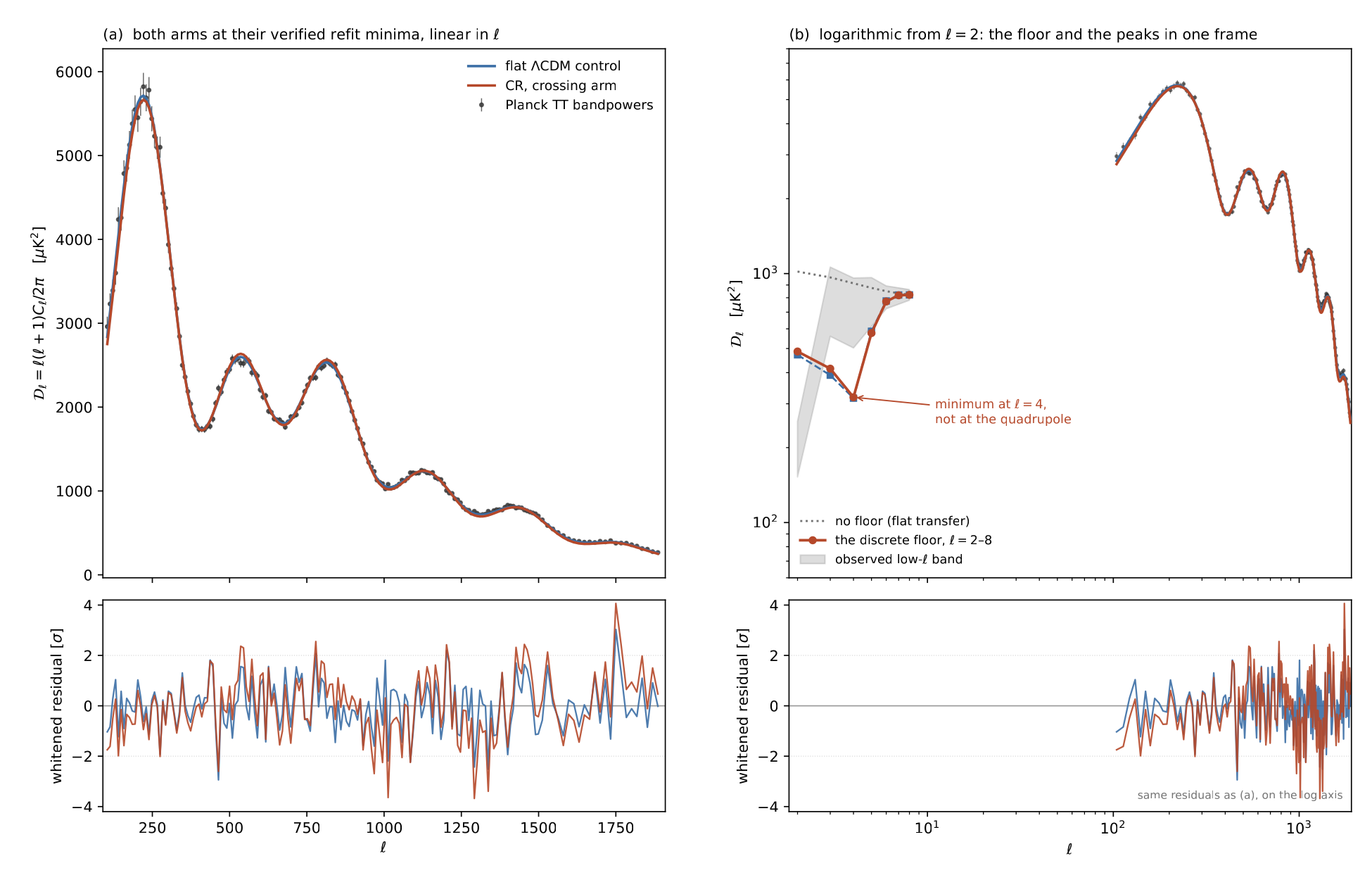
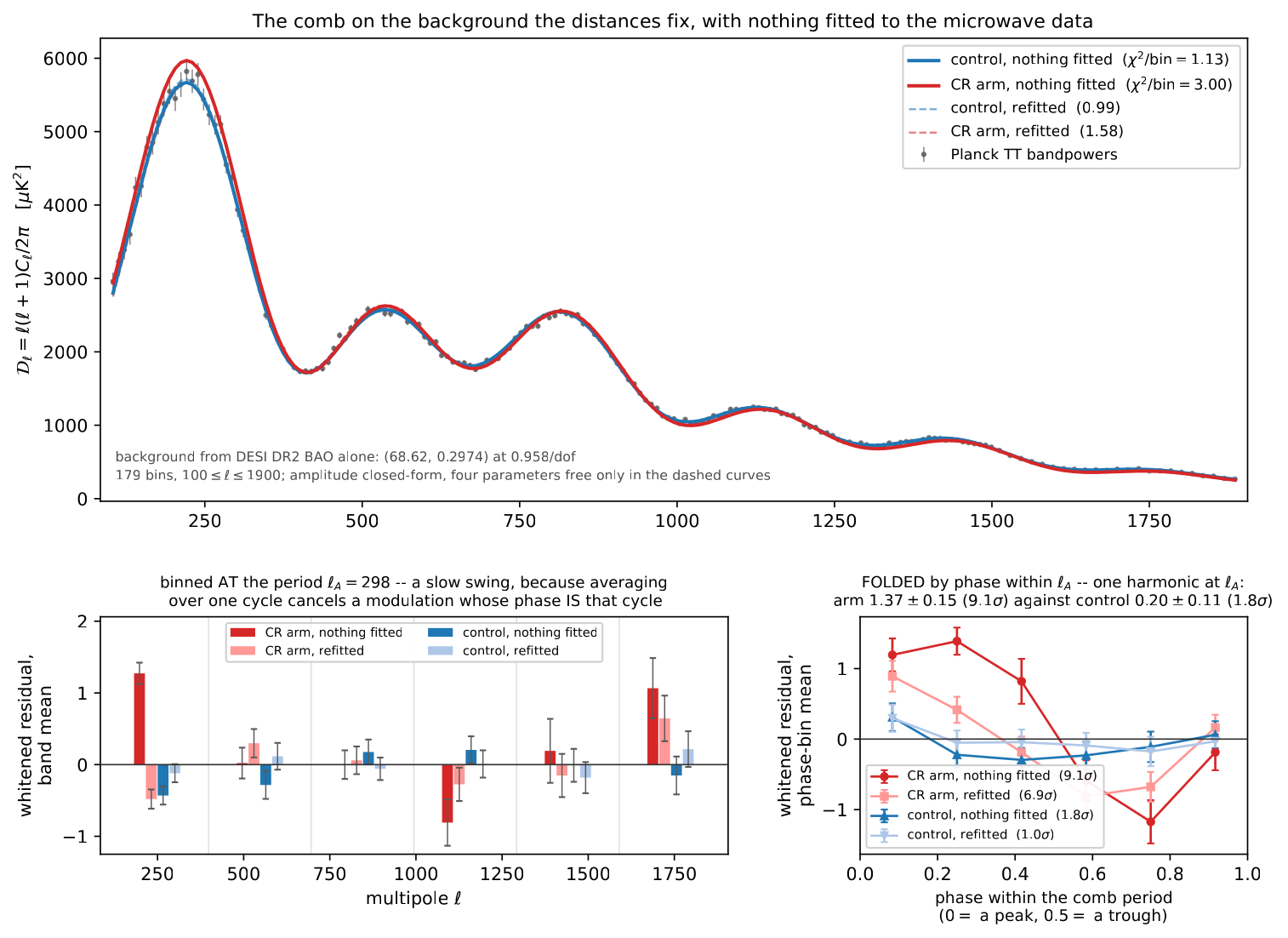
And what the rejection is made of is measured rather than described. Whitened against the full covariance, the two arms' residuals sit at a cosine of 0.855, and projecting the control's direction out of this arm's leaves 73% of it shared — stable across three bin cuts. That fraction is not an attribution, and reading it as one would be an error: both arms are fitted to the same bandpowers, so their residuals differ by the model difference alone and the fraction measures only how alike the two models are — a control deliberately tilted away from its own best fit, which nobody would defend, scores higher still. What the decomposition does say runs the other way. The control already fits these bins at 0.99 per bin, so there is no shared defect for this arm's misfit to be an amplification of; this arm exceeds it by 105 in χ2 and the model difference alone carries 77 of that, so the excess is this construction's, and the factor of 1.3 between the two residuals' sizes is that difference's own sizeP15R174. Within it, position rather than amplitude, tilt or damping: admitting one further parameter at a time, a peak-position rescale buys 4.7 in χ2, the damping 1.4 and the tilt 0.1 — and on the control the position direction buys nothing at all, so the position part is this construction's. It is small: the rescale is under a multipole at the fourth peak, and 4.7 of 283 is under two per centP15R173. Amplitude, tilt, damping and position together do not account for the shape rejection: they carry 5.7% of the model difference between them. What does is a contrast difference, and the sky's noise does not enter it.
Taking the realisation out is what makes the difference readable. With Δ the whitened difference of the two arms at their own minima, χ2 decomposes exactly as 282.96=177.88+27.82+77.26: the model difference carries three quarters of the excess and the cross term a quarter, so the rejection is not this sky's luck — set the cross term to its expectation and this arm still scores 1.43 per bin against the control's 0.99 on a typical sky. And Δ is trough-dominated: +0.011 at the peaks against -0.760 at the troughs, so the two arms agree about where the peaks are and differ between them. Split about a smooth envelope, the oscillatory part carries seven tenths of it and is peak-high and trough-low—antisymmetric about the envelope rather than about each peak, which is a contrast and not a phase and not an envelope. This arm's acoustic oscillation is 1.040 times the control's about its own envelope, and one direction built from the control alone—raise the oscillation at fixed envelope, with nothing fitted—carries half of Δ2P15R175P15R177.
Decomposed about its own envelope the excess is an amplitude and not a lopsidedness: splitting the band variance of the normalised oscillation at its zero gives 1.067 on the peak side against 1.056 on the trough side, and at the located extrema themselves the arm exceeds the control by 5.7 per cent at the maxima against 5.3 at the minima. So heights and depths carry it equally—and Δ's trough dominance is a property of the whitened residual rather than of the contrast, the two not being the same decomposition. The trough depths are nevertheless where the excess becomes observable, and for a reason that is the sky's rather than the model's: the arm exceeds the control by the same amount in each, +0.0106 in depth against +0.0103 in height, while the sky measures depth twice as precisely—so the same excess reads at 1.8 of the sky's own spread in the depths and 0.9 in the heights. And the depths are the one statistic in this comparison whose residual is not shared: the control lands on the measured trough depths at five hundredths of a standard deviation while this arm sits 1.8 above themP15R193. That is a shape the data can see and not a detection, at the spread one statistic carries; and the locating must be anchored to the comb rather than searched for, a free search under the same noise returning a spread six times wider because it latches onto noise minima. One systematic is stated rather than minimised: the envelope's abscissa moves the measured depth by about a third of that spread across the admissible acoustic scales.
And the three features this arm's residual shows and the control's does not are all Δ's: the peak-and-trough asymmetry, the ℓ≃1000 trough where Δ carries -1.074 of the arm's -1.177 in fifteen bins, and the growth with multipole—which Δ does monotonically where neither residual does, a residual being Δ on a noise floor of order one that flattens itP15R175. The channel is identified and the cause is not: the contrast direction is the balance between the monopole and the Doppler terms of the source, bracketed with opposite signs by removing each and re-projecting, on both instrument paths and with the same signs on both; and neither deletion returns the two arms to a common contrast, so what the bracket locates is where the difference enters rather than what produces itP15R176. No mechanism for the imbalance is offered here. And the neutrinos' free-streaming, which the shape invites, is not the difference either: removing it moves both arms' peaks by the same amount—band by band the two agree to a fifth of a multipole, and in units of each arm's own acoustic scale to two parts in ten thousand—while its large effect falls on the envelope rather than on the contrast. A correction the two arms share cannot be what separates themP15R178.
And the trough-filling a contrast excess would be a shortage of is not short on this arm. Four channels carry that, each measured and each larger here. Deeper troughs are what excess baryon loading produces, through the displacement of the oscillation's zero point—and measured against each arm's own loading, this arm's monopole swings about a point that falls short of its own -RΨ, by an effective baryon density of -2.9 per cent, which is the wrong sign for that reading. And the visibility is wider, 43.6 against 38.0 Mpc, so this arm averages over more acoustic phase and not less. So the channels that would each shallow the troughs are larger here, and the same is true of the driving, whose measured grip is weaker.
And the Doppler term, which fills troughs, is stronger here: the dipole-to-monopole ratio of oscillation amplitudes at the visibility peak sits two per cent above the control's and rises with wavenumber. Which of two ratios that is matters, and the distinction is the physics rather than a convention: trough-filling is an oscillating term a quarter period out of phase adding into another's troughs, so what fills a trough is an oscillating amplitude, while the smooth part of the same field displaces the envelope and fills nothing. A ratio of band-integrated powers mixes the two and reads the opposite sign on the same spectra—so the two readings are different quantities and not a disagreement about one, and the one this comparison needs is the amplitude ratioP15R198.
One channel does carry a definite share, and it is the first in this comparison that does. The source is weighted across the visibility by a function rather than a constant, and that weighting is not the same on the two arms: read in the phase the oscillation actually accumulates, the window's spread is 0.0652 of the acoustic scale on the control against 0.0642 on this arm. That the two are within a per cent and a half of each other is itself the two-rate structure, and it is a cancellation rather than an absence—the arm's visibility is fourteen per cent wider in conformal time while its phase accumulates fourteen per cent more slowly per unit of it, and the product of the two comes to within one part in ninety of unity. Imposing one arm's weighting on the other moves the contrast the way a narrower window should, and the size can be read two ways that share no machinery: from the instrument's own response to the weighting, which gives between a quarter and a half of the band excess above the damping scale, and from the direct substitution, which closes between a fifth and two fifths of it. So the weighting is a real channel carrying about a third, measured rather than modelled, and from a quantity nobody chose.
And it cannot be the whole of it, for a reason that is independent of every one of those sizes. The excess is symmetric about the envelope, heights and depths carrying it equally; the weighting is not. Imposed at the arm's own size it delivers four fifths of the peak-height excess and one seventh of the trough-depth excess—a five-fold asymmetry against a symmetric objectP15R194. A peak-weighted channel cannot carry a symmetric excess alone, whatever its share, and two further readings agree without being needed: the measured response extrapolates to a non-zero offset at zero wavenumber, where a window's own characteristic function is identically one, and a weighting large enough to deliver the whole excess moves the first peak by eighteen multipoles and the heights by nearly half. So what this settles is a share and not a mechanism.
A second channel carries the other half of the shape, and it is the term mix rather than the window. The two arms hold different fractions of their window's power in the monopole, and imposing one on the other at a coefficient solved from the profiles themselves—one constant to two per cent across every band—moves the contrast with the signature the long-wavelength offset needs: the response is independent of wavenumber, an intercept against a slope worth three per cent of it, where a window's smearing must die at long wavelength. It is the first channel measured to have that shape. And it is not the remainder either, for the same kind of reason the window was not: it is peak-weighted where what the window leaves is trough-weighted, it over-delivers the whole excess by between one and three times, and it moves the first two peaks the wrong way and outside the widths the sky's own locating carriesP15R195.
And the two together are what the measurement actually settles, because their shares do not add to what is observed but to something larger: a third from the window and above one and a half from the term mix make more than one and a half times the excess. How two such channels compose is then a measurement rather than an assumption, and it is made by imposing both on one control spectrum at the sizes their own comparisons solved, with neither coefficient re-chosen and no third channel admitted.
The rule is multiplicative. The joint response lands within a pre-registered tolerance of the product in every band and of the sum in every band, and of a quadrature combination in none of them—the last by three and a half times that tolerance, which is the one separation this measurement can make and the only one claimed. That the product and the sum differ here by less than a third of the tolerance was declared before the run, so they are not separated and are not reported as though they were. The pair is slightly sub-multiplicative and consistently so, below both the product and the sum in every band and above quadrature in every band. And the composed pair reproduces the two shares' arithmetic directly: what adding the separate measurements put at a little over one and a half times the excess reads, composed in one spectrum, within one per cent of that valueP15R196.
So the remainder left by dividing one response into the excess is a well-defined object, and the over-delivery is evidence about the sizes rather than about the rule. What does not survive is a size reading of it at all, and the reason is a shape. The joint response is the flattest thing this comparison has measured, and the excess is not flat: the pair over-delivers by nearly four times at the longest wavelengths and by under one and a half at the shortest. No coefficient on either channel reproduces the excess—set to match at long wavelength it falls short at short, and set to match at short it is an order too large at long—which is an obstruction of a different kind from a size discrepancy, because a size discrepancy is what a coefficient absorbs and a shape mismatch is not. And that reading is available only because the rule was measured: with the rule assumed, the same numbers read as a size a smaller coefficient could take up.
What the excess's own dependence on wavenumber is has then to be measured before it can be searched for, and the instrument is what has to be measured first. Six forms injected into the control's own spectrum, two of them carrying a scale, are recovered to about a per cent. But the estimator manufactures structure between bands: its bias varies from band to band by about a per cent while the six injected forms agree with each other on that bias seven times more closely, so a contrast that is constant reads as a wobble, and band ordering at the per-cent level is a property of the statistic and not of the spectrum. One alternative anchoring is excluded by its mechanism rather than by its number: a median envelope returns a value three times larger, and the tell is that it does not move with its own smoothing window—at short wavelength the running median collapses onto the curve it is meant to be an envelope of, a median of a locally monotone stretch being its central value whatever the window. So the rise is real and the wobble is not, and the distinction is established on the instrument before anything is concluded from itP15R197.
And the rise decelerates within the statistic as defined, which excludes the form this comparison's own statistics are written in. A departure growing linearly in the squared wavenumber is rejected—the only one of the six so rejected—and every concave form is admitted with none preferred among them, so the direction is settled and the functional form is not. No scale is separated from another either, and the spread that comparison is judged against is the fit's own injection-and-recovery error rather than a noise level. And two things about that deceleration are stated here because a reader would otherwise assume both. It is robust within the statistic—negative under every variation of the envelope's width, the band edges and the sampling—and it is carried by the lowest band alone: with that band set aside the sign is not determined at all, the deceleration being that band lying low rather than the upper bands bending. And it does not survive a change of envelope: a running median in place of the arithmetic one, with everything else held, reverses it. That is a different statistic and the difference is measured—the median absorbs about half the highest band's oscillation on both arms, so its ratios are formed on a much smaller residual—but it is not on its face the worse one, since it leaves a departure of zero mean where the other does not. So the sign of the curvature belongs to the statistic and not yet to the excessP15R201. And the rise is a preference over flatness rather than an exclusion of it, which is stated because the difference matters: a constant departure is a worse description, not an impossible one. The consequence for the numbers above is that a slope read against an intercept is a description and not a model, and the growth of the departure itself is the scale-free quantity that comparison needs.
Read with that quantity, the search this comparison can run in the positive direction leaves exactly one candidate standing. The excess's departure grows by a factor of three and a half across the range with negative curvature, which gives two conditions rather than one, and the source terms and the three channels with measured shares all fail the first: they are flat where the excess grows. The dipole's amplitude ratio does not, and the range over which that can be said has since been extended by an estimator built for it: holding the oscillation's period and fitting its amplitude and phase, rather than reading an amplitude off a window, reaches well below the window estimator's floor. Its own first finding is that the period is not the period—set by construction to one value, it runs about two per cent short of it in the fields and by a different amount for the two of them, so the period is measured per field and per arm rather than assumed. And it is validated before it is used: the two estimators agree on the mean where both are sound, and where the window estimator does not survive its own width—its ripple running from under one per cent to above ten as the window narrows—the held-period one stays near two and a half per cent at every width. The one cost it carries is measured rather than noted, and it is half a per cent of the dependence being measured, for a mechanism: the fit re-fits the phase in every window, so an error in the held period is absorbed there and costs only a common amplitude factor, which cancels in a ratio of ratios.
On the range that unlocks, the candidate's departure is positive in every band as the target's is and grows faster, so it passes both of the conditions that can be applied to it. And it stops where the fields stop rather than where the method does, at a floor that is exact and was named before it was used. An oscillation's amplitude is identified at a point only if the window holds a turning point on either side of it, because across a span with no turning point the held-period pair is monotone and the baseline already spans it. The monopole has no turning point below its first—the first excursion is one-sided—and the monopole is what binds, putting the floor well above the lowest band, which lies far below it while every other band lies entirely above. And the floor is the fields' and not the window's, shown three ways: the same widths spread four times as far below it as above and change sign there; sweeping the window's edge, the departure is negative for every window that opens past the monopole's first turning point and positive for every one that stays above it, what lies below being the field's rise from its initial condition rather than an oscillation at all; and every centre below the floor spreads more than every centre above it, which the floor was not fitted to. So no estimator of an oscillation amplitude can reach inside the first excursion—an acoustic oscillation has a first extremum, and before it there is no amplitude because there is no oscillationP15R200.
And the condition that would decide cannot be applied, for an exact reason rather than a statistical one. The excess decelerates across the full range, and that deceleration is carried entirely by the one band no estimator of the candidate can reach: removing that band alone reverses the sign of the excess's own curvature, while removing any other single band leaves it where it was. So the filter is out of conditions rather than the candidate out of chances—the candidate's own curvature is stable there, and what is missing is the target's sign and not the candidate's number. That is a statement about the filter, and it was one of the two outcomes written down before the estimator was builtP15R200.
And the way that condition is unavailable is worse than a simple absence, which is worth stating plainly. It needs a value in the band the fields close, and that band is shut to amplitude estimators but not to a candidate computed from the projection's kernel—which had one, and which the condition duly excluded. So the filter's full strength is available exactly for the class that cannot carry the excess, and its third condition is permanently unavailable exactly for the class that can, because what fills a trough is an oscillating amplitude and that is what closes the band.
Which leaves the question of what a two-condition filter is, and the answer is that it is what it always was. As a device for excluding it has lost nothing: each remaining condition is necessary, and every exclusion this comparison has made was made on growth alone. As a device for confirming it was never one, with three conditions or with two—all three are conditions on shape, and the surviving candidate matches the excess in sign and in direction of growth while being several times too small at the highest band. So the question this comparison now carries is the coupling and not the shape: a quantitative question, living where the candidate is measured, and needing the closed band not at all.
That coupling is measured, and its sign comes out the same everywhere. Scaling the Doppler source across three banked spectra gives the contrast's response as a finite difference—three points, so linearity is checked rather than assumed—and the response steepens towards the unscaled value, so the slope there is both the applicable one and the one taken over the shortest step. It is negative at every band, on both envelopes, over every interval: forty-two readings of the sign and not one positive. Which is this comparison's own trough-filling physics read forwards—more of an oscillating term in quadrature fills more trough and lowers the contrast.
And the construction fixes it, shown by what fails to change it. The control's own ratio of that term's band power to the monopole's runs across a factor of more than six from the lowest band to the highest, and the coupling's sign is the same at every one. A quantity whose sign is invariant across a factor of six in the very ratio it depends on is not set by a knob: the knob is the probe and not the setter, so the size is a prediction rather than a fit.
And it is measured on the arm itself rather than carried across from the control. The decomposition the instrument already writes resolves each spectrum into its bilinear terms multipole by multipole—ten of them, summing to the spectrum to a part in 1015—and their scaling in the source amplitude is exact, quadratic on the term's own square and linear on each of its crosses, so the response follows analytically on either arm rather than from a difference of runs. It runs from -0.48 to -0.86 across the bands, the two arms agreeing to a few per cent and each agreeing with the finite difference above to better than a tenth—the same quantity reached two ways, on the arm's own spectrum.
The contribution the coupling multiplies is then read by a swap rather than by a product, which is what removes the ambiguity in its input. Replacing the arm's four Doppler-carrying bilinear terms by the control's, envelope-scaled and on the arm's own grid, gives the share of the excess those terms carry as a ratio of contrast differences—the same operation the instrument already sanctions for the clock, and with no coupling-times-amplitude product anywhere in it. The answer is a minority share on either envelope: from a per cent to a quarter of the excess against the arithmetic envelope, and from a tenth to a half against the median one. So the Doppler term is a real contributor and it is not the carrier.
And the share grows with wavenumber while being sign-indefinite at the bottom—negative at the second band on both envelopes—so at the bands where the excess carries its own structure it changes sign rather than settling to a share. Which is exactly how far the envelope ambiguity reaches: the coupling's sign survives both envelopes at every band, so the contribution does not reverse with the statistic, while the share's magnitude moves by about a factor of two between them—so the share inherits that ambiguity where the sign does notP15R203.
And the excess every candidate here is measured against has one dominant feature, which is a step and not a trend. Its lowest band is a fraction of the mean of the others and sits below them by nearly five times the spread the upper bands themselves show about their own trend, while above that band a constant already fits—a line adds a mild slope and halves the residual and no more. So the bands above the lowest carry very little structure with which to tell a flat candidate from a rising one, and that stretch is where every shape comparison across wavenumber is made: a flat candidate matches the featureless part and misses the step, a rising one matches the mild rise and misses the step, and across those bands the two are barely distinguishable.
That the step is the excess's own and not the statistic's is established before anything is read off it, and by a reading that uses no statistic at all. Three running envelopes differing in kind—an arithmetic mean, a median and a local quadratic—and a fourth quantity that needs no window whatever, the peak-to-trough depth of each acoustic cycle, all put the lowest band below the rest, and none of them puts it near parity. What the window-free family settles is the step's freedom from the statistic and not its size: in the lowest band it holds a single half-cycle transition, the first locatable pair of extrema lying above that band's lower edge, so what it returns there is consistent with zero and equally with no step at all—unresolved rather than small. An extremal envelope built from located extrema alone reaches only a quarter of that band, rests on the same single extremum below the step and interpolates across it. So the size is read from the statistics that resolve the band, and on every one of them the lowest band runs between a third and two thirds of the rest—a range because the statistic moves it, and a range that excludes parity throughout. And the one artefact that could produce a step at the lowest band is excluded in the direction that excludes it: the band's envelope comes within five multipoles of truncating, and moving the band's lower edge away from that truncation makes it read higher, where an artefact of truncation would have to make it read lower.
Located rather than merely noticed, the step sits at the second acoustic peak. Its half-rise point, taken in sliding windows at three widths, is stable to better than a per cent and lands within about one per cent of the second peak on either arm, where the nearest other scale this construction fixes is seven times further away; and it is sharp, a clean factor of two on all three widths reached within about a tenth of a comb period—narrower than the narrowest window that resolves it. So the excess in the first acoustic cycle runs between a third and two thirds of its size in every cycle above. What that locates is not a length belonging to this arm: the peaks sit at the same wavenumber on both arms, so the step says that the first acoustic cycle behaves differently rather than that some new scale has entered.
Scored against that feature rather than against a trend, every candidate in this comparison is evaluable, and between them they carry a minority of the step. A candidate's step is its lowest band's departure from the trend its own upper bands set, read on four bases—linear and logarithmic, in the wavenumber and in its square—with a departure counted only where it survives all four. The window weighting steps the wrong way, upward by about half, working against the step rather than making it; the term mix steps the right way at some two thirds of the excess's own departure; and the pair as actually composed—one spectrum with both coefficients at the sizes their own profiles solve—carries about two fifths of the excess's own step, exceeding twice that same upper-band spread on three of the four bases; the share is against the excess's own extrapolated size and not against the larger step the arms have in common, the two denominators differing by about a factor of six on the one departure. The projection width carries none, and the basis family is what shows why: being linear in wavenumber to a few per cent of its own range, it flips sign across the four, so a logarithmic basis would manufacture a step for it. And the Doppler contribution, read at the lowest band by the swap above, changes sign repeatedly in sliding half-period windows with means on either side of the step equal and both near zero—scatter at the step's own resolution, and no transition at all. So against that statistic the step has a partial account: no single channel produces it and two of them together reach a minority of it.
Scored instead on the differential estimator—where the shared nine tenths never enters and only the part belonging to this cosmology remains—the same channels read differently, and the accounting does not survive the change. Each knob is read there as it must be, by the width of its own difference from the control, against the arm's. The window weighting steps, and steps the opposite way to the arm; the term mix no longer steps at all at that resolution, where against the mostly-shared quantity it reached two thirds; and the realised pair changes sign across the bases and measures zero to within its own scatter, where against the mostly-shared quantity it reached two fifths. So a channel that accounts for a substantial share of a quantity nine tenths of which is common to both cosmologies accounts for nothing of the part that is this one's. The weaker word is the supported one: those two are not resolved on the differential estimator, which is not the same as being excluded.
And they cannot be resolved by the family of statistics this comparison is built on, which is a statement about that family proved over its whole reach rather than inferred from a failure. A channel is decided when its own departure at the lowest band exceeds twice the scatter of its upper bands, so the smallest share of the step a channel could carry and still be decided is a computable floor. Every route this construction can take to lower that floor was taken: both aggregations of the width, both pairings of the two arms' multipoles, a wider span of bands and a finer division of the same span. The floor does not move below three fifths of the step, where the two channels carry about a third and about a thirtieth. And the reason it does not move is worth the sentence: the phase-insensitive aggregation lowers the scatter by the factor predicted and lowers the signal by the same factor at the same time, so a reduction in scatter is a gain only where the signal does not fall with it. More of the same statistic would therefore decide nothing.
Nor would it, for a second and independent reason. Of the three channel readings, only the one that steps the wrong way holds its sign across every aggregation; the other two change sign between two legitimate aggregations of the same statistic, so their departures are not established quantities that a sharper measurement would sharpen. What is demonstrated is accordingly narrower than that the channels do not produce the step, and narrower is what is earned: no statistic of this family could tell whether they doP15R208.
And the family is what the limit belongs to rather than the comparison, because the likelihood these spectra are confronted with does not share it. Its bins are a thirty-fourth of a comb period where every statistic above averages over seven tenths of one, two dozen of them fall inside the lowest band, and its bin-to-bin correlation is a flat floor rather than a coupling that grows across a period—so it bins without banding, and it does not inherit the width limit through its covariance either. Read band by band from its own bins, the two arms are distinguishable everywhere, and at the lowest band the step appears in that distinguishability—standing where its upper bands' trend predicts half again as much, with the same sign as every other reading of it and with the instrument's own noise for an uncertainty rather than a scatter taken across a noiseless theory spectrum. And the two channels separate from each other there at some twenty-five standard deviations, which is the measurement the banded family cannot make at all. The two floors are not one number and neither bounds the other—one a share of the lowest band's difference under real instrument noise, the other a share of the step under an empirical scatter of a noiseless spectrum—so what compares is the verdicts: the banded family cannot separate the channels there and the likelihood separates themP15R209.
But what the data can distinguish and what it rejects the arm on are two quantities, and at the lowest band they part company completely. Of the excess in fit that the covered bands carry between them, the lowest band holds under one per cent—and that share changes sign as smooth global shape is absorbed into free coefficients, where every band above it holds to within a few per cent of its value. So the step is not a distinct feature of the residual and not the shape rejection read locally either, the shape rejection being barely present there at all: it lives in the upper half of the range, where four bands carry between them some six sevenths of the total. That location is read off an exact decomposition and not a per-band approximation: because the two arms' residuals differ by the difference of the spectra, the excess is identically a term in that difference alone plus a term coupling it to the control's own residual, and the two reproduce the total to a part in 1013. And the split is the distinction itself written as algebra—the first term never asks where the data sits and the second is the only part that does—which is why a quantity can stand at some twenty-five standard deviations in the one and at nothing in the other. Which puts the comparison's own structure and the data's own verdict in different places—the excess's one prominent feature across wavenumber sits where the rejection is cheapest, and the rejection sits where no smooth shape across wavenumber finds anything at all.
But the rejection is not a level there, and what it does carry is acoustic. Across the individual bins those four bands hold, a constant accounts for none of the scatter, a trend for under a fiftieth of it and a quadratic for under a thirtieth—and a projection at the comb's own period is reached by none of two thousand draws of the instrument's own covariance carried through the same statistic, nor by any of twenty thousand when they are pooled. The period it sits at is fixed only to the resolution the range allows: the peak spans periods 0.88 to 1.19, which is the acoustic period to within the resolution of the two and four fifths periods of data the bands cover, and not to a hundredth of it.
And no banded reading of that stretch can find it, which is not attenuation but a limit of representation. One number per band at seven tenths of a period spacing has a Nyquist period of twice that, so a modulation at the comb period lies beyond what such numbers can represent at all, and the averaging inside each band passes barely more than a third of it before that. The likelihood bins thirty-four times finer, at a Nyquist period a twentieth of the comb's and a transfer indistinguishable from unity at it—so the instrument that rejects the arm is the one instrument in this comparison that can represent what the rejection carries, and the limit that closed the lowest band is the same limit, met at the other end of the rangeP15R213.
And the modulation is a fact about the data rather than the difference looking at itself—the difference is a comb, so the question is which term carries it, and five sixths of it comes from the term that couples the difference to the control's residual against one sixth from the term in the difference alone. The first clears the same noise null and the second has no noise in it to clear, being a property of the difference and not of the dataP15R211.
Scored in the metric the step does live in, every candidate departs the way the arm does. Read as each channel's own lowest-band departure from the trend its upper bands set, in the likelihood's units, the window weighting delivers about a third more than the arm's, the term mix about six sevenths of it, and the pair as actually composed about half—the first time this comparison has held candidates that depart the arm's way on an instrument able to carry the question. And the window weighting's verdict differs between instruments, going the wrong way on the differential estimator and the right way here, which is reported as a disagreement between instruments rather than resolved into a story. The pair again falls well short of every composition rule, product, sum and quadrature alike, delivering about a third of the closest. And what that costs the account belongs in the same breath as the shares: these are shares of a departure in what the data can distinguish, and that feature carries one part in a hundred of what the data rejects the arm onP15R210.
Scored instead in the metric the data's own rejection lives in, the channels sort differently, and one of them sorts the right way. Read across the four bands that carry the rejection, the term mix delivers about four thirds of the arm's cost and delivers it where the arm's falls—the two patterns correlating at seven tenths band by band, on a regression slope of three quarters, with nearly half the arm's cost left unexplained. That is the first channel this comparison has held whose cost is in the right places at all, and it is neither the carrier identified nor no carrier found: four thirds of the cost at that correlation is not the absence of a quantity, and half of it misplaced is not the presence of one. The window weighting is the contrary case, and its small share is the wrong reading of it: its cost is anti-correlated with the arm's at seven tenths, so it is a different cost and not a small share of the same one—the reverse of its standing on separating power, where it led. And the pair as composed matches worse than the term mix alone, raising the total while degrading the pattern, which is the sharpest form in which this comparison can say that a total is not a match: any spectrum that is not the control costs something, so what separates costing the arm's way from merely also being rejected is the pattern and never the share.
Whether that channel carries what the cost is made of, as against carrying the cost in the right bands, is a second question, and against the instrument's own noise the two do not come apart. Projected at the comb period and scored against two thousand draws of the covariance through the same statistic, the channel's own cost is reached by no draw, and neither is the part of the arm's excess the channel does not explain—the latter at the arm's own phase to within a sixth of a radian. The part the channel misplaces is reached by none either, and is not quoted with them. The statistic quoted is the tail count and not the ratio to the ensemble's largest value, that maximum being itself a noisy quantity whose spread across seeds is about a tenth, where the tail count is stable and holds when the draws are pooled tenfold. The channel's own clearance is carried by the term that knows where the data sits, its other term being one the null holds fixed and therefore one no draw could have made it fail. So every piece of this decomposition is acoustically modulated, which is what a detection test can establish here and is not what authorship needs—a knob that moves the balance of two oscillating source terms produces an oscillating cost by construction, so clearing a noise floor does not distinguish a carrier from a participant. A null built instead from the same data at neighbouring frequencies cannot be used for the question at all, its amplitudes carrying the feature they are meant to score: over this range such an ensemble spans only about three independent draws, and its largest values run twice those of the instrument's own noiseP15R214P15R212P15R213.
And the anti-correlated channel is combed too, in antiphase, which locates the reversal without naming it. Its own cost projects at the comb period above its null with a phase π from the arm's to within a 0.021 rad of π, so it is a structure and not a smooth offset. Yet the two channels' modulations in the spectra themselves are in phase, each a quarter to a third of a radian from the arm's, and the smaller one's amplitude predicts the larger's to within about an eighth from that ratio alone—so the magnitude composes and the sign does not, and the reversal appears only after the likelihood's own weighting is applied. What that is not is one structure read with two signs: the window's spectrum difference is not a negative multiple of the arm's, the residual of the attempt keeping almost all of the window's powerP15R212.
The accounting that would settle authorship closes exactly and still cannot attribute, and the reason is an identity rather than a want of precision. Writing each channel's modulation as a vector in the plane the cosine and sine of the comb span, the channel's contribution and the residue left after it reconstruct the arm's own vector to numerical precision—so it is an accounting and not an estimate. But the share a least-squares projection returns in such a plane is the cosine of the phase offset and nothing else: it depends only on the direction the channel points and not at all on how large it is, so a channel a millionth the size scores the same. And the anti-correlated channel is the proof rather than an illustration—pointing π from the arm it is assigned essentially all of the authorship, at a negative scale that turns its own cost upside down to reach it. A quantity that credits a channel with the whole of a feature for pointing the opposite way is not measuring authorship. The other available scale, the ratio of the two modulations in the spectra themselves, fails differently and by measurement: it predicts the realised amplitude for one channel to about an eighth and misses for the other by more than that channel's whole size. So one scale falls to algebra and the other to measurement, and neither failure is the other one twice.
And the second scale has no statistical content to appeal to, which closes the last route. The difference between the two spectra moves with the data only through two fitted amplitudes, so a share or a phase read at that level is a property of the two theories with a systematic uncertainty and no statistical floor at all—the same thing the contrast statistic is, and for the same reason. At the level of the fit the floors are finite, about a twentieth of a radian in phase and a few per cent in ratio, but it is there that the projection is amplitude-blind. And the degeneracy is exactly dimensional: two channels span the plane, so any two of them reconstruct the arm exactly and do it as arithmetic. So what this comparison leaves is a discrepancy whose size, location, period and shape are measured and whose carrier no instrument it holds can attribute—and what attribution would take is named rather than awaited: a channel independent of the plane these two span, or an estimator that uses the channels' amplitudes where those amplitudes carry statistical content. Neither is a refinement of the instruments above, which is why the question is recorded as located rather than openP15R216P15R217.
And the step does not compose the way the contrast does, which is a property of the step rather than of the knobs. The contrast composes multiplicatively, measured band by band. On the step, the two channels' own departures put a product, a sum and a quadrature all at a large positive value where the realised pair measures zero to within its scatter on the phase-dependent aggregation, every rule several scatters away—so on that reading the two very nearly cancel on the step where they multiply on the contrast. The cancellation is a property of the reading and not of the pair, and that is measured rather than left open: it vanishes within its own scatter on every basis of the phase-dependent aggregation and on none of the phase-insensitive one, and in the metric the data's own rejection lives in the two channels add, the realised pair standing at the sum of the two singles to within a fiftieth—so of the three metrics that can carry the question, two show the cancellation and the third shows the contrary, which is what makes it the reading's property and not the pair's. The residuals are quoted in departure units against that scatter and not as a share, a fraction of a near-zero measurement being no fraction at allP15R207P15R211.
What remains to be explained is accordingly what distinguishes the first acoustic cycle from the restP15R205P15R201.
And the step is very largely common to the two arms, which is the decomposition that says where it belongs. Read on each arm's own contrast against the trend its own upper bands set, with no reference to the other arm, both arms step upward at the lowest band—on all four bases and on the windowed and window-free contrasts alike—and this arm's step is always the shallower, by about a tenth and no more. So roughly nine tenths of the step is shared and cancels in the ratio, and the excess's step is the part that fails to cancel: the feature belongs to the acoustic physics the two arms have in common, and what this cosmology contributes is the small residual—which is also why the step's location is the same wavenumber on both. That residual is readable because the ratio is smoother than either spectrum, standing at some seven times its own upper-band spread where each arm's own step stands at four. And a small residual of two large common features is exactly where a nearly-common systematic would sit, so the feature is read again on an estimator that is differential by construction rather than a difference of two large numbersP15R205.
On that estimator it survives. Dividing the two spectra multipole by multipole before any width is taken leaves the common oscillation cancelled rather than subtracted, so the quantity read is the width of the difference of the two arms' oscillations and the shared step is never formed: the lowest band's departure is negative on all four trend bases, on both pairings of the two arms' multipoles, and on both aggregations of the width—a band's own dispersion and a held-period amplitude, which are not the same quantity because a band spans less than one full comb period and its dispersion is therefore phase-dependent by construction—the two differing by about a third in size and neither chosen. So the part that fails to cancel is not an artefact of forming two large numbers and differencing them—and the same construction shows which step of the two it belongs to: dividing instead by a smoothed control removes the differencing while keeping the division, and the departure turns positive, back toward each arm's own.
And the width of a difference is fed by a relative phase as well as a relative amplitude, so which of the two it is has to be settled rather than assumed—and it is settled by an identity. For two oscillations of the same period the width of their difference is a closed function of the amplitude ratio and the phase offset alone, and that function reproduces the measured difference pointwise, so the split into an amplitude-only and a phase-only part is exact rather than fitted. Split that way, the step is the amplitude's: the amplitude-only term carries almost all of the statistic at the lowest band and steps with the same sign, while the phase-only term steps the other way. So the first acoustic cycle is weakened in this cosmology rather than displaced in it. What the split does not settle is the phase channel's size: the relative phase is a fraction of a degree, an order of magnitude below the relative amplitude, and its step reverses sign as the reading window widens where the amplitude's does not—so the phase term sits at this estimator's own resolution and the honest statement is the sign without the share. Read against the comb over several periods rather than locally, the relative phase is determined to a few tenths of a degree, at seven times its stretch-to-stretch standard error—and the lowest band still cannot be reached that way, being narrower than the period the method needs, so a projection across it leaks the baseline and is both noisier and biased. Against a control of stretches matched to its own width the lowest band's phase sits inside one and a half scatters, where against the wide-window error bar it would have read five—so the phase step is not resolved and the amplitude reading is the complete account rather than a verdict on the sign alone. That the lowest band is narrower than every period this comparison measures with is now the same limit met in three places, on the window-free family, on the amplitude-and-phase split, and hereP15R208P15R207.
The shared part, for its own sake, does not reduce to one term of the source. Removing each bilinear term of the decomposition in turn and asking whether the step leaves with it, the fractional losses sum to nearly twice the whole—so the step is a property of the sum and no term carries it. What the same table does show is that leverage is not flat: weighted by how much of the step each term accounts for against how much of the oscillation it holds, the two leading terms are both Doppler—one at more than five times its weight and one at nearly four—where the monopole holds seven eighths of the oscillation and carries the step at less than its weight. The ordering is not simply Doppler against the rest, one Doppler cross term telling against it and the integrated Sachs–Wolfe autocorrelation lying lower still. So a step-weighted reading of the source points at a sector where an amplitude-weighted one points at the monopole—a ranking and not an attributionP15R206.
One whole class is excluded by structure rather than by measurement, and needs no run at all. Every quantity that belongs to the two clocks—the leaf clock, the ruler, the Jacobian between them, the visibility and the optical depth—is a function of conformal time alone, and a function of conformal time has the same value at every wavenumber. So it cannot vary across one. That is neither measured-and-failed nor unmeasured: it is a statement that the class cannot carry the effect, from the shape of the objects in it.
And the projection itself holds a width nothing in this construction has ever imposed, which is where the row's own name has pointed since it opened. Two widths govern the last-scattering window and they are not the same width: the acoustic phase swept across it goes with the window's width measured in the leaf sound horizon, while the projection's own smearing goes with its width measured in conformal time, that being what the projection's argument carries. In a one-rate cosmology those are one object up to the sound speed; on two rates they are not, because the clocks differ. And the difference between them is one object and not a residue: the two sound horizons on this arm are related pointwise by the Jacobian between the two rates, checked across the window to a part in a million, and identically unity on any single-rate cosmology. Measured against the ruler clock the two arms are the same instrument—their windows agree in width to a few parts in a thousand on either definition, the visibility being laid down by scattering on the physical background, which is the same physics on both. Measured against the leaf clock the arm's window is some fourteen per cent wider, and the whole of that is the Jacobian, the arm's own leaf-to-ruler width ratio reproducing the Jacobian's mean to a fraction of a per cent. Which quantity a width is has to be said before the number means anything: a root-mean-square width returns half as much, because the window has long tails that it weights and that neither the projection nor the phase sweep responds to, while the full width at half maximum and the characteristic function's own half-fall agree with each other to better than a hundredth of a per cent.
So the different ratio is a prediction of the two-rate assignment rather than a property of this instrument—the Jacobian carries no free coefficient and is fixed by the background solution once the arm is specified—and the ruler clock is what establishes it, the two arms agreeing there being what leaves the leaf-clock difference nowhere else to come from. And it cannot be imposed as a knob, which follows from that same identity rather than from the instrument's limitations: giving the control this arm's conformal width at the same leaf width is giving it this arm's Jacobian, and a control carrying the Jacobian is not a control.
Applied in the projection's own kernel instead—holding the source's phase and stretching only the projection's argument—it is a real channel whose size the statistic does not fix and it is not the carrier. Its share depends on the anchoring by an order of magnitude: in the band where the excess is largest it delivers about a quarter of what the excess needs on the mean anchoring and about a fiftieth on the peak anchoring, so the quarter is one of the two readings and not the channel's size. What both readings agree on is the sign of its wavenumber dependence, and it is the wrong one—it accelerates across wavenumber where the excess decelerates, under either anchoring. So it is excluded as the carrier on its shape rather than on its size, and the size is left as the range the two anchorings give. And the width ratio is a second reading of the Jacobian rather than a restatement of the first: the comb reads its cumulative value at last scattering, which is what sets the peak spacing this paper already matches, while the widths read its window-local average—and the two differ by about a third. So a construction tuned to the comb must still return the right local Jacobian to match the widths, which is a second and independent demand on the same object, with neither carrying a free coefficient and both identically unity on a single rate. What it is not is separately observable: the width the damping reads differs between the arms by under a per cent where the width the projection reads differs by more than ten, and the projection's own contrast effect is bounded above at about two per cent with its sign undeterminedP15R199.
One thing about the statistic belongs with those numbers, because without it none of them can be read. The anchored contrast is measured against a running-mean envelope that is recomputed for each spectrum, so a purely symmetric change of amplitude does not read as unity on it: applied to the control's own spectrum, amplitude and envelope operations both read near two, a loading below one and a smearing negative, and the near-two is stable across a fivefold range of sizes. So the baseline against which a class is identified is that value and not one, and read against it the anchored statistic and the band-variance split of the excess agree to about a tenth—the same decomposition reached twice rather than two readings in tension. And the baryon density cannot supply the contrast at any value: its response to ωb saturates, spanning 0.028 over the whole range with increments falling monotonically, so four per cent is beyond its reach rather than away from its fitted pointP15R177.
And what kind of statement this statistic makes is worth saying once, because every number above inherits it. The amplitude it fits to the data cancels exactly against the envelope it divides by, so as defined it compares two computed spectra and reads no data at all: its floor is numerical, at some six parts in a thousand, and every spread quoted on it above is a spread of computed quantities rather than a noise level. Its sky counterpart is a different instrument and carries a real floor, built by running the same statistic on noisy realisations of the control against the control through the likelihood's own covariance: across the whole range that floor is 0.018, against which this arm's +0.047 stands at about two and a half floors. Read one band at a time it is coarser than the excess it would measure—between 0.043 and 0.086 per band, where the excess's own per-band values run from +0.022 to +0.076, so band by band the contrast is a statement about theories and would not be an observation, the lowest band's value standing at under half of that band's floor. Which is why the rejection this section closes on is read in the likelihood and not here: the whole-range contrast is what this instrument supports, and the band-by-band structure is a property of the computed spectra that the sky's own noise would not resolveP15R215.
Those four channels all act on the source, and the contrast difference is not in the source. The same statistic that reads 1.047 on the reported spectrum reads 0.996 on the source at last scattering and 0.992 on the η-integrated source, over four envelope windows, both envelope definitions, three term subsets and with or without the k-measure—the source rungs spanning 0.971 to 1.005 and the multipole rung 1.042 to 1.052, against a floor of 0.6 per cent set by the statistic's own bias on a known injected contrast. So the difference is made between wavenumber and multipole, and in wavenumber this arm's relative oscillation is if anything the shallower of the two—which is the direction all four channels point, and is why none of them has anything to overcome. The stage is located here and the mechanism is named below: within the projection, this arm retains 1.054 times as much of its own source oscillation as the control does, the excess rises with multipole where the source ratio is flat, and it is neither the visibility width acting before the kernel, nor the lensing, nor the binning, nor the two arms' different samplings of wavenumber—replacing this arm's physical ladder with the control's uniform grid at the same mode count leaves the multipole rung unchanged. Nor is it the distance: the two arms' comoving distances to last scattering differ by 0.449 per cent with this arm's the larger, their acoustic angles agreeing to 0.085 per cent, and projecting either arm's own source through the other's distance moves its contrast by under a per cent—in the direction that makes the difference larger rather than smallerP15R186.
Nor is it one term of the source, nor the interference between two. Decomposing the projection bilinearly—one transfer per source term, so that Cℓ=a≤bwabk P ΔaΔb closes on Dℓ to one part in 1015—deleting the monopole–Doppler cross term moves the contrast ratio from 1.0452 to 1.0451, its carry running -0.0013 to +0.0008 across four envelope windows. Each piece separately already carries the excess instead: the monopole at 1.034, the Doppler at 1.099 and the polarisation at 1.058, against the full spectrum's 1.045, while every term's source ratio is at or below 0.992—so the projection raises this arm's contrast on nearly everything it projects, and no single term is the channel. Of the difference, about two fifths is this arm weighting the terms differently and the rest is each term's own response, two reweightings run in opposite directions agreeing to 0.001. And the fraction of the source's oscillation the projection retains rises with wavenumber: its arm-to-control ratio goes from 1.030 in the lowest acoustic band to 1.089 in the highest, with a slope of +0.0139 per acoustic period, the twelve envelope settings spanning 0.0021 about it and none of them returning a negative value. The intercept of that rise covers one across the same twelve settings, 1.017 with a spread of 0.010, so what is established is the growth with wavenumber and not a constant offset: whatever the projection does differently here, it does nothing at the longest acoustic wavelengths and more of it at each shorter oneP15R188. That slope's size is not all retention, and the part that is not is measured rather than allowed for. Fed one comb on both arms—no difference to retain—the statistic still returns a rise at the real comb's phase, 36 to 39 per cent of the reported slope and in its direction, because the two arms' own source combs sit at periods 1.0170 and 1.0160 and so drift apart by between 0.013 and 0.042 of a radian across the range, which a band root-mean-square taken over seven tenths of a period reads as a difference in retention. Replacing the two combs by one removes it, the null slope falling to a sixth or less, while flattening the envelope leaves most of it—so the carrier is the source's phase and not the envelope. The rise survives and its size does not: about two thirds of the quoted slope is retention and the rest is that drift. The step at the lowest band is the sounder of the two readings, its false value at the real phase running a quarter to two fifths of the measured step. And the statistic's phase systematic is what limits both, carrying three to three and a half independent modes across the seven bands where its noise response carries nearly seven—the slope's own effective count being between five and nine, so a wavenumber slope read across these bands rests on fewer independent points than its regression error assumesP15R220.
And it is not in the source at all. Replacing the source with a pure oscillation on the visibility—no transfer, no terms, no weights, carrying k(1-ns)/2 so that the smooth part of the projected integrand is the same on both arms—and projecting it through each arm's own kernel, visibility and wavenumber grid gives an arm-to-control retained ratio of 1.066 at a slope of +0.023 per acoustic period, exceeding what the real source gives; the injection's phase does not change it. So the projection's geometry accounts for the whole of the difference and the source is irrelevant to it. And the two factors left in that integral are not separable: the comoving distance the kernel reads is η0-η on both arms, so there is nothing to exchange there, while the visibility's width and the clock the acoustic phase accumulates on close the gap only together—forcing both arms onto one clock moves the comb rather than isolating a factor, and exchanging the widths amplifies the wavenumber dependence eightfold instead of removing it. What they close on is one ratio. Across the visibility's full width at half maximum the sound horizon this plasma accumulates agrees between the arms to 0.08 per cent, 17.307 against 17.294 Mpc, while the comoving distance across that same window differs by 14.6 per cent, 38.04 against 43.59—because the scales accumulate on the leaf rate while conformal time, and so that distance, is the stacking rate's. The sound speed the kernel sees is therefore 0.455 on the control and 0.397 here, and a difference in that ratio is term-independent by construction, grows with wavenumber, and vanishes for a window narrower than one acoustic period—which is the signature aboveP15R189P15R225. That places the residual on the rate assignment of §2 rather than on the projection}—an assignment the reassignment derives on any cut, bent or straight (§10), so the residual is the derived configuration confronted with the sky, and not a fault in how the transfer implements it.
And the retention is not merely located at that acceptance; it is a law, and there is nothing in the law to fit. For a standing oscillation the line-of-sight integral factorises with no approximation at all, Δℓ(k)= cos (krs*) k(1-ns)/2Gℓ(k) with Gℓ(k)=∫g jℓ(kχ) dη, and the factorisation holds to a relative 3×10-15 on multipoles spread across the reported range—so the comb reaches the transfer undamped, and the only thing left that can damp it is the sum over k at fixed ℓ. That sum's weight is Wℓ(k)=P(k) k1-nsGℓ(k)2=Gℓ(k)2 dk/k, the tilt cancelling identically, and since Cℓ=∫Wℓ cos2(krs*) dk= 12∫Wℓ dk+ 12 Re∫Wℓe2ikrs* dk, the comb's fractional amplitude in Cℓ is
built from the window the kernel reads and the comb's period, both of them the background's own. There is no coefficient in it, so it predicts an absolute amplitude and one measurement can kill it—and against the amplitude measured band by band it holds to within ten per cent everywhere, worst deviation 6.7 per cent. What that comparison is worth turns on the measuring statistic's own error, which is not a single number: fed a comb of known amplitude the statistic is accurate to 3.74 per cent at one injection phase and to ten or eleven per cent at the worst phase, so the smaller figure is one phase's error and not a floor. But the phase is measured rather than assumed, and the real comb sits at that phase to 0.03 of a radian, where the statistic is wrong by about four per cent in the lowest band and by under one per cent in the other six. Divided out, the law holds at every band on both arms to better than four per cent—worst 3.4 and 3.6—and the lowest band's apparent six-and-a-half per cent departure is around two thirds the statistic's own. And the two arms are one test of it rather than two: their deviation patterns correlate at 0.998, as do the statistic's errors at the two arms' phases. Within an arm the seven bands are close to independent under the instrument's noise response, 6.9 effective of seven across four hundred draws of the whole instrument, while the instrument's phase systematic carries only some two and a half independent modes across the same seven—so the comparison is seven measurements against noise and nearer two against that systematic. The acceptance the law integrates over is the narrower on this arm, spanning 4.47 of acoustic phase against the control's 5.14—13.03 per cent narrower, and by that same amount at every one of twelve numerical settings, the spread across them being five thousandths of a percentage point, where the sound-speed ratio above independently gives 12.8: two routes to one quantity, and the agreement is built in nowhere. Read physically the law says one thing: a wider χ-extent narrows the kernel's acceptance in wavenumber, so less of an acoustic period is averaged over and more of the comb survives; this arm's visibility is the 14.6 per cent wider in χ while accumulating the same sound horizon to 0.08 per cent, and that is why it retains moreP15R218P15R221P15R219. Three things the law does not do, and they are stated because it would otherwise be read as doing them. The statistic the comparison is scored on does not move under refinement, and that statistic is the band-RMS ratio rather than the acceptance or the retention: swept to full coverage over every numerical axis—the wavenumber ceiling and the mode count, the reported multipole grid, the conformal-time resolution, and the visibility's half-width and its split—the ratio sits at 1.0587 on the control and between 1.0659 and 1.0660 on this arm at every refinement of every axis, the worst last step over all twelve axis readings being 0.008 per cent against a floor of 0.6 per cent pre-registered before the sweep ran, with both base points reproducing their banked values exactly. What that buys is stability and not convergence, and the two are not the same purchase: by the rule fixed in advance a sequence that has not turned over is not converged whatever its last step, and monotonicity is undefined on two points—so exactly one reading of the twelve is reportable as converged, seven having not turned over and four carrying two points only. The axis count is read from the run log rather than from the design: five axes moved the ratio on this arm and six on the control, not twelve, because this arm's mode count is inert by construction—its wavenumber ladder never reaching the decimation cap, so those six configurations never ran at all—while the same setting moves the control outright. And the acceptance's own inert set is a different set, which is why the two are counted separately: three of the twelve pairs cannot move Aℓ, the reported multipole grid because the acceptance is read at the same multipoles by construction and this arm's mode count for the reason just given, the two refinements writing a wavenumber axis, measure, conformal time, kernel argument and visibility identical to the base run to the byteP15R222. What none of that settles is the sum the spectrum is made of: the retention and the peak heights are measured on spectra rather than on the window and are a different quantity from the ratio swept here, and §10 keeps that as its own open reading—a stable statistic beside an unconverged one would itself be a finding, which is why the two are not reported together. The oscillation it is checked against is a known input transferred through the projection, so that the law over-delivers is sufficiency and not identity with the real source. And naming Aℓ does not say why the construction puts its scales and its distances on different rates, which is where the residual sits and is untouched by anything here.
What the rule does reach, and it reaches the projection directly, is the distance the kernel argument is built from. The assignment is not a modelling choice on either side: a comoving separation read across leaves—DM, DH, DV, the observable expansion—takes the stacking rate, while a process running in the content—the plasma's sound horizon, its diffusion length, recombination, the perturbations—takes the leaf's, and there is no locus at which the rate switches. So the two rates do not compete for the line-of-sight integral; they divide it. The integral Δℓ(k)=∫S jℓ(k(η0-η)) dη runs over one variable, and that variable is the stacking conformal time because χ=η0-η is a separation read across leaves; the plasma's quantities then enter it as functions of that variable, carried through the Jacobian dηleaf/ dηstack, which on this arm runs 0.789 to 0.913 across ±3 half-widths of the visibility and is identically one on the controlP15R189P15R224. Two rates inside one integral is what the rule requires. One rate throughout is what it forbids, since the single rate would have to be the leaf's for the plasma's sake and would then carry DM on it—reading a stacking quantity on the leaf's rate, which is the reification the construction's own proposition rules out.
And the division is carried out rather than asserted, which is checkable and is checked. The sound horizon the oscillator's phase is reckoned in accumulates on the leaf rate, and the integral runs over the stacking variable, so the two statements of one quantity—∫cs dηleaf and ∫cs (dηleaf/ dηstack) dηstack—must agree identically. Across the plasma's whole run on this arm they agree to a part in 108, while the same integrand carried on the stacking rate throughout stands 75 per cent away. So the Jacobian is doing the work the rule assigns it, and the phase the oscillator turns over on is the leaf's even though the variable it is expressed in is not.
And the size of what the division decides is worth stating, because the distance is a poor witness to it. One event—recombination at a fixed redshift—carries two conformal times, 485.5 Mpc on the stacking rate and 282.3 on the leaf, and both readings are correct: the first is what χ and DM are built from and the second is what the plasma's accumulations run on. What does not distinguish them is DM: built either way it moves only from 14017 to 13947 Mpc, half a per cent, because the present epoch moves with the recombination epoch. So the distance cannot be read as a check on the assignment—the two clocks differ by seventy per cent in a quantity the projection distance records at half-a-per-centP15R225P15R226.
The same division settles where the plasma's evolution starts, and settles it as a consequence rather than a choice. A sound horizon's memory of its own lower endpoint scales as a power of the scale factor there, and the power is the radiation term—the one thing by which the two rates differ. On the stacking rate, with no radiation era, the integrand runs as a-1/2 and the memory is a square root: measured at 0.5008, the integral is still 1.1 per cent short at z=107 and 43.1 per cent short at z≃6.8×10³. On the leaf rate the integrand is flat in a and the memory is linear, measured at 0.9983, leaving the accumulation 0.0064 per cent short at z=3×10⁷. So a sound horizon carried on the leaf rate has no lower endpoint to place and the acoustic angle is an output, exactly as the handover requires; the same quantity carried on the stacking rate would need its start supplied by hand, and the control, whose single rate obeys the leaf law at 0.9985, is why integrating from a≃0 was never in question thereP15R224. And the start is super-horizon on both rates alike—the comoving horizon vanishes at the handover whichever rate is read, so the condition the coherence argument needs does not turn on this division at all.
With every assignment settled, the configuration the construction specifies can be run against the one it rules out, and the two are measured side by side on the same grid with the same steps. The test was fixed before either was read: a χ2 that improves while the residual still swings is not the fix, and a residual that stops swinging is, even if χ2 moves little—a settled residual having more sign changes, shorter runs of one sign and smaller excursions. The configuration the rate rule specifies moves neither statistic. The contrast coefficient the declared parameters cannot supply moves by 0.08 of its own error, its magnitude rising one per cent to -0.0642; the longest run of one sign goes from 18 to 22 bins, the wrong way; χ2 per bin goes from 3.05 to 3.20. Carrying the projection's distance on the leaf rate instead—which is what the rule forbids—moves the same coefficient by 6.7 of that error to -0.0069±0.0083, its magnitude falling 89 per cent onto the value the control itself returns, while the sign changes rise from 30 to 44, the longest run falls from 18 to 12 and χ2 per bin falls to 1.47. And the acoustic scale follows it: ℓA moves from 302.889 to 301.380 against the control's 301.375. The control's own coefficient is identical across all three grids, which is what says the move belongs to this arm and not to the methodP15R228.
What that comparison can and cannot carry is fixed by where the discriminating feature lives, and it is measured rather than assumed. Across four reading ceilings the three configurations are indistinguishable below ℓ≃800—every one of them with a longest run of eight or nine bins—and separate only above it, where the specified configuration's run grows 9, 9, 13, 22 and the forbidden one's stays 9, 9, 9, 12. So the statistic decides nothing when read low, and what it decides when read high is not an artefact of where the grids stop, which is measured rather than conceded. The projection's reach is a fixed multiple of the inverse distance on every arm—kDM=3998 against ℓ=2000 on each—so a shorter distance does not carry an arm nearer its ceiling and the coupling that would manufacture the separation cancels by construction. More than half the separation is already present eight hundred multipoles below the ceiling: re-fitting all three statistics to data truncated at a succession of ceilings, the specified configuration's excess over the forbidden one runs -1.0, +14.4, +51.0, +67.9, +74.7, +84.0 and +93.8 as the truncation moves from ℓ=850 to 1996, with the bulk of it, about half, falling between ℓ≃850 and 1500; and at every one of those truncations the forbidden configuration sits within about one unit of the control, which a flatness produced by distance from a ceiling would not do. What the comparison therefore carries is a rigidity across scales rather than a feature confined to high multipole: its onset falls between ℓ≃850 and 1000, it is already decisive by ℓ≃1200, and it is not converged—it grows to the last bin—so the quoted separation is a statement about the range read and not a saturated value. Below the onset the parameters absorb everything, even though a third of the separation on the full-range fit sits there, which is what makes the failure a cross-scale one: no single parameter set fits the low and the high multipoles togetherP15R234.
Taken together these fix the open end of this section precisely. The implementation now does what the construction says on every object: the plasma's sound horizon, its diffusion length, its ionisation history and the perturbations on the leaf rate, the optical depth and the projection's distance on the stacking rate, and no free time origin anywhere. What the sky prefers differs from that in exactly one assignment—the rate the projection's own comoving distance is built on—and it prefers it by a large margin on three statistics that do not share a definition. Rebuilt consistently on the assignments the construction makes, the fit's unreachable χ2 moves from 278.795 to 278.788— 0.007 per cent of a gap of 92.8 against the control's 186.007—and the residual's sign changes and longest run of one sign do not move at all, on a rebuild that moved the spectrum itself by six and a half per cent. Built instead with the projection's distance on the leaf rate it closes the whole of it: χ2=184.989, below the control's own value; 91 sign changes against the control's 87; a longest run of 8, which is the control's exactlyP15R230P15R235.
And what that second configuration is, said plainly, is what makes the comparison a statement about this cosmology rather than about its implementation. The leaf rate and the stacking rate differ by the radiation term alone, and the control's single rate carries that term—so building this arm's distance on the leaf rate gives it a rate of the control's own form, radiation present, differing from the control's only in the parameters the distance data fix. The arm keeps everything else that makes it this cosmology's: its own handover datum, its own discrete wavenumber ladder, its own sound horizon. So the configuration the acoustic contrast prefers is the one in which radiation is restored to the rate that builds the distance—which is the single feature this construction removes, and removes not as a choice but because the vacuum kernel fixes the stacking rate from Λ and the cut's offset alone with radiation a bend of the cut and no part of it (§2).
Stated as the two-sided thing it is: that same absence is what the distance ladder is consistent with at χ2/ dof≃1—the ladder lying below the redshifts at which the radiation term is visible, so it is consistent with either rate there—and what reproduces the acoustic scale, πDC/rs coming to 302.87 from the background alone against the 302.889 the grid measures. What disagrees is the acoustic contrast, and it disagrees in the one direction the construction cannot move. So this section leaves neither a residual in search of a parameter nor an arithmetic to re-run: it leaves a localised, quantified disagreement between this cosmology and the microwave sky, on a configuration whose every rate is derived, the projection distance's rate on any cut, with radiation in the cut or not (§10).
And the rule does reach the object that difference lives in, by the one property that distinguishes the two sides of it. The visibility g=τ'e-τ looks ambiguous because the optical depth counts the plasma's own scatterings while being differentiated per unit conformal time. The rate it carries is settled by asking what it is an integral over, not what it is an integral of. Thomson scattering has a single rate per unit proper time, so τ'=Γa/c is the same expression on either reading and the whole question is the accumulation; and by the definition of a conformal time, a dη=c dt, so the proper length a photon covers between two leaves is a dχ=c dtstack. Weighting dτ by the leaf-to-stacking Jacobian would therefore count the scatterings of a photon crossing that same proper length in less time—at 1.130c at recombination and 1.175c by z=1500—and a measure that moves the photon off the null cone of the path it is integrated along is not a second admissible reading. So the optical depth takes the stacking rate, as a photon-path observable alongside the redshift and the distances, and the content enters it through ne rather than through the measure. The apparent counter-case is distinguished by its integrand rather than overruled: the diffusion length's 1/kD2 carries the baryon loading and the polarisation coefficient, so it is the oscillator's own viscous damping and shares the oscillator's clock, while τ carries nothing but neσT a and shares the kernel's. Each integral takes the clock of the evolution it runs over, and the Thomson rate appears in both while setting the measure in neitherP15R227. What is left in the visibility's neighbourhood is the ionisation history alone, which is the content's own chemistry over its own duration and so the leaf's: carried there it moves last scattering by 0.59 per cent in redshift and its width by a tenth of a per cent.
The family that assignment sits in is measured anyway, because what the sky can see of it is worth knowing even once the derivation has settled it. The peak positions are the only one of the three readings with an external referent—the retained oscillation's level and its wavenumber slope have none—so they are the only one against which the span can be scored at all, and the measurement below is of what that referent resolves rather than of what it decides. Letting the weighting on the optical depth run continuously from one clock to the other through the one-parameter family 1+f(dηleaf/ dηstack-1), every reading is linear in f: the first peak runs ℓ1=221.93+4.21f to three hundredths of a multipole. So the whole span between the two admissible assignments is four multipoles—0.01395 in ℓ1/ℓA, which is 4.2 times a one-multipole locating width and 2.1 times a two-multipole one—and the peak positions therefore pin the assignment to about a quarter of that family and no further. Those two widths are assumed rather than measured here: the only locating uncertainty this comparison propagates through the sky's own covariance is the fourth peak's, at 2.19 multipoles, so whether the first three locate to one multipole is not settled by anything above and the span is quoted against a stated assumption. The retained oscillation's level is the shallower reading, at 1.75 of its own band spread across the family, and its wavenumber slope reaches 3.80 of its own regression error over that family. Those two are not the peak positions' statistical equals and are not quoted as such: the comb's width is a locating width assumed of the sky where both of the others are spreads taken across a family of computed curves, so what the comparison supports is which reading moves and which does not—the contrast's spread grows about fivefold across the family while the comb's locating width does not move at all. And the decisive result is not about the choice between the clocks. The sky's 0.7312 lies at f=-0.304 on that same straight line—outside the family, on the far side of the clock the transfer already uses—so no intermediate weighting fits the peak positions better than the endpoint in use, there is no fitted clock to declare, and the residual first-peak disagreement cannot be absorbed by the clock assignment at all, because the direction it would need is not admissible. The height ratio P1/P2 agrees independently, moving 2.141→2.017 away from the sky's 2.217. And the motion the alternative produces is separable into its causes, the projection of an analytic oscillating source with no plasma dynamics in it isolating them: about a third is the visibility peak relocating, so that the sound horizon at last scattering is read at a slightly different time, a tenth is the visibility's re-weighting of the projection kernel, and three fifths is the plasma's own acoustic phase responding to the re-weighted optical depthP15R191.
The comparison between the arms is taken as a distance between the two models rather than as a difference of two numbers each read against the sky, which is what makes it independent of the configuration's own floorP15R93.
The instrument's own accuracy is measured rather than assumed. On the full range its control sits at 1.16 per bin lensed, within about a seventh of what a standard code returns on the same bins, so the ratio above is a statement about the arm and not about the machinery. What the comb does not carry is the disagreement: at 298.0 against 298.4 the spacing is right to a part in six hundred, on both instrument paths, so what remains is about one multipole at each peak.
The result is reproduced independently on a second instrument. A separate implementation—the hierarchy path rather than the line-of-sight one, 185 covered bins rather than 133, its own wavenumber grid—returns peaks at 221.96, 536.11, 815.40 and 1130.53, located sub-bin on a grid refined to unit step and recovered there to a few hundredths of a multipole, against this path's 222, 538, 818 and 1134; height ratios 2.273 and 2.319 against 2.264 and 2.298; and 4.02 per bin in the band from ℓ=700 to 1000 against 4.23: within a multipole on every peak and within one per cent on the heights. The fourth peak's excess reproduces there too, so it is a property of the spectrum rather than of either implementation—and on that path, where the sub-bin location is available on both arms, it is a property the control carries with itP15R166P15R192.
The heights are the polarisation path's and the positions are not. Both paths return the same comb to four figures; the height ratios differ between them by more than either differs from the sky — 2.264 and 2.298 on the polarisation path against 2.448 and 2.934 on the fluid one — so every height quoted here is the polarisation path's and is stated as such, while the position, the phase and the alternation are the construction's.
Where the plasma starts moves the scale and not the peak, which is why the start is not free. Scanning a hand-placed start over a factor of 3.6 runs ℓA from 360.6 down to 239.3 while the first peak sits between 204 and 208 throughoutP15R6: it moves the denominator of ℓ1/ℓA and leaves the numerator where it isP15R24, so the spacing such a start reports is not the spacing its spectrum carries.
What that leaves is the equality, and it is measured rather than supposed. Holding everything else fixed and moving matter–radiation equality alone carries the third peak and the band it sits in with it: the height ratio P1/P3 tracks equality on both routes to it — through the radiation density and through the matter density, which move the projection in opposite directions — agreeing to within a per cent across a 12 to 24% change in the matter density, so what the band responds to is the equality and not the route. And the epoch the distance data fix is what sets it: equality is ωm/ωr with the radiation density measured, so the background that meets the baryon-acoustic distances is the same background that drives the peaks.
One candidate for the residual's carrier is measurable, and it is measured shut. The visibility's width in comoving distance is 14.3 per cent greater on this arm than on the control while the two accumulate the same sound horizon to 0.08 per cent, and it is what sets the kernel's acceptance in wavenumber—so it is the quantity to reach for. The swap is well posed and both directions are run. Widening the control's visibility to this arm's moves its folded harmonic at ℓA from 0.3704±0.0132 to 0.3639±0.0139, away from the arm's 0.4003 rather than toward it; narrowing the arm's to the control's leaves it at 0.4007, unmoved to one part in a thousand. All four folds are resolved at 26–30σ, so a two-per-cent move is one this statistic would have seen, and the arm-to-control difference survives the swap and slightly grows, from +8.1 to +10.1 per cent. A mechanism that made the residual would unmake it when undone, and this one does neither. The same candidate fails a second way: a wider visibility is Silk damping, which acts strongly at high multipole and barely at low, so it predicts an arm-to-control ratio that climbs with ℓ—and the measured ratio is flat to 9.5 per cent of its mean across 100–1900, against the 230 per cent the absolute amplitude moves over the same bandsP15R283P15R282.
And the residual's own period is not the comb's, which is where this sector's open work now sits. The fold is taken at ℓA by construction, and that is not where the modulation actually lies. Fitted as a free parameter over 240≤p lt;380, the unfitted arm prefers 312.0, on a one-sigma interval [308.5,315.2] that excludes ℓA=298 at Δχ2=15.0—an offset of +4.7 per cent; freeing the four parameters pulls it back to 307.3 without reaching ℓA, which is the pattern the amplitude shows in the one quantity the figure does not report. The control prefers a longer period too, 347, so preferring one is not by itself this arm's; what is this arm's is the determination, its interval being 3.6 times the tighter because its amplitude is 6.8 times the larger. And the control cannot serve as the null against which that offset is read. With the period free in both arms and the difference taken as the statistic, on draws of the bandpower noise shared between them, the observed -35.25 sits at 0.97σ of -22.86±36.29: not significant. The reason carries more than the null does. Of that 36.29, the control contributes 35.52 and this arm 2.99: the arm's period is determined to one per cent and the control's to eleven, so the control's preference for a longer period is not a preference but noise, and there is no measurable period there to compare against.
The comparison the data can make is against ℓA itself, which is reproduced to 0.15 per cent where the control's period is known to 11. Against it the unfitted arm is +14.00, which is 4.69σ, with fewer than one draw in a thousand at or below ℓA; refitting pulls it to 1.05σ and widens its determination threefold, the same pattern the amplitude shows. It is not the single-harmonic fit's bias either: giving the second harmonic its own freedom moves the fundamental by +0.25 and leaves 4.90σ.
And the offset is not a competing period at all. A period of 312, and ℓA with a phase running linearly in multipole, are the same two-dimensional model—identical residual sums of squares—so what the residual carries is a drift of the acoustic phase at the correct spacing, -96.6∘ across 104≤ℓ≤1886, which is 0.268 of a comb period over the 5.98 the range spans. So the offset is not a statement about rs/DM: ℓA sets the spacing and the offset is 31 times ℓA's own error, far too large for the spacing to be slightly wrong. It is the phase again, and in the one parameter this section had not yet read it in. The phase intercept is already measured here, φ/π=-0.2349 against the sky's -0.2405; what the period offset adds is the slope. Both are the peak phase and neither is the ruler—which is where this section's own finding already points: the disagreement is in the phase and not in the scale. And the difference read here is this arm against the sky, which is not the difference the model comparison reads: Δ—this arm minus the control—is a contrast at fixed position, with amplitude, tilt, damping and position together carrying 5.7% of it, while the instrument's own floor against the data is decomposed separately again (§4), its peak positions a tenth of a per cent and its peak-trough contrast two-fifths. The three stand together because they are three differences and not one read three times: what this arm departs from flat ΛCDM by, what the measured spectrum departs from this arm by, and what the transfer itself leaves on either arm. A contrast excess at fixed position and a drift of the comb's phase at correct spacing are not the same quantity, and neither is the floor they are both read over. What could carry a running phase at correct spacing is therefore the driving and the baryon loading, and that is named rather than measuredP15R282P15R285P15R287P15R288.
The identity holds and the attribution does not follow from it, and the two are separated here because the free-period slope turns out not to be a phase observable. Moved along each of the four banked background directions, the slope asks for nearly the same fractional change of all of them— between 4 and 6 per cent, a spread of only 1.55 from most to least responsive. The tell is the tilt: ns multiplies the primordial power and leaves the transfer function untouched, so it carries no acoustic phase at all, and it asks for the same move as the baryon density to within a factor of two. A slope fitted to a residual with one amplitude free is therefore reading smooth spectral gradient alongside any phase, and the drift's size is an identity while its name is not something that statistic can supplyP15R287P15R289.
The peak set is the observable the slope is not, and it is read on the same banked spectra. Taking the peak positions against integer index after dividing out one global power law—a de-tilt the same control forces, since without it a primordial tilt appears to move peak positions it cannot move—the common offset and the odd–even alternation separate the baryon direction from a pure tilt by factors of 11.3 and 21.4 on this arm and 11.4 and 22.6 on the control, against 1.3 for the slopeP15R288P15R296. And the two candidate carriers move that pair in opposite senses on both components: on the control the driving gives Δφ=+0.126 with Δalt=-0.0247 while the baryon direction gives -0.0278 and +0.0108—a difference of sign on two independent components rather than of magnitude on oneP15R288. So the plane separates the two candidate carriers from each other and from a pure tilt, and the arm's own driving signature is read on it rather than borrowed. With the driving switched off at the arm's own configuration the acoustic scale is unchanged to the last printed digit, so the pair differs in the driving and in nothing else, and the signature it returns reproduces the control's to half a per cent, Δφ=+0.1259 against +0.1265. On the plane's own discriminant |Δalt/Δφ| the two candidate carriers sit at 0.193 for the driving and 1.039 for the loading—a factor of 5.4 apart, and they move the common offset in opposite senses, more driving lowering it where more loading raises it. The loading is separated from a reparametrization of the clock as well, by a factor of six; the driving is not, sitting within a sixth of the largest clock reading and inside the spread of the three. So the component pair settles which of the two candidates carries a phase, and leaves open whether a driving signature is the driving or the clock it is read onP15R290P15R291.
And the clean lever corrects what the baryon density was taken to be on this observable. Scaling the baryon loading alone moves the common offset by +0.0164 per unit logarithmic change, where the full baryon direction moves it by -0.0276: the part of that response which is not the loading is -0.0440, larger than the loading's own part by a factor of 2.7 and opposite to it in sign. So the baryon density is not a loading lever carrying a second effect alongside—it is a lever whose two effects oppose, with the larger of them not the loading, and a reading that took it for the loading would have placed that carrier on the wrong side of zeroP15R289.
What the plane has not been given is the observed residual's own position on it, and the statistic as built cannot supply it. Every response above is read on model spectra—smooth curves with no noise in them—so what is established is that the two candidates are distinguishable and not which of them the sky's leftover wiggle sits with. The obstruction is the peak locator rather than the data's precision, and it is specific. The binned residual carries the statistic perfectly well: passing a model through the likelihood's own binning moves the common offset by 0.0013 and the alternation by 0.0003, a bias consistent in sign and applied to models and data alike. What fails is that a maximum-finder cannot tell an acoustic peak from a noise wiggle. On the observed spectrum it reads 21 local maxima where the model has 5, and three of the five it then takes—at ℓ=464, 527 and 617—lie inside the second acoustic peak's own neighbourhood, so the refinement fits curvature that is noise. The resampling confirms the diagnosis rather than widening the answer: over 2000 draws of the full 179×179 covariance, 98.2 per cent fail to yield five finite peaks at all, and the survivors return a scatter in the common offset ten times the driving's entire signal while collapsing onto a single direction at a correlation of -0.955—so not a wide interval in this plane but no interval in it. The two regimes are separated by exactly one property, whether a spectrum carries noise at the scale of its own curvature, which is why this bounds where the statistic may be used and withdraws nothing measured on the model side. And that property is set by the binning rather than by the sky, which is what carries the statistic across. At the likelihood's native bin width the per-bin scatter is 2.4 times the signal's own bin-to-bin increment and the located maxima come back out of order, one of them displaced by 547 multipoles. Merging the bins in pairs doubles the increment and reduces the scatter by √2, so the ratio falls by 2√2, to 0.8, and the locator then reads the observed spectrum's first four peaks within 3.4 multipoles of its own reading of a model spectrum passed through the identical merge, the located gaps coming back 303, 268 and 309 against the model's 302, 269 and 312. The usable merge is a factor of two and only a factor of two: merged in threes the locator returns nothing on either, its own search window then holding fewer than four points, which is a property of the locator rather than of the spectrum. So the two halves of this comparison want opposite binnings—the comb wants points the correlation above shows it cannot use, and the locator wants the bank merged, which costs exactly those points—and it is the located peak positions, on a merged bank and at four peaks rather than five, that reach the observed spectrumP15R291P15R292P15R295.
Carried onto that bank the plane reproduces its own banked driving pair, and the observed spectrum can be placed on it. The de-tilted peak statistic through the identical merge gives +0.12703 and -0.02494 for the driving difference against the banked +0.126 and -0.0247, so the merge costs under one per cent on both components; the restriction to four peaks leaves the common offset unchanged to a tenth of a per cent and rescales the alternation by a fifth, which is a property of the peak count rather than of the merge, since the instrument's own unmerged samples give the same 1.20. Re-measured at four peaks the separation survives: the baryon direction is still between 9.8 and 12.1 times a pure tilt on the common offset and between 8.2 and 9.9 on the alternation, against 1.3 for the free-period slope, and the lever lost on the alternation is the tilt control's rather than the signal's, ns's residual leakage onto it growing four-fold at four peaks. The observed spectrum then sits (+0.00756,-0.00255) from the matched control on the plane, the two candidate carriers remaining separated there by a factor of 5.6 on the plane's discriminant. What that position is worth follows from the likelihood's own covariance carried through the merge exactly—the merge is a linear map on the binned spectrum, so no correlation is dropped—and through the locator by simulation: the statistic's distribution is heavy-tailed by a factor of eleven, and on its robust scale one full unit of the driving is 13 standard deviations on the common offset and 3.1 on the alternation, while the observed point sits 0.8 and 0.3 from the control. So the observed spectrum is consistent with the control's own driving, and one full unit of difference either way is excluded—and it is the driving that this bounds, the loading moving the plane by only 1.8 and 2.4 standard deviations per unit. Three things bound that statement and none of them is the noise, and they divide it: the exclusion carries and the agreement is the conditional half. The comparison made here is the observed spectrum against a model rather than one arm against the other, so the projection's own running phase is not differenced away by it: in these units that phase is 5.7 times the displacement measured, and were it to fail to cancel at its full size the observed point would move to 5.3 standard deviations, while the thirteen-deviation scale is a model-against-model quantity and is untouched. And that condition is of the same kind as the one below rather than merely unmeasured: what it asks is whether the model's projection kernel is the sky's, which cannot be settled from the same spectrum without circularity and from outside is another model's answer, so no bounded form of it exists. The acoustic scale is assumed rather than measured here: moving it by one per cent moves the observed offset by 2.4 of those standard deviations, so the agreement would require the scale to be the control's to 0.4 per cent where the exclusion requires only 5.5—and that condition is not one this measurement can discharge, since a scale read off the same peaks enters the statistic that is being tested and any scale brought in from outside is a standard fit to the same sky, so either route restates the condition instead of checking it. And one of the maxima is not certain to be there at all, but it is the third rather than the fourth—on 48 per cent of noise realisations of this spectrum the locator returns three peaks instead of four, and the slot that goes missing is the third in all but a twelfth of those, the fourth being located in 96 per cent—so every figure here is conditional on the statistic existing, which it does on about half of the realisations. That condition costs efficiency rather than width. An offset formed from the first two peaks is defined on 99.6 per cent of realisations, and inside the four-peak selection its robust width is 0.982 of its width over the whole ensemble, with a bootstrap interval of 0.953 to 1.010; the realisations that are discarded are 1.04 times wider, and the loss rate is flat to five points across quintiles of how far the offset already sits from the median, where a selection that cut the statistic would climb. Carried across to the four-peak width—the only route to it, since that statistic does not exist off its own selection—that ratio widens the deviations above by under two per cent, which is why the selection enters this paragraph as a condition on the statistic's existence and not as a correction to its scale. Nor does that reading turn on where the threshold for it was set: taken at the unfavourable end of the interval instead of at its centre, one full unit of the driving is 12.5 standard deviations and the observed point sits at 0.75, so both figures quoted above survive the changeP15R304P15R296P15R304.
Built with those three parameters it does not survive its own control, and what it fails on is this section's own quantity. It recovers the acoustic scale on three spectra of six—both driving-off cases, to about a tenth of a per cent, and one of the driving-on cases to 0.27—and misses the other three by between 18 and 20 per cent. What separates the two groups is not the driving. Each arm's driving pair straddles the divide: the same arm is recovered to a tenth of a per cent with the driving off and missed by 18.5 per cent with it on, so a difference taken across that pair is not a difference in the driving but a difference in whether the instrument worked. The reason is visible in the gaps. A comb's successive gaps are ℓA(1 2a), so its high gaps equal one another and its low gaps equal one another; the arm's run 302, 270, 312, 295—alternating, and rising, the highs by 10 and the lows by 25. On every spectrum tried both the high and the low gaps rise, and a single linear drift term reduces the residue of the gap fit on every one of them—from 9.5 multipoles to 3.8 on this arm. It is the size of that residue and not the presence of the driving that sorts the three the comb recovers from the three it misses. And omitting the term does not merely fit worse, it returns a different alternation—larger by between a third and nine tenths on the driving-on spectra—which is one of the two components the separation above is read on. A drift in the spacing is a linear phase drift at fixed ℓA, which is what this section's residual was found to be, so the instrument is short of exactly the freedom the measurement is aboutP15R292.
Two cautions travel with a fit of this kind, and both were met here. Given each harmonic its own envelope the fit improves by a factor of 542 while the acoustic scale runs to the edge of the search box and the answer worsens by a further 24 points: a good fit is not evidence that the comb was found, the extra oscillatory freedom absorbing the spectrum instead of locating its periodicity. And a search started where the answer is expected cannot report that the answer is elsewhere—a grid of starts offset from the known scale returns a worse optimum on five spectra of six, and on the one the comb recovers it had reported a minimum a fifth away from the true oneP15R292.
Admitting the drift as a fourth fitted parameter confirms that it is the right one and shows that this data set cannot carry it. It is the right one on a test it was not fitted to: the drift the fit returns agrees with the curvature measured independently from the gap sequence, in sign and to within a sixth, on four of the six spectra. And the driving-off pair, which looks ruined on a careless reading, is not—in a drifting comb the fitted spacing is the value extrapolated to the window's edge rather than the acoustic scale, and read without that pivot the drifting spacing passes through the known scale at ℓ≃815 and 813, inside the fitted window, while the fit improves by nearly a factor of two. What defeats it is the resolution of the data rather than the model, and the shape of that limit is sharper than a correlation. Across every spectrum whose fit is interior to its search box the spacing and the drift come back correlated between -0.94 and -0.98, and that correlation is a property of the coordinates and not of the data: referring the comb to a pivot inside the fitted window rather than to its edge is an exact shear on the two parameters, leaves the fitted curve identical to the digits, and drives the correlation to zero, with the decorrelating pivot falling inside the window on every spectrum that has a curvature to transform. What it does not do is deliver the acoustic scale. The combination the data determine at that pivot is the spacing in the neighbourhood of the second peak, and it lies below the computed scale on every fitting window tried, by between 5 and 20 multipoles with one sign throughout. The formal error quoted on it is not a measure of how well it is determined: moving only the window's upper edge moves the number by five per cent while that error runs between 0.01 and 4.3, so the window spread and not the error bar is the honest statement of its reproducibility. So this bank pins one combination of the scale and its drift and the acoustic scale is not that combination: one direction of the pair is tight, the orthogonal one is loose, and the scale lies along the loose one.
What the tight direction turns out to measure is the fit's own grip on the peak train rather than anything about the sound. Pointing the peak locator at the fitted curve instead of at the data, the pivot spacing is that curve's mean peak gap—to a fifth of a per cent on the two driving-off spectra, where the fitted maxima sit 1.6 multipoles from the located ones—and is 21 to 27 per cent away from it on the other four, the observed spectrum included, where they sit 21 to 24 out. So a difference taken along that direction separates a fit that holds the peak train from one that has lost it, and the matched differencing that would carry it to the sky is blind to the quantity of interest: arm against control, with the observed spectrum differenced out of both, comes to 0.3 multipoles against a within-pair difference of 57. And the degeneracy behind all of it is invariant to everything this bank can vary. The correlation between the spacing and its drift stays between 0.94 and 0.98 across thirteen fits spanning 78 to 176 points, five windows and six spectra, and halving the point count moves it in the fourth decimal while inflating the errors by the expected √2 and doing nothing else. The reason is geometric rather than statistical: a level and a slope in the same variable are monomials whose correlation over an interval is fixed by the interval's endpoint ratio, not by its width or by how densely it is sampled, which is both why the shear removes it exactly and why no amount of data touches itP15R293P15R294P15R295. A four-parameter comb is the better description of these spectra and the worse instrument for this measurement, and a finer binning would not change that.
And the drift itself is a determined quantity of this construction rather than a feature of the numerics, which is settled by derivation and localises it away from the acoustic physics entirely. The source comb in wavenumber carries no drift at all: measured on the source extrema at recombination it lands on the integers to 0.015, and switching the driving on displaces it by a nearly constant -0.12 in krs/π—a spread of 0.029 across six peaks—so the driving supplies the offset and the alternation and cannot drift a comb, a constant phase shift having no curvature. The projection manufactures the whole of it. A perfect comb, extrema placed exactly at krs=nπ with no dynamics behind them, acquires gaps of 278.5, 289.5, 293.4 and 295.4 on projection—rising, decelerating and saturating below ℓA. And it is obtained in closed form rather than read off a spectrum: replacing jℓ2(kDM) by its own asymptotic average and substituting x=ℓ cosh t so the inverse-square-root edge integrates exactly returns every peak to better than 0.5 in ℓ and the drift to 0.01, which identifies the drift as the centroid shift of the projection kernel's own window acting on a damped comb, with rs, DM and rD as its only inputs. Moving the handover epoch by a decade shifts the comb by 0.30 in ℓ and the drift by 0.002—the collapse leg's contribution being an amplitude and not a phase, here measured rather than quoted—and the instrument's discrete wavenumber ladder and a uniform grid agree on the drift to 0.6 per cent. So the drift is a parameter-free prediction of the spectrum and no test at all of the rate split: this arm returns +4.38 against the control's +4.42, with every peak position agreeing to better than 0.4 in ℓ, because the three lengths that carry it are shared between the two frameworks to within a per centP15R301.
The same kernel also carries a running phase, and asking it the question the residual asks clears it as a candidate while leaving a floor behind. The kernel's phase depends on exactly two dimensionless ratios—checked by scaling all three lengths together, which leaves it unmoved to ten decimal places—and the two arms differ in one of them by 0.27 per cent and share the other, the acoustic angle, to a part in seventy thousand, because the angle is what this construction computes. So the phase difference between the arms is 0.014 degrees in magnitude across 104≤ℓ≤1886, against a residual of -96.6: nearly four orders of magnitude below it, with the closed-form window and the full spherical-Bessel sum agreeing to the fifth decimal place and each converged in its own parameter. Only the magnitude of that difference is a convention-free statement, and the sign is not. The two arms' damping lengths respond to the choice of endpoint in opposite directions, so on the other convention their separation in the governing ratio widens tenfold and the difference between them changes sign, at 0.14 degrees; the clearance survives either way, at no less than 2.8 orders of magnitude. The projection is therefore not a carrier of this residual and the candidates remain the driving, the baryon loading and the clock the driving is read on. What it does carry is a floor: across the same range the kernel's own running phase is -15.5 degrees, 16 per cent of the residual, and common to the two arms to a tenth of a per cent—so a sixth of a running phase at correct spacing is manufactured in the projection and is differenced away between the arms, which is where the matched-procedure discipline earns its place rather than being a precaution. That fraction is a statement about a range and not a constant: it is insensitive to the endpoint convention, moving under a tenth of a point, and runs from 9 to 24 per cent as the range is taken from 200 or from 50 instead, so the figure must be quoted with the range it was read over. And the Bessel route reaches that answer only when it is sampled finely enough: at under two points per Bessel period it manufactures a difference between the arms 74 times the true one, while the window route is immune because it averages the kernel analytically—the instrument's own documented aliasing failure arriving in the phase rather than in the peak positionsP15R302.
What the plane does not separate is the driving from the clock the driving is read on, and that is established on the construction's own two clocks rather than supposed. The lap's conformal parameter and the seams' own leg parameter disagree about the seam-bounded stretches by a factor of 4.6083 and disagree about which of them is the longer, so reading the drive on one where the oscillator's own clock is the other is a reparametrization of the drive—and its consequence divides in two. The spacing cannot move: rs=∫csdη is an integral on the oscillator's own clock, which a reparametrization of the drive does not touch, so ℓA is identically the same number and whatever moves is a phase at fixed spacing. It is not a constant one, rising by 0.161 to 0.179 radians between ℓ=200 and ℓ=500 against the 0.0305 the same estimator reports with the drive switched off, where that control is flat to 0.03 across the whole range. The direction on the component plane, though, is not fixed by the clock alone. Taken on three pairs of stretches of the one object the common offset changes sign, the ratio |Δalt/Δφ| runs between 0.087 and 0.168, and every reading falls inside the cone the driving's 0.196 and the baryon direction's 0.388 already span, each carrying one of those two sign pairs rather than a third. So the component pair names the carrier between the two candidates and does not distinguish the driving from a reparametrization of it, and the two are distinguished instead by the shape of the run: the reparametrization spends between two thirds and nine tenths of its whole 200≤ℓ≤1400 rise below ℓ≃500 and is nearly flat above, where the driving's own phase rises to +0.468 at ℓ=500 and then falls monotonically to +0.251 at ℓ=1400. A weighting of the high-multipole half of the range against the low is therefore where that separation sits, and it is located rather than builtP15R297.
Two things this section does not claim, and they are separated because a reader would otherwise supply them. The alternation figures are read on a multipole grid whose step is the same size as the sky's own gap contraction is large, so a contraction of the sky's size is resolved while the smaller ones at lower ℓ are notP15R78; a finer grid is what would settle those. And the equality result accounts for the band it moves and not for the phase residual: what the phase is to be read against is the driving subtraction on this arm, and §10 carries it as such.}
What the substrate determines: the amplitude floor and the classical character
One might ask whether the observed fluctuation amplitude is the substrate's own de Sitter vacuum—the natural CR analogue of the inflationary spectrum-is-the-stretched-vacuum story. It is not, by a decisive margin.
One scope qualification belongs with Proposition 2 and is closed in this section, which is what makes the classical reading a result rather than an inference.} Proposition 2 rules out the substrate's vacuum. But the reading it supports locates the fluctuations in the progenitor, and the progenitor's own vacuum is a different quantity: it is normalised at the collapse leg's curvature scale, not at HΛ, and it is amplified on its way here by the branch point's mode mixing. Neither effect is small, and neither is addressed above. Both can be computed, because the collapse-side background is a single function: with A=2M and ρ=2√B/A the exact closed dust-plus-radiation interior gives a=M(ρ|σ|+σ2/2) near the crunch, whose Mukhanov–Sasaki potential z”/z=2/(|σ|(|σ|+2ρ)) is independent of the mass—so M enters only through the final division ζ=v/a. The passage then has exactly three stages, and each contributes one factor of 1/ρ. A mode leaves the sound horizon on the β=2 leg and freezes as v→Dk/|σ| with the scale-invariant Dk=√ℏ/2 k-3/2; the connection through equality is elementary, since v=a∫dσ/a2 solves the k=0 problem in closed form and carries Dk/|σ| to the constant (3/2ρ)Dk at the crunch; the crunch monodromy then leaks that constant into the survivor with coefficient 4π/ρ—twice the tensor value, because the true hydrodynamical zS=a (a+4B/3A)/a' has zS”/zS→2/(ρx) where a”/a→1/(ρx)—the companion paper's numerically obtained -2πi/ρ [JanzenCosmogenesis] being the tensor value of the same object, recovered here in closed form as the continuation of the (σ/ρ) ln σ term the (0,1) resonance forces; and the survivor's curvature is ζ=C/(Mρ), the last 1/ρ being the crunch's own slope a'(ηc)=-Mρ. The result is a transfer law with no free constant,
which is exactly scale-invariant on vacuum data—the k3 cancels the k-3 identically—and which therefore delivers, for the vacuum, As=9(ℓP/M)2ρ-6 (receipt: P15_the_progenitor_vacuum_is_negligible_too.pyP15R88, the connection coefficient confirmed against integration from vacuum data to 0.1% over a decade in ρ). One check is owed here and is not optional, because the hydrodynamical variable differs from a in three places and not one: zS∝a3/2 in the matter era, so the exponents there are (-2,3) against a's (-1,2); the crunch residue doubles; and the final division is by zS rather than by a. Propagating the same physical initial condition under each potential returns a ratio of exactly 2 in amplitude at every composition tested—the matter-era exponents and the change of divisor cancel, and the crunch residue alone survives. So the z∝a chain is corrected by one factor rather than rebuilt, and Eq. (9) is the true-variable law.
So ten orders separate the substrate's vacuum from the progenitor's amplified one—Eq. (9) carries the crunch mixing already, so the amplification is the ρ-6 and is not a second factor on top of it—and it is still short by a hundred and three}, and the classical character of the primordial statistics is established for the source that actually supplies them rather than only for the one that does not. Two consequences of character, not of number, follow.
First, the observed amplitude is inherited classical content—boundary data from the progenitor, not a quantum fluctuation generated within the Schwarzschild–de Sitter era, nor one generated in the progenitor's collapse.
Second, there is no inflationary consistency relation: r=-8nt presupposes that scalar and tensor spectra are one vacuum stretched by one expansion, and with the amplitude not vacuum-sourced that link is absent; the substrate tensor floor is the same ∼10-122, so there are no substrate-sourced primordial B-modes, and any observed tensors would themselves be inherited content rather than a measure of a substrate inflationary scale. And the tensor statement can be made unconditionally, which the scalar one cannot. The scalar law, Eq. (9), is the true-variable law only through the hydrodynamical zS of the progenitor's own fluid, which carries that fluid's equation of state and sound speed—and across the progenitor's own equality neither w nor cs is constant.
For tensors that restriction is absent: zT=aMPl/2 exactly, for any content, any equation of state and any sound speed, so zT”/zT=a”/a identically and the entire passage—background, connection, monodromy—applies verbatim with nothing assumed. It returns
evaluated at the recollapse cap and the largest composition the spectrum permits, against an observational ceiling of ∼7×10-11: below it by a hundred orders (receipt: P15_no_primordial_B_modes_unconditionally.pyP15R89). So the absence of primordial B-modes is a prediction of this construction at any conceivable sensitivity, and it does not rest on the substrate's own floor—the floor argument, like its scalar twin, ruled out the substrate's vacuum and said nothing about the progenitor's. What the crossing does to the ratio is likewise fixed and free of k: every factor of the passage is shared by the two sectors, so rout=6 rin: the passage alone would carry the ratio by 24, and the scalar mixing being twice the tensor's divides that by four in the power, and the observed bound becomes a statement about the parent, namely that its own tensor-to-scalar ratio was below 5×10⁻³. An observed tensor signal would therefore not falsify the construction but measure the previous generation, which is the same reading the amplitude receives. The substrate fixes that the fluctuations are classical, inherited, and not governed by a vacuum consistency relation, and leaves their size to the handover. What it does fix is the multiplier. Eq. (9) holds for any incoming growing-mode amplitude, quantum or classical, so the crossing determines how much an amplitude is magnified without determining the amplitude—which is this construction's one-constant character read at the level of the perturbations rather than of the couplings. Two corollaries follow and are worth stating because each closes a natural hope in one direction and opens a statement in the other. As does not measure the progenitor's mass: with Dk free, the relation cannot be inverted, and the mass must be reached, if at all, by a route that does not run through the amplitude. And the classical datum has a size: since As∝Dk2, the parent's growing-mode amplitude must have exceeded its own vacuum's by ∼1047 at the top of the permitted composition window—so this cosmology does not merely decline to predict As, it says the previous generation's perturbations were enormously super-vacuum, which is a claim about the parent and not about us.
What the substrate determines: the throat and isotropization
At the branch point the near-horizon geometry is fixed, and what the perturbations cross is fixed with it.
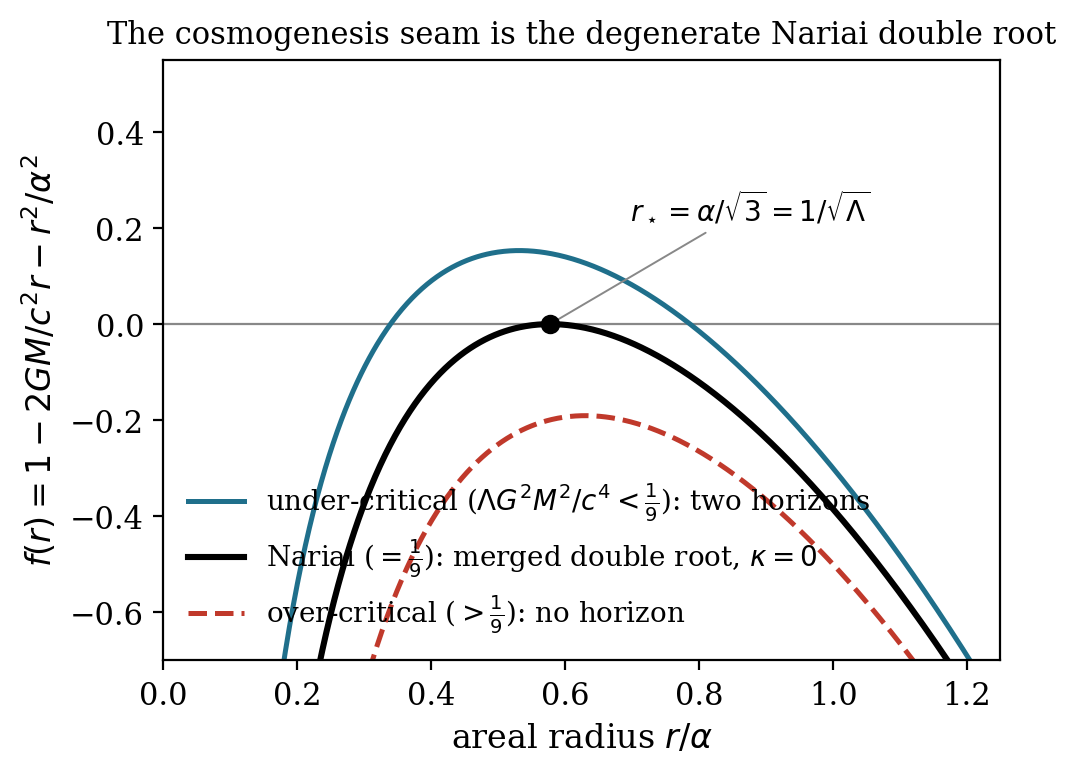
A field on dS2×S2 (Fig. 4) decomposes in S2 harmonics; the degree-ℓ harmonic becomes a dS2 field of effective mass m2=ℓ(ℓ+1)/rN2, i.e. m2/HdS_22=ℓ(ℓ+1). With the dS2 index ν2= 14-m2/H2, the monopole ℓ=0 has ν= 12—a scale-invariant base—while every ℓ≥1 has ℓ(ℓ+1)≥2, hence ν2 lt;0: the heavy principal series, which oscillate and decay through the throat. We read this as an angular no-hair, and the reading is grounded rather than asserted: the dS2 factor of the throat is a positive-Λ epoch, and the de Sitter no-hair theorem [Wald1983] damps exactly the anisotropic content—every ℓ≥1 harmonic is heavy principal-series, oscillating and decaying, while only the isotropic monopole ℓ=0 survives as the ν= 12 base—so the throat isotropizes what passes through it (receipts: verify_throat_tower.pyP15R40). The geometry is established (Proposition 4) and the mode tower follows from it; the no-hair reading is the standard theorem read on the throat, and we flag one guard as load-bearing: the index ℓ of this throat tower is the S2-harmonic degree of the near-horizon geometry at areal radius 1/√Λ, and is not the observable microwave-background multipole, which lives on the last-scattering sphere of radius DC. And the same conclusion is now reached a second time by a route that shares neither the decomposition nor the theorem, which is why it is worth having: carrying the layer's S3 harmonics along the cosmogenetic bead in its own conformal time, where the lift from the comoving turnaround to r=0 is a segment of purely imaginary η of finite length stot=Γ(16)√π/Γ(23)√3 21/3=3.3387380 (S10). There the isotropic mode crosses with amplitude exactly unity—u=a solves the lift equation identically at k=0—while every anisotropic one is damped by a pure-number function of its own degree, T(k)→27/3k2e-k stot, and the eigenvalue k2 is the carried layer's own rather than a round sphere's. §7 obtains that layer with squashing ε, and its Laplacian—built from the left-invariant forms of the same group manifold—has spectrum
so L(L+2) is its ε=1 member. For scalars the deformation reaches the spectrum and not the basis: the same matrix elements diagonalise the Laplacian at every squashing, so (L,m) is conserved along the bead and nothing mixes. The scope of that sentence is the scalar sector and is not general—it holds because a scalar on a left-invariant metric carries no frame index, and the vector sector below is where that premise fails. Two sectors the squashing cannot reach at all: λ(0,0)=0 identically, so the isotropic mode crosses at unity for every ε; and m=0, admissible exactly when L is even, keeps λ=L(L+2) with no ε in it. And every other scalar mode is bounded below uniformly—the minimum at |m|=L/2 is 2L+L2/ε2, so λ≥2L for every εgt;0—which puts the suppression exponent at no less than √2L stot: at L=1 that is 4.722, giving at most 8.97×10⁻² against 4.66×10⁻² for the same asymptote at the round value—and the exact transport, below, weakens it by 2.49 at that degree rather than by the bound's factor of two, a suppression still above ten and monotone in degreeP15R258. Where the squashing drops out of the eigenvalue, the constant-k transport is exact rather than approximate, so on the m=0 slice the transmission is a number and not an envelope: 4.158×10⁻³, 1.116×10⁻⁵, 2.438×10⁻⁸, 4.730×10⁻¹¹ and 8.497×10⁻¹⁴ at L=2,4,6,8,10, against T(0)=1 to a part in 1014 as the control. Those degrees sit below the asymptotic regime of the parameter-free form, which therefore understates every one of them and the lowest by most—exceeding it by 30, 17, 12, 9 and 7.5 per cent of the asymptotic value in turn—so 27/3k2e-k stot is a lower bound on this sector's transmission rather than an estimate of it, approached from above and not crossedP15R268P15R274. The charged modes do carry a squashing-dependent eigenvalue, and it diverges at the double root—so an exact figure exists on the slice whose amplitude the transport delivers, and is absent on the modes whose amplitude it does not. The Berger parameter is the squashing normalised to the horn's round datum, α√-f/r, since the bare ratio tends to 1/α rather than to unity; so normalised it passes through unity at exactly r=2M= 23rN, free of α. On the lift the layer is timelike, -f lt;0, so that parameter is imaginary there and what enters the spectrum is its modulus—and the m=0 modes, which carry no ε at all, reproduce the round exponent exactly, which is the control that fixes the modulus as the right object to feed it. That radius is positive and the lift occupies -A lt;r lt;0, so the squashing exceeds its round value along the whole of it—1.3747 at the comoving turnaround and rising without bound at the close—and the stretch where a squashing below unity would raise the eigenvalues lies on the expansion side, which the transport never visits. So the uniform bound above is not attained, and what the lift actually supplies is exact. Dividing (11) by its round member gives λ/L(L+2)=1-σ(1-ε-2) with σ=4m2/L(L+2), the fraction of the eigenvalue the Hopf charge carries—so the exponent's ratio to the round one is a function of σ alone, and (L,|m|)=(1,12) and (6,2) share σ= 13 and return the same ratio to ten figures. Both endpoints are exact: the ratio is unity at σ=0, and at σ=1 it is σtot-1 ∫|ε|-1dη=0.2591, free of α by three independent routes—so the most transparent band sees an effective segment length 0.8651 rather than 3.3387. And because the infimum λ≥2L is reached only as ε→∞, which is a set the transport does not dwell in, the exponent stays LINEAR in degree rather than turning into the bound's √2/L: at L=1024 it is 934.0 against the bound's 151.1, the gap widening past a factor of six. What the squashing buys is a shortened segment and not a change of functional formP15R259.
The uniform floor above is the scalar sector's, and the vector sector has no counterpart to it. The Hodge Laplacian commutes with d and d* on any Riemannian manifold, so the gradient and co-exact subspaces are each invariant at every squashing—and the gradient sector returns (11) member for member, which is the control that fixes the convention. Inside the co-exact sector the deformation does reach the basis: a 1-form carries its own charge in the frame index, so the conserved label is the difference and the invariant blocks are the triples {e+ (q+1),e3 q,e- (q-1)}, with coupling 2√2 ε at L=1 and 4ε at L=2—proportional to the squashing itself and vanishing only in the collapsed limit. So (L,m) is not carried unmixed there and the transport is a three-channel problem, bounded at 3×3 and never a new infinite one; and the extreme-charge block is 1×1, mixing with nothing, which is also the smallest block at large squashing and therefore available exactly where the lift goes. The transverse eigenvalue is λ⊥=(L+2)2/ε2 exactly—9, 16, 25, 36, 49, 64 for L=1 to 6—so it runs to zero as ε→∞, which is the end of the lift where the scalar floor still held. And the suppression survives the broken floor, because ε→∞ happens only at r→0 and almost no measure sits there: carrying the exact minimum through the lift's own measure gives 2.595216 at L=1—exactly 3×0.8650719, the scalar effective length, free of α to thirteen figures and with the minimiser the unmixed block, so nothing adiabatic is assumed—and 2.555, 3.780, 4.793, 5.742, 6.661 at L=2 to 6, against the most transparent scalar band's 2.447, 3.350, 4.238, 5.118, 5.993. The exponent is linear in degree and larger than the weakest scalar band at every degree computed, so a pointwise bound running to zero costs the damping nothingP15R261. Above L=1 the vector figures are a short-wavelength reading on a rotating basis and are quoted as such.
For the tensor sector this route does not reach a spectrum at all, and the obstruction is identified rather than merely met. The Lichnerowicz Laplacian preserves tracelessness at every squashing and generates divergence as soon as the layer stops being Einstein—and the layer is Einstein only at the round point, its Ricci eigenvalues being (4-2ε2,4-2ε2,2ε2), equal if and only if ε2=1. So the transverse-traceless subspace is not invariant off that point: the generated divergence is linear in the Einstein deficit near it and is already a quarter to a third of the image at the lift's entry. What the tensor route needs is therefore a decomposition the squashed layer does not supply, and not an eigenvalue on it—the object such an eigenvalue would belong to is not preserved by the transport. This bounds a computation this paper's own route would require, and is not a claim about the tensor sector. And the obstruction belongs to the reduced description rather than to the geometry it reduces: the four-metric the layer sits in is exactly Einstein, Rab=Λgab identically with R=4Λ=12/α2, the mass and the throat constant free—so the traceless Ricci that drives the obstruction vanishes identically one dimension up. And the obstruction is proportional to that deficit rather than merely correlated with it, the ratio holding to four figures across four decades of it at 0.255551 for L=2 and 0.183473 for L=3 with the trace at machine zero throughout, so a vanishing deficit is a vanishing obstruction and not a smaller one. What is obstructed is therefore the layer-by-layer harmonic method, and the question is well posed in four dimensionsP15R262. And the four-dimensional treatment keeps that economy, with more of it than the three-layer route has. The four-chart's angular factor is a round two-sphere at every radius, the areal radius its only radial dependence and no squashing parameter present on that chart at all—so moving along the curve rescales the fibre and does nothing else to it, and a round fibre has no shape to deform. The angular dependence separates, and the reduced radial operator is identical across every azimuthal label at each degree, with the degree entering only as ℓ(ℓ+1): a one-label family of radial problems where the layer route is a two-label one, since (11) depends on m2 and needs the second label. What does not travel is the label itself: the layer's m=0 harmonics are exactly the fibre-independent ones, so exactly that sector descends to the Hopf base, and there the two spectra are one number—L(L+2)=4j(j+1) at j=L/2, identically in the degree. So the bridge is exact where it exists and absent elsewhere, and the sector it exists on is named three times over: by the Hopf projection requiring j=L/2 to be an integer, by the parity rule admitting m=0 exactly for even L, and by the layer spectrum depending on the squashing only through m2—which makes it the squashing-free sector as wellP15R263. The modes the bridge does not reach carry charge under the fibre direction the degeneration closes up, and what becomes of such a charge is a question about the degeneration rather than about this sector. And the sector the bridge does reach is thin and begins late: the layer's multiplicity at degree L is (L+1)2 with L+1 charges carrying L+1 states each, so the zero-charge slice is exactly 1/(L+1) of the degree on even L and empty on odd—13, 15, 17, 19 at L=2,4,6,8—and it contains no L=1 mode at all. What that exclusion does not do is reach past the sector it describes. The parity it rests on empties the neutral slice at every odd degree, so the degrees it removes properly contain the ones the companion's tensor tower removes—but it is a statement about which slice keeps the round eigenvalue, and not about which modes exist. At odd degree all L+1 slices are present and every one of them is charged, and all are carried along the bead exactly, the harmonics conserving (L,m) with nothing mixingP15R267. Neither route by which that parity might have bounded the arriving content survives measurement. The crossing cannot carry it: its kernel is a function of the degree alone, while L(L+2) is the same on all L+1 charges of a degree, so the charge the parity distinguishes does not appear in the kernel at all—a function constant along the ladder cannot implement a condition that distinguishes its rungsP15R269. And composition cannot carry it either: the charged eigenvalue diverges where the squashing vanishes, and the normalised squashing attains its minimum 1.3747 at the comoving turnaround and rises from there to the close, so the divergence lives on the leg the transport never traverses.
So the odd ladder arrives, and it arrives with a number rather than a sign. The exponent's ratio to the round one is a function of σ=4m2/L(L+2) alone—two modes of different degree sharing σ agree to ten figures—and at the lowest odd degree it gives an exponent of 4.868603 against 5.782864 for a round mode of that degree: exponentially small, non-zero, and less suppressed than the round mode by a margin that grows with degreeP15R272. And the projection carries that degree lower in the sky than the even floor. The window in which (16) is quasi-injective is two degrees wide, so L=1 sits inside the mode spacing comfortably where L=2 sits inside it by less, and the two land at ℓ≃3 and ℓ≃6—three multipoles apart, and stable across the range of the stretch this paper admits. With the even floor's own neutral slice at exponent 9.443377, the gap is e4.57 in the odd degree's favour, so the lowest multipoles the projection reaches draw on the degree a parity bound would have removed, and exponent and modal multipole both rise monotonically over the computed degrees, so no higher degree reaches below itP15R273. What that locates is a window and not a spectrum: these are exponents and not amplitudes, the charged slice's eigenvalue moving along the path so that no prefactor follows from a ratio of exponents; one slice is carried per degree; and the primordial weights a Cℓ would sum against are fixed nowhere in this construction, which is the datum §10 names as inherited rather than derived.
What the bridge does not carry across is the measure. On an Einstein four-metric the Lichnerowicz curvature term splits, and while the Ricci part is proportional to the tensor and shifts the problem by a constant, the Riemann part is not, because this background is not conformally flat: the Kretschmann scalar is 48M2/r6+24/α4, the second term exactly the Λ-only value 8Λ2/3, so the Weyl invariant is 48M2/r6—mass-driven, and divergent as r→0, which is the close of the lift. At the forced mass the ratio of the two is 2α6/27r6, exactly one half at the comoving turnaround—a closed value at the lift's own entry—then 32 at half that radius and 5×10¹¹ at a hundredth of it. So it is nowhere a small correction on the segment the transport traverses, and the layer's cross-section problem carries no counterpart to it: a tensor exponent on this background is the Regge–Wheeler reduction with that coupling carried through the radial problem, and not an extension of the measure the scalar and vector exponents are computed onP15R264. That computation belongs with the tensor sector itself, which §1 places in the companion dynamics paper [JanzenDynamics].
So the throat's isotropization is not only the standard theorem read on the near-horizon geometry; it is a damping factor computed on the construction's own curve, with no Λ, H0, Ωm, mass or epoch in exponent or prefactor—the seam is isotropic by identity rather than by tuning. The guard above applies to this route in the same form and with the same force: L here is the degree on the cosmological layer, and the observable multipole is reached only through the map of §7P15R240. The map between them is §7, not an identity; conflating them would manufacture a prediction the geometry does not make. And §7 measures how far from an identity it is, which bounds the degrees over which an exponent in L may be read as one in ℓ}: the projection is quasi-injective while its width stays inside the mode spacing, which holds at L=1 and L=2 and fails from L=3 up. So the exponential-in-degree statement above transfers to the sky for the first two degrees—where this route's own figures are computed—and above them becomes a statement about the lowest contributing degree instead, since a steep envelope carried through a smearing map is dominated by the bottom edge of each band. The functional form is not preserved there, and that is a limit on how the envelope may be read rather than a correction to it. And a second guard belongs to this route in particular, because it is the premise that makes the expansion possible: carrying (L,m) along the bead needs a harmonic decomposition of the layer at every point of the curve, the lift included—and the layer there is squashed rather than round, §7 measuring its squashing as √-f/r. The decomposition exists and is the same one, because the squashed layer is a left-invariant metric on the same group manifold: that is what (11) above records, and it is why the transport carries (L,m) unmixed. The guard that remains is narrower and is worth stating as such: the round value L(L+2) is the ε=1 member and not the generic one, so a damping quoted at L(L+2) is a statement about a horn and not about the lift, and what the lift supplies is the uniform bound. The isotropization conclusion does not rest on this route in any case: the near-horizon one needs nothing of the cosmological layer, resting on the throat geometry of Proposition 4 and the de Sitter no-hair theorem alone. That the two agree in direction, by mechanisms sharing neither a decomposition nor a theorem, is what makes the second worth computing. A second guard belongs beside it, and it bounds what the tower damps. The computation above is a statement about propagating field modes—degrees of freedom carrying a mass on the dS2 factor, which is what being heavy principal-series means. The low multipoles of a perturbation about a spherically symmetric background are not such modes: ℓ=0 carries the mass and the axial ℓ=1 carries the angular momentum, the latter a stationary slow-rotation configuration rather than an oscillation, with the radiative content beginning at ℓ≥2—the multipole face of the non-radiative skeleton the range paper describes [JanzenRange]. So what the throat isotropises is the radiative content, and a conserved charge sitting in a constrained sector is not among the modes this argument is aboutP15R8. This is a bound on the claim and not a claim in the other direction: that the angular momentum is not removed by this mechanism says nothing about whether it is carried off by matter or torqued on the way, which this paper does not settle: it is matter dynamics on the collapse leg, a modelling task awaiting a progenitor interior with matter content, which is where the inherited data's derivation waits as well (§10). And the geometry the tower is computed on is itself a non-rotating one, Proposition 4 following directly from f at the Nariai mass. So it is worth measuring how much the conclusion rests on that. Writing λ for the ratio of the dS2 curvature radius squared to the S2 one, the index generalises to ν2= 14-λℓ(ℓ+1), with λ=1 the equal-radii case above. The monopole is untouched: ν2= 14 for every λ, so the scale-invariant base does not depend on the radii being equal. And the damping persists well away from it: every ℓ≥1 remains heavy principal-series for λgt;1/4ℓ(ℓ+1), which at ℓ=1 is λgt;1/8—the dS2 radius would have to fall below 0.354 of the S2 radius, a factor near three, before the dipole ceased to decay, with the higher multipoles safer stillP15R9. What ratio a rotating progenitor would produce is not computed here, and a rotating near-horizon geometry is generally warped rather than a direct product, so a single ratio may not describe it; what the margin establishes is that the conclusion does not turn on the equal-radii point itself. The ratio can in fact be computed on the rotating family, and it runs the helpful way. Kerr–de Sitter's radial function Δr=(r2+a2)(1-r2/α2)-2Mr reduces at a=0 to r2f(r), and its degenerate locus Δr=Δr'=0 gives a2=r2(α2-3r2)/(α2+r2), which returns rN=α/√3 and the Nariai mass at a=0 rather than presupposing them. The family is bounded: a reaches (2-√3)α at r/α=0.3933, where Δr” vanishes and the double root becomes triple—the ultracold member. Along it the ratio begins at unity and rises: λ=1 exactly in the static case and λgt;1 monotonically with a, so rotation carries the throat away from the 1/8 threshold rather than toward itP15R10. That ratio is read at the pole, where the sphere's radius is rN; the rotating near-horizon sphere is warped through rN2+a2 cos2θ and a single ratio does not describe it, so what the calculation establishes is the direction and its size at one well-defined point, with a factor of eight in hand at the outset.
The warped problem is done directly, and does not need the proxy. The near-horizon limit of the degenerate family, taken as a limit rather than posited, is a warped product and not a direct one: ρ02=r02+a2 cos2θ multiplies the dS2 and polar directions alike, and the dS2 is fibred over the sphere by k=2r0a /(r02+a2), which vanishes only at a=0. A massless field still separates on it, the warp cancelling from the relation between the transverse eigenvalue and the dS2 operator because it multiplies both. For the axisymmetric modes it cancels altogether: the transverse problem is (Δθ sin θY')'+E sin θY=0 with Δθ=1+(a/α)2 cos2θ—a spheroidal deformation of Legendre in which ρ0 does not appear at all, so the harmonic label survives the warping rather than being spoiled by it. The decay condition generalises to ν2= 14-L2E-L4m2 k2, the last term the rotation's own fibration, which is non-negative and so can only deepen the damping. Two exact bounds then settle the family without a scan: L2≥1 on the physical branch and E≥2 above the monopole, each with equality only at a=0, so L2E≥2 against the threshold 14. The monopole keeps ν2= 14 exactly on the warped sphere too. So the conclusion holds across the whole family 0≤a lt;a with the same factor of eight, and the marginal member is the non-rotating one—rotation strictly improves the case rather than threatening itP15R11.
Large scales: the flat/discrete decoupling and the low-multipole floor
Here the construction makes its sharpest large-scale statement, and the load-bearing piece is established.
The decoupling follows. The distance slicing is the flat constant-τ one—Ωk=0, no curvature term in the redshift–distance relation—while the cosmological layers are the closed S3, labelled by constant τ=τ+χ and read as a sphere in the de Sitter presentation (§2). The attribution matters and is stated rather than left to the reader: on the reassigned chart of (2) a constant-τ surface carries the induced metric -f(r) dχ2+r2dΩ2, whose intrinsic Ricci eigenvalues are (0,1/r2,1/r2)—a flat line times a round S2 of radius r(τ), not a three-sphere—which is what the reassignment does and is the same fact as the 45∘ picture of §2. The line's causal character is the congruence's own speed, and it is not the same along the whole curve: the E=1, k=0 radial equation gives (∂χr)2=2M/r+r2/α2 identically, so the χ-block coefficient -f=(∂χr)2-1 is positive where the congruence exceeds unit areal speed and negative where it falls below it, vanishing at the two loci where it is unit. At the Nariai mass the cubic factorises exactly,
a double root at r=+α/√3 and a simple one at r=-2α/√3—which are the lap's two seams, necessarily so, since -f=0 and |∂χr|=1 are the same condition. So the sign of -f is the sign of (r+2α/√3)/r, and the surface is spacelike on both legs and Lorentzian through the whole interior of the lap—-1 exactly at the comoving turnaround, where ∂χr vanishes and the surface is a unit-timelike line times S2(A). The flat-line reading is therefore the signature outside the seamsP15R239. The non-synchrony τ=τ+χ is the decoupling itself: flat distances and a closed S3 of comoving worldlines coexist, the one read on the constant-τ slicing and the other on the layer the same construction labels by τ. And the relation between those two readings is stated exactly, because it is not the one a reader will assume: they are not two coordinate presentations of a single metric, and nothing here claims they are. The two are reached from one another by the reassignment of the null condition—the operation that promotes one null bundle of the cosmological horn to the fundamental timelike congruence (§2)—so they are two metrics carried on one ontological layering, isometric through that reassignment and not through any change of coordinates. What is common to them, and what makes the layering one object, is the foliation itself: the cosmic layers are the surfaces of constant areal radius, on the de Sitter horns and inside the lap alike, and it is the growing-r foliation that begins at the branch point where r and τ vanish together. The difference between a flat reading and a curved one is therefore nothing but which bundle is called at rest, and the lift's purely imaginary conformal time—the Euclidean segment of §10—is what keeps that reassignment well defined across the lap. One consequence is worth stating so that it is not mistaken for a defect later: a curvature invariant computed in one presentation and compared with the other registers that the reassignment is not a diffeomorphism, which the construction asserts of it, and is therefore not evidence about where the layer's sphere livesP15R239. What the de Sitter presentation displays plainly is the layer outside the seam, before the lap and after it; inside the lap the seam buries the explicit form, and the sphere's character there is reached by analytic continuation along the bead rather than read off a chart. The foliation is the constant-r one at every point of the curve, and the layer's SIZE continues across the lap with it; its SHAPE does not. That is settled below rather than assumed in either direction, by carrying the sphere the de Sitter presentation displays at a horn along the flow and measuring what arrives. What the construction does supply is a sharp test for it, and the test's own discriminating power is measured rather than assumed. A round S3 of radius r has scalar curvature R=6/r2 and volume V=2π2r3, so the scale-free combination
carries no r at all—it cancels symbolically—so it is insensitive to the layer's size and reports only its shape. And it does discriminate: on a Berger sphere of squashing ε the same combination is 2·22/3π4/3ε2/3(4-ε2), which varies with the squashing and takes the round value only at ε=1. That point is a strict maximum of the combination and its first derivative there vanishes, the second being -77.9, so the test's sensitivity to a departure from roundness is second order in the squashing—sharp enough to discriminate, and weaker against a near miss than a reader would assume of it. So (13) is the quantity a demonstration of the continuation would have to return, evaluated on a layer metric obtained from the construction rather than written down}—and what it has to be evaluated on is exactly that: the three-metric of the layer inside the lap carried from the sphere the de Sitter presentation displays at a horn, rather than posited at each point of the bead. And the presentation that demonstration must be carried in is fixed, because (13) cannot be evaluated on the reassigned chart's surface at all.} The volume of a line times a sphere carries the coordinate extent of the line, so the combination is not scale-free there; and wherever -f lt;0 the surface carries no Riemannian volume, so the combination has no real value—at the comoving turnaround -f=-1. The test is therefore a test of the de Sitter presentation's layer, which is where the sphere is displayed and where the continuation is the question. And carried in that presentation the requirement reduces, because the imaginary segment turns out to be transparent to the test and the flow does not. The layer at a horn follows from the closed slicing's own equation a'=a√a2/α2-1 with a(0)=α, giving a(η)=α/ cos η, so there the layer is a2 times the unit round S3 and (13) returns its value with the factor cancelling. Carrying that factor off the positive axis leaves the modulus exactly fixed—| R V2/3|=43.8232… for a gt;0, a lt;0 and a=±i alike—while the principal value picks up a cube root of unity fixed by a, the lap's own thirds. So the lift is not what the sphere has to survive: what it has to survive is the shear of the flow that carries it, and the carrying is conformal on the layers only where the constant-r foliation is umbilic. On (1) that condition is rf'=2f, whose only root is r=3M with the mass carried free}—so it is a statement about the family and not about a member—and at the Nariai member that radius takes the value α/√3, the merged horizon's areal radius, with the shear non-vanishing at the comoving turnaround and away from the seam. The coincidence of those loci is computed and is not an identification of the two objects: the umbilic radius of the foliation and the merged horizon's areal radius agree in value at the forced member. And the sheared layer's own invariant settles it, which is why the continuation is stated here as failing rather than as open. The foliation's trace-free extrinsic curvature is axisymmetric with σ1=-2σ2—one distinguished direction against an equal pair, which is the squashing (13) parametrises, so the test is applied in the direction the flow actually shears. Carrying the horn's round datum along it, the squashing obeys d ln ε/dr=f'/2f-1/r, which is identically d ln (√f/r)/dr, so ε∝√f/r with no layer metric written down at any point of the lap. The response to a squashing has no linear term—g(1+u)/g(1)=1- 89u2-8/81u3 exactly, which is the second-order stationarity above in closed form—so a squashing of either sign lowers the invariant. And approaching the seam the squashing runs to zero: at the Nariai member f has its double root there, so ε vanishes linearly in r-rN while the parameter along the flow diverges as - ln (r-rN). So the round shape is not carried to the seam, and the obstruction is in the approach rather than at a point—the seam lies at infinite parameter and the layer degenerates on the way to itP15R256. What the degeneration leaves is not nothing, and saying what it is completes the answer. A squashing running to zero collapses the Hopf direction at finite curvature: by the Berger expression above R→ a finite limit while the volume vanishes linearly in ε, so the S3 degenerates onto its Hopf base rather than shrinking. The surviving factor is the construction's own angular block r2dΩ2 at r=rN=1/√Λ—which is the areal radius of the S2 in the merged horizon's near-horizon geometry of Proposition 4. So the cosmological layer does not carry its sphere through the seam; it becomes the throat's S2 there, and the Hopf direction it gives up is the one the reassignment of §2 trades into χ. And the two descriptions are not merely in agreement at that radius: they are one geometry, which the seam limit of the carried layer gives outright. Because the χ-block coefficient depends on cosmic time alone, the shift dχ+d τ/(-f) is an exact differential, so with χ=χ+∫d τ/(-f) and dT=dr/√-f the four-metric is identically
with T the proper time orthogonal to the cosmological layers. The lapse diverges exactly where -f vanishes—which is |∂χr|=1—so that divergence is the cosmological slicing going null at the seam and belongs to the degeneracy rather than to the chart: T grows like Λ-1/2 ln [1/(r-rN)] at the forward seam's double root, while at the back seam's simple zero the same integral converges. In that parameter the approach is exponential, r-rN∝e-√ΛT, so the χ scale factor √-f has rate exactly √Λ and two-dimensional curvature 2Λ—a dS2 of radius 1/√Λ, which is Proposition 4's own √-2/f”(rN) reached from the flow rather than read off the static chart. The angular block tends to rN2dΩ2 and both blocks approach their limits linearly in r-rN, so the warping switches off and the limit is a direct product. The limit metric is Einstein with Rab=Λgab, has R=4Λ and Kretschmann 8Λ2—the static metric's own value at rN, computed separatelyP15R257. And the join is then an identity rather than a coincidence: the squashing above is √-f/r and the scale factor here is √-f, so the layer's squashing is the throat's own dS2 scale factor divided by the areal radius. The layer's loss of shape and the throat's dS2 are one object described twice, and the coincidence of radii at the forced mass is not a coincidenceP15R255. Two things about the lap are settled without it. The angular block enters only through r2 and is blind to the sign of r, and the χ block is not: -f carries 2M/r, which is odd, so two chart values of equal |r| carry S2 factors of equal radius and χ blocks that differ—at |r|=A they are opposite in sign. So |r| is the label of the layer's size and not of the layer, and the identification that closes the lap is the translation r↦r+√3α carrying one seam to the other, -2α/√3+√3α=+α/√3 exactly, rather than the reflection |r| would implement. And r=0 is not a single event but one on each worldline, since ∂χr=∂τr makes the level sets of r the 45∘ lines of constant τ+χ; the vanishing volume and divergent curvature of the layer at that one cosmic time are the areal coordinate degenerating, which this paper's own reading of the branch point already states. The cosmological seam is likewise a locus and not a point, and its position is fixed exactly: the handover from deceleration to acceleration is the inflection of r(τ), which vanishes where cosh (3 τ/α)=2, and the areal radius there is 2-1/3A=α/√3=rN identically—so the cosmological seam is the merged horizon of Proposition 4}, where f and f' vanish together, and the reassigned layer's χ block -f=(∂χr)2-1 vanishes there with them, so that layer is null at the handover. On the signed chart it is null at both of the lap's unit-speed loci—the two roots of (12)—and the translation that closes the lap carries one to the other, so the two are one locus of the substrateP15R254. A literal closed-Friedmann reading would put Ωk=-ΩΛ≈-0.685 into the distance relation and be excluded; CR avoids that not by tuning but because its distance slicing is the flat one, the curvature living on the orthogonal layers. Spatial curvature and dark energy are one Λ read on two slicings—the corpus identity, here at the observational rung. And that reading is an identity rather than a correspondence, which is worth having explicitly because it also separates two lengths the same sentence could be read as conflating. The curvature radius the closed readout returns is
exact in the construction's own parameterisation—symbolic residual zero, and 2×10-16 on both backgrounds—so what |Ωk|=ΩΛ fixes is the substrate's throat. That is not the layer's present radius: α/r0=√3/x0=1.0320, so the two differ by 3.2 per cent, and the quantity the low-multipole floor is built on is r0 (§7, below) while the quantity the closed readout names is α. The content the identity carries is unchanged and is if anything firmer—Ωk is not a free parameter, because its magnitude is forced to ΩΛ by one Λ—and what the two lengths say is that the readout and the layer are the same Λ read at two epochs of the bead rather than one number serving twiceP15R232.
The low-multipole floor. The closed S3 carries a discrete mode spectrum, labelled by integer degree L, with comoving wavenumber kL=√L(L+2)/r0 and the lowest physical mode the quadrupole L=2 (the monopole L=0 is the background, the dipole L=1 pure gauge). The eigenvalue in that wavenumber is the scalar one, and the dipole's exclusion is derived rather than conventional: the traceless second covariant derivative of a degree-one harmonic is the zero map, rank 0 where the full Hessian at that degree has rank 2, so it vanishes identically and not for want of modes to act on—and the same map has full rank L+1 from L=2 up. The companion's tensor tower floors at the same degree for the opposite reason, its transverse-traceless eigenvalue being L(L+2)-2, which has no member at either of the two lowest degrees [JanzenCosmogenesis]: so one tower excludes two degrees it has and the other has none to exclude, and the shared number carries two statementsP15R271. The decoupling fixes how these project to the sky, and the fixing is the whole point. Because the distance slicing is flat (Proposition 5), the photons are projected through the flat geometry—the comoving angular-diameter distance is DM=DC, the same flat-ΛCDM observable that places the acoustic scale at ℓA≈301—while only the source modes carry the closed-S3 quantization. The transfer is therefore the discrete closed-S3 spectrum projected through the flat spherical Bessel jℓ(kL DC), not the hyperspherical transfer of a literal closed universe: that transfer carries the closed distance relation, which CR does not have, and would (wrongly, here) deliver the lowest mode to the quadrupole and no deficit. The flat projection places the discrete modes at
with r0 the present S3 areal radius and DC the comoving distance to last scattering, both fixed without new parameters: DC≈1.4011×10⁴ Mpc is the comoving distance to last scattering and r0≈5051 Mpc is the Nariai amplitude 21/3/√Λ carried to the present epoch u= arcsinh√ΩΛ/Ωm≈1.22, both on the background the distance data fix. The stretch factor DC/r0≈2.774—the ratio of the flat projection distance to the curvature radius, the decoupling made numerical—carries the lowest mode to ℓ2≈7.8, with no source below it.
What (16) returns is the peak argument of a projection and not a multipole}, and the distinction is load-bearing wherever a statement about the degree L is carried to the sky. The weight a layer degree places on a multipole is wℓ(L)=(2ℓ+1)jℓ(ℓL)2, a genuine distribution over ℓ by the Bessel closure ℓ(2ℓ+1)jℓ(x)2=1; evaluated on the two lengths above, the printed value sits near the ninetieth percentile of that distribution rather than at its centre—P(ℓ≤ℓL) running 0.875 to 0.961 over L=1 to 8, with ℓL above the modal multipole by between 1.74 and 3.02, a displacement of order one mode that is bounded both ways and does not grow with degree. And the width crosses the spacing between consecutive degrees at L=3: against a mean spacing of 2.19 to 2.39, the standard deviation runs 1.20, 1.83, 2.45, 3.07, 3.70, 4.32, 4.94, 5.56 for L=1 to 8, and each degree's band of 2% weight overlaps its neighbour's in 4 to 7 multipoles from the third degree up. So the map is quasi-injective for the first two degrees and smears without bound above them, and a statement exponential in L transfers to ℓ as a statement about the lowest contributing degree rather than keeping its form—the bottom edge of each band, not its centre, because a steep envelope is dominated there. The figures above are the geometric minimum: they are the projection kernel alone, with no transfer function, window or visibility in them, so a real projection can only be wider. What this does not disturb is the floor itself: the leak below ℓ2 falls fast with degree, P(ℓ≤3) running 0.591, 0.151, 0.059, 0.032 for L=1 to 4, so the floor is softened by about a sixth of one mode and not erasedP15R260P15R273.
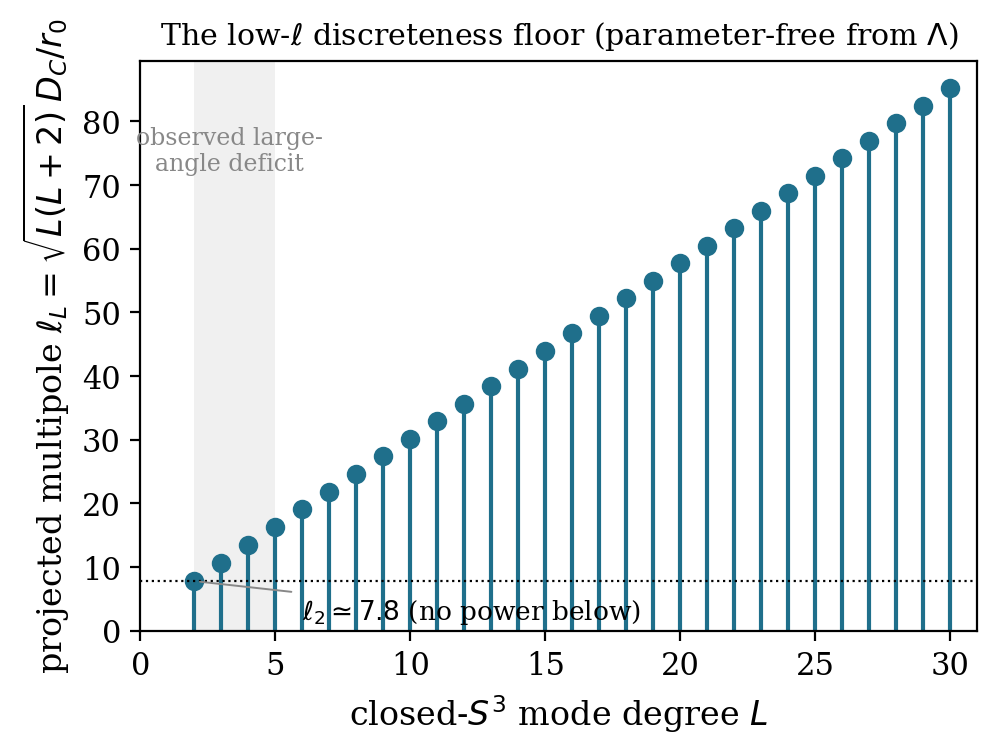
The full flat-projection transfer confirms the estimate and sharpens it into a prediction. Carrying the discrete spectrum through jℓ(kL DC) with the scale-invariant measure—the first-principles closed-S3 Harrison–Zel'dovich weight [Harrison1970, Zeldovich1972] wL=(L+1)/(L(L+2)), fixed as the mode degeneracy β2 (with β=L+1) times the per-mode power 1/(β(β2-1)) that equal power per logarithmic interval in k requires, and reducing to the continuum dk/k at large L so that ℓ(ℓ+1)Cℓ returns to the flat plateau as DC/r0→0 (receipt: verify_lowell_exact_measure.pyP15R29)—yields a low-multipole deficit: ℓ(ℓ+1)Cℓ falls below its high-ℓ plateau for ℓ≲7 and recovers by ℓ≈8, because the flat projection of a discrete source with a hard lowest mode at k2 leaves the lowest multipoles starved (receipts: verify_closedS3_nonsync.pyP15R28).
The one effect that partly fills it is the late integrated Sachs–Wolfe term [SachsWolfe1967], sourced near the observer where small line-of-sight distances send wavenumbers k k2—above the floor—down to ℓ∼2.
By the decomposition of the empirical-forcing paper [JanzenModernParallax] the cumulative term is the standard Sachs–Wolfe and integrated Sachs–Wolfe—CR's own differential-expansion floor being zero under uniform expansion—so this late boost rides the same modes the discrete source keeps, and the deficit is milder than the bare Sachs–Wolfe starvation alone.
The depth is a matter for a genuine Boltzmann transfer rather than for the geometry, and the reason is that the deficit is two effects and not one. In the pure Sachs–Wolfe limit the suppression splits exactly into a floor—the projection integral truncated below k2—and a ladder coarseness, the discrete sum minus that same truncated integral. At ℓ=5 and 6 the two are comparable and pull opposite ways: the ladder puts back power a pure cut-off removes. And they respond to the fitted parameter with opposite signs—under ±2% in r0 the floor moves by a few per cent while the full result moves by tens—so the location is the floor and is robust for that reason, and the depth is the ladder and is volatile for that reasonR. The recovery multipole is the ladder's too: with it the spectrum recovers by ℓ≈8, on the floor alone not until ℓ≈10. Because the only CR modifications are the discrete source and the flat projection—every transfer ingredient (Sachs–Wolfe, early and late integrated Sachs–Wolfe, Doppler) shared with flat-ΛCDM [JanzenModernParallax]—the exact CMB temperature transfer Δℓ(k) of a standard Boltzmann code is CR's transfer, and the discrete spectrum is read off it: CℓCR=L≥2wL Δℓ(kL)2 against the continuum ∫d ln k Δℓ(k)2, the measure wL being exactly d ln kL/d L so the CR sum is the L=2-floored Riemann sum of the very integral ΛCDM does continuously.
Carried out with the exact transfer (gate-validated: the continuum reproduces the code's own Cℓ to four figures; and the r0 sensitivity is measured rather than assumed: the shape is stable—the minimum stays at ℓ=4 and the recovery multipole moves by 0.1%—while the depths drift by up to 15% at ℓ=4 under ±2% in r0), the deficit is milder than a Sachs–Wolfe-only estimate suggests, and it has a shape: ℓ(ℓ+1)Cℓ sits at ≈0.487, 0.435, 0.359 and 0.666 of the flat-ΛCDM expectation at ℓ=2,3,4,5, recovering by ℓ≈8 (receipts: verify_lowell_boltzmann.pyP15R31 for the transfer, and the depths with the late integrated Sachs–Wolfe term carried to the presentP15R171). The prediction is therefore not a monotone recovery from the quadrupole but a dip whose minimum falls at ℓ=4P15R34—and the quadrupole and octopole, the two multipoles a large-angle discussion reaches for first, are its two shallowest points.
The shape is not one code's, and that was checked here by running it rather than by comparing tablesP15R36.
Driving the photon hierarchy built for this programme (§9) through the same discrete projection puts the minimum at the same multipole, ℓ=4, and recovers at the same place, ℓ≈7–8. The two independent Boltzmann treatments cross-validate the depth as well as the shape once each carries the late integrated Sachs–Wolfe term to the present: on the exact transfer the deficit is 0.487, 0.435, 0.359, 0.666 of the flat expectation at ℓ=2 to 5, and the hierarchy agrees to three per cent at every multipole and one per cent above ℓ=5 (§10)P15R171P15R237.
The reason is the late integrated Sachs–Wolfe: it is sourced near the observer at wavenumbers k k2 (small line-of-sight distances), above the floor, so the discrete source retains it rather than losing it, and the deficit is milder than a Sachs–Wolfe-only treatment of the same source would give.
This is a parameter-free deficit, set by Λ through r0 and DC, and what is robust is its existence, its location (ℓ≲8, geometric, set by k2 DC), its minimum at ℓ=4, and that the single floor k2 starves ℓ=2 and ℓ=3 together: the exact discrete measure and the Doppler term (super-horizon velocity through jℓ') each leave the ℓ=2-to-ℓ=3 ratio near unity, if anything suppressing the octopole slightly more (receipts: verify_lowell_exact_measure.pyP15R29, verify_doppler_lowell.pyP15R30). Whether this predicted deficit matches the observed sky is the data test, against the large cosmic variance of the lowest multipoles. Confronted with the measured low multipoles, the verdict is a wash. CR predicts a smooth modest deficit bottoming at ℓ=4; the observed sky has a sharp quadrupole-only dip (∼0.2) with a near-ΛCDM octopole (∼0.6–1.0), so CR sits above the observed quadrupole and below the observed octopole, matching neither sharply. Under the exact cosmic-variance likelihood the net over 2≤ℓ≤10 is Δ(-2 ln L)≈+1.6 (range +0.2 to +3.4 across the octopole estimator), a small residual well inside cosmic variance (receipts: confront_lowell_data.pyP15R32P15R171). Broken up by multipole, the sector's weight does not lie where its name suggests: the quadrupole rewards this cosmology (-2.5, its milder dip nearer the observed low power than flat ΛCDM's), the octopole penalises it at +1.0, and the largest single-multipole penalty is the +2.0 at ℓ=4—the prediction's own minimum, and the one multipole of the four that the large-angle literature does not treat as anomalous. The low multipoles are thus a genuine but non-discriminating sector: neither a parameter-free correspondence success nor a sharp falsification edge, but a mild deficit consistent with ΛCDM within the lowest multipoles' cosmic variance.
One further question belongs with this prediction, and it is a located one. The branch-point filter that sets what crosses into the expansion leg is, in its quantum reading, a Euclidean kernel whose action on a mode is controlled by an adiabaticity parameter C/μn, with μn the harmonic index of the layer's S3 tower [JanzenCanonicalTime]. That parameter is small for all but the lowest harmonics and reaches order unity only at n=2 and n=3, where it takes the values 0.70 and 0.47. Three independent routes put the approximations at their limit on the same scale: the transmission calculation's boundary at ℓ≈2.5, the projection's incompleteness below k∼2×10⁻⁴ Mpc-1 (ℓ≈3), and this parameter's reaching order unity at n=2,3. Whether that is a loss of control is decided by computing the filter rather than estimating it.
The transmitted amplitude at low multipoles can be computed rather than estimated, and doing so settles what the estimates left open. The branch-point filter's action on a mode is, in the quantum reading, a Euclidean kernel [JanzenCanonicalTime]. The exponential-of-an-integral form e-∫ωdη is a WKB approximation whose adiabaticity parameter is of order unity at ℓ≲5; but the underlying mode equation d2ψ/dη2=ω2ψ, with ω=kcs and dη=ds/a along the segment, is well posed at every k, and integrating it is a matter of numerics rather than of approximation. Composing exact constant-ω transfer matrices in the stable direction over the segment (|Δη|=3.33874 in units α=1) gives exact/WKB ratios of 0.926, 0.913, 0.901, 0.891 and 0.889 at ℓ=2,3,5,15,40: the WKB form is accurate to 7–11% at every multipole from 2 to 40, with the exact transmission slightly smaller, so the filter is marginally stronger than the approximation givesP15R81.
Those ratios are read at ω=kcs, where the segment's own field is the substrate one, whose frequency is √3 larger (§3)—and what that costs is fixed by a scaling rather than by a second run.} The frequency enters the segment only through the product kcs, cs being constant along it and the whole η-dependence sitting in dη=ds/a, so the substrate reading is the same curve read at √3 times the wavenumber: each entry above moves by about one step of that table, and because the ratio saturates with ℓ the spread across ℓ narrows rather than widens. So both readings below stand a fortiori on the settled rate—the offset keeps its size, its sign and its monotone direction in ℓ, a rescaled argument preserving all three identically, while its ℓ-dependence, which is what the comparison with the sky turns on, is smaller than the figures quoted.
Two readings suggested by the adiabaticity parameter alone are thereby excluded. The first is that the treatment is uncontrolled at ℓ=2–5: it is not, and the parameter was the wrong figure of merit, measuring as it does the fractional error in an exponent that is itself small at low ℓ. The residual's own behaviour settles this independently of any argument about the parameter: the ratio decreases monotonically with ℓ—0.926, 0.913, 0.901, 0.891, 0.889—so the discrepancy is smallest at ℓ=2, where the adiabaticity parameter is of order unity, and largest at ℓ=40, where it is small. An error of adiabatic origin runs the other way, WKB being an expansion in that parameter, so such an error is largest where the parameter is O(1) and vanishes as it does. What the numbers show is therefore a systematic offset rather than an adiabatic breakdown—the WKB form is uniformly slightly generous and the exact filter uniformly slightly stronger, which is a correction of known sign and bounded size and not a loss of controlP15R81L19. The second concerns the comparison with the observed sky. The correction is very nearly ℓ-independent—varying by 4% across a factor of twenty in ℓ—so between ℓ=2 and ℓ=3 it alters their ratio by 1.4%. The structural expectation that a single floor starves ℓ=2 and ℓ=3 together is therefore not relieved by the exact treatment, and the construction produces no selective suppression of ℓ=2 alone. Whether that is a discrepancy is a question of cosmic variance, and it is measured rather than argued. On Gaussian isotropic skies drawn from this section's own depths, the observed suppression of the quadrupole against the octopole is reached or exceeded in p=0.054 of them at the central estimator (0.017 to 0.155 across the estimator bracket, 0.082 on a cut sky); under flat ΛCDM the same statistic gives p=0.067. So the selective suppression is the sky's own: a low quadrupole of about two standard deviations that ΛCDM carries at the same size, which the single floor makes a fifth less probable because its C2/C3 is 1.12 and not 1, and not a shape this construction fails to produceP15R323. The low-multipole prediction of this section therefore stands as stated, and faces no discrepancy beyond the sky's own.
Finally, the two Boltzmann treatments above agree, on the depth as well as on the shape, the minimum and the recovery, once both carry the late integrated Sachs–Wolfe term to the present (§10). What both supersede is the Sachs–Wolfe-analytic estimate (0.22 and 0.20 at ℓ=2,3), which takes the Sachs–Wolfe source as the matter-domination value 13Φ, whereas at recombination ρr/ρm=0.317 and the source is 0.4006 Ψ—a 20% error in the very ratio of Sachs–Wolfe to integrated Sachs–Wolfe that fixes how much the latter fills the bare deficit.
What the progenitor supplies: the transmission proof
The decomposition's decisive proof is here: why the substrate transmits the spectral shape rather than imprinting one of its own. It turns on how a mode approaches the locus it meets. Two horizon cases bound the question: a non-degenerate horizon, and the degenerate Nariai double root, at r=+α/√3—the front seam, where f and f' vanish together so that κ=0. The locus the modes cross is neither: the branch point sits at r=0, carries no surface gravity because f diverges there rather than vanishing, and is not a Killing horizon at all. And the lap's other seam is a case of its own, which must be kept apart from the double root rather than folded into it. The back seam at r=-2α/√3 is one point of the substrate with the front seam, met a lap earlier, but the two chart values carry different orders of contact with zero: the back seam is the horizon cubic's simple root, so f' does not vanish there and κ=3√3/4α. It is the lap's one non-degenerate horizon. Whose horizon it is depends on the level, and the framework states both: at substrate level it is the merged horizon re-entered, one point with the front seam; read locally on the sheet the collapse runs on, it presents as the cosmological horizon of the mass, with the radius timelike outside it and the geometry static within [JanzenCRframework, JanzenSlicing]. What matters for the dichotomy is neither of those but the order of the root, and that is unambiguous. Both cases of the dichotomy are therefore realised on the lap, and which one a given seam realises is a question about that seam and not about the pair.
The amplitude separates from the tilt in the same statement. What the progenitor supplies is the potential power PΨ; what the construction contributes is the factor (0.4835)2=0.2338 carrying it to the observed As. That factor is computed rather than fitted: the inherited quantity is PΨ and the map from it to As is derived, so what the construction takes from the progenitor here is the potential power and nothing about the map [JanzenCRframework].
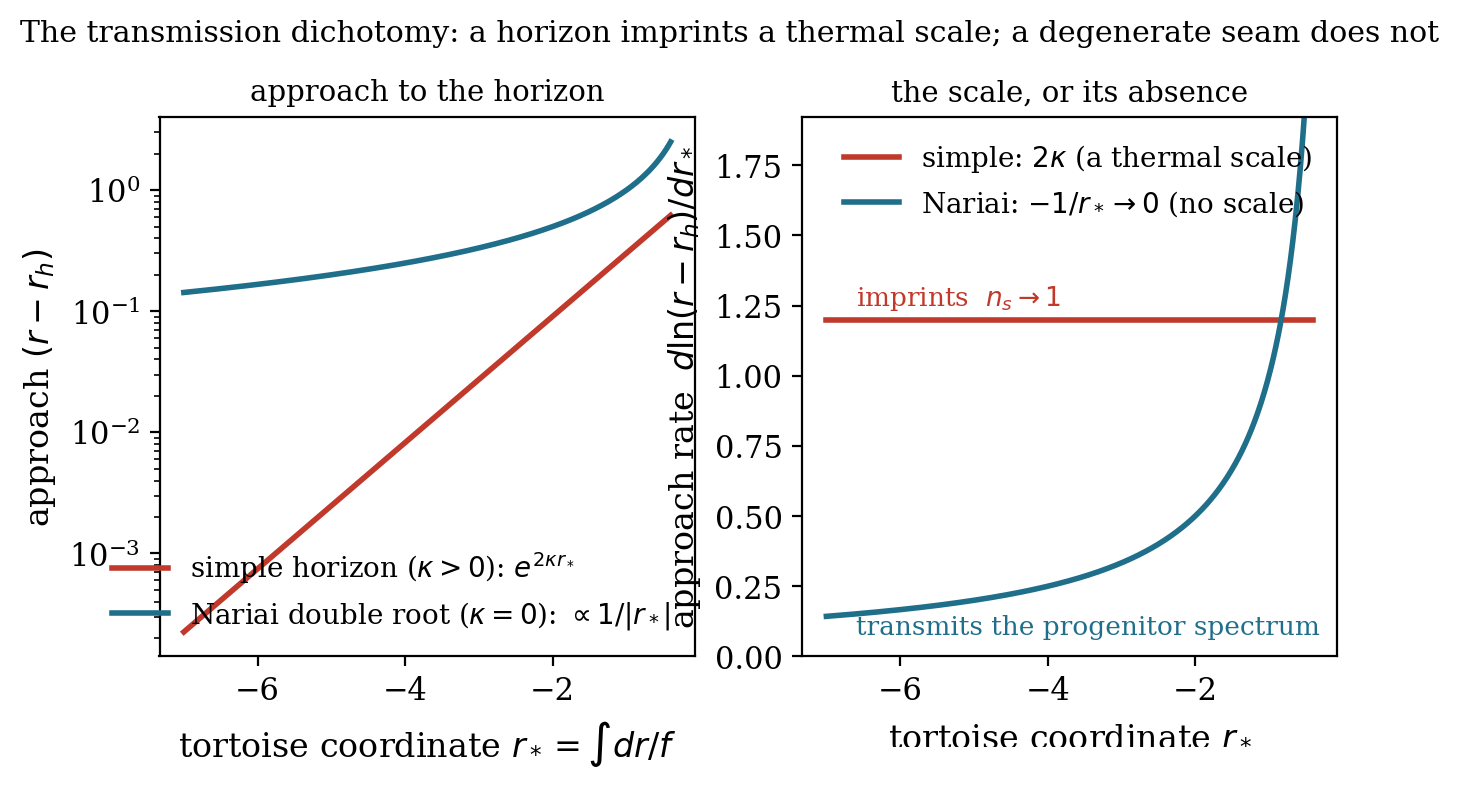
The physical reading is the result (Fig. 6). The exponential, non-degenerate approach is the thermal (Hawking) law—the mechanism by which a de Sitter horizon imprints a scale-invariant spectrum (ns→1): the exponential redshift erases the infaller's spectral information and stamps the horizon's own thermal scale. The power-law, degenerate approach carries no thermal scale; it is scale-free, and the infalling spectrum is transmitted faithfully. CR's transmission locus is the branch point r=0, where f diverges as -2M/r so the tortoise coordinate is finite—the crossing accumulates no divergent phase and stamps no scale, a third case beyond the dichotomy's twoP15R42. The Nariai double root (Proposition 4, f”(rN)=-2Λ, κ=0) is the front seam, r=+α/√3. It is one point of the substrate with the back seam the bead meets on the way in, the two chart values r=-2α/√3 and r=+α/√3 being the same φ modulo 2π in the phase φ=2πr/√3α; being one substrate point does not make them one case of the dichotomy, since the degeneracy is a property of the root and the back seam's root is simple. The branch point sits two thirds of the lap in from the front seam (240∘, with 120∘ remaining), so the crossing at r=0 and either seam are distinct loci on the lap without a seam being an endpoint of anything. Hence:
The absence of any scale where the modes cross is thus the proven reason CR carries the primordial tilt rather than manufacturing it. What the transmitter carries is, from the Schwarzschild–de Sitter side, not this side's to set: ns and As are inherited, fixed by the progenitor collapse and handed over at the branch point with η—and not derived here. Naming them together is convenient and has concealed that they are not the same kind of quantityP15R86. The vacuum normalisation is the only place a quantum constant enters the spectrum, so P(k)=ℏA0kns-1 and ℏ is an overall multiplicative factor: it survives in the amplitude and cancels in every logarithmic derivative. An amplitude is the spectrum at one wavenumber; a tilt is its ratio to itself at two. So the construction's inability to force a dimensionless magnitude bears on As and not on ns—the first is permanently inherited, the second need not be. And read backwards the same statement is useful rather than limiting: a quantity fixed by the moduli rather than the invariants is one the observation measures rather than one the construction must predict, so the observed As is a measurement of the progenitor's boundary data. It does not isolate the mass: the parent's growing-mode amplitude Dk enters alongside it, which is the corollary recorded above, so the mass must be reached by a route that does not run through the amplitude and checked against the independent requirement that it lie below the Nariai value. And it is worth saying precisely what that openness is, because a count settles its kind.P15R85 The progenitor family described here is parametrised by M alone—α is the one invariant and E=1 a choice of geodesic—so the geometry is one-dimensional; and the Kretschmann along the bead is mass-free in the faller's own proper time, so that one parameter does not survive the approach either. A quantity identical for every member carries no information about which member it was, and the collapse geometry therefore transmits not one parameter but none. Against that stand at least four independent inherited numbers. So `inherited from the progenitor collapse' cannot mean inherited from the collapse geometry: what is inherited is inherited from the progenitor's matter content—its composition, its entropy per baryon, its perturbation spectrum—and none of that is carried by M, the exterior here being exactly vacuum and the marginally-bound interior dust without composition. Deriving them is accordingly not owed: they are the progenitor's boundary data, measured as the standard account measures its own inherited inputs, and a derivation would be not an argument awaiting more cleverness but a modelling task awaiting a progenitor interior; and what the geometry supplies in its place is a cutoff rather than a content: the segment's conformal length |Δη|=3.33874α is fixed by Λ alone on the Nariai member—below it |Δη| runs as M-1/3, reaching 4.21α at M/2 and 15.50α at M/100—and says which modes survive without saying how large they wereP15R81P15R245. And the multiplicative statement above settles the one join the inherited pair needed: the handover's own factor is a constant of exactly the kind named there, so it survives in As and cancels in the tilt—the latter identically, with the power to which the transfer enters left free, so no convention choice touches it. What it costs is a number rather than a mechanism: the factor is 0.48352=0.2338 on the spectrum, 6.49 per cent against the handover's own three, while a transfer carrying the plasma's sound speed instead shifts the spectrum by 2csk|Δη|—some 7.6×10³ times the tilt budget the refit leaves (§4)—so the sound-speed reading cannot deliver the tilt it would be invoked to carryP15R253.
Predictions, and the progenitor boundary
The signatures, with their maturity marked:
- Classical, non-vacuum primordial statistics; no inflationary consistency relation; no substrate-sourced primordial B-modes (established, §5).
- The transmission character: the branch point carries the progenitor tilt and does not drive ns→1 by any inflationary attractor (established, §8). Nor does the construction lack a scale-invariant attractor—it has one, and it is not the inflationary root.P15R82 Scale invariance for a background a∝(-η)β with z∝a requires β(β-1)=2, a quadratic with two roots: β=-1, de Sitter inflation, and β=+2, a matter-dominated contraction. The collapse leg of this construction is the second root exactly: near the branch point f→-2M/r, so the leg is pressureless there and the banked law r3= 92Mτ2 with a=|r| gives a∝τ2/3∝η2; the mode equation integrated from vacuum data returns a flat spectrum to a part in 104. The mode-selection question that shadows this in the literature was accordingly put to the construction directly, and it answers in the negative.P15R83 The scale-invariant spectrum sits in the mode that dominates the contraction, whose curvature perturbation goes as η-3; the mode that survives on the expanding side is the constant one, and from vacuum data its spectrum is ns-1=6. Whether the first reaches the second is a connection problem at the branch point, and here it is settled rather than assumed: the exponents 2 and -1 differ by an integer, so a logarithm could mix them, but the sinh2/3 law is even in τ, which in conformal time places its correction at η6 and steps the Frobenius recursion in sixes past a resonance sitting at three. No logarithm is generated, the continuation acts diagonally, and the scale-invariant spectrum does not reach the observer—confirmed independently by continuing the dominant solution numerically around the branch point, where the admixture it produces is what the claim turns on, where the admixture falls as δ2/3 and the diagonal entry goes to unity. What survives is therefore narrower than it first appeared and sharper than what it replaced: the construction has a scale-invariant background, the spectrum that background freezes is confined to the contracting side, and the obstruction is a parity property of the construction's own solution rather than a missing mechanism. Mixing would require a background correction odd in τ, and that question is settled here too, in the negative.P15R84 Writing the law as r=Au2/3g(u) with g=[ sinh u/u]2/3 places every branched factor in u2/3 and leaves g even, analytic and non-vanishing at the origin—exactly, since log ( sinh u/u) is analytic in u2 there and the exponential of a series in u2 is one. The three sheets differ by a constant cube root of unity, and a constant multiplier cannot change a parity; the conjugate branch is even as well, and carries no branch point at all. So the evenness is unavoidable, and what it says is not a technical fact but a symmetry: r(-τ)=r(τ), the cosmogenesis is time-symmetric about the branch point, and a time-symmetric background cannot mix a growing mode with a decaying one, since mixing would distinguish a direction of time the background does not. The same invariance appears one observable over: the driven acoustic amplitude of §4 is a resonant Fourier magnitude exactly invariant under time reversal, a theorem about the driving, though what it carries about the peak heights is what that section's instrument does not return. One symmetry, read at two places. And it locates rather than forecloses what would be needed: this leg is exactly even because it is the marginally-bound geodesic of an exactly vacuum exterior, so a progenitor carrying real matter content—pressure, dissipation, anything with an arrow—would not be, which returns the question to what the progenitor was.
- Flat distances (Ωk≃0) coexisting with a closed-S3 low-multipole deficit below ℓ≈8, set parameter-free by Λ—mild, and on a genuine Boltzmann transfer a dip bottoming at ℓ=4 (≈0.49, 0.44, 0.36, 0.67 of the flat-ΛCDM expectation at ℓ=2,3,4,5), its shape and depth cross-validated between two independent transfers (established for the existence, the location, the minimum and the depth (§10); non-discriminating as a test, the deficit sitting inside the largest multipoles' cosmic variance). Confronted with data it is non-discriminating: it starves ℓ=2 and ℓ=3 together, matching neither the sharp observed quadrupole-only dip nor the near-ΛCDM octopole, and sits consistent with ΛCDM within the lowest multipoles' cosmic variance—the quadrupole-only dip itself being the sky's own, reached by 5.4 per cent of this construction's skies and 6.7 per cent of ΛCDM's (§7).
- Coherent acoustic peaks with no inflationary epoch: the super-horizon freeze-out that fixes one phase per mode is forced by the collapse geometry (§4).
- The acoustic scale is resolved in the cosmological development above (§2), and the geometric rate (4) is the standing CR-versus-ΛCDM discriminator on data in hand (established, §2)—a strength established before the spectrum, not this section's to re-assert.
The boundary is principled. The substrate carries everything the branch point's null geometry lets it carry—coherence, isotropization, the discreteness floor, the classical character, the faithful transmission—and the scale-free crossing proves precisely where it stops: the spectrum's amplitude and tilt are not the substrate's to set. This is the shape inflation has when it parametrizes its observables through an unknown inflaton potential; CR routes them through an unknown progenitor collapse, with the arrival constrained—whatever the collapse supplies must reach the branch point coherent, isotropized, scale-freely transmitted, and classical.
The symmetry between the two unknown suppliers is only apparent, and the asymmetry is the substance. Inflation is not structure the standard cosmology already contains; it is an added sector—a scalar field with a freely specified potential—introduced to produce features that cosmology was known to lack: the causal contact the horizon problem denies, the flatness the dynamics do not single out, and, once these were in view, a near-scale-invariant spectrum. The potential is then chosen to deliver the observed amplitude and tilt. A model built to be tunable, and tuned to a target known in advance to require tuning, earns precisely what such a model can earn—it establishes that the features are possible, that an apparatus permitting them exists. It does not establish that they were required, and the routine elevation of the spectral fit into a vindication of inflation conflates the two: that a freely chosen potential can be set to match ns and As is not evidence that inflation occurred, but the statement that a model with enough adjustable structure to fit has been fit. This is the distinction between a world that requires a phenomenon and one that merely permits it through adjustable parameters—the same distinction the programme draws in reading the cosmic foliation as forced rather than chosen [JanzenModernParallax]—and it places the inflationary spectrum on the permitting side.
The present cosmology adds no such apparatus. Causal contact, isotropy, flatness, phase coherence, and scale-free transmission are not produced by a field introduced to produce them; they are read off structure the construction already contains—the de Sitter throat that isotropizes by the no-hair theorem (§6), the branch point at which every mode arrives frozen, one datum per mode, so that coherence is the handover (§4), the exactly Euclidean constant-time slice (§2), and the degenerate horizon whose vanishing surface gravity transmits rather than imprints (§8)—each fixed by Λ alone, with no parameter free to do the producing. The one quantity it does not derive, the amplitude and tilt, it inherits in exactly the sense flat ΛCDM inherits the baryon-to-photon ratio; on that single datum the two frameworks stand level, and on everything the inflationary sector is invoked to supply they do not. The verdict this licenses is not symmetric, and it does not await a future measurement. On the data in hand the two align; on the structure each must assume in order to align, one introduces an entire tunable sector and tunes it while the other introduces none—and makes, in its place, falsifiable commitments where inflation keeps its freedom: no scale-invariant attractor reaching the observer, no consistency relation, no substrate-sourced B-modes (§5, §8)P15R83. By the economy of assumption that distinguishes a required structure from a permitted one, that comparison is settled by what each theory must presuppose, and it is settled in this cosmology's favour. The bound on that verdict is stated in the same breath: it is a verdict on what each theory must presuppose, and the data axis is split. The expansion history fits the distance ladder and fixes H0 with the acoustic angle (§2); the abundances are confirmed within 1σ [JanzenCosmogenesis]; the spectrum's content remains inherited; and the acoustic peak structure, computed from that background with nothing fitted to it, reproduces the comb to a part in six hundred and is still rejected on TT shape (§4)—the sharpest datum against the construction.
The acoustic instrument: what it is validated against, and to what accuracy
The low-multipole prediction above and the ratio statements below are carried by a Boltzmann transfer built for this programme, and its standing should be stated plainly rather than assumed. It is a full photon hierarchy with polarisation, second-order tight coupling, massless neutrinos, and a Peebles recombination history; the line-of-sight source carries the monopole with the potential, the Doppler term, the integrated Sachs–Wolfe term, and the quadrupole with its own projection kernel (jℓ+3jℓ”).
Against a like-for-like reference—an independent Boltzmann code run at identical parameters, unlensed and with reionisation off—it reproduces the acoustic peak and trough positions to ≤0.5% across P1–P4, the ionisation history xe(z) and its derivative to ∼1% through the visibility peak, matter–radiation equality to 0.02%, and the transfer function to better than 1% for k lt;0.02 Mpc-1. Above that wavenumber it agrees to 1–2%, with the residual scatter in both directions and no trend across the rangeP15R43.
Two construction details are worth stating, because both are easy to omit and both have signatures that read as physics.
The first is the reach of the mode ladder. The angular spectrum at multipole ℓ is an integral over wavenumber, and the projection kernel jℓ(k(η0-η)) has substantial support above k=ℓ/DM, not merely at it; a ladder cut at k therefore truncates the integral, and does so more severely as ℓ rises toward kDM. Quantitatively, truncating an exact transfer at kDM=900 retains 99.2% of Cℓ at ℓ=200 but only 61% at ℓ=800 and nothing at all at ℓ=1150; carrying the ladder to k≥2 ℓ/DM recovers every multipole to better than half a per cent. The tell is unmistakable once known: the highest peak simply fails to appear, so a spectrum that should show four acoustic peaks shows three, and the peaks that do appear are displaced downward by an amount that grows with ℓ. Increasing the ladder's density at fixed reach does not help—the loss is the range, not the sampling, which is worth checking explicitly because the two are easily confused.
The second is the seeding of the conformal time. It is a cumulative integral, η(a)=∫0ada'/(a'2H), and a numerical grid necessarily begins at some finite a; the interval already elapsed below that point must be carried as a seed rather than set to zero. In radiation domination H∝a-2 makes the integrand constant, so the omitted piece is a/(H0√Ωr) exactly—for a=10-5 it is 4.6 Mpc. It is a fixed offset at every epoch, and therefore 0.03% of η0 but 12% of η at z=104: the acoustic scale, the peak positions and the peak ratios are insensitive to it, while any early-time quantity or any comparison against a second code is not. Its signature is instructive—because the potential decays more steeply at larger k, a fixed error in the time coordinate reads out as a smooth, monotone, k-growing error in amplitude, which is the shape one would otherwise attribute to a physical suppression. The grid must also extend below the intended starting redshift, so that the initial epoch is interpolated rather than clamped.
That residual does not enter the claims made here. The Cosmological Relativity and flat-ΛCDM spectra are computed through the same machinery, so an instrumental transfer error afflicts both arms identically and cancels in their ratio—and every prediction stated in this paper is a ratio. The low-multipole deficit in particular lives at ℓ≲8, i.e. k 0.02 Mpc-1, where the two agree to better than 1%. What the residual does forbid is an absolute amplitude claim: this instrument should not be read as reproducing the observed small-angle power to better than a few per cent, and no such claim is made.
The open frontier: the pieces this cosmology is built to close
The result stands on what the substrate determines. What it does not yet claim has been carried to a sharp, gradable edge rather than left vague—and those edges are the most interesting part of the programme from here, each a gap to be closed, not papered over.
We hold them to the criterion of necessity the programme's epistemology names—that a structure is credited for requiring a phenomenon, not for permitting a value that fits it [JanzenShadowExistence]—and sort them by it: a gap that is buildable is a debt owed, to be built before the claim it bears on is a proof rather than a coherent proposition, while a genuinely external unknown may stay open at no cost, exactly as flat ΛCDM leaves its own inherited data open.
The buildable ones below are named as debts, not softened into frontiers. Of the four, three are run and the fourth is not owed: the end-to-end branch-point-to-recombination transfer, the large-angle depth and the likelihood are built and confronted below, what the transfer leaves being a difference in the acoustic contrast rather than in the phase (§4); and the progenitor spectrum is boundary data, measured, whose derivation would be a bonus rather than a debt. Four stand out:
- the acoustic coherence (§4), fixed by the frozen state the branch point hands over—one datum per mode, so one phase per mode—with the time-reversal driving equality established there as a Fourier theorem, and carried through the full transfer below, which starts from that state with nothing chosen per mode. The end-to-end branch-point-to-recombination transfer is run (§4): a two-arm line-of-sight Boltzmann integral, Δℓ(k)=∫S jℓ(k(η0-η)) dη, carried on this cosmology's own background with the perturbations on the leaf congruence the framework assigns them, and validated on its control to 0.23% in the first-to-second height ratio in the configuration the arm's own numbers are taken inP15R160P15R108. On this arm it returns a comb of 298.0 against the sky's 298.4 and height ratios 2.264 and 2.298 against 2.217 and 2.277, with the likelihood leaving, on the construction's assignment of the projection's distance to the stacking rate, a contrast residual that the leaf-rate distance removes; the diffusion-scale signature it carries is located by the joint fit as a Gaussian residual in ℓ that no tilt removes (§4). What the transfer leaves is about one multipole at each peak, and the sky cannot resolve it: the comb is right to a part in six hundred, the phase intercept sits inside the sky's own locating spread, and the fourth peak is 0.9 to 1.3 standard deviations out with most of that offset shared with the control. What remains is not a position at all: the difference between this arm and the control is a contrast about the acoustic envelope—not a phase and not an envelope—it carries three quarters of the likelihood's excess, and its channel is the balance between the monopole and the Doppler terms of the source, bracketed with opposite signs on both instrument paths, and the difference itself is made between wavenumber and multipole—in wavenumber the two arms' relative oscillations agree to the measuring statistic's own floor—and not by any one source term nor by the interference between two, the projection raising this arm's contrast on nearly everything it projects and increasingly with wavenumber, the mechanism being the kernel's own acceptance in wavenumber and stated as a law with nothing fitted in it (§4). Two things about that excess are measured rather than left to the frontier: the Doppler channel's coupling to the contrast is negative at every band on the arm's own spectrum and the share of the excess that channel carries is a minority on either envelope, growing with wavenumber and sign-indefinite at the lowest bands; and the excess's own structure across wavenumber is a step at its lowest band rather than a trend, the bands above it fitted by a constant, so the discriminating power of every shape comparison across wavenumber sits where the excess carries least structure. The step survives three running envelopes differing in kind and sits at the second acoustic peak to about a per cent—sharper than the window that resolves it—with the lowest band running between a third and two thirds of the rest on every statistic that resolves it. Every candidate this comparison holds is evaluable against that step, and between them they carry a minority of it: the window weighting steps the wrong way, the term mix the right way, the pair as actually composed about two fifths, and the projection width and the Doppler none. And the step is very largely shared—both arms step upward at the lowest band and this arm's is shallower by about a tenth and no more, so the feature belongs to the acoustic physics the arms have in common and the excess's step is the part that fails to cancel. That part survives an estimator that is differential by construction, the two spectra divided before any width is taken so the shared step is never formed—negative on all four bases, both pairings and both aggregations—and it is an amplitude difference and not a phase one, the split being exact rather than fitted, so the first acoustic cycle is weakened in this cosmology rather than displaced in it. The shared part reduces to no single term of the source, the removal losses summing to nearly twice the whole, though a step-weighted reading of the decomposition is led by the Doppler where an amplitude-weighted one is led by the monopole. And scored on the differential estimator the candidate list accounts for none of the step: one channel steps the opposite way to the arm and the other two are not resolved there, where against the mostly-shared quantity they reached two thirds and two fifths—and they cannot be resolved by the banded family of statistics, the smallest decidable share standing at three fifths of the step against carried shares of about a third and a thirtieth, with every route to a lower floor taken and the phase-insensitive aggregation lowering scatter and signal by the same factor. But that limit belongs to the family and not to this comparison: the likelihood these spectra are confronted with bins at a thirty-fourth of a comb period rather than banding at seven tenths of one, and in its metric the two channels separate from each other at some twenty-five standard deviations, with every candidate departing the arm's way at that band. What that metric measures is what the data can distinguish, and the data's own rejection of this arm lies elsewhere: the lowest band carries under one per cent of the excess in fit and changes sign as smooth shape is absorbed, while four bands in the upper half carry some six sevenths of it on an exact decomposition—so the excess's one prominent feature across wavenumber sits where the rejection is cheapest, and the rejection sits where no smooth shape finds anything. But the rejection there is not a level: bin by bin it is modulated at the comb's own period, reached by none of twenty thousand pooled draws of the instrument's own covariance through the same statistic, with five sixths of it carried by the term that couples the two arms' difference to the control's residual—so the rejection carries acoustic structure, the period fixed to the range's own resolution and not finer. And no banded reading can find it, which is a limit of representation and not attenuation: one number per band at seven tenths of a period spacing has a Nyquist period of twice that, so eight of the eleven instruments this comparison has used cannot represent a comb-period feature at all, where the likelihood bins at a Nyquist period a twentieth of it and passes it whole. And across those bands one candidate channel costs the arm's way: the term mix delivers about four thirds of the arm's cost with the two patterns correlating at seven tenths and nearly half of it misplaced, where the window weighting's cost is anti-correlated and the pair as composed matches worse than the term mix alone—so a total is not a match, and on this metric the two channels add rather than cancel. But whether that channel carries what the cost is made of is a question no instrument this comparison holds can settle, and that is established rather than left open: against two thousand draws of the covariance the channel's own cost, the part of the excess it leaves unexplained and the part it misplaces all clear, so every piece of the decomposition is acoustically modulated—a knob moving the balance of two oscillating source terms producing an oscillating cost by construction, which is what a detection test establishes and is not what authorship needs. And the accounting that would settle it closes exactly and still cannot attribute: the least-squares share in the plane the comb's cosine and sine span is the cosine of the phase offset identically, so it is blind to the channel's amplitude—the anti-correlated channel being credited with essentially all of the authorship for pointing π away—while the one scale that is not amplitude-blind fails by measurement and carries no statistical floor, the spectra's difference moving with the data only through two fitted amplitudes. So the acoustic contrast excess is a measured discrepancy of known size, location, period and shape whose carrier is not attributable from here, the degeneracy being exactly dimensional in that two channels span the plane; and what attribution would take is a channel independent of that plane or an estimator using amplitudes where those amplitudes carry statistical content, neither of which is a refinement of the instruments above. And the stage at which the excess is made is located, and so now is the mechanism, which is where this sector's open work now sits: the difference is not in the source—the same statistic reads 1.047 on the projected spectrum against 0.996 and 0.992 on the source, and in wavenumber this arm's relative oscillation is if anything the shallower of the two—so it is made between wavenumber and multipole, this arm retaining 1.054 times as much of its own source oscillation as the control does and increasingly with multipoleP15R186, and not by the wavenumber sampling, the total distance to last scattering, the visibility width before the kernel, the lensing or the binning, each of which is excluded by direct substitution. And the mechanism is the kernel's own acceptance in wavenumber, stated as a law rather than as an account: for a standing oscillation the line-of-sight integral factorises with no approximation, so the comb reaches the transfer undamped and only the sum over k at fixed ℓ can damp it, and what survives is that comb averaged over the window the sum carries—Aℓ=| ∫Wℓe2ikrs*dk|/ ∫Wℓdk, with no coefficient in it to fit, holding to within ten per cent of the measured amplitude on both arms at every band, and narrower here because this arm's visibility is the 14.6 per cent wider in χ while accumulating the same sound horizon to 0.08 per cent. What that leaves is a question about the line-of-sight integral on this background rather than about the statistics above, and it is now answered far enough to be stated as one thing rather than two. The retention is not an artefact of how the integral is carried: the acoustic phase is already expressed in the integral's own variable, the two statements of the sound horizon agreeing identically to a part in 108, and every other assignment the construction makes has been settled by derivation—the plasma's scales, its chemistry and the perturbations on the leaf rate, the optical depth on the stacking rate as a photon-path observable, and no free time origin. The retention is what the kernel's acceptance makes of a given projection distance, and so it turns on which rate that distance is built on—the one assignment where what the construction specifies and what the sky prefers come apart. Run both, the specified configuration moves neither the contrast coefficient nor the residual's alternation, while carrying the projection's distance on the leaf rate removes the contrast anomaly entirely, taking it onto the value the control itself returns and bringing the acoustic scale with it. And the comoving distance entering jℓ(kχ) is settled as a length on one ground, and the rate it is built on on a second. The ground is the observer's own readout: the constant-proper-time slice is exactly flat, so the comoving angular-diameter distance is the light-travel distance DC, and on that slice the expansion law is exactly flat-ΛCDM's with radiation absent from it—a statement about the slice's induced three-metric, with no rate in it at all, which is why it can supply an identity a rule about rates cannot. The rate rule reaches the same distance by naming DM, and reaches the projection's argument only through that identification: the lapse is the rate the observable expansion rides and the shift is the projection through which it is observed as distance, so a classifier over rates fixes which rate a length accumulates on and not which length a kernel takes. And the optical depth's null-cone argument is that same rule applied a second time, resting as it does on the optical depth being a photon-path observable of the same kind as the redshift and the distances. So the support is one ground rather than a count, and what the ground supplies is an identity and not a rate: the flatness is rate-neutral—DM=χ at Ωk=0 holds for a distance built on either rate alike—and the three-metric statement has, as it says, no rate in it at all, every constant-τ slice being isometric to one fixed flat R3, so that the stack carries no expansion of its own metric. So the readout fixes the length and not the rateP15R276P15R326, and the rate is fixed by the reassignment instead. The reassignment that gives (2) sends the photon bundle to the constant-τ family (§2), which is spacelike in the proper frame—(∂χr)2≥1 on the whole branch—and so is not that frame's light cone. It crosses the leaves, and it crosses them advancing cosmic time at exactly the rate the matter congruence advances along them: d τ/dχ along the one and d τ/dτ along the other are both identically 1, which is what step (v)'s forcing of the integration function to be χ itself buys. A length accumulated along that family is therefore a comoving separation read across leaves, which is the rate rule's first slot: on the construction's chart it is the layer-time integral r0 ∫d τ/r, equal to the implementation's own DC=14011.456\,Mpc to a part in 1014, while the separation read on a single leaf is r0z/(1+z)=5046.857\,Mpc, 0.360 of it and bounded by r0 at every redshiftP15R327. So the stacking rate the projection's distance is built on is derived, by the reassignment's own identification of the photon family, and not assigned. Nor is the proper frame's own light cone the missing distance: the proper length along that frame's null rays, read in each fundamental observer's own frame, differs from the layer-time distance by the non-synchrony factor ∂χr/(1+∂χr) epoch by epoch, which bottoms at exactly 12 at the merged Nariai radius, and it comes out at 8787 against 14011\,Mpc, putting the acoustic scale at 190 against the sky's 298.4, so the comb excludes it outrightP15R326. And a search for a second, independent support returns something better than a list of closed channels: it returns the reason there is none to find. The one candidate that never mentions a slice is the beam side—the angular-diameter distance from the Jacobi focusing equation, whose inputs are the beam's own tidal matrix and an affine parameter. On (2) that computation goes through in closed form, the metric being exactly Einstein with R=4Λ for arbitrary M, the areal radius an exact affine parameter on both radial null congruences, and the whole optical tidal matrix vanishing identically on them; and it returns the flat length. But the rays that carry it carry a blueshift—1+z of 0.099 and 0.008 between the same pair of fundamental worldlines, against the construction's own 1090.9, wrong in sign and so beyond the reach of any tolerance. They are not the rays the construction's redshift is defined on, so the candidate is independent and is not a support. The reason is structural: DM's two factors are read on two different objects, the comoving length a separation on the flat constant-τ slice and the redshift a ratio of the layer's own areal radii, and the slice is Riemannian and so carries no null congruence for a beam argument to be about. A second support could therefore not be an invariant computed inside either presentation; it would have to be a statement about the reassignment that joins them, which is not a diffeomorphismP15R281. Which settles what kind of claim the equality is, and it is not the kind a second support could strengthen. Under the reassignment the photon congruence is the constant-τ family (§2), so the comoving length the kernel takes is a separation read on the constant-τ slice by what that congruence is, and not by an inference that something else might second or contradict. The theorem supplies the slice's metric and the reassignment supplies the slice; together they make the identification constitutive rather than evidential. That is a narrower position than three independent routes and a firmer one: the identification the sector's verdict rests on cannot be seconded, and equally cannot be undercut by the absence of a second support. And the same congruence fixes the rate: it crosses the leaves at unit cosmic-time rate, so the length accumulates on the stacking rate, and the sky's preference for the leaf-rate distance meets a derivation. And the derivation is not a property of the vacuum chart. Steps (iv) and (v) rest on the radial equation at E=1, dr/dτ=rH(r)/c, whose right-hand side depends on r alone for every mass function, so its solutions are translates of one another and the unit rate holds on any cut, bent or straight. Nor does putting radiation into the cut supply the leaf rate. Radiation is a bend of the cut, m'(r)≠0 (§2); taken as the radial profile ρr∝r-4 the bend gives H2=H02[Ωm(1+z)3+ΩΛ-3Ωr z(1+z)3], a radiation term -3z/(1+z) times the leaf's, so the distance along the photon family lengthens to 14397.425\,Mpc, 2.75 per cent beyond the stacking distance and away from the leaf distance the sky prefers, and the bent rate vanishes at z=1123.76, just above recombinationP15R328. So the comparison is between the construction's derived configuration and the sky: the projection's distance is on the stacking rate by derivation, and the difference in the acoustic contrast is carried by radiation's absence from that rate, which is the cosmology's load-bearing commitment (§2). Two readings that might have moved it are excluded rather than left open. The construction does carry a second radial object—r0, the layer's areal radius—but it is already spent: it sets the source's discrete spectrum where DC projects, the two differing by the stretch 2.774 the low-multipole floor is built on, and reading the angular part at face value would give DM=r0 at every redshift, which the comb excludes outright at πr0/rs=109 against 303. And the proper frame's line element genuinely is not the standard comoving form—there the radial-to-angular ratio is the Hubble radius, r/(dr/ d τ)=α tanh (3c τ/2α)=c/H identically—but that does not move the kernel, because the standard form is claimed on the observer's constant-τ slice and not on that chartP15R229P15R186P15R216P15R217P15R214P15R212P15R213P15R211P15R206P15R205P15R203P15R218P15R228; So the comparison is not between a specified configuration and a preferred one: the specified one is the construction's, three times over, and the preferred one restores to the rate the single term this cosmology removes from it. What this leaves is a result about this cosmology rather than a defect in its machinery—a disagreement with the microwave sky that is localised to the acoustic contrast, quantified, and in a direction no parameter reaches. And the one step that could have replaced the identification with a derivation is not available on this construction, which is established rather than assumed. jℓ(kDC) is licensed by an identification—the flatness of the distance slice together with the exact recovery of the expansion law—and the alternative would be to expand a plane wave on the proper frame's own slice with the observer at a general point of it. Carried out, that expansion contributes nothing and cannot be set up. It contributes nothing because on a Euclidean slice the addition theorem about an off-centre observer is exact and the offset is a pure phase that cancels in Cℓ: no measure, no weight, no ℓ-dependent factor, so the kernel's form is confirmed. What it cannot do is be set up on the reassigned chart, and the reason is that the chart is the wrong presentation for it rather than that the construction lacks one. There the cosmological surface is the 45∘ line with an S2 of directionality rather than the sphere (§2), every epoch sitting on spheres about the branch point so that the recombination locus is at r0 and not at DC—short by exactly the stretch 2.774—while that chart's own null geodesics give 1+z=(1±vo)/(1±ve), on which the construction's locus is a blueshift and the radial area distance saturatesP15R229. Those are not the geodesics the redshift is read on, and a mode expanded against them is not a mode of the thing observed. And the presentation it belongs in is not simply the de Sitter one either, because what the expansion needs is three things no one of the construction's presentations supplies together. It needs the cosmological layer as a sphere, so that there are harmonics to expand on; it needs the lap resolved from the branch point out to the cosmological seam, since that arc is where this sector's physics sits—the acoustic epoch falling in the first part of the 120∘ third that runs from r=0 to the handover from deceleration to acceleration at r=α/√3; and it needs the lift carried, the stretch of the bead's path across which the areal radius climbs through r=0 while cosmic time does not advance. The de Sitter presentation gives the first and buries the second—the whole lap, seam to seam, is the hyperboloid's finite minimum equator, so the sector is compressed onto the throat—and it is excluded a second time, numerically, by what its own layer would do to the projection. On that layer the comoving distance to last scattering is χrec=DC/α=2.6876=0.8555π, so last scattering sits 85.6 per cent of the way to the antipode: there is no small-χ limit available, so the layer's own hyperspherical kernel is not a correction to the flat one but a different answer, mapping through α sin χrec=2286 Mpc in place of DC=1.4011×10⁴ and placing the comb at 49.4 against the measured 302.9P15R229. And the Hopf structure does not enter the projection either, which is a measured negative and not a silence: the degree-L harmonics on the S3 are the (L/2,L/2) of SU(2)×SU(2) and the Hopf circle lies in one factor, so the invariant content is the other's spin-L/2—exactly the S2 harmonics of degree ℓ=L/2 for even L and empty for odd. That is a selection rule rather than a distance, and it would carry the lowest physical mode L=2 to ℓ=1, the sky's own pure-gauge dipole, where the flat projection places it at 7.85; so a comb of order unity is what the Hopf reading predicts, and the Hopf direction's role is the one §2 already gives it—traded into χ by the reassignment}. The proper (τ,χ) chart reaches the branch point but cannot carry the lift, which collapses there onto a single segment at vanishing cosmic time. And the presentation that does carry the whole bundle continuously across real r, lift included, is the bead flattened against arc length—one curve, and so with no angular structure left to expand on. And the object that holds all three is not a fourth presentation but the harmonics' own parameter: complex conformal time along the bead, dη=d τ/r, the variable the mode equation is already written in. The layer is a sphere of radius |r(τ)| at every point of the curve, so (L,M) is defined everywhere; every leg has finite η-length, so nothing is compressed onto the throat; and the lift's η is purely imaginary, a segment at right angles to the two Lorentzian legs. In it the lap closes as an exact 1:√3:2 right triangle—collapse c0B(13,16)/4 real, lift c0B(16,12)/2 imaginary, expansion c0B(13,16)/2 real, with c0=2/√3 21/3, each leg taken whole—the collapse horn from the far past to the comoving turnaround, the lift, and the expansion horn from the branch point outward without bound—the two ratios being identities by reflection, 2B(16,12)/B(13,16)=Γ(12)2·2/Γ(13)Γ(23)=2 sin (π/3)=√3, so that the collapse and lift sum to the expansion's modulus with argument exactly -π/3. The two numbers are the construction's own: √3=α/rN, and π/3 is half the 120∘ third the lap is built from [JanzenCRframework]. The closure is on those three whole legs and on no sub-stretch of them, and the point is worth making because the lap carries a second exact factor of two that pairs different objects. The seam-bounded pieces are 1.0311α from the back seam to the turnaround and 2.3759α from the branch point to the front seam—neither of them its horn's length, and not in the ratio 2. In cosmic time, though, those same two pieces stand at 0.8780α to 0.4390α, which is exactly 2:1, by the identity arccosh2=2 arcsinh(1/√2)= ln (2+√3). So one factor of two is conformal and on the whole horns and the other is in cosmic time and on the seam-bounded pieces, and neither is to be read with the other's stretchesP7R27. And the question answers in two halves. The angular label crosses untouched, exactly and without an integration—the bead's angular block is r2dΩ2, the lift moves r at fixed angles, and (L,M) is a discrete label on a continuous path, so it cannot change along one. The amplitude does not. On the lift the mode equation is uss=(k2+ass/a)u with s real: both signs flip together, so nothing oscillates anywhere on it, and of the two-dimensional space of mode data exactly a one-dimensional subspace reaches r=0 regular—which is §4's one characteristic datum per mode, obtained here as a property of the curve rather than of the surface}. On that subspace the transmitted amplitude is a pure-number function of k alone: T(0)=1 exactly, since u=a solves the lift equation identically at k=0, and T(k)→27/3k2e-k stot with stot=Γ(16)√π/Γ(23)√3 21/3=3.3387380—the lift's own conformal length, and parameter-free: no Λ, no H0, no Ωm, no mass and no epoch anywhere in exponent or prefactor. So what the lift adds is an envelope and exactly no phase, ReΔη=0 identically across it rather than small. A comb is a phase, so this is not the acoustic sector's missing piece—and what it is instead is stated in §6: the construction's own isotropizing step, every L gt;0 damped with not one adjustable quantity in itP15R240. So the kernel's form rests on an expansion whose offset-observer behaviour is established, and its distance on an identification, the rate that distance is built on being derived by the reassignment, with the derivation that would replace the identification located rather than absentP15R231P15R233P15R228P15R226.
- the exact large-angle depth (§7): the flat-projection transfer of the discrete closed-S3 source is built with a genuine Boltzmann transfer—the exact CMB temperature transfer Δℓ(k) (Sachs–Wolfe, early and late integrated Sachs–Wolfe, and Doppler, all common to CR and flat-ΛCDM) sampled at the discrete modes kL, gate-validated (the continuum reproduces the reference Cℓ to four figures) with the r0 sensitivity measured rather than asserted—shape stable, depths drifting up to 15% at ℓ=4 (receipt:
verify_lowell_boltzmann.pyP15R31). It gives a mild deficit, ≈0.487, 0.435, 0.359 and 0.666 of the ΛCDM expectation at ℓ=2,3,4,5—a dip whose minimum falls at ℓ=4, not at the quadrupole, the shape and the depth both reproduced by the programme's own photon hierarchy to three per cent—recovering by ℓ≈8: the late integrated Sachs–Wolfe term is sourced above the floor and is therefore retained by the discrete source, leaving the deficit shallower than the bare Sachs–Wolfe starvation. The mechanism is robust—parameter-free, located at ℓ≲8, bottoming at ℓ=4, with ℓ=2 and ℓ=3 starved together (the exact discrete measure and the Doppler term each leave the ℓ=2-to-ℓ=3 ratio near unity: receiptsverify_lowell_exact_measure.pyP15R29,verify_doppler_lowell.pyP15R30). Confronted with the sky the sector is a wash: CR's smooth ∼0.4–0.5 deficit sits above the sharp observed quadrupole (∼0.2) and below the near-ΛCDM octopole (∼0.6–1.0), matching neither, and the exact cosmic-variance likelihood returns Δ(-2 ln L)=+1.58 over 2≤ℓ≤8 and the same to the digit over 2≤ℓ≤10, both arms being at unity by ℓ=8 (range +0.2 to +3.4 across the octopole estimator), a small residual inside cosmic variance — and it is a near-cancellation rather than a uniform cost: per multipole the quadrupole rewards the construction by -2.5 and ℓ=3 to 5 penalise it by +1.0, +2.0 and +1.0, with nothing aboveP15R171. So the low multipoles are a genuine but non-discriminating sector, neither a parameter-free correspondence success nor a sharp falsification edge; the deficit's existence and location stand as a real parameter-free feature, but its depth places it consistent with ΛCDM within the lowest multipoles' cosmic variance. The location is robust and so is the depth, and what each turns on is measured rather than estimated. On the background the distance data fix, the discrete scale moves by a quarter of a per cent and the lowest mode lands at ℓ≃7.8, so where the deficit sits is not a background choice. The depth turns on the late integrated Sachs–Wolfe term, which at these multipoles is sourced above the discrete floor and is therefore retained by the sum, filling the deficit: a line-of-sight integration truncated before the present misses it and returns a deficit up to twice as deep at ℓ=4, where moving the discrete scale alone buys three per cent. Carried to the present, the two treatments agree: on the exact transfer the deficits are 0.487, 0.435, 0.359, 0.666, 0.911, 0.983 and 0.998 of the flat expectation at ℓ=2 through 8 — the exact transfer being the one carried here, with the hierarchy agreeing to within three per cent at every multipole and one per cent above ℓ=5P15R169P15R171, and the agreement does not move under a doubled opacity grid, a halved late step count, or a further-extended continuum. So the shape and the depth both cross-validate — minimum at ℓ=4, recovery by ℓ=8 — and the sector is scored above against the measured multipoles with cosmic variance carried. The exposed edges lie elsewhere—the acoustic contrast difference of the first item and the damping signature it carries; - the progenitor spectrum itself—ns and As (§8)—inherited boundary data fixed by the progenitor collapse and measured, so not a debt, the baryogenesis-analogue computation belonging to the matter sector [JanzenOperator, JanzenRange], with the target a consistency between the inherited composition and spectrum and the measured primordial abundances and tilt, not a derivation from the geometry alone—the most ambitious reach of the four, the one that would close the decomposition from both ends and give CR a derivation where the standard model keeps a measured datum. And the target is now a number rather than a direction: refitting both arms on this construction's own background prefers a tilt of 0.998 here against 0.954 on the standard one (§4)P15R253, so a derivation has to land near the bluer value and not near the one the standard model infers. And what supplies it is the progenitor's vacuum and not the collapse leg: on the leg both the potential and the effective temperature are functions of the single variable kη/√3, so a handover at a fixed phase is exactly scale-free—the ratio of amplitudes at two wavenumbers is one—and a handover at a fixed time would contribute not a tilt but a running, red in both channels and growing as k2, which no amplitude choice makes look like a constant. At the branch point it vanishes quadratically, so the leg is a wavenumber-independent amplitude and nothing else. And what the substrate alone fixes is ns=1 exactly: in conformal time the mode equation carries no length, so the curvature radius enters only as the prefactor that sets the amplitude and reaches the tilt for no value of it; and on the forced member the progenitor's mass is that same radius up to a pure number, so the two candidate scales are one and fall together. But the fluctuations are not generated on the substrate, and the interior they are generated in carries a scale the substrate does not. Solved there, the mode potential interpolates between the scale-free matter form and a radiation form that is not, so the generated spectrum breaks at the wavenumber the radiation content sets: its log-slope runs from +0.30 to +1.98 across the observed band, tending to the radiation value +2. So it is a running and not a tilt, by the same band test that closes the collapse leg — and blue at every wavenumber, where the measured value is red by two parts in a thousandP15R183. The flattest slope goes as the radiation fraction, so exact scale-invariance is the pure-dust limit and reaching red would need that fraction negative. And the running is the interior's own and not the vacuum's, which is what the two readings of this interior share. Measured on unit incoming amplitude, so that what comes out is the multiplier itself, the transfer's log-slope runs from -0.866 near the bottom of the observed band to -0.010 near its top: it is neither scale-free nor a power law, and what it adds to any spectrum's tilt is twice that spread. The exact scale-invariance the vacuum shows is that same function's low-wavenumber limit: below the break the log-slope tends to -1 and kT(k) to a constant, and the vacuum's k3|T|2 is scale-invariant exactly where that slope is -1. So the cancellation is the vacuum normalisation meeting the transfer's low-wavenumber power law, and it holds only where that power law does. The split is an identity rather than an argument—the tilt is d ln T/d ln k+1, the wavenumber dependence always the transfer's and the constant always the normalisation's. And the transfer is the same function for every input, linear to parts in 1014 and reproducing its slope to parts in 1012 across inputs including one that is not a power lawP15R185. So the question is not what the progenitor's vacuum gives but what this interior does to whatever enters it, and the answer is that no power-law progenitor spectrum emerges with a red, near-constant tilt: an input that did would have to run by 1.71 to 1.72 across the band, opposite in sense to the transfer, the spread being the differencing convention rather than the measurement, and the figure moving by two per cent over the range the arm's own distance mapping allows. That is a requirement on the progenitor and not a result about it, and it is stated as one. And it is bounded, because the transfer's running is a function of one variable. In the interior's own radial variable the potential carries no radiation fraction at all—the fraction and the wavenumber enter only through their product—so the log-slope is a universal function of that product and the break sits at a fixed value of it, which places the break wavenumber inversely with the radiation fraction exactly rather than approximately. At the other end the potential is Coulombic: the crunch's 1/x against the mode's k2 is the repulsive zero-angular-momentum Coulomb wave equation, and the expansion of its irregular solution's amplitude carries the log-slope to zero as 1/k. So the excursion is exactly one, from -1 to 0; what the transfer can add to any tilt is at most two; and no band, however wide, can ask a progenitor for a running above it—the observed band asking 86 per cent of that maximum, which is a structural statement and not an empirical one. The limit is derived where the integration is not trusted and only checked where it is: past the wavenumber at which the incoming mode would start inside the radiation era rather than outside the break the construction's premise fails, and the asymptote is compared with the solved transfer only below that wavenumber, where the two agree to better than two per cent. And what forces the requirement is the radiation fraction. A fraction that carries the whole observed band below the break—where the transfer is a clean power law and a power-law progenitor would come through untilted—does exist, below 10-3 on the looser of two stated criteria for where the break is and below 1.4×10⁻⁴ on the stricter; but it lies fifty-five to nearly four hundred times under the determined value, so the requirement stands because the composition this construction determines elsewhere forces it. Both runnings are then set by the same object, the break, so a progenitor that cancels this one is not a tuning of an arbitrary function but a progenitor whose own spectrum breaks where the interior's does—a structural candidate, and nothing here shows that any progenitor doesP15R187. And the substrate's power-law formula does not apply off the substrate: its coefficient is dimensionless, which is what makes it a power law, where the interior's carries a scale—a distinction invisible to a tilt read off a background fitted to the other arm. The figure is provisional in one respect and it is stated: it is measured on the range below the damping tail, which is where a tilt has most of its leverage. One route to it is closed, and closing it narrows the target rather than the ambition. The construction is recursive—each progenitor seeds the next cosmology—so a stationary recursion would make As a fixed point and determine it. But entropy per baryon rises strictly at every branch-point crossing, the crossing being an erasure and the increment bounded below by Landauer's kBln 2 independently of the network and of η [JanzenCosmogenesis]: a map that strictly increases a coordinate has no fixed point, and independently the chain it generates is finite, so there is no asymptotic limit for a fixed point to be the limit ofP15R2. So the derivation must reach the head of a bounded genealogy rather than a stationary state—the same terminus the inherited composition reaches, and the two are one question asked of two quantities;
- the likelihood-level model selection: the parameter-free ratio comparison above is joined by the exact low-multipole cosmic-variance likelihood—each Cℓ a scaled χ22ℓ+1 about the model Cℓ, the absolute baseline cancelling in the CR/ΛCDM ratio (
verify_lowell_likelihood_v2.pyP15R33), the proper instrument where cosmic variance dominates. With the genuine-Boltzmann depths (≈0.49/0.44 at ℓ=2/3, above) the sector is a wash: the low quadrupole still mildly rewards CR (Δ(-2 ln L)≈-2.5, its milder dip nearer the observed low power than ΛCDM's), the octopole and ℓ=4 mildly penalise it (≈+1.0 and +2.0)—so the sector's largest single-multipole penalty sits not at the octopole but at ℓ=4, the prediction's own minimum—and the net over 2≤ℓ≤10 is Δ(-2 ln L)≈+1.6 (range +0.2 to +3.4 across the octopole estimator)—a small residual well inside cosmic variance. A Monte-Carlo over 104 skies puts the sector's in-principle discriminating power at only ∼3.4σ (the short multipole lever arm and cosmic variance), and the current measurement uncertainty swamps even that. The low multipoles are therefore a genuine but non-discriminating test: CR and ΛCDM are statistically indistinguishable there, the mild deficit neither favouring CR nor refuting it. Decisiveness comes from outside the sector—the geometric expansion rate (4), confronted with the distance ladder (§2), as the standing discriminator, and the likelihood across the full spectrum, which is run and rejects this arm's spectrum on TT shape (§4), its amplitude level not established by the time-reversal driving equality (§4).
One item that stood on this frontier is settled, and it is stated here because the results above bear on it: the dynamics of matter crossing the branch point, which concerns the matter itself rather than the perturbation observables above.
Three facts about that crossing follow from the structure already established here.
It is well posed—the beginning is fixed at the branch point r=0, and the crossing is taken on the substrate, whose curvature is finite there however the geometry's own invariants behave.
The bend ρ=m'/4πr2 that carries the matter is accordingly finite, and its data on that null surface is characteristic rather than Cauchy: a characteristic crossing with no obstruction from the substrate's curvature. The geometry's Kretschmann scalar does diverge at that locus, as the abstract states and the circle paper computes [JanzenCircle]; what makes the crossing well posed is that the divergence belongs to the chart-borne geometry and not to the substrate the cut is taken on, and that the tortoise measure converges so the crossing carries no scale.
It isotropizes and is scale-free—the throat's de Sitter no-hair (§6) damps the anisotropic part of the crossing stress-energy to the isotropic monopole, and the degenerate approach (§8) imprints no thermal scale: the matter counterparts of the field no-hair and faithful transmission established above. Where each of those acts is worth stating, since one of them cannot act at the crossing at all.
Damping is a process and requires elapsed time, and the crossing has none: the real part of the complex cosmic time is frozen along the segment reaching it [JanzenCanonicalTime].
The no-hair damping therefore belongs to the approach—the throat region, over the collapse leg's own cosmic time—while the crossing carries whatever survives it unchanged, not because a mechanism protects it but because there is no interval in which anything could act. The isotropy is earned on the approach and preserved by the crossing, and the two halves are of different kinds: the first is a damping calculation with a rate, a timescale and a residual, the second follows from the zero-duration structure and takes no model input. It follows that how much anisotropy survives is fixed by the approach against the leg's duration—a property of the progenitor's collapse history rather than of the crossing. And it obeys a structural transition law: because the reassignment preserves the cosmic foliation and the density is leaf-carried and lapse-independent [JanzenOperator], the reassignment acts on the time-stacking—fixing the Λ-set rate (6)—and not on the leaf, so the isotropic density crosses as inherited progenitor content, which is the structural reason the inherited datum of §2 is inherited rather than produced; and two conditions must be met at that crossing, which a concrete model has to satisfy separately: the reassignment requires a degenerating Killing field whose freed null direction can be re-founded as a clock, the joining of the legs requires a branch point, and these are independent—the forced Nariai member carries the degeneracy and is not a branch point, while r=0 is the branch point and carries no Killing degeneracy [JanzenDynamics], so a model furnishing one without the other furnishes no cosmogenesis.} The first of the two is settled as a uniqueness, not merely an availability: across the slicing family the reassignment that promotes a null direction to the fundamental congruence is uniquely the one selecting the forced Nariai member, every other vantage yielding a congruence that crosses the embedding's symmetry structure transversally and so reading as a localised black hole [JanzenGroupoid]. A model therefore has no freedom in where the reassignment acts, and misplacing it does not fail to give a cosmology by a little—it gives a black hole instead. The scoping of the two rates this law forces—the excursion-side local readout against the observable geometric rate, their boundary—is drawn out in the cosmogenesis paper [JanzenCosmogenesis]. The detailed dynamics of the crossing are computed, on the interior's own exact solution in the cosmogenesis paper [JanzenCosmogenesis]: the crossing is an involution for dust and, with radiation, an involution that reverses the sign of the radiation amplitude, a sign no observable reads, and the regulated peak before it is a density of ρPlanck/6π free of the progenitor's mass—so the crossing shown well posed here is carried through there, and nothing at it is left for a matter model to supply. The worldline half was never among what a matter model could be owed, and the reason is this paper's own: a comoving worldline terminates at finite proper time and what carries on through the locus is the continuation, so there is no worldline dynamics across the crossing for a model to supply—which is §12's statement that the branch point is crossed by continuation and not traversed by a worldline, read here as a restriction on what the frontier asks for rather than as a separate result.
None of these unsettles the result obtained: the branch point's null geometry decomposes the primordial scalar spectrum into a substrate-determined structure and a progenitor-supplied content, and the branch point transmits that content rather than imprinting one of its own; the super-horizon transfer across the branch point is itself computed—Φ→Φi for every k, with the expanding leg inheriting 9/10Φi scale-invariantlyP15R106—and carrying the acoustic evolution from that datum through to recombination is the transfer of §4, which is run and returns the comparison recorded there. They are, rather, the map of where this cosmology goes next—what displaces the fourth peak, and the full oscillating medium downstream in the matter sector, the tensor sector's companion in the dynamics paper [JanzenDynamics].
Discussion
What this paper determines is one thing seen from several sides. A single de Sitter geometry, its scale set by the cosmological constant alone (the maximally symmetric substrate's sole scale [JanzenGeometricCore]) and read through a causal reassignment at the cosmogenesis branch point, is the observed cosmology: the flat-ΛCDM expansion history is its areal radius (§2); the acoustic scale is computed from its geometric rate, which the distance data and that angle fix together (§2); the primordial scalar spectrum is the characteristic data of its branch point, structure fixed by the substrate and content inherited across the branch point (§§4–8). The Einstein field equations are unchanged; what changes is the reading, and under it the quantities the standard model carries as independent inputs—the present matter density, the dark-energy fraction—are readings of one cosmic clock, not drivers of the expansion, so that the coincidence of Ωm and ΩΛ dissolves into our observing at a time of order the geometry's one timescale. There is a single seed, and the observed universe is what grows from it. And the one scale reaches down as well as out: the same cosmological constant that sets this expansion sets, for every mass M, the Hubble–Eddington radius [Eddington1933] rHE=(3GM/Λc2)1/3—the boundary within which local structure stays bound against the cosmic flow and beyond which it is carried off. The slicing geometry reads that boundary as the flat locus of the existent slice's own curvature, the local bend of the cut exactly cancelling the substrate's cosmological term [JanzenSlicing], and the slicing operator reads it as the handover from sub-marginal bound orbits to the marginally-bound E=1 congruence that is this cosmology [JanzenOperator]. So the substrate's single Λ governs both the global expansion this paper computes and the local scale at which structure resists it—one constant read at two ranges—and the Hubble–Eddington radius, proposed as a local, per-structure test of Λ from the largest bound structures [PavlidouTomaras2014], is an independent observational handle on the very constant the expansion history here measures. The two ranges are moreover the same length up to a pure number. The Hubble–Eddington radius—where the slicing surface's Gaussian curvature KG=1/α2-M/r3 vanishes, the local bend cancelling the substrate's cosmological curvature [JanzenSlicing]—is rHE=(Mα2)1/3; while the expansion's own amplitude, (2Mα2)1/3, is exactly the areal radius at matter–Λ equality (ρm/ρΛ= csch2(3 τ/2α), unity at sinh =1). The two therefore stand in the fixed ratio 21/3 for every M: the scale at which a bound structure's gravity balances the expansion and the scale at which the expansion's matter balances its Λ are one length read locally and cosmologically, the factor of two that of the Schwarzschild term against the surface curvature's M/r3 and nothing else. P15R35
The comparison with the standard cosmological model is accordingly not only a contest of fits—though the geometric rate fits the joint acoustic-and-distance-ladder data at one H0 (§2)—but also, and more deeply, a difference in what each must assume to do so. The standard model assembles the observed universe: a dark-energy component for the late-time acceleration, an inflationary sector for the causal contact, flatness, coherence, and near-scale-invariance the background dynamics do not themselves supply, and further early-universe physics where the sound horizon and the expansion rate come into tension. Each part is a real solution to a real problem, and each was introduced to yield the feature it produces. This cosmology adds no such part. Causal contact, isotropy, flatness, phase coherence, and scale-free transmission are read off structure the construction already contains—the isotropizing throat (§6), the branch point at which every mode arrives frozen, one datum per mode, so that coherence is the handover (§4), the exactly Euclidean constant-time slice (§7), the scale-free crossing that transmits rather than imprints (§8)—each fixed by Λ alone, with no parameter free to produce it. This is the distinction between a structure that requires a phenomenon and one that merely permits it through adjustable apparatus [JanzenShadowExistence, JanzenModernParallax], and it is the criterion by which competing frameworks are rightly weighed ahead of the measurement that will decide between them.
The dark-energy component is the plainest case of the difference: on this cosmology the acceleration is not a sector at all. Since (dr/ d τ)2=E2-f on the energy family, one has d2r/ d τ2=-f'/2=rKG: the comoving acceleration is the existent slice's own Gaussian curvature, up to the positive factor r.P3R12 So the expansion decelerates while the slice is negatively curved, turns over exactly where it is flat—the Hubble–Eddington radius, ρm=2ρΛ, at sinh (3c τ/2α)=1/√2—and accelerates thereafter, with nothing added to make it do so. And that locus is a measurement, not only a description: the turnover sits where the areal radius reaches the front seam, r=rN, so the acceleration-onset redshift is the offset parameter itself minus one,
against (2ΩΛ/Ωm)1/3-1=0.632 on Planck's parameters—the two agreeing to well within the quoted interval, and with no fit performed here. That interval is carried as an input throughout rather than derived here, so it is quoted as the stated uncertainty on the offset parameter and not converted into a significance. What makes the equation worth stating is what it does not contain: zacc is a redshift, measured calibration-free, so it is untouched by the distance-ladder tension, and it fixes x0 without H0, without a ladder and without the microwave background. The single dimensionful scale is where any disagreement must then live, and the age follows from the same parameter in closed form, t0=(2rN/√3 c) asinh(x03/2/√2). The late-time acceleration is thus read off the same structure that fixes the local boundary of a bound system.
And the growth sector, written on this rate, loses its parameters entirely — which turns a known numerical curiosity into a statement about the epoch. Substituting H=(c/α) u and the Friedmann readout's 4πGρ= 32(c/α)2 csch2u into the growth equation and changing to u, every factor of (c/α)2 divides out:
The scale does not merely fail to appear—it cancels, because at Nariai the source is fixed by Λ and the time variable carries α too. The decaying mode is the rate itself, D-= u=Hα/c, and reduction of order gives D+= u∫0u sinh2/3v sech2v dv. And the matter fraction is a clock reading: cosh2u=1/Ωm exactly, so Ωm= sech2u.
On these variables the normalisation of the standard growth factor — J(Ωm)=∫0∞(1+z) dz/[Ωm(1+z)3+1-Ωm]3/2, known to cross unity once near the concordance density [JanzenGrowthNorm] — becomes J= 23 cosh2u0 (D+/a)|0, whose matter-domination limit D+/a→ 35 returns the analytic endpoint J→ 25. Differentiating the condition J=1 gives an exact identity between the two sides' derivatives, ∝ 92Ωm-2, and integrating it from the common origin leaves
the growth-weighted history of Ωm balanced about 23P15R12.
The pivot is the deceleration-to-acceleration turnover: Ωm= 23 is ρm/ρΛ=2 exactly. (19) is solved at Ωm=0.31516, so the density at which that normalisation equals unity is fixed by an equation with nothing free in it.
Two scope statements belong with that, and both narrow it. The turnover is not this construction's property: any flat matter-and-Λ rate has it, and what is this construction's is the identification of that turnover with a geometric locus — the areal radius there being α/√3=rN, the Nariai radius and the merged double root (above). So the balance pivots on the turnover, and the geometry is what makes the turnover a place.
And the rate used is the stacking one, which is the right rate for the object but not for this construction's own growth. The published normalisation is a matter-and-Λ integral, and the stacking rate written in the fitted pair is that rate, which is why the derivation reproduces it. The rate rule assigns perturbations to the leaf (§2), and on the leaf rate the same integral returns 0.99940 rather than unity. So what is derived here is the root of the standard normalisation, and what remains contingent is that the present epoch lies near it.
What that figure does not measure is how far the root moves, and saying so matters because it invites that reading. Continuing the closed form onto the leaf rate is a closed form applied to a rate it does not solve. Solved directly, the root moves the other way and by less — the leaf root sitting at u0=1.180039 against the stacking 1.180309, a shift of 1.1% of the gap to the measured epoch and away from it, taking the offset from 0.704 to 0.713σP15R13. So the root's two-per-cent offset from the measured epoch—x0=1.6315 at the leaf root against the measured 1.6648—is not an artefact of the rate: it stands, and wants a mechanism.
The transmission dichotomy (§8) is where the distinction between requiring and permitting is sharpest, because there the two frameworks make opposite structural commitments about one object. A non-degenerate horizon's exponential approach imprints a scale-invariant spectrum—the very mechanism by which inflation produces near-scale-invariance—while the degenerate Nariai seam carries no scale and the branch point, where the modes cross, accumulates no phase at all, so the progenitor spectrum is transmitted unaltered. Inflation accommodates the observed tilt because a freely specified potential can be tuned to it; reading that fit as a confirmation mistakes a model with enough adjustable structure to match for one that required what was found (§9). This cosmology cannot tune: the finite tortoise coordinate at the branch point requires that the crossing not imprint a scale, so the framework has no inflationary scale-invariant attractor, no consistency relation, and no substrate-sourced primordial B-modes. The amplitude and tilt it does not derive it inherits, exactly as flat ΛCDM inherits the baryon-to-photon ratio from a baryogenesis it does not model; on that single datum, of the same kind and count the standard model already carries, the two stand level. A framework is credited for requiring the structure it explains, not faulted for measuring the boundary data it does not—and the asymmetry falls on everything else.
The verdict this licenses must be drawn on the right axis, and confined to it. On the axis of theory-choice—the requiring rather than the permitting of the phenomena, the consolidation of many results under one structure, the absence of a device added per problem—the comparison is decidable from the structural record, and it falls to this cosmology [JanzenShadowExistence]. On the axis of data-discrimination the picture is split: the geometric rate fits the acoustic scale and the baryon-acoustic distance ladder together at one H0 (§2), leaving the discrepancy with the local ladder where the standard model leaves it—while on the light elements and the low multipoles the two frameworks are even. On the microwave-background peak structure they are not: the transfer's likelihood comparison rejects this arm's spectrum on TT shape (§4), and that is the sharpest datum against the construction that the corpus holds. So the standing is stated as it stands: favoured on the structure, level with the standard model on the light elements and the low multipoles, and carrying a spectrum computed from a background fitted to the distances alone—which reproduces the comb to a part in six hundred and is rejected on shape. The data axis is not even, and where it is uneven it runs against the construction, which is the direction a framework that has staked falsifiable commitments—no scale-invariant attractor reaching the observer, no consistency relation, no substrate B-modes—must be prepared for, precisely where the standard model keeps its freedomP15R83.
The low-multipole deficit is a mild, non-discriminating feature (§§7, 10). The flat projection of the discrete closed-S3 source gives a parameter-free deficit below ℓ≈8—real, and set by Λ through r0 and DC—bottoming at ℓ=4, at ≈0.49, 0.44, 0.36 and 0.67 of the ΛCDM expectation at ℓ=2,3,4,5. At that depth CR's smooth deficit matches neither the sharp observed quadrupole-only dip nor the near-ΛCDM octopole, and under the exact cosmic-variance likelihood the two frameworks are statistically indistinguishable at low ℓ (Δ(-2 ln L)≈+1.6 over 2≤ℓ≤10, inside cosmic variance). So the sector neither confirms nor refutes: it is a genuine parameter-free prediction whose depth places it consistent with ΛCDM within the lowest multipoles' cosmic variance. The framework's exposed edges are the acoustic peak structure, where the transfer reproduces the comb and differs from the sky in the acoustic contrast (§4), and the damping-scale signature (§4), a computed, non-reabsorbable effect whose size the handover fixes and whose sign the diffusion integral's endpoint does. Its sharpest test is the geometric expansion rate itself, carried to the distance ladder and confronted with the DESI DR2 baryon-acoustic dataset at χ2/ dof≃1 (§2): the rate that carries the full ladder is the rate the spectrum is computed on, so the two are one commitment.
The framework's standing includes what the standard model has genuinely built and this cosmology has not. Dark matter is inferred from multiple independent, cross-consistent lines—rotation curves, gravitational lensing, the merger offsets, the acoustic-peak structure, the growth of structure—and this cosmology carries the matter density as the bend of the spatial cut without yet removing the component or answering its particle question; that column stands at full weight. Standard nucleosynthesis derives the light-element abundances from one measured parameter, a genuine achievement this cosmology meets on the same footing rather than exceeds: the collapse's cooling leg is a standard nucleosynthesis run on one inherited datum (§2; the cosmogenesis paper [JanzenCosmogenesis]), producing helium-4 and deuterium at their observed values—the freeze-out temperature the data demands being the bottleneck the standard rate delivers—and, because the run is standard, carrying lithium-7's standard threefold over-prediction, the lithium problem shared rather than solved. On the light elements the two frameworks stand even: the same two successes, the same one problem, one progenitor handover fitting the pattern together, and this cosmology's open edge the last-percent precision against the measured abundances. And the framework is young in two respects, and neither is a debt: the inherited data are measured rather than derived, as flat ΛCDM measures its own, so deriving them would be a bonus; and the Standard-Model matter content—the gauge representations and the mass spectrum—is fixed where it is fixed for every theory, by the Standard Model and by measurement, the geometry forcing only the discrete flavour skeleton [JanzenMatter] (§10; [JanzenCRframework]). The dynamics of matter crossing the branch point is not among them: the crossing's field evolution is computed on the interior's own exact solution, and the worldline half has nothing to compute (§10; [JanzenCosmogenesis]). Neither is a defect: a theory is not marked down for what it has not built, only for a claim it makes that fails. They are named plainly here because an economy that favours this cosmology on the structure it carries would be worth nothing bought by concealing the structure it does not.
Conclusion
So, plainly, what this paper claims and what it does not. It claims that the observed expansion history, the computation of the acoustic scale, and the structure of the primordial scalar spectrum are consequences of a single de Sitter geometry read through the causal reassignment its own horizon geometry selects—one seed, grown, the field equations unchanged—and that on the economy of assumption, the criterion by which theory-choice is rightly made ahead of the deciding measurement, this reading is favoured over the assembled standard picture. On the data axis it claims a more limited thing: that the axis is split—the expansion history fitting the distance ladder, which fixes H0 with the acoustic angle, and the abundances confirmed, while the acoustic peak structure, computed from that same background and scored by the full-spectrum likelihood, counts against it—with that structure the edge still to be settled and the damping-tail signature decidable on the tail but not decided at Planck's precision (the low multipoles a mild non-discriminating deficit consistent with ΛCDM within cosmic variance). It does not claim to be a complete cosmology in the sense of constructing its own inputs: its matter content is fixed where the Standard Model and measurement fix it [JanzenMatter], and its progenitor spectrum is measured as boundary data rather than derived. The dynamics of matter crossing the branch point are not among what it leaves open: they are computed on the interior's own solution [JanzenCosmogenesis]. It claims to have shown that the universe we observe is the reading of one geometry, and to have staked the falsifiable commitments by which that claim can be tried.
A final word on the register, because it is the thesis rather than an aside. The beginning this cosmology describes is the branch point at r=0—the locus at which the collapse leg of the cosmogenetic contour becomes the expansion leg [JanzenCRframework]—and it is not a curvature singularity reached and left behind. The curvature there is set by the substrate's own scale. The throat is α, the defining constant of the maximally symmetric manifold the cut is taken on, and the divergence of the invariants computed in the areal chart is that chart degenerating, exactly as a polar chart degenerates at a pole—not a curvature scale of the geometry [JanzenCosmogenesis, JanzenGeometricCore]. Two further facts stand with it: no finite cosmic-time layer ever reaches the locus, and the continuation through it carries no scale, since f→-2M/r diverges so that the tortoise coordinate r*=∫dr/f converges and what is transmitted is fixed by the analytic structure rather than by a length. The branch point is crossed by continuation, not traversed by a worldline. The expansion is not a space ejected from a point but the reading, on the near side of that branch point, of a spatial layer still advancing, the branch point itself a collapse that in the frame it bounds is never complete. The distinction the whole programme turns on—between what has finished happening and what is still underway—is thus the distinction the cosmology is built from: the universe is not the collapsed record of a beginning but the still-evolving layer that record represents, read here as one de Sitter geometry.