P13
The de Sitter substrate and the Standard Model
four converging routes to a geometric boundary on what one maximally-symmetric Lorentzian substrate's isometry does and does not force, and the framework and gauge on its two real forms
Abstract
The slicing operator of Cosmological Relativity (CR) generates the spherically symmetric, stationary sector of general relativity as symmetry-breaking cuts of a single de Sitter substrate [JanzenOperator, JanzenRange]. It is natural to ask whether the same substrate geometry yields the Standard Model—colour SU (3), the full gauge group, and chiral matter—as a continuous isometry, the way it yields the gravitational solutions as cuts. This paper maps a precise negative boundary and grounds it in the established literature. The substrate's continuous symmetry is exhausted by SO (5,1), and su (3)⊄ so (5,1) structurally; the gauge structure can live only on the compact (Wick) face, reached by a change of signature and not by any real-substrate operation—the candidate real involution is a Weyl reflection, demonstrably not the Wick rotation.
Three operations must be kept apart, the last two co-localised at the equatorial seam: that real Weyl reflection, which fixes the signature and the geometry; the seam continuation, which flips the signature of a single slicing curve and reaches the equatorial S4 with isometry SO (5); and the global Wick rotation, which reaches S5 with isometry SO (6)⊃ su (3). Only the last lands on the face where colour lives, and it is the so (6)∖ so (5) generators, supplied by neither of the others, that su (3) requires.
A rank count caps the raise at SU (3)×U(1) and pushes the full Standard Model to a tower; and on the compact face a continuous gauge isometry meets a positive-scalar-curvature obstruction that leaves the geometric fermion sector not vector-like but without massless content—the round five-sphere carrying a full tower but no Dirac zero modes at all—with the known escapes all abandoning the geometric premise. The index route's hypotheses include even dimension and so lapse on a five-dimensional face; the Lichnerowicz route needs only compactness and a continuous isometry; and neither needs a product or Kaluza–Klein structure, so that CR's being a single irreducible substrate rather than a product is by itself no escape—a premise neither theorem used.
Three converging routes—the rank cascade, the Weyl involution, and the discrete A2 skeleton—place the gauge structure off the real substrate, and the index obstruction is a fourth face of the same wall.
The skeleton's residue exceeds the route that closes on it: Aut(A2)=S3×Z2 is a direct product, and the route closed here and the opening left below are its two factors, differing in kind because the structures they act on are the throat circle's two relations—the three roots the points on it, the two null rulings the lines tangent to it—so that permuting roots moves through the solution space while exchanging rulings moves the geometry itself.
That obstruction and CR's gravitational chirality occupy complementary parts of the group—the index theorem is a statement about a compact connected group, and a positive-dimensional connected group contains a circle whose action is what forces the equivariant Dirac index to vanish, while the gravitational handedness is carried by the discrete orientation parity O(5,1)∖SO0(5,1), no such circle action and so no trigger—so observed fermion chirality is not merely found non-geometric but forced to be, the boundary the conclusion of a mechanism and not only the report of a wall; a fermion sector built on that discrete component, rather than a connected-group isometry, is the single geometric opening the wall leaves. Most securely, colour-closure for the matter sector rests on the causal structure rather than on the wall alone: the cosmogenesis is a signature-preserving reassignment on the real Lorentzian substrate, so the matter rides that horn while su (3) lives across the signature seam, and su (3) is not a symmetry of the world the matter inhabits whatever the compact face's status.
The geometric-isometry route is thus excluded, and the one apparent escape—the substrate's non-compactness—is closed for that route by localisation, su (3) being no substrate isometry.
The compact (Wick) face is real-by-construction but, being Riemannian and atemporal, not a co-equal existent: by CR's criterion that existence requires an enduring cosmic time—itself empirically determined, by the uniform expansion the isotropy of the CMB redshift certifies—a timeless face is no second physical world, so the “two co-equal real forms” reading is closed ontologically, not structurally. A first structural result of that opening is available—the substrate's one discrete residue grades mass in both its faces, the geometric mass-reflection and the spinor chirality, so that mass, geometric or fermionic, is its R-odd datum; a companion boundary falls on charge conjugation, field-level (antilinear) like the charge it acts on, so the geometry supplies the discrete orientation skeleton of matter and its antimatter—P, T, the γ5 grading, and the R-parity carrying the fundamental 3 to its antifundamental 3—but not the charge on either, and a geometric CPT is not auto-yielded. Yet the antilinear conjugation is not wholly field-level: worked on the full analytic bead, the reality involution τ↦ τ on complexified cosmic time is antilinear and geometric, so charge conjugation factorises as a geometric kinematic (Feynman–Stückelberg) face and a field-level charge sign—the substrate carrying all of C's kinematic content and only the electric-charge sign closing from the matter field, that geometric factor being the cosmogenesis bead's own r=0 crossing. The boundary thereby encloses a positive result the negatives alone could not state, a drawn connection between charge conjugation and the cosmology; and the fermion sector the companion builds realises that face on its actual zero-modes [JanzenMatter], R carrying each wall-mode to its bound opposite-chirality antimatter partner; while the chiral content of that sector, the identification of a mode with a specific charged particle, and the full antilinear C are fixed outside the geometry, on the ordinary gauge route.
The boundary's deepest inside is a synthesis of the two real forms themselves.
The Lorentzian SO (5,1) and the Euclidean SO (6) are real forms of one complex SO (6,C), and they carry the two sides of the divides the corpus keeps apart: the Lorentzian form bears general relativity's constraint algebra—the symmetric-space coset whose indefinite signature is the problem of time [JanzenAlgebroid]—together with the matter and its discrete residue, the existent temporal physics; the Euclidean form bears colour su (3) and the quantum of action, the horizon's Gibbons–Hawking thermal gauge, which the same six-dimensional count that walls colour (su (3)⊂ so (6) but su (3)⊄ so (5)) places on the one global-Wick S5 where colour lives. The quantum framework straddles—its constraint structure Lorentzian, only its scale ℏ Euclidean—so that the general-relativity/quantum and gravity/gauge divides read, on this account, as one substrate seen on its two real forms rather than two unifications owed, the wall intact and colour placed exactly where it puts it. We do not claim the universal “colour-from-geometry is foreclosed,” and colour by the ordinary route—an SU (3) matter bundle introduced by hand—is untouched. What the boundary sharpens is CR's actual claim: the substrate does not force the Standard Model from its Lorentzian isometry—that is the wall—but it carries the gauge group and the quantum framework on its other real form—that is the synthesis, a unification on one substrate's two real forms.
The question
The slicing operator promotes the de Sitter slicing curve from a classifier of geometries to a generator of them: a straight cut of the substrate is vacuum, a bend is matter with density ρ=m'/4πr2, and the reach of the construction is the symmetry-reducible sector of general relativity, bounded by a wall at which the last symmetry able to anchor a sweep is lost and free gravitational radiation begins [JanzenOperator, JanzenRange]. The whole of the gravitational solution space in that sector is, on this account, one substrate seen through different cuts.
A unification this economical invites its own extension. If the gravitational content is read off the substrate's geometry, can the matter content be read off the same way—specifically, can the Standard Model gauge group, and colour SU (3) in particular, arise as a continuous isometry of the substrate, so that gauge symmetry would be substrate symmetry the way gravity is substrate geometry? This is the natural and tempting hope, and it is the one this paper tests. The answer, established three converging ways and grounded in results that have stood for forty years, is that the geometric-isometry route to the Standard Model is excluded. The purpose of the paper is to state that boundary precisely, at the scope it is earned and no further, and to locate the escape it closes and the frontiers it leaves open—and then to draw what the boundary encloses, because a perimeter drawn well has an inside. That inside is two results the negatives alone cannot reach: on the substrate's discrete structure, charge conjugation as the cosmogenesis's own kinematic face (§7); and on its continuous structure, the synthesis of its two real forms—the Lorentzian bearing general relativity's quantum framework and the matter, the Euclidean bearing colour and the quantum scale—so that the wall which places colour off the Lorentzian isometry is the same fact that places it, with the quantum of action, on the substrate's other real form (§8).
We fix the register at the outset, because a negative result is as easy to overstate as a positive one. What is established is bounded: colour does not arise as a continuous internal gauge symmetry of CR's geometry through any examined geometric-isometry route. What is not established—and is not claimed anywhere below—is the universal statement that no construction whatever could yield the Standard Model from this geometry. Colour by the ordinary route, an SU (3) matter bundle placed on the spacetime by hand, is in no jeopardy and is not the subject; the subject is the specific hope of reading colour off the geometry as one reads gravity.
The substrate and the hard constraints
The substrate is five-dimensional de Sitter space dS5—de Sitter space being, in each dimension, the only real pseudo-Riemannian manifold that is maximally symmetric and carries an intrinsic Lorentzian signature, which is the geometric core paper's Proposition on the substrate's uniqueness [JanzenGeometricCore, JanzenThesis]—with isometry group SO (5,1) of dimension 15. This symmetry is complete: a maximally symmetric space has no further continuous isometry to find, so SO (5,1) is the entirety of the substrate's continuous symmetry, not a piece of some larger group [JanzenRange]. That same completeness is what, in the cosmological sector, sets the expansion rate from the geometry alone—the maximal symmetry leaving nothing to tune, so the observable rate is read off the geometry and the matter and radiation are content the set rate carries, not terms that source it [JanzenCRframework, JanzenCosmogenesis]. The rigidity that gives the cosmology no knob and the hardness that walls the continuous matter symmetry here are one property of the exhausted substrate read at two rungs: the geometry that carries the leaf's content across the seam as inherited (fixing the cosmological rate but not the leaf) is the same geometry that, having spent its continuous symmetry, cannot carry the chirality—forcing it onto the discrete residue below. Three structural facts follow and constrain everything below.
- [(C2)] su (3)⊄ so (5,1), and structurally so. The smallest faithful real representation of su (3) has dimension six (the complex fundamental 3 carried as R6), so su (3)⊂ so (6) but su (3)⊄ so (5), and so (5) is the maximal compact subalgebra of so (5,1). Colour as a compact symmetry needs a six-dimensional real carrier; the Lorentzian substrate's compact sector supplies only five.
- [(C3)] Where su (3) can act geometrically, it acts spatially, not internally. On a six-real-dimensional carrier su (3) acts transitively on S5= SU (3)/ SU (2) (the Hopf action S5→CP2); it admits no equivariant map to the cosmological S3, so the cut to the cosmological slice breaks it. A would-be geometric colour is a symmetry of space, which the physical cut destroys, not an internal symmetry of the matter on the cut. This constraint is stated on the five-dimensional substrate and is conditional on it, which is worth marking because the conditionality is structural rather than rhetorical: a totally geodesic four-geometry in dSD has stabiliser SO (4,1)× SO (D-4), and at D=5 the second factor is trivial—there is no normal direction to rotate, so any su (3) would indeed have to act on the cut itself, spatially. From D≥10 the normal factor so (D-4) contains su (3) and acts trivially on the cut while rotating the normal index of the second fundamental form, which is the bend the framework reads as matter—an internal action by construction. Nothing here asserts such a substrate, and the corpus asserts neither the continuous su (3) nor the dimensional rise; what this scopes is (C3) itself, which is a true statement at dS5 and not a theorem about every dimension. The obstruction it names does not disappear at higher dimension so much as change shape: the normal bundle's structure group is so (6), not su (3), and the reduction so (6)→u(3)→ su (3) requires an orthogonal complex structure and a preferred complex volume form that nothing established supplies—so colour would be permitted rather than required, which is precisely the case the criterion of necessity condemns.
- [(C7)] su (3) lives only on the compact face. It sits in so (6)—realized either as the isometry of the Wick-rotated sphere S5 (x0↦ix0) or as the maximal compact part of SO (6,1) on the raised substrate dS6—and in both realizations that face is reached off the real Lorentzian substrate, by a change of signature.
The substrate is, moreover, a single irreducible Lorentzian manifold, not a product M4×K of a spacetime with a compact internal space. We flag this because it is a feature that does not do the work one might expect: as §4 makes precise, the chirality obstruction below turns on compactness and continuous symmetry, not on a product/Kaluza–Klein structure, so the absence of a product is not by itself a reason any obstruction fails to apply.
The closed routes
Three routes to reading colour off the geometry have been worked; each closes, and they close for reasons that turn out to be the same reason seen from different sides.
The σ-lift: a real involution is not the Wick rotation
The substrate carries a genuine discrete structure—an A2 root system, with the sky-angle triple and the fundamental ellipse realizing the A2 quadratic form, and a real involution σ (the root exchange w↔π/3-w, whose fixed point is the Nariai crest r=α/√3). Because su (3) lives on the SO (6) face (C7), the tempting bridge is that σ is the Wick rotation x0↦ix0 carrying SO (5,1)→ SO (6), so that the real-substrate A2 skeleton would be the real shadow of the Wick-face su (3) and colour would lift, continuously, from the geometry.
Computed in the embedding coordinates rather than judged by family resemblance, the bridge failsP13R13. The Wick rotation complexifies the global timelike coordinate, sends the Lorentzian metric to the Euclidean one (ηL→ηE under J^ ηJ), is imaginary, and changes the geometry. The involution σ is a real Weyl(A2) reflection of the spatial sky/root plane; it fixes x0, preserves both signatures (so it is not a signature change at all), and fixes the manifold (it permutes charts of one rigid geometry, a morphism of the description groupoid). The two objects differ on every axis: real discrete reflection versus imaginary continuation, spatial root plane versus the time axis, fixing the geometry versus changing it. The clincher re-derives (C2): su (3) must use the so (6)∖ so (5) generators that the Wick rotation creates and that σ precisely fixes, so σ cannot be the bridge and does not carry the A2 skeleton to su (3). The match was by flavour; in coordinates it is false.
The distinction is sharper still when the three operations are separated by type and target, since a second tempting bridge conflates two imaginary operations the way the first conflates a real one with an imaginary one. Three operations are distinct: the real Weyl reflection σ (fixing x0, the signature, and the geometry, and acting on the descriptions of one geometry rather than at any locus of it—its fixed point is the Nariai crest); the seam continuation θ↦π/2+iψ, which flips the signature of a single slicing curve [JanzenSlicing] and reaches the equatorial S4 with isometry SO (5); and the global Wick rotation x0↦ix0, which reaches S5 with isometry SO (6)⊃ su (3). Only the last lands on the face where su (3) lives. Reading σ as the bridge conflates the first with the third; reading the seam continuation as the bridge conflates the second with the third—an SO (5) operation with an SO (6) one. The seam (SO (5)) and the global Wick (SO (6)) are co-localised at r=√3/Λ but are not the same operation, and colour's home is the global Wick alone; the so (6)∖ so (5) generators su (3) needs are supplied by it and by neither of the other two.
What this closes is bounded and exact: colour-from-geometry via the σ-lift does not hold. Intact are the gravitational core, the genuine discrete A2 structure (which is real and forced, but discrete—Cartan and Weyl data, not the Lie algebra—and representational, a symmetry of the observer-vantage groupoid rather than of field content), and the location of su (3) on the Wick face reached by the actual Wick rotation. The universal claim is not touched.
The cascade rank-map: the gauge structure is dropped at the real cut
Suppose one grants the raise to dS6, whose isometry SO (6,1) does contain a compact SO (6)⊃ SU (3), and asks what survives the cascade M7→dS6→dS5→(cuts) as a residual isometry. The cut dS6→dS5 leaves the spacetime isometry SO (5,1), whose maximal compact is SO (5), and SU (3)⊄ SO (5) by (C2). Colour is therefore dropped the instant one descends to the real substrate: “the gauge structure is which isometry survives the real-substrate cut” returns gravity, not gauge. The colour that exists on the raised face survives only there, on the compact (Wick) face, off the real Lorentzian substrate—the same conclusion as §3, reached from the cascade rather than the involution.
A rank count sharpens how much the raise could ever buy. The Standard Model gauge group has rank four; SO (6) has rank threeP13R12; since a subgroup's rank cannot exceed the group's, the weak SU (2) does not fit, and the raise to dS6 buys at most SU (3)×U(1) (the U(3)⊂ SO (6)). The full Standard Model would require the compact part of the isometry to have rank at least four, pushing the ambient tower out to a much larger raise (the chiral grand-unified landmark is SO (10)⊃ SU (5)⊃ SM [GeorgiGlashow1974, FritzschMinkowski1975]), each rung of which is unforced by the real geometry. So even granting the raise, the geometry does not deliver the Standard Model at dS6; it delivers at most colour-plus-a-U(1), and the rest is a tower of posits.
The A2/S3 skeleton: genuine, but discrete
The remaining route reads colour from the substrate's discrete root structure directly. The structure is genuine A2 root-system geometry, geometrically forced—not generic cubic numerology, as a dedicated genericity check confirmed. But it is the discrete Weyl(A2)=S3 skeleton acting in the observer-vantage groupoid, permuting descriptions of one rigid geometry; it is not the continuous Lie algebra su (3) acting on field content. A genuine discrete shadow is not a continuous internal symmetry, and reading the one as the other is the error §3 diagnosed in coordinates. But the skeleton's residue is larger than this route needs, and the surplus is where the routes converge. The skeleton's full automorphism group is Aut(A2)=S3×Z2, a direct product [JanzenAlgebroid], and this route closes on the S3 alone; the other factor is the orientation parity that §4 finds the index obstruction cannot reach. The route that closes here and the opening that survives there are the two factors of one group. Why the two differ in kind is read off the figure rather than off a rank, an involution or an index: the structures they act on are the throat circle's two relations, the three roots the points on it and the two null rulings the lines tangent to it [JanzenSlicing, JanzenGeometricCore]. The distinction is not which factor exchanges the rulings—every orientation-reversing isometry does that, so the exchange itself distinguishes nothing—but what the exchanged structure is. A ruling is a line of the substrate, so the factor acting on the pair moves the geometry: an isometry, and one carried on the discrete component. A root labels a different cut, so the S3 acting on the triple moves through the solution space and not the manifold—which is what permuting descriptions of one rigid geometry says. The wall this paper maps and the single opening it leaves are thus one property of the residue read at two rungs, as the substrate's exhausted symmetry was at §2: the same reason seen from different sides, and the sides are the two ways a figure can stand to one circle.
The chirality wall
The three routes converge. Each places the gauge structure on the compact (Wick) face and off the real Lorentzian substrate; the substrate's own continuous symmetry, exhausted by SO (5,1), does not contain it. There is a fourth face to the same wall, and it is the one with forty years of standing behind it: even granting the gauge structure its home on the compact face, the chiral matter charged under it cannot be obtained from the geometry there.
The relevant theorem is the Atiyah–Hirzebruch index obstruction [AtiyahHirzebruch1970]. On a compact, connected, even-dimensional spin manifold carrying a non-trivial smooth action of a compact connected Lie group by isometries, the equivariant index of the Dirac operator vanishes in the representation ring of the group [AtiyahSinger1968, LawsonMichelsohn1989]; for a non-abelian compact group the vanishing is enforced a second way, since such an action forces an invariant metric of positive scalar curvature and Lichnerowicz then kills the index [LawsonYau, Lichnerowicz1963]. The two routes do not require the same hypotheses, and the difference decides the case below. The index route needs compactness, a continuous isometry and even dimension—the equivariant index it kills is Z2-graded, and the grading exists only there. The Lichnerowicz route needs only the first two. Neither needs a product or Kaluza–Klein structure, which is the escape most often reached for. The second of those has a dynamical reading that says where the obstruction can and cannot reach. A continuous isometry is a Killing vector, and a Killing vector is a linear first integral of the geodesic flow—so the hypothesis is that the flow on the face carries a conserved momentum. The strata of the construction are graded by exactly that count: the substrate carries fifteen such integrals, and the cuts it sweeps inherit four at Schwarzschild–de Sitter, two at Kerr–de Sitter, and none at all at the Type-N edge of the range, where the plane wave's own five-dimensional Heisenberg isometry is not inherited from the substrate [JanzenAlgebroid, JanzenRange, JanzenDynamics]. So the obstruction bites highest up the ladder and lapses at the bottom, and the opening this paper turns to—the substrate's discrete orientation structure—is on the side of the wall where the hypothesis is unavailable rather than merely unusedL14. Witten ran almost exactly this construction and reached its physical content: eleven-dimensional supergravity with seven dimensions compactified can yield an SU (3)× SU (2)×U(1) gauge group, “but the proper fermion quantum numbers are difficult to achieve” [Witten1981, Witten1983]—gauge group reachable, chirality the rock. The four-dimensional chiral content is an index, and for the gauge group acting as an isometry that index vanishes, so no net chirality survives, against the observed chirality of the fermions.
The bearing on CR is direct. The defining geometric hope is colour SU (3) as a continuous isometry; that is exactly the theorem's trigger. The compact (Wick) face on which the gauge structure lives is itself a compact Riemannian spin manifold with the group acting by isometry—compact, connected, spin, non-abelian continuous isometry, and odd-dimensional, being the five-sphere. So four of the theorem's five hypotheses are met and the fifth is not, and the fifth is not decorative: the equivariant index it kills is that of a Z2-graded operator, and the grading exists only in even dimension. On this face the obstruction is vacuous rather than canonical, and the conclusion rests on the second route below.
That route is dimension-independent and gives more than the first would have. A non-abelian compact group acting by isometries forces an invariant metric of positive scalar curvature, and Lichnerowicz then kills the kernel outright. On the round face of radius α the Dirac spectrum is ±(52+k)/α, so the least eigenvalue is 5/2α and there are no zero modes at allP13R2. So a geometric, isometry-realized fermion sector there is not vector-like but without massless content — there is no spectrum to be chiral or vector-like about, which is the stronger statement and the one that holds. That CR is not a product is no escape: the obstruction does not depend on the product/Kaluza–Klein mechanism, only on compactness and continuous symmetry, so reading the absence of a product as a reprieve removes a premise the theorem never used. The escapes that the literature does record are uniformly non-geometric—identifying the gauge group with something larger than the exact isometry, turning on gauge fluxes or boundary conditions, or the supersymmetric Calabi–Yau (heterotic) constructions—and every one abandons the “gauge group = isometry” premise that the geometric route is built on.
Two qualifications bound this fourth face and keep it from hardening into more than it is.
First, the substrate's non-compactness looks like an escape: the index theorem needs a compact manifold, and dS5 is not one. It is no escape for the geometric-isometry route, on a localisation argument independent of whether the index ever bites. The escape presupposes a continuous su (3) acting by isometry on the non-compact substrate, whose non-compactness might then shelter a chiral sector from the obstruction. But su (3) is not an isometry of the real substrate at all: su (3)⊄ so (5,1) (C2), so it acts only on the compact (Wick) face (C7), which is compact. There is thus no isometry-realised su (3) sector on the non-compact dS5 for its non-compactness to protect—where su (3) acts as an isometry the manifold is compact, and where the manifold is non-compact su (3) is not an isometry. The non-compactness of dS5 is therefore not an escape for the isometry hope, not because the AH index is shown to bite on a non-compact manifold (it is not invoked here), but because the route's own premise—su (3) as a substrate isometry—fails on the non-compact substrate. This closure is proof-level: it rests on su (3)⊄ so (5,1), the structural fact the routes converge on. It is bounded to the geometric-isometry route and carries no claim on the universal; colour placed by hand, or motivated by an empirical-coherence ground, is untouched (§6).
Second, the chirality wall is the obstruction that any geometric-isometry fermion sector would face, and CR's matter is not such a sector. Its gravitational matter is the classical bend of the slicing curve, ρ=m'/4πr2, not a spinor field. A gauge-acted sector placed on the compact face where the gauge structure lives walks into the obstruction, and §6 specifies that sector and finds it obstructed twice; the one geometric way around—the substrate's non-compactness—is closed for the isometry route by the localisation argument above, su (3) being no isometry of the non-compact substrate to begin with. The fermion sector CR does build [JanzenMatter] lives on the other component—the discrete orientation parity, the single opening the wall leaves (§6)—and it is a spinor on the real Lorentzian slicing structure, not a gauge-acted sector on the compact face [JanzenMatter]; it therefore supplies no equivariant index for the obstruction to act on, and leaves the gauge wall of this paper exactly where it stands.
The two chiralities at play are not merely distinct objects; they occupy complementary parts of the isometry group, and seeing why turns the reconciliation into a mechanism. The handedness CR's gravitational sector carries is the substrate's orientation parity: a single reflection in O(5,1)∖SO0(5,1), a discrete datum lying outside the connected isometry group, which surfaces in the radiating sector as the graviton's two helicities and, past the wall, as the un-undoable chirality of the turning polarization plane [JanzenDynamics, JanzenAlgebroid]. The Atiyah–Hirzebruch obstruction, by contrast, is a theorem about a compact connected Lie group acting by isometries (§4): a positive-dimensional connected group contains a circle, and it is the circle action that forces the equivariant Dirac index to vanish—a discrete orientation parity is no such action and does not trigger it. The two therefore cannot conflict: they live in complementary pieces of one group, the obstruction on the identity component SO0(5,1) and its connected subgroups, the gravitational chirality on the disconnected complement. This is sharper than the mere absence of tension, for it says where geometric chirality can live at all—only in the discrete orientation parity, never in a connected-group isometry action. The Standard Model's chiral fermions are charged under a connected gauge group, so a geometric-isometry realization of their chirality would fall squarely under the obstruction's hypothesis and, on the compact face, be left without massless content at all (§4); observed fermion chirality is therefore not merely found to be non-geometric but forced to be, by the very part of the group structure in which chirality can and cannot be carried. The gravitational sector is chiral precisely through the component the matter obstruction cannot reach—and the boundary of §9, that colour is excluded from the Lorentzian isometry and carried with the quantum of action on the substrate's other real form, is in this the conclusion of a mechanism, not only the report of a wall.
Where colour lives, and what the compact face is
The boundary above is a statement about isometries and indices. Two further points fix what it does and does not assert about physical reality, and the first is the more secure.
Colour-closure rests on the causal structure
That su (3) is not a symmetry of the world the matter inhabits does not depend on any claim about the compact (Wick) face; it follows from the causal structure of the cosmogenesis. In CR the emergence of the expanding cosmos is a signature-preserving reassignment of causal roles on the real Lorentzian substrate—a null congruence promoted to the fundamental timelike one, the manifold and its Lorentzian signature held fixed [JanzenCRframework, JanzenBHcausality]. The matter of the theory rides that real Lorentzian horn—the expansion leg of the single closed cosmogenetic bead the framework proves [JanzenCRframework], on which the prior universe's collapse continues as this one's matter. The colour su (3), by contrast, lives on the compact face reached only by the global Wick rotation across the signature seam (S sec:sigma, S sec:setup); it is not on the horn the matter rides. So su (3) is not an internal symmetry of the matter sector, and this holds whatever one concludes about the ontological status of the compact face—it is fixed by where the matter is (the real horn, by the cosmogenesis) and where su (3) is (across the seam, by su (3)⊄ so (5,1)). This is the most secure layer of the result, resting on the structural fact the routes converge on together with the established causal structure of the companion papers. The cosmogenesis whose causal structure this colour-closure rests on is worked to its quantitative consequence in the cosmogenesis paper [JanzenCosmogenesis]: the matter riding the real Lorentzian horn re-expands after the crossing to produce the primordial light-element abundances, while su (3), across the signature seam, plays no part in that history.
The compact face is real-by-construction, not a co-equal world
The remaining question is the status of the compact (Wick) face itself: is it a second, co-equal physical substrate—so that su (3) would be a real symmetry of a real world standing beside the Lorentzian one? It is not, and the reason is ontological rather than structural. Mathematically the compact SO (6) face and the Lorentzian SO (5,1) substrate are two of the five real forms of the one complex group SO (6,C)—the others being SO (4,2), SO (3,3) and SO*(6)≅ SU (3,1). The group theory does privilege one, and says so on dimension alone: su (3) is compact of dimension eight, so it requires a maximal compact subalgebra of at least that dimension, which excludes so (4,2) and so (3,3); and so (5,1)'s maximal compact is so (5), too small to hold a subalgebra whose smallest faithful real representation is six-dimensional. It does not, however, privilege the compact form uniquely: so*(6) has maximal compact su (3)⊕u(1), so su (3) sits inside it outright, and no dimension argument excludes itRL15. What the construction reaches is what settles the question, and the reachable set can be named: the Lorentzian substrate so (5,1), its Wick rotation so (6), and its symmetric dual h⊕i m—which is so (4,2), since among the five forms only that one has seven compact directionsRL15. So so (4,2) is not one of the `others' at all: it is AdS5 on the coset SO (4,2)/ SO (4,1), sharing this substrate's isotropy exactly, and the duality is involutive—dualising back returns so (5,1). Neither route produces SO*(6), which is a statement about two computed routes and not a proof of unreachability. So the enumeration bounds which forms could host a colour, while the section's own criterion decides which one the world is. So the group theory privileges one among the forms this construction reaches—the compact face and the Lorentzian substrate are what the two routes produce, and of those the compact form is the one that admits su (3). The claim is scoped to the reached forms and not to the five, precisely because SO*(6) is not excluded on dimension. Nothing in the section turns on the wider claim: what decides which form the world is, is the criterion below and not the enumeration, and the ontological argument is untouched by either reading. What breaks the symmetry is CR's criterion for what exists: a thing exists only insofar as it endures—existence is what a clock measures, and “things do not exist atemporally” is oxymoronic [JanzenCanonicalTime]. The fully Wick-rotated S5 is Riemannian: no timelike direction, no clock, no duration. However maximally symmetric, it cannot be a co-equal existent; it is real-by-construction—a genuine real form, a faithful analytic continuation—but not a second physical world. The “two co-equal halves of one maximally symmetric object” reading is thereby closed—not by the group theory, which makes the two co-equal, but by which reading the existence criterion and the measured cosmic time require, the inference the foundational method makes explicit [JanzenShadowExistence].
The cosmic time this criterion turns on is not a metaphysical posit but an empirical determination. The isotropy of the CMB monopole redshift certifies that cosmological space has expanded uniformly through cosmic history: a differential expansion (a local rate set by the inhomogeneous matter) would accumulate a line-of-sight scatter more than two hundred times the entire measured anisotropy of the CMB, and is excluded [JanzenModernParallax]. Uniform expansion presupposes a cosmic time, a cosmic rest frame, and an objective simultaneity; the CMB dipole measures our motion through that frame. The Lorentzian world's clock is measured, not assumed—so to deny it, and thereby reopen the compact face as a co-equal timeless world, is to deny an observational result, not to decline a commitment.
Two scope bounds are carried with this, and neither is loosened by it. The closure is ontological, not structural: it does not deny the mathematical co-equality of the real forms, only the co-equality of existents, and it holds within CR's empirically-grounded one-world ontology. And it does not touch the universal: that no construction whatever could yield colour from geometry is a strictly stronger claim, not made here (S sec:open).
What stays open
Two things sit outside the boundary of Proposition 1, and stating them is part of stating the result.
The universal claim is not made. “Colour-from-geometry is foreclosed,” for any construction whatever, is a strictly stronger statement than the bounded one established here; it would require an exhaustive argument that no route exists, not the closing of the examined geometric-isometry routes plus one index obstruction. We do not make it. The discrete A2 structure is real, the location of su (3) on the Wick face is real, and what is shown is that the bridge from the one to a continuous internal colour on the real substrate is not there by any route examined.
The second is the construction on the compact face, and it is more decided than it first appears. A spinor sector on the slicing structure is built, as bound leaf-modes [JanzenMatter]: it delivers the count, the chirality, and the discrete structure of the families within CR. But it lives on the substrate's discrete component and supplies no equivariant index—its count is a wall-localized leaf index, well-defined precisely where the bulk index is not, and localized modes are indifferent to the bulk's non-compactness. The sector the obstruction would act on is the other one—gauge-acted and isometry-realized, on the compact face—and that sector can be specified, and is obstructed twice.
What such a construction would be can be said, and the missing product structure is not the obstacle it looks like. The face is not an internal space attached to a spacetime: it is the same manifold on its other real form, so a field there is related to one on the Lorentzian substrate by continuation, not by reduction—and the absence of a product obstructs only the framing, not the object. That fixes what a fermion there is. The face is S5= SO (6)/ SO (5), so its spin group is Spin(6)= SU (4), with Spin(5)= Sp(2) and a four-component Dirac spinor: a fermion on the compact face is an SU (4) object. So colour acts as a subgroup of the face's own spin group rather than as an internal gauge group on a factor—there being no factor—with SU (3)×U(1) lt; SU (4) and the fundamental splitting 4→3⊕1, a colour triplet and a singletP13R14. That branching is the familiar one in which a lepton is a fourth colour, arising here from the face's own spin group rather than imposed on it; it is noted as the same branching and not as a claim that this construction yields that model.
And on that object two obstructions meet from different directions: su (3) admits no equivariant map down to the cosmological three-sphere, so the physical cut destroys it; and the round face carries no Dirac zero modes, so there is no massless content for it to act on. The second is robust on this face, which is worth establishing rather than assuming, because it is not robust in general. The five-sphere written as SU (3)/ SU (2) carries a one-parameter family of SU (3)-invariant metrics—the canonical variation of the Hopf submersion with the fibre scaled by t, whose scalar curvature is Rt=24-4t2 in units of the overall scale, reproducing the round value 20 at t=1. That vanishes at t=√6 and is negative beyond it, with the isometry intact—so a squashed member would defeat the positive-curvature argument without abandoning the premise, as flux and Ricci-flatness both do. But no squashed member is available here, for two reasons neither of which is a preference. The face is the substrate on its other real form, and the substrate is maximally symmetric with a fifteen-dimensional isometry algebra, so its Euclidean section is too—while a squashed five-sphere has SU (3)×U(1), of dimension nine. And independently, the squash parameter is a second dimensionless constant: on the round member every curvature invariant is a pure power of 1/α2, and on a squashed one it is notP13R15. So each of the routes out is closed. Those the literature offers—taking the gauge group larger than the exact isometry, turning on fluxes, imposing boundary conditions, or going to a Ricci-flat internal space—abandon the premise by construction, and the last of them has nothing to act on here in any case, the face being closed. The squash is the only one that keeps the premise, and it is closed by the two reasons just given. And a sixth route sits in the obstruction's own hypothesis, closed by the same clause. The positive-curvature argument rests on the Weitzenböck identity for the Levi-Civita spin connection; a connection carrying torsion alters the curvature term, and zero modes can then exist at positive scalar curvature. That route is live on precisely the presentation the squash lives on—SU (3)/ SU (2) is not symmetric, which is why it admits the one-parameter family at all, and the canonical connection of a non-symmetric reductive homogeneous space carries torsion. But forcing the maximally symmetric member forces a symmetric space, where the canonical connection is Levi-Civita and the torsion vanishes—so the clause that excludes the squash excludes this too. What is not claimed is that no further route exists: the list is the one this literature draws, together with two found here, and an escape outside it would bound how robust the obstruction is—though not whether it is shown, which is what this paper claims and no more. The specification does not build the sector and does not evade the positive-curvature obstruction, so what is definite is the emptiness of a definite object.
One consequence of the single scale belongs here rather than in the matter sector, because it is the geometry that forces it. Every curvature invariant on the face is a pure power of 1/α2 [JanzenGeometricCore], so any mass read off the face's own geometry is a multiple of ℏc/α—of order 10-33 eV. So the matter sector's mass spectrum being external to the geometry is not a boundary conceded there but one required here [JanzenMatter]: with one scale, and that scale cosmological, the geometry could not have supplied a fermion mass in principle. And the question whether a Dirac eigenvalue on the Euclidean face maps to a four-dimensional mass at all is settled, in a direction that strengthens rather than qualifies it. It does not map, by either route available. As an internal space, the separation that would make an internal eigenvalue a mass requires a product, and there is none. And directly, a mass is the eigenvalue of a time-translation generator, while the face is Riemannian and atemporal—so there is nothing for a mass to be the eigenvalue of, and the eigenvalues there are inverse lengths of a Riemannian manifold. So it is not that the face supplies masses at an impossible scale: it supplies none at all, mass being a Lorentzian notion and the face the Riemannian sectionP13R16. That a continuation may relate Euclidean data to Lorentzian observables in general is not in question—the temperature above is read off a period on this very face; what is denied is that these eigenvalues are masses.
The construction there and the ontological upgrade of the face are different questions, and only the first is motivated. Coherence with the empirical Standard Model is an independent ground: the Standard Model is a century-constrained body of fact, and that is a reason to attempt a gauge-acted, isometry-realised sector on the compact face and see what it returns. The face is real by construction, the location of su (3) on it is real, and a construction there would be a construction, owing no ontological claim; nothing above forbids the attempt, and the specification and its two obstructions above are what it returns. Motivating the upgrade is a different move and it fails on this framework's own terms. The criterion that places the compact face short of a co-equal existent is temporality, and that criterion is not a metaphysical posit but an empirical determination: the isotropy of the cosmological redshift measures the cosmic time it turns on (§5). So the question is not empirical coherence against metaphysics but one empirical ground against another—and the two are not in competition, because they constrain different things. The redshift isotropy constrains what exists; the Standard Model constrains what structure must be accounted for. A body of fact about structure does not reach a claim about existence except through the step that says the face must exist because it accommodates the structure—and that step reads an ontology off a formal scaffold, which is the reification the companion discipline forbids, and forbids by the same argument that refuses existence to the four-manifold organising the record of events [JanzenShadowExistence]. A coherent gauge-matter route would therefore have to supply both a construction and its motivation, by some route other than su (3) as a substrate isometry, the non-compactness escape being closed (S sec:wall).
The mechanism established above says where such a route could be geometric at all: geometric chirality can be carried only by the discrete orientation parity O(5,1)∖SO0(5,1)—the one component the index obstruction, a theorem about connected groups, cannot reach, and where the gravitational sector's chirality already lives—so a fermion sector built on that discrete component, rather than on a connected-group isometry, is the single geometric opening the wall leaves. A word on how this paper's result should be read, since “boundary” invites the wrong picture. What is proved here is not that the representation content is unreachable but that one route to it is closed, and the proof identifies the single component the obstruction cannot reach. A closed route with a named exception constrains a search; it does not end one. And the constraint is sharper than a prohibition would be, because it is structural: the vanishing of the equivariant index turns on a circle action, so the exception is not a loophole in the argument but a consequence of it.
The companion sectors give the constraint its other side. The cosmological handover delivers two composition data of different kinds—a ratio of energy densities over the matter as a whole and a ratio of numbers over the baryons alone—whose quotient is fixed by measured quantities and states, empirically, how much matter energy the handover carries per baryon [JanzenMatter, JanzenCRcosmology]. So the undelivered content is bounded from two directions at once: a proved structural result fixing where an admissible mechanism may live, and measured ratios fixing what it must produce. Together they make a well-posed problem, which is the proper use of a boundary result and the reason it is stated at this length. Four further results sharpen it, and each is computed.
First, the wall is not particular to the compact form. A continuous su (3) isometry would have to embed in the substrate's rotation group and cannot, the smallest faithful real representation being six-dimensional. The other real forms of sl(3,C) are excluded too, and not all of them by that count. su(2,1) is: it preserves a Hermitian form of signature (2,1), so its realified carrier is six-dimensional bearing a real form of signature (4,2), which lands it in so(4,2) and not in the substrate's. But sl(3,R) acts faithfully on R3, so the dimension count does not reach it, and it is excluded on a different ground: the substrate's isometry algebra so(5,1) has real rank one, sl(3,R) has real rank two, and a subalgebra's real rank cannot exceed its ambient's. So the wall holds for all three forms, by two arguments rather than one—which is worth separating, because the count alone would appear to do work it cannot do. And on the leaf's spinor bundle, where the count no longer bites, the exclusions persist for different reasons: a compact algebra of dimension eight cannot sit in sp(1,1), whose maximal compact is six-dimensional, and the non-compact form founders on the quaternionic structure that group preserves, C3 being of odd complex dimension. So the geometry does not supply the wrong real form; it supplies no real form.
Second, the discrete structure the geometry does supply is larger than Aut(A2). The residue pairing carried by the horizon roots' surface gravities has a non-trivial holonomy about the Nariai points, and adjoining it to the monodromy symmetry closes the Weyl group of the substrate's own complexified isometry algebra [JanzenGroupoid, JanzenAlgebroid]. The grading this paper says the geometry supplies is accordingly richer than Aut(A2), while the charging it says the geometry does not supply remains exactly as stated—which sharpens the paper's own distinction rather than disturbing it.
Third, the wall construction constrains the charging from inside the gap. The distinction drawn here is that the geometry supplies the chirality arena and its grading operator while the chiral content—the unequal population of the two gradings—is the differential gauge assignment and is not supplied. The matter sector's wall construction imposes a condition on exactly that assignment: having no bulk gauge field for anomaly inflow, it requires each wall's content to be anomaly-free on its own, and anomaly freedom is a condition on how the gradings are differentially charged. Given chiral colour and isospin assignments it accordingly fixes the hypercharges, uniquely up to normalisation, rather than permitting them; on the achiral member the matter sector builds, the structure is vector-like and the same conditions are automatic and fix none, so what this construction contributes is the constraint and not the chiral content it acts on [JanzenMatter]. So the boundary and the constraint meet: this paper says the differential assignment is not geometric, and the wall says the geometry nonetheless constrains it—which narrows what remains outstanding to the colour and isospin structure both take as given.
Fourth, the orbifold route is carried out on bound modes. On the discrete component the parity acts as γ5: it does not exchange the two chirality eigenspaces but grades them. The orientation parity reflects the cut-normal—the transverse direction along which the offset r0, which is the mass, carries one cut to the next [JanzenOperator, JanzenAlgebroid]—so that, while orientation-reversing on the five-dimensional substrate, it is orientation-preserving on the four-dimensional spacetime, fixing all four spacetime legs and reflecting only that one transverse leg, whose Clifford generator on the cut is the chirality operator γ5 itself. The substrate's one orientation Z2 is therefore the operator that measures left against right, the L/R distinction on a substrate spinor being that parity's eigenvalue, and the discrete residue supplies the chirality grading itself, geometrically, not merely an arena for some externally-given handedness. Two routes to a geometric chirality on this component read differently in consequence. The direct route—the parity carrying a fermion's handedness while its gauge charges are placed by hand—fails, because the Standard Model's chirality is the differential gauge assignment (left and right in different representations), gauge-internal and non-geometric, not a bare handedness carried apart from it. The orbifold-type route does not fail on the projection: because the parity acts as γ5—a chirality projector—a discrete projection by it yields a chiral spectrum, not the vector-like one an exchange would force. Its two conditions are a propagating spinor sector to project, and the fifth substrate direction being the non-compact slicing normal rather than a compactified circle. The second is not an obstacle to projection but the setting in which a domain wall does what an orbifold does on a circle, and the matter sector's wall is that construction on bound modes: its superpotential is odd in the signed radius, which is the direction the parity reflects, and the bound mode is the γ5 eigenstate [JanzenMatter]. The first is met on the chiral member, which is the unpolarised one: its Dirac sector is built and propagates [JanzenDynamics], and on it the chirality-asymmetric action is permitted and not selected [JanzenMatter]. The matter sector is built on exactly that discrete component: a spinor on the slicing structure whose chiral zero-modes sit one per throat wall, on each of the three hinges the maximal-symmetry principle keeps—three chiral seats related by a global S3, with the generations seated on the comoving turnaround's cyclic three [JanzenMatter]—the discrete opening realised within CR as the discrete skeleton of the Standard Model's families, and leaving the gauge wall of this paper exactly where it stands. What came through it is what this paper says the geometry supplies: the count, the chirality and its grading operator, and not the differential charging. That the route delivers exactly the wall's content and no more is a consistency of the two results. What the discrete residue geometrically supplies is thus the chirality arena together with its grading operator γ5; what it does not supply is the chiral content—the unequal population of the two gradings—which is fixed by the ordinary, gauge-differential route. That no discrete mechanism whatever could carry chiral content is a stronger claim, not made here. The boundary of this paper is precisely what makes the remaining question well-posed: it says what the bare geometry does not force, so that what an empirical-coherence argument would have to supply is exactly delimited.
A first structural result of that sector, at the level of its bilinears, follows from the parity's action. The substrate cut inherits the unique spin structure of dS5≃R×S4, and a Dirac field on it carries the chirality grading γ5=R just established; its Dirac operator is the ordinary one, and what the substrate contributes is read off the parity. The kinetic term ψγμ∇μψ is R-even while the mass term ψψ is R-odd, so the massless (chiral) fermion is precisely the R-respecting sector and a fermion mass is the breaking of the substrate's one orientation parity.
This closes a loop with the gravitational side: the same R is the geometric mass-reflection r0↦-r0, under which the offset-mass 2M=α ((r0/α)-(r0/α)3) is itself R-odd [JanzenOperator, JanzenAlgebroid]. The one discrete residue therefore grades mass in both its faces—the geometric mass-reflection and the spinor chirality—so that mass, geometric or fermionic, is the R-odd datum of the substrate, joining the graviton-chirality/geometric-mass face to the fermionic one.
The R-odd fermion mass is not the cut's single geometric offset: one cut carries one offset while the fermions on it carry many masses. But the offset-to-mass map is no mere labelling: it is a cubic, 2M=α ((r0/α)-(r0/α)3) [JanzenOperator], whose three zero-sum roots are the A2 weights that S3 permutes [JanzenAlgebroid]—mass-tied, moving with 2M—so the geometry carries a genuine three-fold R-odd mass structure, and the three seats of the built sector realise its count within CR [JanzenMatter]. And whatever the individual masses turn out to be, the parity-character of mass is fixed without them: the M=0 central cut is the one R fixes and massless fermions are the ones γ5 fixes, so the R-symmetric sector is exactly the offset-free, massless vacuum, and mass (geometric M or fermionic m) is the R-odd departure from it. Geometric and fermion mass are thereby the same kind of object, the one discrete residue broken. The electroweak breaking that supplies the fermion mass is, in this reading, the breaking of the substrate's orientation parity, and CR's R-structure does not constrain that breaking: the electroweak transition is the ordinary thermal event, on which the substrate sets no scale, chirality, or epoch, and the cosmogenesis places no parity-breaking event at all, the Nariai crest being a fixed point of the S3 factor and not of R. The substrate's remaining discrete factor S3—the Weyl permutation of the three horizon roots of the solution space, Aut(A2)=S3×Z2 [JanzenAlgebroid]—descends on the built sector as the global symmetry of the three seats, the index that distinguishes constituents within a bound state; the family symmetry proper, acting on the generations and on nothing else, is the turnaround's cyclic Z3 [JanzenMatter]. What the geometry supplies is the arena—which is the very L/R distinction the electroweak interaction is chiral about, the weak coupling distinguishing the substrate's R-eigenspaces—together with its grading operator and the parity-character of mass; the chiral content (the unequal population of those eigenspaces) and the breaking scale are fixed on the ordinary gauge and matter-sector route.
Three parts of the content the geometry does not fix—the individual mass values, the electroweak scale and assignment, and the cosmological breaking history—and those are fixed on the ordinary route; on them the boundary is sharp. But the family multiplicity is not among them. It is exactly where a geometric content did enter: the mass-offset cubic carries a genuine three-fold R-odd structure, and the built sector realises the count within CR [JanzenMatter], with the mass values fixed on the ordinary route.
Whether the cubic reaches the mass values themselves is decided here, and it does not. A fermion mass is the R-odd departure the same substrate structure governs, so it is natural to ask whether it inherits the cubic's three-fold form. The three roots sum to zero—which is what makes them a Cartan element—and that same vanishing trace holds the magnitudes of the two larger roots within a factor of two of each other across the whole undercritical range—nearly equal away from the crest, where the triple takes the shape (ε,1,1)—and never a separated (1,a,b). Tuning 2M/α so that the first ratio reproduces mμ/me exactly forces the second to 207.8 where observation requires mτ/me=3477, short by a factor of seventeen; and the bound is not particular to this cubic: across every zero-sum cubic x3-x-q with three real roots the largest and middle magnitudes never separate by more than a factor of two, a supremum reached only at the crest where two roots merge. So the cubic supplies the count and not the mass hierarchy, and the result is one of shape rather than of any fitted value P13R9; the hierarchy is fixed where the Standard Model fixes it, in the Yukawa couplings on the skeleton.
The three roots carry more structure than their count. The substrate's full discrete automorphism is Aut(A2)=S3×Z2≅D6 [JanzenAlgebroid]: its Z2 is the orientation parity R=γ5 shown above to grade fermion chirality, and its S3 permutes the three mass-tied roots of the offset-mass cubic. Read on a fermion sector that product is exactly 3×2—three chiral seats times two chiralities—with the chirality factor grounded (Z2=γ5, established here) and the seat factor a within-CR result [JanzenMatter]: the three seats are the three roots of the substrate's one R-odd mass cubic, their S3 the index that distinguishes constituents within a bound state and the mass the cubic's R-odd value, the two coinciding at the Nariai crest where two roots merge; and the generations sit on a second three, the cube-root sheets of the comoving turnaround, whose family symmetry proper is the cyclic Z3. The descent onto a spinor sector is built as bound leaf-modes [JanzenMatter]; the propagating Dirac sector is built on the chiral member, which is the unpolarised one [JanzenDynamics]. The cubic factors as (r-r0)(r2+r r0+r02-1) [JanzenAlgebroid], singling out r0—the mass-carrier—against the fundamental-ellipse pair; and the three zero-sum roots furnish a Cartan element of su(3) with S3 its Weyl group, the discrete A2 skeleton, never the continuous su(3) excluded above. So the seat triple, built within CR [JanzenMatter], is the substrate's discrete su(3)-shadow—an S3 triplet, the two chiralities the γ5 grading.
That triplet is degenerate in the mass parameter 2M—the three roots each solve 2M(r)=2M, so all carry the one mass, S3 fixing it—but not in the roots themselves: they are physically distinct horizons, of differing surface gravities, r0 singled out by the factorization, so S3 is a solution-space monodromy symmetry rather than a claim that the three coincide. And the geometry does not leave the triplet degenerate for something external to split: fixing the mass is taking r0 as one of the three roots (2M=r0-r03), which factorises the cubic as (r-r0)(r2+rr0+r02-1) and singles r0 out from the fundamental-ellipse pair [JanzenSlicing]—a 2+1 prying-apart forced by the slicing (the hole, r=0 pinned at the throat, the reticle offset the observation geometry fixes), not a symmetry imposed and broken by hand. A breaking structure for that S3 is thus supplied with the triplet, read off the slicing rather than posited. We do not claim that this geometric 2+1 is the Standard Model's mass hierarchy: the breaking-structure being geometric does not make the mass-values so, and the identification of a geometric quantity with a fermion mass is not made.
The triplet carries the full discrete symmetry Aut(A2)=S3×Z2≅D6, and it must be read with both generators coupled—their group-theoretic form, and the monodromy group's realisation across the Nariai crest, given in the groupoid paper [JanzenGroupoid]: σ exchanges a pair within a sign-half [JanzenSlicing], while the backward-radial reflection r0↦-r0—the outer Z2—carries between the two-positive and two-negative halves, so the two-positive-one-negative labelling is spanned by that Z2, not a fixed asymmetry. That pair of facts decides which of D6's three order-six subgroups the discrete symmetry is, and the decision is not a labelling: a transposition staying within a sign-half carries trivial Z2 component, so the S3 here is S3×1 and not the graph {(σ,sgnσ)} in which every root transposition would flip a chirality. Root transpositions do not flip chirality, which is what lets three same-chirality zero-modes coexist in the matter sector [JanzenMatter]. Read with the reflection in hand the structure is the clean S3 triplet (the three roots) times the Z2—the 3×2 above—rather than an awkward asymmetric object, with the genuine regime-dependence that the discriminant 4-3r02 leaves the three real and distinct only in the undercritical regime, merging two at Nariai.
What the discrete structure supplies, then, is why three chiral seats—the generations being seated on the deck Z3 instead [JanzenMatter]—and the count is forced rather than fitted: the offset-mass relation is the pure triple-angle 2M=2/3√3 sin 3w [JanzenSlicing], driven to that single-harmonic form by the unique slicing scale 2/√3 that the gnomonic image of the hole on the observer's sky fixes, so the three roots are the three preimages of 3w under the sine and the threefoldness is the triple-angle's own—the degenerate su(3)-shadow triplet with its γ5 chirality, grounded as structure—not their masses, which stay the breaking. A first test of the descent, run at the representation level, fixes its kind: of the two D6 factors only the Z2 is a substrate isometry—the parity R∈O(5,1)∖SO0, acting on the cut spinor as γ5—so chirality descends as an isometry, a spacetime symmetry acting on the spinor with no gauge field, whereas the S3 is the monodromy (Weyl) symmetry of the solution space and no isometry, its continuous parent excluded above (su(3)⊄ so(5,1)), and a single Dirac spinor carries no three-fold to realise it. The same verdict is returned by the substrate's null structure, independently of any spinor: the sky-angle periodicity τ—the order-three factor of D6's S3—is realised as two steps along a null ruling, a closed path of light on the substrate, whereas the Weyl reflection σ is a loop in the complex 2M-plane about the Nariai point [JanzenGroupoid], and 2M labels the family rather than pointing along the manifold. So the rulings walk exactly the isometries and nothing else, and the isometry/global split of the two factors is legible in the light cone before any Dirac field is put on the cut [JanzenSlicing, JanzenGeometricCore]. So the seats' S3 on this structure is global and not carried by an isometry—the kind the Standard Model gives its flavour symmetry, beside a chirality carried by spacetime symmetry, here not assumed but following from which factor is an isometry and which the monodromy group. The descent is built [JanzenMatter]: a spinor sector of bound leaf-modes inherits the count within CR; the kind of each symmetry the representation test settles, and the splitting of the values is the breaking. This whole reading—the forced multiplicity, the kind of each symmetry, and the seats as three hinged vantages—is drawn together in the geometric-core paper [JanzenGeometricCore], and its descent is built [JanzenMatter], the discrete structure of the families realised within CR, with the cubic route to the mass hierarchy closed.
A second boundary of the same kind stands beside the chirality wall, on charge conjugation, and completes the discrete picture. The substrate's discrete residue is richer than the single grading.
At the cosmogenesis exit r=0 its discrete isometries include, besides the orientation parity R=γ5 (the cut-normal reflection, which grades chirality), the spatial parity of the areal-radius reflection r↦-r—the signed radius is the spatial antipode, flipping all three spatial legs er,eθ,eφ∝r, so its Clifford generator γ1γ2γ3 anticommutes with γ5 and flips chirality where the cut-normal parity grades it—together with the time-direction reflection x0↦-x0; the three are commuting linear reflections generating a Z23, the geometric P, T, and γ5 the substrate carries. Charge conjugation is not among them, and cannot be. C on a Dirac field is antilinear—ψc=Cγ0ψ*, acting on the complex conjugate of the field, on its charge structure—whereas every substrate isometry acts linearly, ψ↦Mψ with M a real Clifford element.
The complex structure C acts on is the matter field's charge, which the substrate does not carry: the metric depends on the charge only through Q2, so Q↦-Q leaves it invariant—charge conjugation present in the geometry not as a blindness but as a symmetry, the even-face degeneracy of Prop. 2—and it is the charge sign, the odd datum the metric does not carry, that lives entirely in the Maxwell potential (linear in Q), a bend on the matter side and not a substrate datum [JanzenRange]. C is therefore field-level for the very reason charge is the bend, and the discrete antimatter structure factorises accordingly: the substrate supplies P and T (and the γ5 grading, and the R-parity carrying 3↔3) as geometric linear reflections, while C—and the antiunitary half of a physical time reversal—is the field-level complex conjugation the C-blind geometry does not source. A geometric CPT is not auto-yielded by the substrate's orientation structure; PT is geometric, C closes it from the matter field. This holds identically for classical (Maxwell) and fermionic (Dirac) charge—one C-blindness serving both—and, like the wall, it is grounded (the C-blindness established [JanzenRange], the linear/antilinear distinction elementary) while the propagating charged sector it would act on stays the ordinary route.
What must be read correctly is the scope of this boundary, for it is symmetric and does not withhold a name. The substrate supplies the discrete matter/antimatter skeleton—the representation (3 against its R-image 3), the chirality (γ5), and the mass-sign (R-odd 2M)—and not the charge, on both sides of the pair equally: matter's charge is field-level exactly as antimatter's is. That the geometry does not source C is therefore no more a bar to naming the 3 branch antimatter than to naming the 3 branch matter; the built fermion sector [JanzenMatter] realises the pair, and within CR the R-image of a generation is its antimatter at the weight the generation is matter. So the substrate's geometry supplies the orientation skeleton of matter and antimatter—the discrete 3⊕3 the R-parity relates—and not the charge that closes C: two faces of one boundary, a boundary on what the geometry sources, not on which branch earns which name. On the cosmogenesis this pairing is not abstract: the 3 branch the R-parity names antimatter is the conjugate (r lt;0) branch of the bead, the completed collapse whose future is our expansion, so our own universe's progenitor sits on it—an antimatter black hole in the signed-radius continuation [JanzenCRframework], our matter and its the two ends of one standing R-conjugation and no seam-made asymmetry.
The positive closure: charge conjugation is the cosmogenesis's kinematic face
The boundary this paper maps is not a list of walls; it is a shape, and a shape has an inside. The negatives just drawn—su (3) is no substrate isometry, C is no isometry, the charge closes from the field—are the perimeter. What they enclose is now stateable, and it is a positive result the negatives alone could not reach: the reflections the substrate does carry, composed with the antilinear complex-analytic face restored to the perimeter in Remark 1, are exactly charge conjugation's kinematic content, and their composite is the cosmogenesis bead itself.
The statement is made on the full analytic object, not on any real slice of it, which is the level at which alone it can be made: the reflection r↦-r and the reality involution τ↦ τ are stated together on Cr×Cτ, and the neutral/charged and particle/antiparticle distinctions they carry are properties of that object, not of a chart drawn through its real part.
The verification is elementary and is receipted at each step P13R1: R preserves the bead relation with 2M↦-2M and leaves the metric invariant; K preserves it by the real-analyticity of sinh, fixing Im τ=0 and exchanging Im τ=±πα/3; both leave Q2/r2 untouched, so neither can move the charge sign; and (R∘K)2= id. The one datum on which R∘K and C part—the sign of Q—is exactly the field-level residue Proposition 2 isolates as the odd part of the Maxwell potential. The deeper reason is not the mere absence of a Q in the maps but a difference of kind: C is internal, carrying a solution of charge Q to a distinct solution of charge -Q at the same spacetime point (same place, different solution), whereas R is a spacetime map, carrying a point to another point of the one solution (same solution, different place). On the conjugate branch the same even field strength Ftr=-Q/r2 is read as -Q—not a chart artefact but because ∂r points outward at r gt;0 and inward at r lt;0, so an observer there, measuring against their own outward, infers the opposite sign. R does not flip the charge; it carries one to where the same charge reads as its opposite. Relocation is not conjugation—which is precisely why the geometric factor reproduces C's kinematics yet never sources the charge sign, and why the “C is fully geometric, the sign included” reading is wrong. At the spinor level the operation is explicit: the reality involution lifts to S=γ0γ1γ3, the (up-to-phase unique) solution of Sγμ*S-1=γμ in the Dirac representation, and γ5S=- iγ2=-(Cγ0) is the operator implementing the charge-conjugation map ψ↦ψc (verified (γ5S)ψ*=-ψc on the cut spinor)—not the C-matrix proper iγ2γ0 (the matrix satisfying CγμC-1=-γμ; the field map is ψc=C ψ=Cγ0ψ* [PeskinSchroeder]), a convention distinction on which a naive check falsely refutes—while on a mode e- iω τ↦e+ iω τ exchanges positive and negative frequency. So R∘K carries C's kinematic operation, not merely its labels; the electric-charge sign remains the one field-level residue. And a Clifford identity contains no charge, so this is the operator half alone: whether the two frequency wings are a particle/antiparticle pair (the species half) is a real-slice question the operator identity does not reach, and it is settled on the built sector [JanzenMatter] rather than by the operator (P13R8).
The geometric factor is anchored on the bead's own r=0 crossing. R is the signed-radius reflection whose sole fixed point r=0 is that branch point, and which exchanges the two species-regions r gt;0 and r lt;0 bijectively (carrying 2M↦-2M): the bead's two halves therefore carry conjugate species and conjugate mass-sign, the collapse half (r lt;0) the antimatter progenitor branch [JanzenCRframework]. The relation is this co-location—the conjugation's fixed point is the cosmogenesis's branch point—and the region-exchange, not a carrying of one leg onto the other: R is a reflection, the bead's passage through r=0 a continuation, and the two legs (the expansion sinh2/3 and the collapse cosh2/3) are structurally distinct curves, not mirror images [JanzenCRframework]. K is the conjugation of cosmic time whose fixed locus is the neutral photon congruence riding the real axis and whose swapped wings are the two conjugate continuations of the lap. So the conjugation's geometric factor and the cosmogenetic bead meet at the one locus: the r=0 crossing that completes collapse into our expansion is the fixed point on which charge conjugation's kinematic face turns. This is the connection between charge conjugation and the cosmology that the framework paper's synthesis figure exhibits panel by panel [JanzenCRframework]; the boundary paper draws its inside. That the vertex the conjugation rides is a feature of the geometry and not of the mass is confirmed at the level of curvature: along the bead r6=4M2α4 sinh4(3 τ/2α), so the Kretschmann scalar K=48M2/r6+24/α4=(12/α4) ( sinh-4(3 τ/2α)+2), in which the mass cancels identically—the vertex is mass-free, as a purely kinematic conjugation vertex must be (receipt P13R10). The reciprocal reading is the circle paper's: taken near the origin, where the background term 24/α4 is finite against a diverging first term, this reduces to 64/27 τ4, and read there through the perspectival scalar 48M2/r6 it exhibits the same cancellation as the amplitude's exponent, 6× 13=2 [JanzenCircle]. The statement here is the stronger one—identical cancellation on the full invariant, not a limit—and the two are one fact at two scopes.
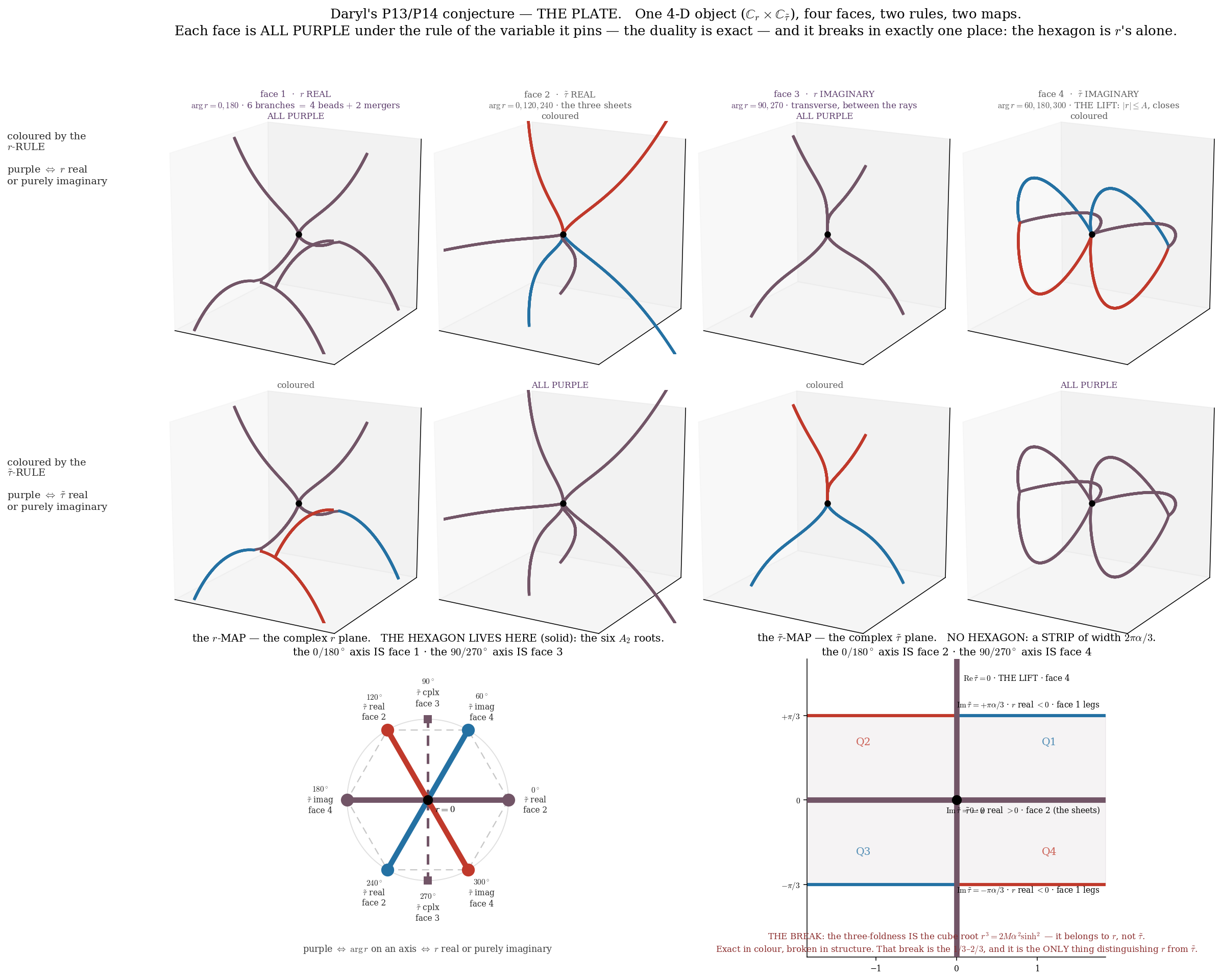
The scope is stated as sharply as the boundary. What is established is a factorisation of C at the level of the bead geometry: its kinematic content is geometric, its charge sign field-level. Its action on the built fermion sector is established in the matter sector [JanzenMatter]: R∘K acts on the actual zero-modes as charge conjugation's kinematic face, R carrying each wall-mode to its bound antimatter partner on the reversed wall and K, the reality involution of cosmic time, acting on the propagating fermion the real-to-imaginary continuation carries the bound mode into, with the full antilinear C and its charge still closing from the field. Two things lie beyond it: that a wing of the bead is a specific charged particle, which needs the charge the geometry does not source; and a geometric CPT, which is not auto-yielded, the charge still closing from the field. Nor does the factorisation vindicate a “species = sign r” reading: the maps are stated on the full object, where sign r has no meaning off the real axis, and the particle/antiparticle content is the Feynman–Stückelberg relation the object carries, not the slice's sign. What Proposition 3 settles is the boundary's inside at exactly the earned weight: the geometry carries C's kinematics, the field carries C's charge, and the join between them is the cosmogenesis.
- [(i)] carries the fundamental to the antifundamental, 3=R(3)—the matter/antimatter skeleton;
- [(ii)] reverses the mass, 2M↦-2M;
- [(iii)] swaps the substrate's two null rulings—though this face, alone among the four, is generic: every orientation-reversing isometry swaps them, so it distinguishes nothing and nothing below leans on it; and
- [(iv)] fixes exactly the locus r=0, which is the bead's branch point, and exchanges the two signed-radius regions the bead's halves occupy [JanzenCRframework].
What the two closures say together. The factorisation fixes what C is made of; Proposition 4 fixes what the geometric factor is—and it is not a fragment of machinery that happens to sit in the substrate, it is the symmetry of the object the cosmology is. So the substrate's contribution to matter is not a separate gift standing beside its cosmology: it is the cosmogenesis, read on its discrete structure instead of its continuous one. The companion framework's antimatter-progenitor theorem is then this boundary's first consequence rather than an independent result—the progenitor collapse is antimatter relative to our expansion because the bead's two halves lie in the regions the conjugation exchanges, on either side of the locus it fixes [JanzenCRframework]. And the matter-sector facts fall in as instances of one thing: that the Nariai crest is a fixed point of the root permutation but not of R, and that consequently no matter/antimatter asymmetry is a cosmogenesis event but a standing relation across the bead [JanzenMatter].
This is what the negative boundary was always mapping. The wall's content is that the substrate cannot supply matter's content; the closure's content is that what it does supply is not a fragment but the cosmogenesis's own discrete structure—and that the two questions the corpus keeps apart—what conjugates matter, and what became of the collapsed universe—are questions about one map.
The physics synthesis: the framework and the gauge as the substrate's two real forms
Section 5 fixed the two real forms and the asymmetry between them; the closure of §7 read the discrete structure they share. What remains is the continuous inside of the same boundary. It is not that the substrate yields the Standard Model—the wall stands, su (3) no Lorentzian isometry—but that the divide the last century drew between the gravitational and the quantum, and between gravity and the gauge forces, is one substrate read on its two real forms. This is the positive result the two-real-forms structure was pointed at from the start, stated as its pieces stand.
The Lorentzian form carries the framework. The real form the matter rides is not merely where general relativity's solutions live; it is where general relativity's quantum framework lives. The hypersurface-deformation (Dirac) constraint algebra that is the canonical root of the problem of time is the symmetric-space coset structure of the Lorentzian substrate SO (5,1)/ SO (4,1), its structure function the coset metric and the “wrong sign” that obstructs a global time the coset's own indefinite signature [JanzenAlgebroid]. Read on the empirically forced foliation the scalar constraint deparametrizes to a true Hamiltonian generating unitary advance in cosmic time, the frozen Wheeler–DeWitt constraint and that Hamiltonian the same content differing only in whether the manifold is granted existence [JanzenCanonicalTime]. So the framework's whole apparatus—the constraint algebra, the problem of time and its deparametrization cure, the unitary cosmic-time evolution, the discrete graviton tower that projects to the flat-ΛCDM mode—is carried by the Lorentzian real form, on the horn the matter rides and the cuts the discrete residue grades [JanzenMatter]. The temporal, existent physics is one real form's content.
The Euclidean form carries the gauge and the quantum scale. The colour su (3) lives on the compact face reached by the global Wick alone—operation (3) of the seam, S5= SO (6)/ SO (5), not the seam continuation's S4= SO (5)/ SO (4) (§2, §5)—because colour requires the full SO (6): the smallest faithful real representation of su (3) is six-dimensional (the realification of the fundamental 3, on which su (3) preserves the real symmetric part of the Hermitian form, the antisymmetric part being the one that gives sp instead; the 3⊕3 is that carrier's complexification and not the carrier), so su (3)⊂ so (6) but ⊄ so (5), and the Lorentzian compact sector supplies only five. The quantum of action enters through the de Sitter horizon's Gibbons–Hawking thermal state, a Euclidean continuation of period β=2πα [JanzenCanonicalTime, JanzenGeometricCore]—and that Euclidean is the same face. The thermal regularity's sphere is the global-Wick S5 (its period independent of dimension, the round sphere its Euclidean section), and it cannot be stranded on a smaller carrier than the one su (3) already requires whole. So the quantum of action and the colour symmetry share the one Euclidean real form the way c,Λ,G share the Lorentzian one—gauge on it because operation (3) is the only seam operation that lands there, ℏ on it because the horizon's Euclidean is that same sphere (receipt P13R11).
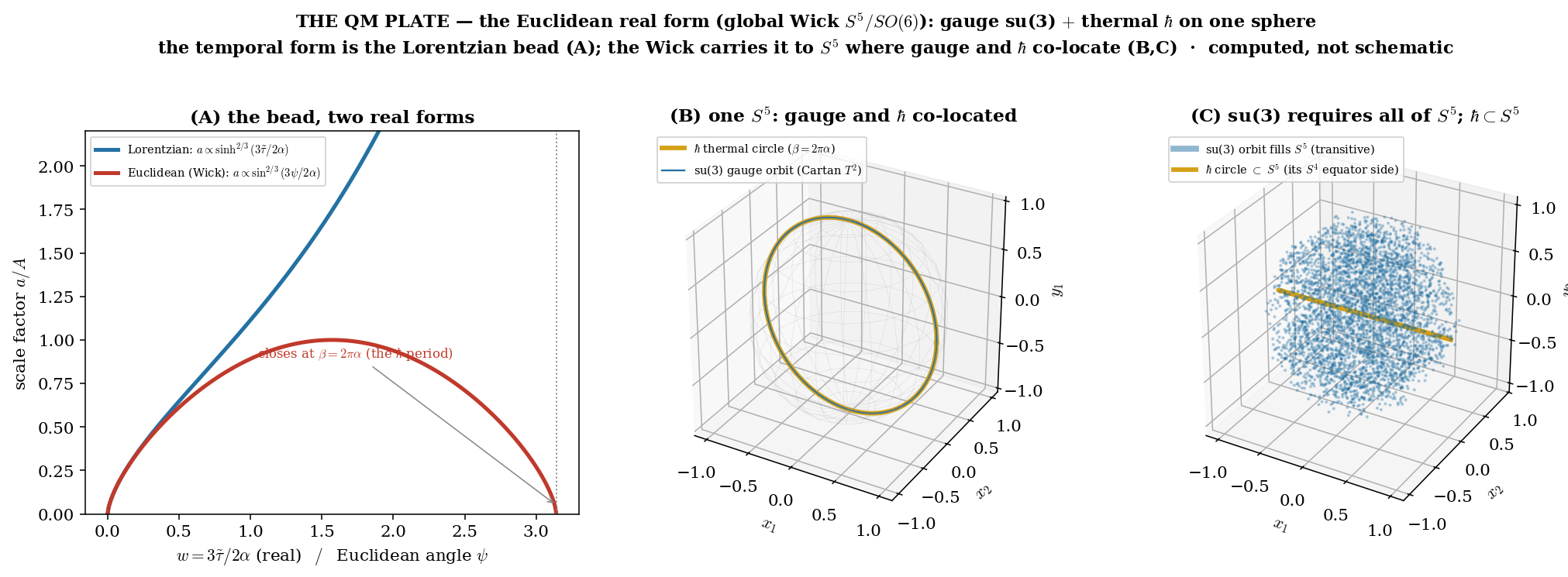
The framework straddles; the quantum is not a third thing. This locates “the quantum” precisely, and it is not a separate ingredient the geometry must also produce. The framework's structure—the constraint algebra, unitarity, the discreteness of the graviton tower, the problem of time and its cure—is Lorentzian, the temporal real form's own. Only the framework's scale, the quantum of action ℏ, is set on the Euclidean face, by the horizon's thermal state, which closes the free sector's lone quantization ambiguity without a free parameter [JanzenCanonicalTime]. So the quantum enters the corpus not as a fifth force awaiting geometrization but as the thermal gauge of the compact real form, its framework already carried by the Lorentzian one. The continuous dynamics is first-class general relativity, admitting rather than forcing a quantum structure, any forcing isolated to the discrete root structure and not the continuous evolution [JanzenAlgebroid, JanzenMatter].
The synthesis. Put together: the substrate wears two real forms of the one complex group SO (6,C), and each carries one side of the divides the corpus keeps apart. The Lorentzian form SO (5,1) is the existent temporal world—general relativity, the framework, the matter, the seats and generations the residue grades, and the classical cosmology whose fluctuations are inherited progenitor content rather than a substrate quantum vacuum [JanzenCRcosmology]. The Euclidean form SO (6) is the atemporal structure that world carries—the gauge group and the quantum scale together—real by construction but no co-equal existent, holding no clock (§5). The two meet at the horizon where β=2πα, the join already present in the complexification the substrate was reached through. On this reading the general-relativity/quantum divide and the gravity/gauge divide are not two unifications owed but one fact: one substrate, one complex group, read on its two real slices. The wall is not breached—the reading places su (3) exactly where the wall does, across the seam on the compact face—but what the wall encloses is now stated at the level of the real forms, not only the discrete residue. This is the continuous companion to §7: there, the substrate's discrete structure is the cosmogenesis read on its residue; here, its continuous structure is the framework and the gauge read on its two real forms.
What the synthesis dissolves. Gathered, the two-real-forms reading is one dissolution seen twice, and of the same kind the framework paper performs on general relativity's pathologies [JanzenCRframework]—not a reconciliation engineered between two structures, but the recognition that the structures were one. Two of the last century's standing divides are its subjects. The gravity–gauge divide—gravity and the Yang–Mills forces taken as separate structures awaiting unification—dissolves by identity: general relativity's solution space is the cuts of the Lorentzian real form SO (5,1), and the colour group is the su (3)⊂ so (6) the Euclidean real form SO (6) carries, the two being the real forms of the one complex SO (6,C)—not two forces to join but one substrate read on its two slices. The general-relativity–quantum divide—the incompatibility a quantum gravity is asked to repair—dissolves the same way: general relativity's quantum framework, the constraint algebra and the problem of time, is already the Lorentzian form's own symmetric-space structure [JanzenAlgebroid, JanzenCanonicalTime], and only the quantum scale ℏ is set on the Euclidean face by the horizon's thermal state, so the quantum is not a third thing to reconcile with gravity but the thermal gauge of gravity's own conjugate real form. The two are therefore not two unifications owed but one fact read twice—the consolidation the epistemic discipline reads as the signature of a sound framework [JanzenShadowExistence]: where the standard expectation meets each divide with a separate programme, this reading meets both with one substrate, requiring the identity where a reconciliation would merely permit one arrangement among many. The standing is the paper's own: the pieces are established—the constraint algebra as the Lorentzian coset, colour's need of the full so (6) (su (3)⊂ so (6) but su (3)⊄ so (5), computed), and ℏ on the same global-Wick S5 the horizon's Euclidean closes on—while the identification — that these real forms are physics' actual quantum and gauge sectors rather than a structural rhyme with them — is not discharged here. And what would discharge it can be named, which is what makes this an open question rather than a caution: a rhyme and an identification are told apart by dynamics, a coincidence of algebras predicting nothing further while an actual gauge sector carries a field strength and a coupling. That discriminator is the one this construction has shown it cannot supply from isometry: the bundle at the branch point is flat, so the compact face delivers colour's discrete content and no force [JanzenMatter]. Nor do the three routes outside isometry the construction offers directly supply it, each for a reason computed rather than assumed: a connection the Lorentzian form's dynamics induces on the face preserves a real metric and so is antisymmetric, three components where su (3) needs eight, and in its Berry form it needs a base over which a state varies, which a face related to the substrate by continuation rather than by reduction does not provide; the horizon's thermal state enters as one number, β=2πα, and a one-parameter datum carries no two-form for any connection built on it to have as curvature; and the walls have only the flat bundle to source, which is rigid as well as flat, H1(G, su (3))=0 on the order-27 holonomy group, so there is no local degree of freedom for a wall current to exciteP13R20. A spectral triple built from the pieces the matter sector carries is closed as well: its space of states and Dirac operator live over the leaf [JanzenMatter], a one-dimensional base, and a one-dimensional base carries no two-form for a connection's curvature to be, however the Dirac operator is perturbedP13R21. Over the face itself a field strength is reached, and a coupling is not. The almost-commutative triple there—the face's functions tensored with M3(C), acting on spinors tensored with the bimodule M3(C), with the face's own Dirac operator, which the round face carries with a gapped spectrum—satisfies the order-one condition exactly, and its inner fluctuations are su (3)-valued one-forms over a base carrying ten independent two-forms, so a generic one has a curvature that does not vanish: a field strength reached from the algebra and not from an isometry. What the construction does not fix is that field's coupling. The coupling is read off the spectral action Tr f(D/Λ), whose Yang–Mills coefficient is a moment of the cutoff function f, so the action needs both f and the scale Λ. The face's only data are lengths, α and β=2πα, and the one dimensionless number they form is their ratio, which is not a moment of a cutoff functionP13R22. They do supply the scale, Λ=β-1, and the construction carries one particular trace over the face: the horizon's thermal weight e-βHθ, with Hθ the generator along a great circle of the face itself, of circumference β, which is the reading most favourable to its being a spectral action. It is not one. The face's Dirac operator commutes with the great-circle generator without being a function of it: on the lowest Dirac eigenspace, which is four-dimensional, the generator takes the two values ± 12, so the thermal weight takes the values e-π and eπ there, a ratio e2π≈535, on a space where every function of the Dirac operator is constantP13R24. The construction therefore supplies a spectral action's scale and not its cutoff function, and without the cutoff function there is no coupling. So the gauge half narrows to whether anything in the construction fixes the cutoff function and with it that coupling, with a composite or emergent connection the one route not yet examined. So the dissolution is by identity at the level of the structure, and at the level of the world it turns on a test the same obstruction places outside the geometry — a located question with a stated blocker.
What it feeds. The synthesis is what lets the cosmology close classically. Because the framework is Lorentzian and the quantum scale is only the compact face's thermal gauge, the existent cosmology is classical through and through: the acoustic and abundance data it answers to are computed on the real horn, the graviton tower deparametrized and projected to the flat-ΛCDM mode without a free parameter, the quantum structure confined to the Euclidean face it never leaves [JanzenCRcosmology, JanzenCosmogenesis]. The cosmogenesis paper's matter history and the cosmology paper's rate and abundances are computed on the one real form, with the gauge and the quantum of action located—not omitted—on the other. The physics synthesis feeds the cosmological closure precisely by keeping the quantum where the two real forms put it.
What it means for the programme
The boundary is not a setback to CR's gravitational claim; it sharpens it. The substrate is the complete gravitational object—dS5 has no continuous symmetry beyond SO (5,1), and the slicing operator generates the gravitational solution space from it—and the present result says, precisely, that this completeness does not extend to the matter sector through isometry. That exhaustion is one face of the substrate's maximal symmetry read across the corpus [JanzenGeometricCore]: the same completeness that locks the cosmological constants and fixes the parameter-free rate is what walls a continuous geometric colour, the wall its matter-boundary face and the discrete orientation parity O(5,1)∖SO0 the leading residue it leaves—enlarged in §7 to carry, together with the antilinear complex-analytic face, charge conjugation's kinematic content, realised on the built fermion sector [JanzenMatter]. What positive structure that discrete residue may carry—the full automorphism Aut(A2)=S3×Z2≅D6 read on a fermion sector as three chiral seats times two chiralities—the generations being a different three, seated on the deck Z3 of the comoving turnaround [JanzenMatter]— and with it a reading of the Standard Model's own discrete structure as a maximally-symmetric breaking of this maximally-symmetric substrate—is drawn together in the geometric-core paper [JanzenGeometricCore], the discrete skeleton built and forced within CR [JanzenMatter], its A2 skeleton realised geometrically by the slicing paper as a skew hexagon of null rulings [JanzenSlicing]; the present paper fixes only the perimeter within which any such reach must live. CR is then a gravitational-cosmological unification: one substrate, all the spherically symmetric stationary geometries, the dynamics up to the radiative wall. And on its two real forms it reaches further than that phrase alone conveys. The wall that places colour off the Lorentzian isometry is the same six-dimensional fact (su (3)⊂ so (6) but su (3)⊄ so (5)) that places it, together with the quantum of action, on the substrate's Euclidean real form; and the constraint algebra that is general relativity's quantum framework is the Lorentzian real form's own (§8). What CR declines is the geometric unification of matter from isometry; what it draws, on the substrate's two real forms, is the synthesis of §8—its wall intact, and the identification of its two real forms with physics' own sectors stated as the located question it is.
There is a service in mapping a wall well. The geometric-unification programme has not obtained chiral generations from isometry, and the obstruction to it has stood since 1970; a precise statement of where and why the de Sitter substrate meets that same wall—grounded in the literature the gravitational corpus did not need to cite—spares the programme, and others, the cost of re-walking a road that three converging obstructions close. The bounded negative is itself a result: it is the perimeter of what one maximally symmetric Lorentzian substrate's geometry forces. And a perimeter drawn well encloses more than it excludes. What §7 and §8 state is the boundary's inside: on the substrate's discrete structure, charge conjugation's kinematic face is geometric, carried by the cosmogenesis bead's own r=0 crossing, with only the electric-charge sign closing from the field; and on its continuous structure, the two real forms carry the quantum framework and the gauge—one substrate read on its two slices, the general-relativity/quantum and gravity/gauge divides on that reading a single fact. These are the positive results the negative alone could not reach, and a drawn connection between charge conjugation, the quantum framework, and the cosmology. The paper that began by mapping a family of negative boundary results thereby closes them into a shape, and draws the shape's inside.