P1
The event horizon is a metric singularity
a missing definition in general relativity, and the black-hole problems it dissolves
Abstract
We identify a relation between events that standard general relativity has not named among its definitions. On a null hypersurface along whose generators the spatial extent has also contracted to zero—a non-expanding null hypersurface, of which every Killing horizon is one—the events of a generator are topologically distinct and causally ordered yet carry no metric separation; we call such a hypersurface a metric singularity. Using only Lorentzian structure we prove that two events both null-separated and spatially coincident have vanishing temporal separation as well; events on an ordinary null hypersurface, such as a past light cone, keep theirs. The future event horizon of the Schwarzschild geometry satisfies both hypotheses, since horizon-crossing events on a generator share the areal radius, and the same forcing extends to every Killing horizon and so, by the rigidity theorem, to the event horizon of every stationary black hole. Independently, the horizon's defining property as the null future boundary of the exterior, H+=∂J-(I+), forces every Cauchy temporal function of the exterior domain adapted to an exterior observer to accumulate on the horizon, meeting it only in the limit of infinite exterior time; the result assumes no symmetry, and because the exterior approaches only the horizon's future end, where a collapse of any shape has settled to a Kerr–Newman exterior, the horizon it approaches is a metric singularity. No finite exterior slice contains the horizon or the densities of the central singularity. The completed horizon on which the standard problems of black-hole physics rest is therefore never realised in the exterior of a collapsing body: Penrose's theorem has a physical precondition the astrophysical domain does not meet, and cosmic censorship is not needed; Hawking's exactly thermal state, with the evaporation and the information loss built on it, has no realised background, while the near-Planckian flux of the still-collapsing surface is presentL10; and the horizon-thermodynamic apparatus has no realised horizon to be defined on. No modification of general relativity is involved.
Null separation, non-invariance, and metric singularities
Black-hole physics has for half a century built its central results—the singularity theorems, Hawking radiation, the information paradox—on a reading of the event horizon as a removable coordinate artefact: a surface a suitable chart passes through smoothly, behind which a completed interior and a curvature singularity are taken to lie. This paper supplies a definition that reading has lacked, and corrects it. We identify a geometric structure standard general relativity does not name among its own—the metric singularity, a null hypersurface along whose generators the spatial extent has, in addition, contracted to zero—and prove that the event horizon is one. The condition itself is known: a null hypersurface whose generators preserve their cross-sectional area is a non-expanding horizon [AshtekarKrishnan2004]. What has not been named is the relation that condition imposes on the events along each generator, and it is that relation the definition supplies. The horizon is not a coordinate artefact but a locus at which the metric's spatial measure collapses; and, being the null future boundary of the exterior, it occurs without ever existing on any finite exterior-time slice, so that the densities of the central singularity never form at finite exterior time. The completed, physically realised horizon on which the standard problems rest is therefore never instantiated in the exterior of a gravitational collapse, and four of those problems—the singularity theorems, Hawking's thermal state and the evaporation it drives, the information paradox, and horizon thermodynamics—dissolve on causal grounds alone, with no modification of general relativity. The whole argument uses nothing but standard Lorentzian and causal structure; we reach its central definition first by following an elementary limit, beginning with what an observer in relativity can and cannot know about a distant object.
According to general relativity, there is a fundamental distinction between the events contained within an observer's fixed causal past—defined by the interior of their past light cone—and events that are merely “past” according to some arbitrary coordinate slicing but are spacelike separated from the observer. Only the former constitute physically certain information; the latter do not admit invariant temporal status relative to the observer.
For example, consider M31 V1, a Cepheid variable in the Andromeda galaxy [Hubble1929M31]. In our fixed causal past, M31 V1 is observed as a bright, evolved supergiant. The fact that we see it as such today implies that the star must have previously formed and undergone stellar evolution to reach this phase before the light we now observe was emitted.
However, Andromeda lies roughly 2.5 million light-years away. What we observe “now” is M31 V1 as it was 2.5 million years ago. M31 V1 may well have already undergone a core-collapse supernova sometime within the past 2.5 million years; yet we do not possess causal knowledge of that event. The reason is formal: the putative M31 V1 supernova is spacelike separated from here-now. Therefore, no positive statement about whether that explosion has already occurred (in any absolute sense) is meaningful without adopting a specific relativistic coordinate convention.
Thus, an observer's fixed causal knowledge in relativity is constrained entirely by the past light cone. The physical state we ascribe to distant astronomical objects is necessarily based on the most recent event in our causal past, which depends on their lookback distance. No astronomer refers to M31 V1 as “a supernova remnant,” although that may well be its status on a natural cosmological time slicing; rather, we may only say with certainty what it was when it emitted the photons that currently reach Earth. The same constraint, we will see, applies to a verb form that has propagated through fifty years of horizon literature: speaking of a black hole as a “collapsed object” presupposes a past-tense status that the horizon's causal structure does not license.This epistemology of causal knowledge—only the fixed causal past yields certain information, so an appearance is not the present state of the world it images—is a bespoke instance of an inference a companion foundation later sets out in general (do not take the appearance at face value; infer the world it arises from) [JanzenShadowExistence], and it is not the only such instance here. The same discipline, reached on causal structure alone, recurs through the paper: that the metric's verdict of coincidence is a fact about the ruler and not the identity of the events it separates only in null order (§2) is a projection read as a projection—here a real projection, not an illusory one; that “collapsed” presupposes what the geometry does not licence, so the grammar must follow the geometry (§4), is ontology read from the evidence rather than off a reified coordinate—the reification error caught in a verb tense; and that the standard black-hole problems dissolve once the premise they rest on is seen never to be instantiated (§7) is dissolution by identity, not by patchwork. Each is reached here without the general treatment, and that independence is exactly what lets the general account draw on these instances without circularity—the same non-leaning relation this paper holds to the empirical keystone it converges with [JanzenModernParallax].}
This causal structure has a consequence for the temporal relation between null-separated events that is easy to half-state and thereby get wrong, and the distinction we draw now is the one on which the rest of the paper turns. Consider two events p and q on a single future-directed null geodesic—a photon's emission and its later reception, say. They are distinct points of the manifold; they are causally ordered, p before q; and their spacetime separation is zero, because the geodesic joining them is null. The question is what this says about their temporal separation, and the answer has two parts that must not be merged.
First, the temporal separation Δτ=τ(q)-τ(p) assigned by a smooth temporal function τ is not a geometric invariant. Different admissible temporal functions assign different values; a boost changes it; it is frame-dependent. This is true of every null-separated pair, and it is all that holds in general.
Second—and this is the part that is easy to overstate—non-invariance is not degeneracy. That Δτ is frame-dependent does not mean it can be driven to zero. The photon emitted from the far side of the Andromeda galaxy and received here now is null-separated from its emission, causally ordered, and topologically distinct; its temporal separation is frame-dependent, yet in no admissible frame is it anything but enormous. The reason is that p and q are separated by a large spatial distance—some two and a half million light-years—and an ordinary null pair carries exactly this nonzero spatial separation. A generic null geodesic, and a generic null hypersurface such as one's past light cone, is null in its spacetime interval while remaining spread over nonzero spatial extent. Its events are not metrically coincident.
What makes the temporal separation collapse is an additional condition: that the spatial separation vanish as well. This is a special circumstance, not the generic one, and it is the circumstance the event horizon will turn out to realise. To see the condition built up as a limit before stating it as a theorem, it is worth following a thought experiment.
The Andromeda galaxy spans roughly 100 kly in the radial direction relative to Earth. Consequently, the image we observe is not Andromeda “as it is now,” nor even “as it was exactly 2.5 million years ago.” Instead, we receive light whose emission times vary by ∼105 years across the radial extent: photons originating on the far side were emitted roughly ∼105 years earlier than those from the near side. As light propagates along the null geodesic connecting those regions to us, photons emitted from progressively nearer regions join the same bundle of null generators; the image we observe is the accumulated result of this continual inflow of successively later emission events.
Now imagine a hypothetical scenario in which Andromeda contracts along the radial direction, bringing its near and far sides increasingly close together, asymptotically approaching coincidence in the infinite future. In that limit, photons from the near and far regions would ultimately arrive from exactly the same spatial location in our past light cone. Their emission events remain distinct and causally ordered—the far-side emission event precedes the near-side emission event along a null geodesic connecting the two—yet their spatial separation in our frame vanishes. As the spatial separation contracts to zero while the null relation is maintained, the two emission events become coincident in both a practical and a metrical sense, even though they remain topologically distinct and causally ordered. The set of emission events, and their order, is preserved entire; only the geometry laid over the set collapses.
Crucially, the construction does not require that the worldlines hosting these emission events remain nonsingular in the future. Even if either or both regions of Andromeda encounter a curvature singularity at some later time, as long as the segment of spacetime in the causal past of the relevant null geodesic is smooth, the result holds without modification.
A second construction, with no light and no geometry in it at all, reaches the same object and is worth setting beside the first. Picture a row of runners aimed at a wall—idealised as a single point of space at which all the runners arrive—spaced out behind one another along the common approach line: one at 10 metres, one at 100 metres, one at a kilometre, and so on, as far back as you like. Let each runner's speed be conditioned on both how far from the wall they are and what time it is, tuned so that every runner reaches the wall at the same instant. There is nothing exotic in this; it is an ordinary rule assigning a speed to each runner at each position and time, and one can write it down explicitly. To see what it forces, take the extreme case: the runner a kilometre out and the runner at 10 metres cross the finish together, so over the final stretch the distant runner—who began far faster—must have its speed driven smoothly toward zero, slowing without limit as the wall approaches, so as not to arrive early. Push the starting line farther back, to a light-year, and the effect only sharpens: the farthest runner spends almost the entire race shedding speed, arriving neither sooner nor later than the one that started a step away. The single extreme case settles the whole row at a glance. Every arrival happens at the wall, at one instant.
And now read off the three properties without any computation. The arrivals are topologically distinct: different runners, distinct in identity and origin—each having travelled its own path from its own starting distance. They are causally ordered: traced back along the approach, the near runner's arrival precedes the next, which precedes the next, in a definite sequence—exactly the order an Eddington–Finkelstein diagram would display. And they are metrically coincident: all arrivals occur at the wall, at one instant, with no spatial and no temporal separation between them. The causal order is real; the metrical separation is not. Position alone would not do this—runners at fixed speeds and different distances arrive at different times—it is the conditioning of speed on time as well as position that forces the coincident arrival. The Andromeda limit builds the structure optically, by contracting the spatial depth of an image to zero; the wall builds it kinematically, by driving approach speeds to zero separation at the instant of arrival. They are the same object, reached two ways.
Both constructions exhibit one structure, and it is worth saying plainly what it is, because it invites the very misreading the rest of the paper turns on dispelling. In each, a set of genuinely distinct events—distinct emission events across the galaxy's depth; distinct runners of distinct origin—is assigned, by the measure laid over it, a single place at a single instant. The distinctness is a fact about the events; the coincidence is a fact about the ruler. To read “one place, one instant” as “therefore one event” is to mistake the place the metric assigns for the identity of the points it assigns it to—and a place is not a point. A metric can collapse every separation it measures and still not merge events it did not individuate, nor revoke an order it does not carry, for it did not lay the set down. This is not a defect of the constructions to be cleared away; it is the object the paper names—distinct, ordered points at one place. The Schwarzschild horizon of Section 3 is shown to be the same object once more, reached a third way, by the geometry itself: what the optical and kinematic limits approach, the horizon realises exactly.
We now isolate the condition these two constructions share as a theorem. It is the central definition of this paper, and—once both its hypotheses are in view—it is trivially provable. The triviality is the point: it identifies, with no machinery, exactly the extra condition that turns an ordinary null relation into a metrically singular one.
- [(a)] null-separated: their spacetime interval vanishes, Δs2=0; and
- [(b)] spatially coincident: their invariant spatial separation vanishes, Δx=0, in the sense that p and q—and every point of the null geodesic joining them—share the same value of an invariantly-defined spatial coordinate, so that no frame adapted to the corresponding foliation assigns them a spatial separation.
Topologically distinct, causally ordered, metrically coincident
The structure isolated in Theorem 1 has a characteristic threefold character, which we state plainly because it is the structure the event horizon will be shown to possess. A metric singularity is a set of events that are pairwise null-separated and spatially coincident; its points are simultaneously distinct manifold events, ordered along the null direction, and metrically inseparable. The three properties are not in tension. Distinctness and causal order are facts about the point set and its ordering; metric coincidence is a fact about the measure laid over that set. Because they belong to different structures, the second cannot overturn the first: that the metric assigns the events one place and one instant is its verdict on a set it did not lay down, and it neither merges points it does not individuate nor revokes an order it does not carry. So “same place, same time” is not a ground for reading the events as one—it is what it means for distinct, ordered events to be metrically coincident. A metric singularity is exactly an object on which the first two hold while the third collapses: an infinite, ordered set of events carrying no metric separation. The shrinking-Andromeda limit of Section 1 constructs one as a process—a sequence of past-light-cone images whose spatial and temporal depth contracts to zero while the set of emission events, and their order, is preserved entire.
The corollary below states the threefold structure formally, in the setting of a single null geodesic segment.
- [(i)] (Topological distinction) The events p and q are distinct points of the manifold M and are therefore topologically distinguishable.
- [(ii)] (Causal ordering) The events satisfy the strict null ordering p∂ q [penrose1972], meaning that q lies on the boundary of the causal future of p and no event strictly between them lies in I+(p).
- [(iii)] (Geometric coincidence)
The Lorentzian separation between p and q is identically zero:
g(γ,γ) = 0along the entire segment of γ [Wald1984]. Consequently, the metric assigns no nonzero spacetime interval between p and q; they are geometrically coincident in the sense that their separation is null.
- [(iv)] (Metrical coincidence under spatial coincidence) If p and q are additionally spatially coincident in the sense of Theorem 1(b), then by Theorem 1 their temporal separation vanishes as well, and they are metrically coincident: the metric assigns them no nonzero separation—spatial, temporal, or spacetime. Without this additional condition, the temporal separation τ(q)-τ(p) assigned by any smooth temporal function τ has no invariant geometric meaning, and may be altered arbitrarily by smooth local deformations of τ in a neighbourhood of γ.
We emphasise, against the generic case, that an ordinary null hypersurface has (i)–(iii) but not (iv): its events are spread over nonzero spatial extent and are not metrically coincident. The past light cone of any observer is null, infinite as a set of causally ordered events, and yet—because it carries real spatial depth—assigns nonzero temporal separations between the emission events along it. It is not a metric singularity. The event horizon, we show next, does possess all four, because the geometry forces its events to share a single spatial location.
A word on scope. The metric singularity defined here—an infinite, ordered set of events carrying no metric separation, the manifold intact and worldlines crossing it—is a locus at which the curvature remains finite. It is therefore a different object from the one standardly called the curvature singularity, at r=0, where the curvature invariants computed on the areal radius diverge without limit. The present paper establishes the first of these, with the event horizon as its exemplar, and says nothing about the second; that the two admit a common treatment, and what becomes of the divergence at r=0 under it, is the subject of a companion paper and is established there, not here [JanzenCircle]. The identification of this boundary as a metric singularity, reached from general relativity alone, is also what a later companion takes as its structural starting point [JanzenGeometricCore]. Nothing in the present argument depends on either companion; it stands on standard Lorentzian structure.
The Schwarzschild event horizon is a metric singularity
We now verify that the future event horizon H+ of the Schwarzschild geometry satisfies the hypotheses of Theorem 1, and is therefore a metric singularity in the precise sense defined above. The verification has two parts, one geometric and one algebraic, which agree—two ways of seeing the same fact.
The future event horizon H+ is a null hypersurface [Hawking1973], foliated by null generators; hypothesis (a) is met along each generator by construction. The decisive observation is that hypothesis (b) is met as well. Every event at which anything crosses the horizon occurs at one and the same areal radius, r=rh=2GM/c2. The areal radius is an invariant—it is defined by the area 4πr2 of the symmetry spheres, independent of any chart—so two horizon-crossing events share the same value of an invariantly-defined spatial coordinate, and their invariant spatial separation vanishes. Hypothesis (b) holds. At the horizon itself the gradient of r is null, as shown below, so what (b) asserts there is not that some spatial coordinate is constant but that the transverse geometry is: the symmetry sphere through every event of a generator has the same area, which is the statement that the generators have vanishing expansion. By Theorem 1, the temporal separation between horizon-crossing events vanishes also: the horizon's generators are metrically coincident, and H+ is a metric singularity. The same constancy has a dynamical reading that makes it less surprising. In ingoing Eddington–Finkelstein coordinates the outgoing null rays obey the one-dimensional flow dr/dv=f(r)/2, with f=1-rh/r, whose equilibria are precisely the zeros of f—so a generator remains at rh not by accident of parametrisation but because rh is a fixed point of that flow. Its eigenvalue is the surface gravity: linearising gives dr/dv≃κ(r-rh) with κ=f'(rh)/2, so neighbouring outgoing rays separate as eκv and the fixed point is hyperbolic exactly when κ≠0. Read at the next order the pair of horizons says more than either alone: between two consecutive simple zeros f does not change sign, so f' at consecutive zeros must alternate, and the Schwarzschild–de Sitter black-hole and cosmological horizons are necessarily a repeller and an attractor whose fixed-point indices sum to zero. The alternation is forced by the intermediate value theorem on any function with simple zeros and not by the metric, and the Nariai member is exactly where its hypothesis fails—the two roots merge, both eigenvalues vanish, and the degenerate fixed point carries the index the pair had between themP1R5L13. The horizon's invariant spatial constancy and its surface gravity are therefore one statement about one fixed point, read at zeroth and first orderL14.
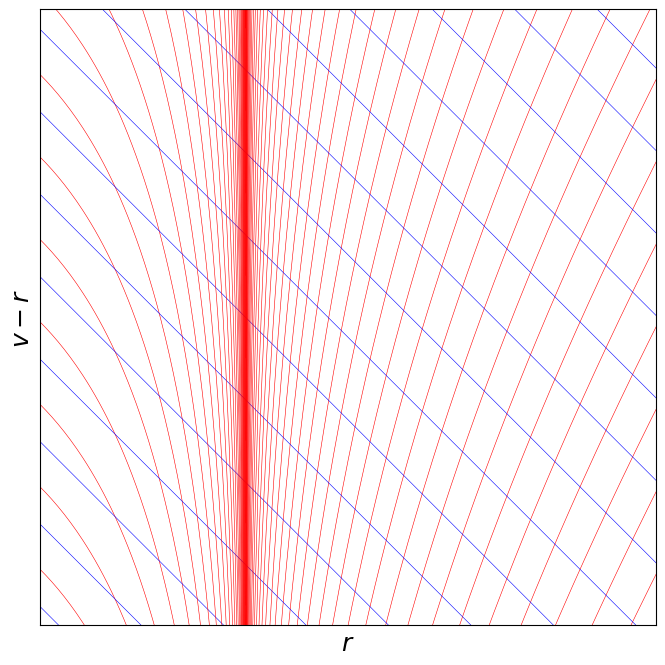
The same fact appears in the line element directly, and it appears forced—in any chart at all. Take any coordinates (t,r,θ,φ) in which r is the areal radius, and follow a generator of H+. Along it the areal radius is constant and the angle is fixed, dr=dθ=dφ=0, so every term of the line element carrying a dr or an angular increment drops, and the interval reduces to
In ingoing Eddington–Finkelstein coordinates [Finkelstein1958, MTW1973] the surviving coefficient is the lapse factor gvv=-(1-rh/r), which vanishes at r=rh; the apparent vertical extent of the generator in such a diagram (Fig. 1) is this vanishing coefficient multiplying a nonzero dv—causal order drawn as coordinate length, carrying no metrical duration. The geometric argument by Theorem 1 and this algebraic forcing are two readings of one structure: along each generator of H+ the horizon-crossing events occur at once—radially, temporally, and spatiotemporally—in every chart. The horizon is the 2-sphere of such generators, each a distinct direction of approach. Two events on different generators are spacelike-separated across that sphere—but they are not events the theorem relates: they fail hypothesis (a), and every horizon-crossing event lies on a single generator. The angular separation is therefore neither a residual extent left uncollapsed nor a sector in which the result is weaker; it is not what the metric singularity is. Along every generator the collapse is total, and that is the entire content of the horizon's metric-singular structure.
It is worth saying what the vanishing coefficient is, invariantly, for it is not chart-dependent. In coordinates adapted to the static symmetry it is gtt=g(ζ,ζ), the squared norm of the timelike Killing vector ζ=∂t; its vanishing at rh is the Killing-horizon condition |ζ|2=0, a scalar, and on the Killing horizon ζ is null and tangent to the generators. A scalar carries no slicing to be tested against: |ζ|2=0 is the invariant of which “gtt=0 in this chart” is merely the reading. The areal-radius gradient tells the same story—|∇r|2=gab ∂a r ∂b r=grr vanishes at rh, so the direction spacelike in the exterior degenerates onto the null generator, leaving no spacelike radial direction at the horizon to carry a separation. The two invariant separations the geometry supplies between two events on a generator therefore both vanish: the interval Δs2=0 (null) and the areal-radius separation Δr=0 (an invariant scalar, constant along the generator).P1R1 This is the statement the infinite-redshift and Killing-horizon notions, read from the same factor, do not make. Each of those is a property holding at the surface—a redshift diverging, a Killing field gone null—compatible with reading the horizon as an extended null hypersurface persisting through time. The metric singularity is the relation between distinct events on a generator: null-separated, sharing the areal radius, and assigned no metrical separation of any kind.
Having established that the Schwarzschild horizon is a metric singularity, we first read what it means for collapse as an exterior observer meets it, in that geometry, before generalising.
Gravitational collapse and black-hole merger causality: the Schwarzschild picture
This section reads what the metric singularity of Section 3 means for gravitational collapse and black-hole mergers as an exterior observer meets them, in the Schwarzschild geometry, with processes modelled through purely radial motion. It is offered as exactly that: a picture drawn in the one geometry the paper has so far treated, and drawn largely from what an exterior observer's past light cone contains. The general case—the horizon of any stationary black hole, and collapse of any symmetry—needs the general results of Sections 5 and 6, and the statements made here about exterior time slices are made exact by Proposition 1 there.
Figure 2 illustrates a standard radial collapse scenario [Oppenheimer1939b, Penrose1965] in ingoing Eddington–Finkelstein coordinates. The surface of the collapsing star follows a timelike worldline and crosses rh in finite proper time, later forming a curvature singularity at r=0. An external observer remains at fixed areal radius r gt;rh just beyond the star's original radius, and releases two test masses toward the collapsing object at different proper times. Test mass 1 intersects the stellar surface before the formation of the horizon, while Test mass 2 is released sufficiently late that its ingoing null ray at the moment of release fails to intersect the worldline of the collapsing surface at r gt;rh.
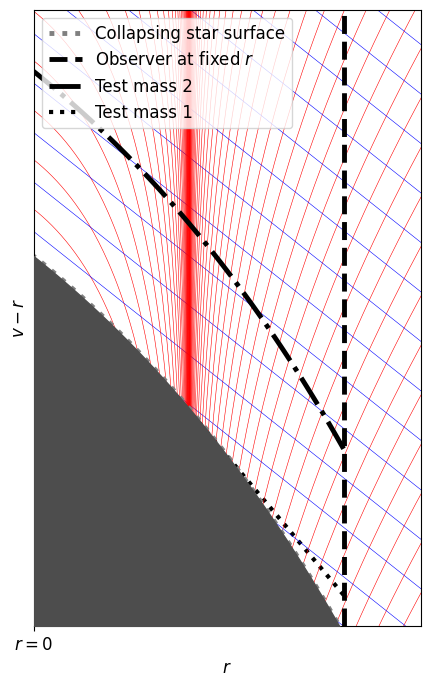
Outgoing null rays in the exterior region, shown in red, all intersect the observer's worldline. Thus, regardless of how long the observer waits, the collapsing surface is never seen to reach rh, since no horizon event lies in the causal past of any exterior event: anything in the causal past of an exterior event can itself send a signal to future null infinity, and so is not on the horizon. Even if the observer were equipped with an antenna capable of detecting signals of arbitrary wavelength, the portion of the stellar surface visible to them would only approach rh as their own proper time tends to infinity.
Before turning to the behaviour of the test masses and the application of the theorem and its corollary, it is helpful to summarise the observational appearance of mergers from the standpoint of such an exterior observer, at fixed r gt;rh. If the observer is equipped with a perfect antenna and gravitational wave detector, they will continually see the collapsing surface at radii strictly larger than rh. Therefore, any merger event that generates gravitational waves the observer later sees must have occurred at a time when the stellar surface remained visible in their causal past. Consequently, at the moment the merger signal arrives, the observer sees a consistent picture: the collapsing mass continues to asymptotically approach rh, a test mass or additional object falls radially inward and meets it, a burst of gravitational radiation is emitted and later detected, and a post-merger object is subsequently observed to continue its approach toward a new effective radius r'h determined by the total mass. Since the merger event lies within the observer's causal past, and since its outcome remains visible afterward, the entire process must have occurred in the region of the spacetime where both bodies remained larger than their respective horizon radii.
Having laid this conceptual groundwork, we can now proceed to interpret the causal generation of gravitational waves in the scenario shown in Figure 2, in the case of the two test-mass collisions.
Since test mass 1 encounters the collapsing surface while its radius is clearly larger than rh, the interpretation is trivial. The wave generation occurs when the two masses are sufficiently close that the waves are generated in the strong field exterior. Those gravitational waves subsequently travel along an outgoing null line and are later observed by the observer at fixed r.
The case of test mass 2 is far more interesting and informative, and highlights the metrical degeneracy in the horizon vicinity remarkably well. Note that as the test mass approaches rh, the most recent causal signal along the null connection to the collapsing star comes from ever closer in r. The situation is exactly the “shrinking Andromeda” limit of Section 1: the radial separation across the null connection contracts toward zero, so the emission and observation events approach spatial coincidence, and by Theorem 1 their temporal separation collapses with it. One is tempted to interpret the graphical separation of these two events in Figure 2 as implying temporal distance, but the metric-singularity structure of the horizon events ensures this is merely an artefact of the chosen coordinate system, which separates them by causal, not metrical, order. Thus the figure, accurately interpreted, illustrates that the distance in r between the collapsing star's surface and the test mass continually decreases when measured across their null connection. And if gravitational waves are generated, and later seen by the external observer, the wave generation event must have occurred at causal times preceding the horizon-formation event along both worldlines, relative to their shared null connection.
Every Killing horizon is a metric singularity
The picture of Section 4 was drawn in Schwarzschild. The verification of Section 3 on which it rests used two features of the Schwarzschild horizon: its generators are null, and they sit at a single value of an invariantly defined spatial coordinate. Both hold at any Killing horizon, and the argument carries over unchanged once the spatial coincidence is read off the Killing field rather than off the areal radius. A Killing horizon is a null hypersurface K to which a Killing field χ is normal; χ is then null on K and tangent to its generators, which are null geodesics and, away from any bifurcation surface, orbits of χ [Hawking1973, Wald1984].
Nothing in the proof uses the surface gravity, so degenerate (extremal) horizons, with κ=0, are included. Nor does it use curvature, and it applies as it stands to the Killing horizons of flat spacetime: the Rindler horizon of a boost, and every null hyperplane, which is a Killing horizon of a null translation, are metric singularities too. That is what the definition should do. A metric singularity is a relation the metric imposes on the events of a non-expanding null hypersurface, not a feature of curvature (Section 2); what singles out the event horizon is not that it is one, which it shares with these, but that it is in addition the null future boundary of the exterior on which every exterior time accumulates (Section 6).
The cases need not be checked one by one, but it is worth recording the horizon-generating field for the standard families, in units G=c=1. For Schwarzschild, χ=∂t, and Lemma 1 reduces to Section 3. For Reissner–Nordström, with f=1-2M/r+Q2/r2, again χ=∂t: the event horizon r+ and the inner horizon r- are both Killing horizons whose generators sit at constant areal radius, and the argument of Section 3 applies word for word with this f. For Kerr [Kerr1963], χ=∂t+ΩH ∂φ with ΩH=a/(r+2+a2) the angular velocity of the horizon; for Kerr–Newman [Newman1965] the same, with r+=M+√M2-a2-Q2. For the Kerr–Newman–(anti-)de Sitter family [Carter1968], χ=∂t+ΩH ∂φ with ΩH constant over the horizon, its value depending on how the coordinates are normalised; when Λgt;0 the cosmological horizon is also a Killing horizon of a field of this form, and is a metric singularity as well. In the rotating cases the static reduction of Section 3 does not apply: the generator twists in the static azimuth, and gtt is nonzero at the horizon, its vanishing locus being the ergosurface, which lies outside the horizon except at the poles. That is a fact about the static chart, not about the horizon; the forcing is read on |χ|2 instead, and nothing fails to carry over.
The proof also identifies a generator's order, and a companion paper finds that order at work in a cosmological setting. On a Killing horizon the generators are orbits of χ, so the causal order along a generator is the order of its Killing parameter, which is affine exactly when the surface gravity vanishes. In the companion framework's non-synchronous cosmology the direction along which each layer of cosmic time orders its comoving worldlines is the static Killing field of the Schwarzschild–de Sitter metric; the layers through the horizon radii are Killing horizons of that field, and so metric singularities by Lemma 1; and the order a generator carries there is at once the order of the worldlines it threads and the order of their proper times [JanzenCRframework]. That is the framework's result and not this paper's; nothing here depends on it.
The identification therefore holds at every stationary horizon. How a horizon is approached from the exterior is a question of causal structure, taken up next, and it is there that collapse which is neither stationary nor symmetric is brought in.
Asymptotic alignment of exterior temporal slicings with the horizon
The event horizon H+=∂J-(I+) is the null future boundary of the exterior domain: every one of its generators is a limit of the past-light-cone boundaries of exterior observers. The time of the external universe is a time function of that domain, and any Cauchy temporal function of it must accommodate this boundary—as one moves to increasingly late exterior times, the observer's level sets are forced to approach and ultimately “pile up” against H+, meeting it only in the limit of infinite exterior time. This accumulation is a consequence of causal structure alone, independent of the metric-singularity identification of Sections 2–5; we record it first in full generality. Throughout, the exterior domain is D=I-(I+), the region from which future null infinity can be reached, regarded as a spacetime in its own right. The section turns on one identification, and it is a premise, stated as one: the time of the external universe is a Cauchy temporal function of D. Its ground is that the state of the exterior must be specifiable on each of its slices, so that a slice must meet every body that has not yet crossed into the black-hole region; a slice that misses bodies before they cross, as a horizon-penetrating slice restricted to D does (Remark 2), does not specify the exterior's state. Granted that premise, what follows is causal structure.
Exterior slicings of any event horizon
Collapse of any symmetry
Proposition 1 assumes no symmetry, and it also settles which part of the horizon the exterior's late times approach: its future end, since the past light cones ∂J-(O(τ)) approach H+ ever further along its generators. That is what carries the identification of Section 5 to realistic collapse, which is neither stationary nor symmetric. A collapsing body of any shape and rotation radiates away its higher multipoles as it settles [Price1972], and its exterior approaches a member of the Kerr–Newman family, which by the uniqueness theorems carries only mass, angular momentum and charge [Israel1967, Carter1971, Robinson1975]; with a positive cosmological constant the expected endpoint is the corresponding Kerr–Newman–de Sitter member, the slowly rotating Kerr–de Sitter black holes being nonlinearly stable [HintzVasy2018], though uniqueness in that family has not been established. The settling and the approach to the horizon are one and the same limit. What the exterior approaches, in collapse of any symmetry, is therefore a Killing horizon, and by Lemma 1 a metric singularity. Spherical collapse is the special case in which Birkhoff's theorem makes the exterior Schwarzschild from the start [Hawking1973]; nothing in the argument needs it. Inside the collapsing matter the event horizon begins at the centre and grows to rh as the surface crosses it, so the constancy of the areal radius along its generators is a property of its vacuum portion, the part the exterior's late times approach.
Both results are therefore general—the horizon's occurrence only at the infinite-time boundary of the exterior, and its metric-singular character there—and so is the picture of Section 4.
The Schwarzschild exterior, explicitly
We may therefore work without loss of generality in the Schwarzschild geometry. There the degeneration of the exterior slicing can be written down explicitly, and for the stationary slicing the metric fixes its magnitude as well—the rate at which the lapse of the foliation collapses—which Proposition 1 leaves open.
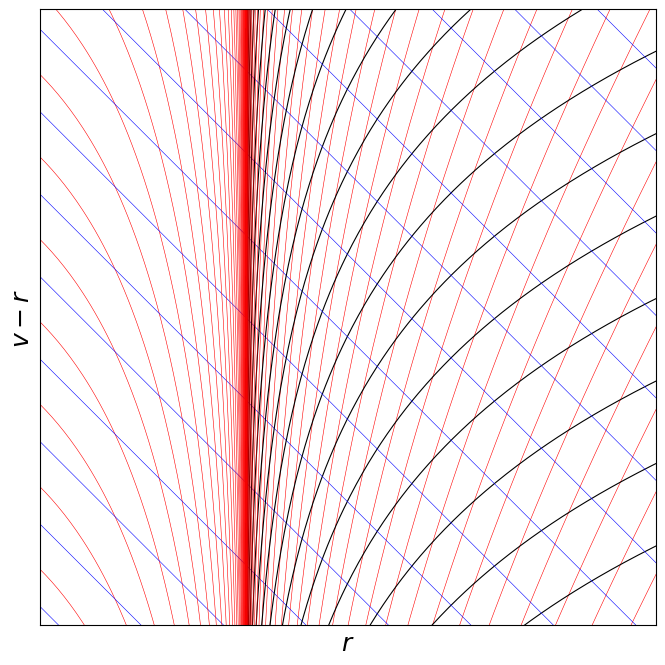
- [(i)] (Accumulation on the horizon) The past light cones ∂J-(O(τ)), none of which meets H+, approach it ever further along its generators as τ→∞, and the slices Sτ accumulate on H+. In the angle-suppressed radial picture of Fig. 3, where H+ appears as one generator, the observer's past light cone hugs that generator from outside over a stretch that climbs it as τ grows.
- [(ii)] (Asymptotic alignment)
As Sτ accumulates on H+, the tangent hyperplanes of Sτ become asymptotically tangent to the generator, so that ∇Θ aligns with the generator in direction, and Sτ meets H+ only in the limit. For the stationary slicing, Θ∝t, the lapse of the foliation collapses as H+ is approached,
gab(∇a t)(∇b t)=- (1-rh/r)-1 ⟶-∞,N=√1-rh/r ⟶0.The collapse of the lapse is a property of that slicing and not of every Θ: in the exterior of a collapse, whose outgoing light cones run back through the collapsing body to its centre, a slicing whose level sets near H+ follow those cones, Θ=a(u+ηr) there, with u the retarded time, a the adapting constant and ηgt;0 small, also accumulates on H+ and meets it only in the limit, with gab(∇aΘ)(∇bΘ)→-2a2η, finite.
The standard problems of black-hole physics
The result of §6—that within the causal domain of the external universe the event horizon occurs only as the null future boundary, present on no finite exterior slice and approached only in the infinite-time limit—bears on a family of problems that have organised black-hole physics for half a century. Each of them presupposes a physically realised, globally completed event horizon: a surface that has formed, that separates a causally disconnected interior, and that persists as a structure of the spacetime. That presupposition is what the preceding sections deny for any black hole causally accessible to the external universe, and since Proposition 1 assumes no symmetry, the denial holds for collapse of any symmetry. Throughout this section “realised” carries the meaning §6 gives it: present on a finite slice of a Cauchy time of the exterior domain. Nothing below denies that an infalling body reaches a trapped surface, or the horizon, in finite proper time in the maximally extended solution; what is at issue is what the external universe contains at any finite time. We draw the consequences using only the standard causal structure the rest of the paper uses, and no modification of general relativity. They share a single form: each removes a premise rather than proposing a mechanism to satisfy it. Companion papers gather them with others of the same form [JanzenCRframework]; that gathering is theirs, and what is established here is the causal result and the four consequences drawn from it below.
Trapped surfaces and the singularity theorems
Penrose's theorem establishes that a closed trapped surface, with the null energy condition and suitable global assumptions, forces geodesic incompleteness—a singularity [Penrose1965]. Its hypothesis is a realised closed trapped surface, and under the null energy condition every closed trapped surface lies within the black-hole region, interior to the event horizon [Hawking1973, Wald1984]. By the above, no completed horizon, and so no trapped surface it would enclose, is ever physically realised for a black hole causally accessible to the external universe. The theorem is therefore a correct mathematical result whose physical precondition is never met in the astrophysical domain: it describes the maximally extended geometry, not the realised spacetime. Singularities are, on this reading, not avoided by any new physics or any modification of general relativity—they are rendered physically irrelevant by causal structure alone, the curvature singularity of the maximally extended geometry remaining a feature of a global extension the realised worldtube never instantiates. For the same reason cosmic censorship—the conjecture that realistic collapse keeps its singularities behind horizons—is not a hypothesis the present universe requires: where no singularity is physically realised, none needs to be censored.
Hawking radiation
The semiclassical derivation [Hawking1975] is carried out on the collapse spacetime. Traced backward, every outgoing mode that reaches I+ at a finite retarded time u came in from I- through the collapsing body and left its surface while the surface was still outside rh; it never meets the horizon. Its frequency is stretched by the exponential relation between advanced and retarded times, v0-v∝e-κu, where v0 is the advanced time of the last ray to escape and κ the surface gravity—the same exponential with which neighbouring outgoing rays peel away from the generator in Section 3. The Bogoliubov coefficients at finite u are therefore computed on the realised exterior, and they return a flux whose spectrum is close to Planckian at temperature κ/2π, approaching that spectrum ever more closely as u grows; no horizon need form anywhere for such a flux to arrive [Barcelo2011]. What the realised exterior never contains is the limit of that sequence. The exactly thermal state is its u→∞ end, and with it the permanent inequivalence of the in- and out-vacua, for which there is an exact criterion: two Fock representations are unitarily equivalent precisely when the Bogoliubov coefficient β is Hilbert–Schmidt [Shale1962], and an exactly thermal β fails that test at the infrared end, where its 1/ω tail makes βHS2 logarithmically divergentL10. That failure belongs to the completed horizon, which occurs only at the infinite-time boundary of the exterior (§6), and so does evaporation carried to completion. At every finite exterior time the field is defined on a single connected exterior domain with no permanently inaccessible region, and the radiation that reaches it is emitted by a body still outside its horizon.
Three other horizons a reader will bring decide what the criterion here actually is. A uniformly accelerated observer in flat space, carrying proper acceleration a, detects an exactly thermal spectrum at temperature a/2π [Unruh1976]. The horizon responsible is the Rindler horizon: the bifurcate Killing horizon of the boost field, uncontroversially observer-dependent—a different accelerated observer has a different one, an inertial observer has none—with no gravity, no collapse, and nothing anyone would call a completed physical surface in the sense of a black hole's. The spectrum is thermal all the same. An argument of the form “the horizon is perspectival, therefore there is no thermal flux” is therefore refuted before it starts, and that is not the argument made here. What is denied above is a horizon that is never completed, and completion is a different property from observer-dependence: the Rindler horizon is observer-dependent and complete—the boost field is an exact Killing field of the whole spacetime and its horizon is a global structure of that spacetime, available in full without waiting for any future development. The same holds of the cosmological horizon of de Sitter space, of surface gravity κ=1/α with α=√3/Λ, which is not the endpoint of a collapse, requires no completion, is present on every slice, and carries the Gibbons–Hawking temperature [GibbonsHawking1977]; a companion paper places the regular Euclidean—Hartle–Hawking—state there [JanzenCanonicalTime], and there is no tension with the denial above, because the two horizons are different objects. Read across the four horizons at issue, the sorting is clean, and it is clean on one criterion onlyP1R2: the Rindler horizon (complete, observer-dependent) is thermal; the de Sitter cosmological horizon (complete, observer-dependent) is thermal; the eternal Schwarzschild horizon (complete, observer-independent) is thermal; and the collapse horizon of a present astrophysical black hole (never completed) is the one case whose exactly thermal state has no realised background, the realised exterior receiving instead the near-Planckian flux of a surface still approaching the horizon. Observer-dependence sorts the first two into the wrong class; completion sorts all four. The argument of this paper turns on a horizon that never finishes forming; it says nothing against a horizon that was never forming.
In de Sitter space the accelerated case also says something the flat one cannot, and it is a consequence of there being a single constant rather than an additional assumption. The accelerated temperature is T(a)=1/2π√H2+a2 [NarnhoferPeterThirring1996, DeserLevin1997], which reduces to a/2π as a grows and to the Gibbons–Hawking value H/2π at rest. Here H=1/α with α=√3/Λ the de Sitter radius, the geometry's one dimensionful constant, so the rest term is exactly the κ=1/α of the de Sitter horizon above and
carries no adjustable parameter at all: the observer supplies a and the geometry supplies the rest, and there is nothing else to supply. The structural difference from the flat statement is that the rest term does not vanish. An unaccelerated observer in Minkowski space sees nothing; an unaccelerated observer in de Sitter space is already in a thermal state, and acceleration adds to a bath rather than creating one.
And there is a sharper thing to say about the collapse case, which the framework paper computes for a different purpose and which belongs beside this one. The member a collapse reaches on this construction is the Nariai one, at which the metric function has a double root and the surface gravity vanishes [JanzenCRframework]. So the exactly thermal state the information paradox requires is absent twice over and for independent reasons: absent because no completed horizon is realised, which is this paper's argument and does not depend on which member is reached; and, granting the completion for the sake of the objection, κ=0 at the member that would be completed. The second is not offered as a replacement for the first. A degenerate horizon is the case in which reading a temperature off κ/2π is least safe—the near-horizon geometry of the degenerate member is dS2×S2, which carries a scale of its own—and the two readings are not reconciled here. What is claimed is the coincidence and not a value: the configuration at which the framework says the ringdown carries no scale is the same configuration at which the surface gravity is zero, and both are the configuration a collapse is said to reach. And there is a third thing to say about that configuration, which says what is true of it rather than what cannot be read off it—and the cosmology paper uses it for another purpose. What makes a non-degenerate horizon thermal is not the number κ but an exponential: near a simple root f∼2κδ, so the tortoise coordinate r*=∫dr/f is logarithmic, the approach is δ∼e2κr*, and it is that exponential relation between the affine and Killing parameters that carries a mode's positive frequencies into a Planck spectrum. At a double root the relation is not available at all: f∼c δ2 gives r*∼-1/cδ, a power law, so the construction that produces a thermal spectrum has no first step to takeP1R3. The right statement is therefore not that the temperature is zero but that the mechanism is absent—and the two are different claims, the first of which this paper has just declined to make. The same simple-root against double-root split is put to a second use in a companion paper, where a non-degenerate horizon's exponential approach imprints a scale on what passes it and the degenerate member's power-law approach imprints none [JanzenCRcosmology]: one fact serving two purposes. What this does not say is that the configuration is athermal in every sense—a scale-free power-law approach can still act on a spectrum, which is exactly what the cosmology paper argues it does, and that is a different question from whether a Planck spectrum arises.
What none of this claims. It does not claim that Unruh's result is in tension with anything here—the opposite: it is the case that shows the criterion used above is the one that works. It does not claim a derivation of the Unruh effect from the geometry, or any new value for a temperature. And it does not claim that κ=0 settles the collapse case, which rests on completion and not on a surface gravity.
And the result of this section does positive work in the companions' Euclidean construction, which is worth recording because it is not obvious from either side. A regular Euclidean state exists at a horizon only if the Euclidean continuation is smooth there—free of a conical defect, with the curvature finite. That is precisely the content of the distinction this paper draws: the horizon is a metric singularity, at which the spatial measure collapses while the curvature stays finite, and not a curvature singularity, at which no smooth Euclidean section would exist and no regular state could be selected. So the definition supplied here is what makes that state available, and with it the imaginary-time construction the companion papers build on it [JanzenCRframework, JanzenCanonicalTime]. The general point is sharper than a single criterion, and worth stating carefully because the obvious version of it is false. Finite curvature is sufficient for a continuation to cross a boundary, but it is not necessary, and the two boundaries of the Schwarzschild geometry are of opposite type in exactly this respect. At the horizon the curvature is finite while the tortoise measure r*=∫dr/f diverges. At r=0 the reverse holds: f→-2M/r diverges, so r* converges while the curvature invariants do not. Each is crossable, and for opposite reasons—one because nothing diverges in the geometry, the other because nothing diverges in the measure along which the crossing is taken. What the two share is not a property but a negation: neither failure is a failure of both. That is worth recording against the habit of reading “singularity” as a single verdict; the curvature criterion and the affine-measure criterion are independent, and this construction realises each without the other.
The scope of this conclusion is narrower than “black holes do not radiate,” and the distinction is essential. What is absent is the exactly thermal state and the evaporation it would drive to completion—the part of Hawking's result whose mechanism is the completed horizon and the vacuum inequivalence it induces. The near-Planckian flux of the still-collapsing surface is present, at about 6×10⁻⁸\,K for a solar mass, and so are local particle-production processes that do not require a horizon at all, strong-field vacuum polarisation and the like; a perpetually collapsing ultra-compact body is not quiescent. The claim is precisely that the completed-horizon state, and the evaporation it would drive, have nothing to be defined on in a spacetime that realises no horizon. It needs no ultraviolet completion of gravity and no modification of quantum theory; it rests on the causal structure already established.
One standing objection to the standard derivation belongs here too, because this reading has a version of its own and the scope of what can be said about it is the whole of what is said. The trans-Planckian problem observes that the late-time quanta of the Hawking flux, traced backward through the collapse, originate as modes of arbitrarily high frequency, so that the derivation's output depends on physics above the Planck scale which the derivation itself does not supply [Jacobson1991, Unruh1995]. In that form the objection targets the mode-tracing behind the late-time flux, which the argument here does not use. But the reading advanced above has a version that needs no mode-tracing at all. A static observer at areal radius r outside a still-collapsing surface measures a local frequency ωloc=ω∞/√f; near the root f≃2κδ with δ=r-rh, so the blueshift factor goes as δ-1/2 and diverges only as the surface is reached. Section 6 is precisely the statement that it is not reached at any finite exterior time. So the blueshift is finite at every finite exterior time, and the divergence sits inside a limit this paper says is never taken.
And the scoping of that is its content, because the available claim is weaker than the one it resembles—it is not that the blueshift is bounded. For a radially infalling surface with unit energy per unit mass, dr/dt=-f√rh/r≃-2κδ near the root, so δ∝e-2κt and ωloc/ω∞∝eκt: the factor grows without bound, and its supremum over exterior time is infinite. What is available is “finite at each finite exterior time” and not “bounded”, and the two are not interchangeable here, because the growth is exponential with the same κ identified above as the mechanism of thermality—one exponential seen twice, once as what carries a mode's positive frequencies into a Planck spectrum and once as what carries the collapsing surface into the ultraviolet. Taking ω∞∼κ, the exterior time at which the local frequency first reaches the Planck value is κ-1 ln (κ-1/tP), the logarithm suppressing nothing: about 2×10⁻³ seconds at a solar mass, 2×10⁻² seconds at ten, and of order months for the heaviest resolved supermassive holeP1R4. The finiteness is therefore not a suppression of ultraviolet physics but a statement about which limit is taken, and the regime is entered on a timescale short by every astrophysical measure.
What that does and does not buy is worth stating flatly, because the weaker claim is easily read as the stronger one. The argument of this section is causal: it turns on the absence of a completed horizon and hence of the limit in which the flux becomes exactly thermal, computes no mode functions, and does not depend on any local frequency being finite. The sentence above—that the conclusion needs no ultraviolet completion of gravity—is accordingly a claim about what the argument requires, and not a claim that the late-time collapsing surface is free of ultraviolet physics. It is not, and this paper does not say it is. Whether that regime is benign, and what a treatment of it would have to supply, is not settled here and is not claimed. What is claimed is the pair: the objection as usually posed concerns the mode-tracing behind the flux, which this argument does not use, and the corresponding statement about the realised surface holds at each finite exterior time and not uniformly.
The information paradox
The information-loss paradox arises only if a completed horizon forms and subsequently evaporates, so that quantum evolution must be defined on a spacetime containing a permanently inaccessible interior into which information has fallen and from which only thermal radiation returns. Both premises fail. No completed horizon forms, by the above, and evaporation is never carried to completion. The radiation the exterior does receive is emitted by a body still outside its horizon, so it remains correlated with a source the exterior contains rather than being the thermal remainder of an interior the exterior cannot reach. The realised spacetime remains globally connected: its domain of quantum evolution admits a global Cauchy surface, there is no hidden interior sector to trace over, and unitary evolution is unobstructed. The paradox is therefore not resolved by some mechanism that recovers the information—it does not arise, because the spacetime it requires is never physically instantiated. Approaches that would restore unitarity by modifying the near-horizon state while retaining the completed-horizon background address a configuration the realised universe does not contain; the present result removes the premise rather than adjusting the response to it. The nearest account to this one is that of Vachaspati, Stojkovic and Krauss, who model a collapse as a distant observer sees it, find the collapsing body radiating non-thermally before any horizon forms in that observer's time, and argue that the information-loss problem does not then arise [Vachaspati2007]; the present argument reaches the absence of a completed horizon from causal structure alone, and needs no radiation to reach it. What the collapse carries on into is the companion papers' subject, and there the content the leaf carries crosses the branch point without loss [JanzenCRframework].
The laws of black-hole mechanics
The laws of black-hole mechanics—the constancy of the surface gravity over the horizon, the first law dM=κ/8πdA+ΩdJ+ΦdQ, and the area theorem that the horizon area never decreases [Bardeen1973, hawking1971]—are, like Penrose's theorem, correct results whose object is a realised event horizon: a null boundary carrying a definite area and surface gravity. That object is, by the above, never instantiated on a finite exterior slice; the horizon occurs only as the metric singularity of the infinite-time boundary, and no finite slice carries the area whose monotonicity the theorem asserts. The laws therefore characterise the maximally extended geometry, not the realised worldtube—the classical, area-side companions of the exactly thermal state already set aside above. The Bekenstein–Hawking entropy [Bekenstein1973], in the reading on which it is the entropy of that horizon, shares their status; what content survives for a perpetually collapsing ultra-compact body—as with the local particle-production processes—is not settled by this argument, though the geometric-core paper finds that a collapse horizon, being no bifurcate Killing horizon, has no distinguished cross-section on which a Noether-charge entropy could be evaluated [JanzenGeometricCore]; what the collapse does produce—its continuation as an expanding cosmology—is the subject of the companion framework and cosmology papers [JanzenCRframework, JanzenCRcosmology]. The point is only that the specific horizon-thermodynamic apparatus, area law and entropy alike, has on a finite exterior slice no realised horizon to be defined on, just as the exactly thermal state has none.
Conclusion
The event horizon is a metric singularity: a null hypersurface whose generators also share a single spatial location, so that the distinct, causally ordered events along each generator are assigned no separation of any kind. Independently of that identification, the horizon's defining property as the null future boundary of the exterior forces every Cauchy time of the exterior domain to accumulate on it, so that it occurs, for every exterior observer, only at the infinite-time boundary. No finite exterior slice contains a horizon or the curvature singularity it would enclose. The densities associated with the central singularity therefore never form at any finite exterior time; mass remains finite in extent on every finite slice, with each infalling element asymptotically approaching its own horizon event. The completed horizon presupposed by the singularity theorems, by Hawking's exactly thermal state and the evaporation it drives, by the information paradox and by horizon thermodynamics is never realised in the exterior of a collapsing body, and those problems lose the premise they rest on. All of this follows from the standard Lorentzian and causal structure of general relativity, with no modification of the theory.
This places the present geometric result within a wider programme. The companion slicing construction for the Schwarzschild–de Sitter family identifies the metric singularity established here as the geometric cause of the horizon-versus-centre asymmetry of the standard description [JanzenSlicing]; the existence/occurrence distinction this paper turns on—that the horizon occurs without ever existing on a finite exterior slice—is, there, the same distinction set at the root of the cosmological ontology, where the enduring cosmic time that existence requires is itself empirically forced [JanzenModernParallax], the present paper reaching it from standard general relativity alone. The same companions argue that the collapse does not end at the centre, and continue it past r=0 as an expanding cosmology [JanzenSlicing, JanzenCircle, JanzenCRframework]; the primordial light-element abundances are read there as a record of that history [JanzenCosmogenesis]. Those are their results and not this paper's, which reaches the metric-singularity structure and stops. What the present result supplies them is one thing, and it is worth naming because it is load-bearing there: a boundary at which the curvature is finite gives a continuation across it finite, characteristic initial data, where a curvature singularity would give it a wall. The dynamics of matter and observers crossing such a boundary is not settled here and is not settled by the finiteness alone; the companions settle it, the crossing well posed and structurally governed, lossless for the content the leaf carries and fatal for bodies [JanzenCRcosmology, JanzenCRframework].